Attempted carjacking in St. Paul leads to gunfire Thursday night

posted in: All news | 0

Police are investigating an attempted carjacking that led to gunfire on Thursday night in the Hamline-Midway area of St. Paul.

Shortly after 8:30 p.m., officers were called to an attempted carjacking in the 1400 block of Blair Avenue, according to Nikki Muehlhausen, a St. Paul police spokesperson.

Shots were fired in an attempted carjacking in St. Paul on Thursday night. (Courtesy of Ramsey County Sheriff’s Office)

When officers arrived on scene, the driver reported that three people, two of them armed, had attempted to steal their vehicle. One of the suspects reportedly fired two shots into the vehicle as they fled the scene. Nobody was injured.

The incident was detailed in Ramsey County Sheriff Bob Fletcher’s “Live on Patrol” Facebook page in a post called, “Lucky to be alive!”:

“A young man was dropping his college friends off in the 1400 block of Blair last night when three suspects approached him and demanded his vehicle. He refused and drove away only to hear two shots strike his car. One narrowly missed him. You can see the entrance hole on the back window and the exit hole in the center of the windshield. Too close. The three suspects fled west on foot.”

Related Articles

Crime & Public Safety |


St. Paul man charged in fatal stabbing of wife in city’s first homicide of 2025

Crime & Public Safety |


Skywatch: Absolute perfection

Crime & Public Safety |


Petitioners seek first-degree murder charges in killing of Minnesota transgender man

Crime & Public Safety |


Woodbury teen killed in Friday crash ‘so beloved’ by all who knew her

Crime & Public Safety |


No evidence NY killing of transgender MN man was hate crime, authorities say

Trump administration approves major nearly $3 billion arms sale to Israel

posted in: All news | 0

WASHINGTON (AP) — The Trump administration has approved a major nearly $3 billion arms sale to Israel, bypassing a normal congressional review to provide the country with more of the 2,000-pound bombs that it has used in the war against Hamas in Gaza.

Related Articles

National Politics |


What they said: Trump, Zelenskyy and Vance’s heated argument in the Oval Office

National Politics |


What US lawmakers are saying about the White House clash between Trump and Zelenskyy

National Politics |


Vice President JD Vance, a Catholic, acknowledges the pope’s criticism of US immigration crackdown

National Politics |


Already-lagging broadband program faces more uncertainty under Trump

National Politics |


Where things stand as Congress tries to avoid a partial government shutdown in two weeks

In a series of notifications sent to Congress late Friday, the State Department said it had signed off on the sale of more than 35,500 MK 84 and BLU-117 bombs and 4,000 Predator warheads worth $2.04 billion.

Secretary of State Marco Rubio “has determined and provided detailed justification that an emergency exists that requires the immediate sale to the Government of Israel of the above defense articles and defense services in the national security interests of the United States, thereby waiving the Congressional review requirements,” the department said.

Deliveries are set to begin next year, it said.

Using the same justification, the department also said Rubio had approved another munitions sale to Israel worth $675.7 million to be delivered starting in 2028.

In addition, it said Rubio had approved the emergency sale of D9R and D9T Caterpillar bulldozers worth $295 million.

What Trump’s order making English the official language in the US could mean

posted in: All news | 0

By FERNANDA FIGUEROA, Associated Press

As President Donald Trump is expected to sign an executive order designating English as the official language of the United States, activists and advocacy groups are alarmed by what that will mean for non-English speakers when it comes to immigration, voter access and other issues.

The order, which was announced Friday, will allow government agencies and organizations that receive federal funding to choose whether to continue to offer documents and services in languages other than English, according to a fact sheet. The move rescinds a mandate from former President Bill Clinton that required the government and organizations that received federal funding to provide language assistance to non-English speakers.

Related Articles

National Politics |


What they said: Trump, Zelenskyy and Vance’s heated argument in the Oval Office

National Politics |


What US lawmakers are saying about the White House clash between Trump and Zelenskyy

National Politics |


Vice President JD Vance, a Catholic, acknowledges the pope’s criticism of US immigration crackdown

National Politics |


Already-lagging broadband program faces more uncertainty under Trump

National Politics |


Where things stand as Congress tries to avoid a partial government shutdown in two weeks

Designating English as the national language “promotes unity, establishes efficiency in government operations, and creates a pathway for civic engagement,” according to the White House. But some activists and organizations think the move is just another way for the president to stoke division and fear.

“This isn’t just an offensive gesture that sticks a thumb in the eye of millions of U.S. citizens who speak other languages, but also will directly harm those who have previously relied on language assistance for vital information,” Vanessa Cárdenas, executive director of America’s Voice, an advocacy group for immigration reform, said in an email.

What does it mean to have an official language?

According to the International Institute for Democracy and Electoral Assistance, an official language is what is used by the government to conduct official, day-to-day business. Having one or more official languages can help define a nation’s character and the cultural identity of those who live in it.

Prioritizing one language may place certain people in position of power and exclude others whose language is not recognized, according to the institute.

U.S. English, a group that advocates for making English the official language in the United States, believes having an official language provides a common means of communication, encourages immigrants to learn English to use government services and “defines a much-needed common sense language policy.”

Currently there are more than 350 languages spoken in the United States, according to U.S. Census Bureau data. The most widely spoken languages other than English are Spanish, Chinese, Tagalog, Vietnamese and Arabic.

People in the U.S. also speak Native North American languages such as Navajo, Yupik, Dakota, Apache, Keres and Cherokee, among others.

Potential impact on citizenship and voting

Anabel Mendoza, the communications director for United We Dream, a nonprofit immigrant advocacy organization, said limiting the language of federal communication will make it harder for people to become citizens if they are denied the ability to speak their native tongue throughout the process. Currently, people of certain age and residency requirements can qualify for a waiver to do the citizenship test and interview in their native language.

“Trump is trying to send the message that if you’re not white, rich and speak English you don’t belong here,” Mendoza said. “Let me be clear: Immigrants are here to stay. No matter how hard Trump tries, he can’t erase us.”

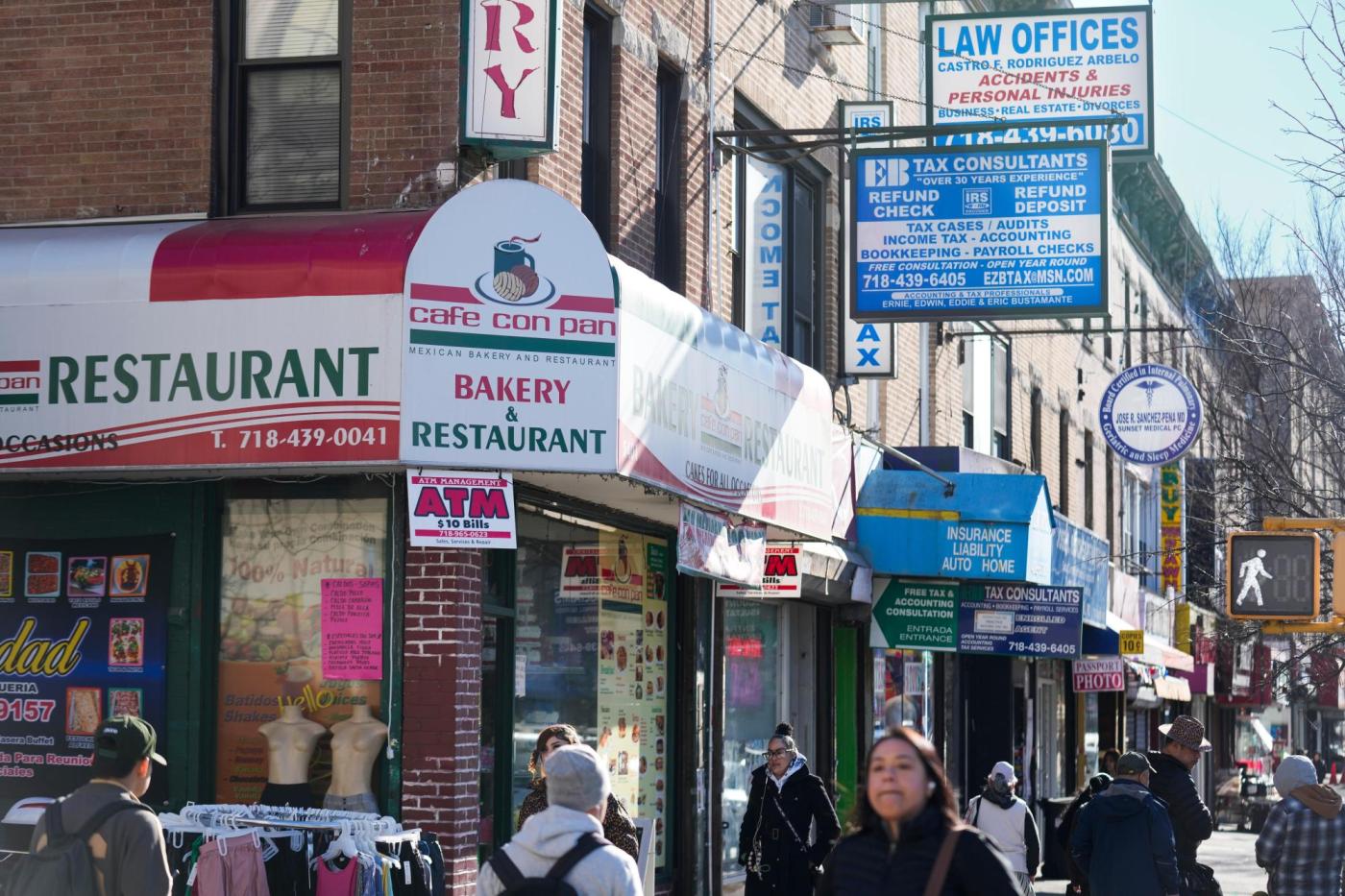
Signs in Chinese and English are displayed in the Brooklyn borough of New York, Friday, Feb. 28, 2025. (AP Photo/Seth Wenig)

The Congressional Hispanic Caucus announced Friday that New York Rep. Adriano Espaillat, caucus chair, will deliver, on behalf of Democrats, the official Spanish-language response to Trump’s upcoming joint address to Congress.

George Carrillo, co-founder & CEO of the Hispanic Construction Council, said it seems like a step backwards in a country that has championed its diversity. He is also concerned how limiting governmental communication might affect U.S. territories such as Puerto Rico where the predominant language is Spanish.

“This executive order, while framed as promoting unity, risks dismantling critical supports like ESL programs and multilingual resources that help immigrants adapt and contribute,” Carrillo said. “Imagine families navigating healthcare or legal systems without materials in a language they understand, it’s a barrier, not a bridge.”

APIAVote, a nonpartisan nonprofit focused on registering Asian American and Pacific Islander voters, also expressed worry this could mean barriers for millions of voters such as naturalized citizens or elderly residents who aren’t English-proficient.

“It will make it harder for them to participate civically and vote, as well as access critical healthcare, economic and education resources,” the group said in a statement.

Furthermore, the organization says this action could make anyone who speaks another language a target.

“The exclusionary nature of this policy will only fuel xenophobia and discrimination at a time when anti-Asian hate and hate against other minority and immigrant groups are rising.”

States that have English as the official language

More than 30 states, from California to New Hampshire, as well as the U.S. Virgin Islands have already passed laws designating English as their official language, according to U.S. English. Hawaii is the only state to declare two official languages, English and Hawaiian.

Signs in Spanish and English are displayed in the Brooklyn borough of New York, Friday, Feb. 28, 2025. (AP Photo/Seth Wenig)

For decades, lawmakers in Congress have introduced legislation to designate English as the official language, but those efforts failed. The most recent effort was in 2023, when Sens. Kevin Cramer, R-N.D., and JD Vance, R-Ohio, introduced the English Language Unity Act. Vance is now vice president.

How many countries have official languages?

It is estimated that over 170 countries have an official language, with some having more than one language.

Mexico does not have an official language. In Canada the official languages are English and French. According to Canada’s Official Languages Act of 1969, the purpose of designating two languages ensures “the equality of status” and protecting linguistic minorities “while taking into account the fact that they have different needs.”

Figueroa reported from Austin, Texas. Associated Press writers Michelle L. Price in New York and Terry Tang in Phoenix contributed to this report.


St. Paul and Minneapolis chambers of commerce consider merger — again

posted in: All news | 0

The St. Paul Area Chamber of Commerce and the Minneapolis Regional Chamber have made no secret of how difficult it is to keep a dues-based association afloat in an era where many employers have gone virtual and are more prone to sell their services online and around the world than within their local geography.

Is it time for them to merge? The question, which has been raised more than once across the St. Paul Chamber’s 157 years in operation, has resurfaced, this time with more organizational energy and public process.

Jeff DeYoung, a recently retired partner from the Baker Tilly accounting firm, told a crowd of more than 700 onlookers during the St. Paul Chamber’s annual dinner at the downtown RiverCentre on Thursday that the St. Paul and Minneapolis chambers formed a joint task force to debate the pros and cons of a possible merger. The task force, which met for the first time on Wednesday, also will consider whether the two chambers might remain independent of each other but share certain services, such as information technology.

“It could be that we stay separate and we decide that there’s some joint things that we’re going to work on together,” DeYoung said. “This has been a conversation that a lot of you have had … why do we have so many business chambers? Why do we have so many business associations?”

“Are we at a point where we now look at things from a Twin Cities and community perspective, versus one side of the river or the other? … Or do we want to stay in our separate areas?” he added. “We know that we have to keep a local presence, and we’ve heard that loud and clear. We’re not going to abandon that.”

Regional focus?

DeYoung said members of the task force brought a variety of views to the table, from those gung-ho for a merger to those opposed. The subject of a possible chamber merger has been broached before, with members in 2010 raising concern that west metro priorities would overshadow St. Paul issues. Bloomington and Minneapolis maintain a larger tax base than St. Paul and east metro suburbs like Maplewood, and a growing number of large employers have left downtown St. Paul to head westward.

Among them, the design and engineering firm TKDA left the capital city and moved to Old Shakopee Road in Bloomington, relocating some 300 employees from the UBS Tower at the Town Square complex on Cedar and Minnesota streets. Cray, Inc., the supercomputer company, left downtown St. Paul for Bloomington around 2016.

While St. Paul and Minneapolis mayors may advocate side-by-side for public transit, affordable housing and other regional interests, questions around the fate of particular sports teams and where their stadiums might land have sometimes set east metro and west metro political interests against each other.

Still, both chambers could benefit from fewer overhead costs or other economies of scale.

To stay afloat financially, the St. Paul Chamber has in recent years staffed and hosted smaller business advocacy organizations like the Minnesota Hmong Chamber of Commerce and the Minnesota Black Chamber of Commerce, while also offering its WorkStream consulting services to business retention programs in suburbs like Maplewood and Roseville.

The Minneapolis Chamber launched an investigation of its own finances last year after projecting a $500,000 deficit, leading to the abrupt resignation of longstanding president and chief executive officer Jonathan Weinhagen.

Related Articles

Business |


St. Paul man charged in fatal stabbing of wife in city’s first homicide of 2025

Business |


‘Purely evil’: Man sentenced to 40 years in prison for killing, dismembering 2 women

Business |


Letters: St. Paul’s West End has long had to fight for its character

Business |


2 teens charged in St. Paul fatal shooting: Victim was walking with cousins, unaware they were being ‘hunted’

Business |


Charges: St. Paul father caused 60 fractures, other injuries to 3-month-old twin sons