SAN DIEGO — Here’s a hot take. Publishing beautiful books has never mattered more than now. Gorgeous covers, gilded edges, swirly endpapers and sharp illustrations have long been ways to give the words inside importance, draw readers to new stories, make old stories fresh, create an immersive experience and in some cases show status.
But now, in the age of the digital and audio texts, designing a book that feels and looks fetching is also about offering readers a form self-expression, sensory pleasure and an escape from screens: the warmth of leather, the smoothness of paper, and the exhibition, for better or worse, of the reader’s tastes. Because unlike an e-book, which fits discreetly inside a screen, a paper book sits on a shelf or cafe table and announces this reader is into murder. Or robot romances. Or Jane Austen.
A San Diego publisher is on the cutting edge of crafting lovely looking paper books that make statements as literary and aesthetic objects. Canterbury Classics, in Mira Mesa, publishes out of copyright works including “Frankenstein,” “The Great Gatsby” and “Pride and Prejudice.” Its leatherbound series looks like something out of Mr. Darcy’s library. Another series has covers heat stamped with clouds of words and quotes. Another series has brightly embroidered covers with threads actually woven into the paper.
“Beautiful, tactile, unexpected,” is how Peter Norton, the publisher of Canterbury Classics, described these books.
Almost 20 years after Amazon launched the Kindle, Norton said there is demand for paper books, in part because people want a refuge from digital experiences. “Tactile is the best way to unplug,” he said.
Leather-Bound Classics with genuine leather covers, printed endpapers at Canterbury Classics in Sorrento Valley. (Alejandro Tamayo / The San Diego Union-Tribune)
“I think books, physical books, are doing fantastic,” he said. “They’ve been doing well over the past several years. The sky was falling up until about 2013 with e-books getting more market share. But I think the iPad came out and you could no longer unplug on a Kindle or a Nook, because now you were getting your texts and all that stuff on that. So I think since then, physical books have come back in a big way, or taken back some of that market share.”
In 2012, 591 million print books were sold in the U.S. That number has been mostly rising, reaching a high of 837.66 million in 2021 and falling to 767.36 in 2023, the last year reported, according to data from Statista.
Justine Epstein, the owner of Verbatim Books in North Park, said trends at her store show that people are craving beautiful books.
“(There is) a resurgence of people appreciating the aesthetics of the book, in response to — a lot of our lives are just online. I don’t know exactly what it is, but it does seem like there’s certain people who are looking to remember why we appreciated books in the first place. … They can be so, so beautiful just in themselves, little objects d’art.”
Crafted Classics books, by San Diego publishing company Canterbury Classics Books, feature a decorative embroidered cover of classic titles from Jane Austen and other authors. They give the books a unique, handcrafted appearance. (Alejandro Tamayo / The San Diego Union-Tribune)
Canterbury Classics has a knack for choosing classic titles by Poe, Homer and the Brothers Grimm that readers want, she said.
“They’re popular titles, and then the way that they look is just so beautiful. I think that they fit in well with the whole decor that we have in the store,” she said.
Epstein said people buy these books for a few reasons. Some are gifts. Some readers are drawn to the striking covers and spines and buy them if they were already curious about that author.
“I think people are also looking to upgrade their collection, having nicer editions of the things they’re going to be rereading,” she added.
Getting noticed
Last year, Costco announced it is cutting back on physical book sales.
Norton pointed to the bright side: “From my perspective, the fact that they still have 101 locations that are carrying it year-round is a good thing. I think books are an important part — they add a lot to every retailer. Target sells a lot of books. Walmart sells a lot of books. And they do it because it adds something to the consumer’s experience,” he said.
Others are more optimistic about print books. Barnes & Noble announced this month it will open a record 60 new stores across the U.S. this year, including in California.
Still, Costco’s pullback points to what Norton said is the tough part about publishing paper books: real estate. It’s not just about how many Costco warehouses sell books, but how they’re displayed in any store. Spine or cover out? Under a big promo sign by the front window or behind a turnstile of alphabet placemats at the back of the store?
“Everybody’s trying to get space at retail in an environment that is competitive. It’s the same thing that everybody used to say about Amazon: discoverability.”
Word Cloud Fiction is a classic literature series published by Canterbury Classics, a San Diego publishing company. (Alejandro Tamayo / The San Diego Union-Tribune)
How can a book publisher make its books easy to discover?
“I do think getting the cover right and being on trend with the covers — you only have like three seconds to catch somebody’s attention who’s walking by. Also, having books in all channels and having access to create formats in that work in multiple channels helps with discoverability, exponentially,” he said. In other words, making books that fit with discount retailers, online retailers, big box stores like Amazon and indie bookstores.
Sandra Dijkstra, the owner of a Del Mar, California, based literary agency, and Amy Tan’s longtime agent, said a book’s title and cover are essential.
“From the get-go, I have always fought for jacket art and titles which are magnets, each element therein vital to its appeal to potential book buyers,” she wrote in an email. “From Joy Luck Club on, this was my mantra: Each word in a title has to count, to make an impact, as do the colors and design of the book jacket itself, whether it be physical or online.”
She added one caveat. “Physical and virtual books too have always been designed to appeal, the sad thing being one never knows until it’s too late, if one got it wrong!”
Austen hits a milestone
Jane Austen, whose novels combine biting wit and melting romance, is one of Canterbury Classic’s most sought after authors.
“We do sell Jane Austin extraordinarily well,” Norton said.
Jane Austen turns 250 this year. San Diego-based Canterbury Classics Books publishes her books in several editions that all focus on the visual presentation and physical feel of the book. (Alejandro Tamayo / The San Diego Union-Tribune)
On one hand, no surprise, because, have you read her stuff? On the other, this is interesting, because public domain texts including “Pride and Prejudice” are free online. They’re also available for a few dollars plus shipping, from secondhand merchants. Yet these new releases of old hits sell very well. Since 2010 Canterbury Classics has sold around 850,000 copies of Jane Austen’s books and more than 10 million copies of the Canterbury Leather and Word Cloud Classics editions.
Jane Austen’s novels got a modern-day reboot thanks to brightly colored covers and beautiful foil-stamping. The publisher is Canterbury Classics, in San Diego. (Alejandro Tamayo / The San Diego Union-Tribune)
“Which overindexes, considering she’s only got six novels. So she’s a big plus for us. We’re behind her in a big way,” Norton said. Its “Pride and Prejudice” edition with quotes and words stamped on its magenta cover has sold “well over 100,000 copies.”
For context, if a new book sells 5,000 to 10,000 copies, it’s considered a commercial success by most publishers, Norton said.
With Jane Austen’s 250th birthday this year, the publisher has planned a few special events to help these novels sell even better.
One is a 12-month reading challenge. March invites people to buy its Word Cloud Classics boxed set, which has quotes — “My feelings will not be repressed” and others — stamped on the book covers. April nods to independent bookstores: “The 12th Annual Independent Bookstore Day is celebrated April 26th, so why not show some love to a local retailer and add to your Regency Romance collection at the same time?” the publisher asks. November is about Austen, the person. “Since National Author’s Day is November 1st, let’s take a dive into a biography about Jane, or even her own letters.”
In September, the company is releasing a redesigned boxed set of her novels, with a suggested price of $90. The six spines line up to form a pattern that runs across them, and on the other three sides of each book, the edges of the pages are color printed to connect and create a different, larger image. The publisher will also promote her titles at its booth at the American Library Association conference this summer. And they’re using the standard book marketing channels: connecting with online influencers, investing in enhanced product pages on Amazon. (Author readings stopped being an option in 1817, when Austen died, at 41.)
Norton expects these efforts to translate into a significant bump in sales.
“We think we’ll sell 50% more Jane Austen titles than we have in prior years,” he said.
Innovating with classics
Reading challenges and conference booths are marketing. Long before that, how does a publisher create successful new hits out of texts that are centuries old? (Or at least 70, given U.S. copyright law.) And how does Canterbury Classics spot the next trend, whether it is quotes on the cover or embroidery?
“I think there’s several things,” Norton said. One is looking at data on what is selling, from BookScan and Circana, two book market intelligence companies. “You could read the tea leaves from that. And maybe because of my background in Barnes & Noble and seeing sales every day, you could immediately spot trendlines, whether it’s micro or macro, and using my career experience.”
Norton, an English major, came to publishing through bookstores. Before becoming the publisher and a vice president at Printer’s Row Publishing Group, of which Canterbury Classics is an imprint, he was a book buyer for Barnes & Noble and led the book chain’s proprietary publishing.
“Understanding what happens at retail is very valuable,” he said.
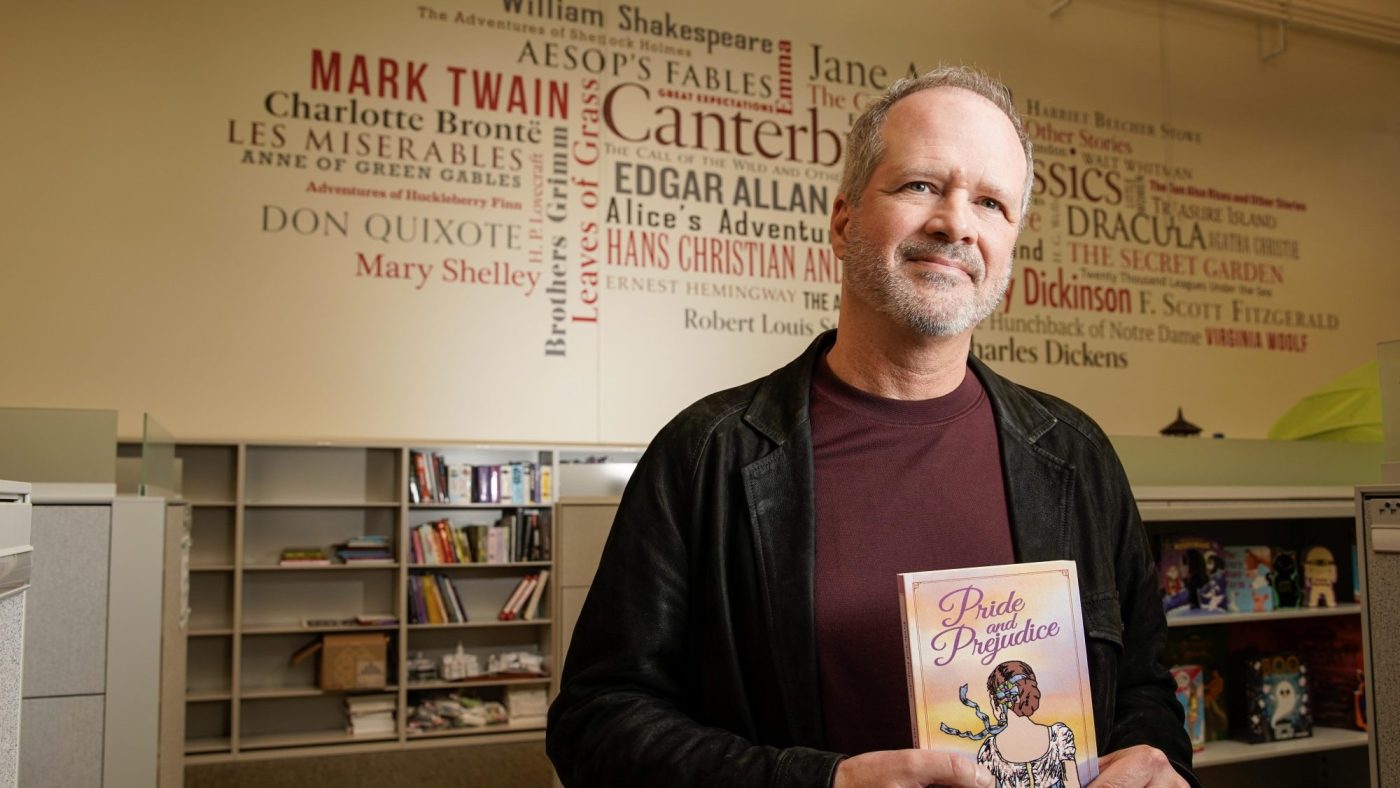
Peter Norton is the publisher of Canterbury Classics, a San Diego book publishing company. (Alejandro Tamayo / The San Diego Union-Tribune)
He also keeps an eye on the world around him and taps his “very creative team” to do the same; 11 people work on the editorial side, and others work in production, sales and marketing. “We go to a lot of different retailers, we pick up things that catch our eye and we think look really cool, in the book space or not in the book space,” he said. “And then we bring it back and we say, Well, what can we do with this?”
One example is the delicately embroidered covers, which came out in 2024. Norton was seeing embroidery and crocheting everywhere. Then he saw an embroidered greeting card and thought, “If they could do this on a card, we could do this on a book. So it’s looking not just in the book space, but looking at all of the adjacencies and getting ideas that way.” He was aware of embroidery and crochet circles, which can be like book clubs — wine, friends, conversation — but with needles and hooks.
“Books weren’t necessarily being targeted for that audience, but that audience was already there,” he said.
Former Meta official’s ‘explosive’ memoir about the social media giant to be published next week
Literary calendar for week of March 2: ‘That’s Not Funny, David’
Readers and writers: A guide to Minnesota’s spring and summer books
Readers and writers: Focusing on collections from Minnesota poets
Literary calendar for week of February 23: ‘Creature Needs’ anthology
Norton is also the publisher of two other imprints of Printer’s Row Publishing Group: Thunder Bay Press, which makes adult activity books — word search, coloring books, crochet and embroidery kits. The other is Portable Press, which publishes trivia and joke books. The imprints sometimes spill into one another: one sells embroidery kits, another sells embroidered covers. Both tap into the trend of embroidery that has taken Etsy by storm. All three try to create things that shoppers want, before they know they want it.
Overall, he said, new ideas come through “creative osmosis, where there’s so much out there, and if you’re letting yourself take it in, but also buying things just to say OK, and then thinking about it and sharing it with the team.”
They’re also always looking out for new titles that will enter the public domain. This year and next, that includes works by Hemingway, Faulkner and Woolf.
At Canterbury Classics, which releases between five and 10 new titles a year, both in print and for e-readers, it takes about 18 months to develop a book. So Norton and his team will have to wait until late 2026 to find out if today’s ideas and author picks will resonate with readers.