Trevi Fountain fee goes into effect as Rome seeks to manage tourist flow at celebrated water feature

posted in: All news | 0

By PAOLO SANTALUCIA and NICOLE WINFIELD

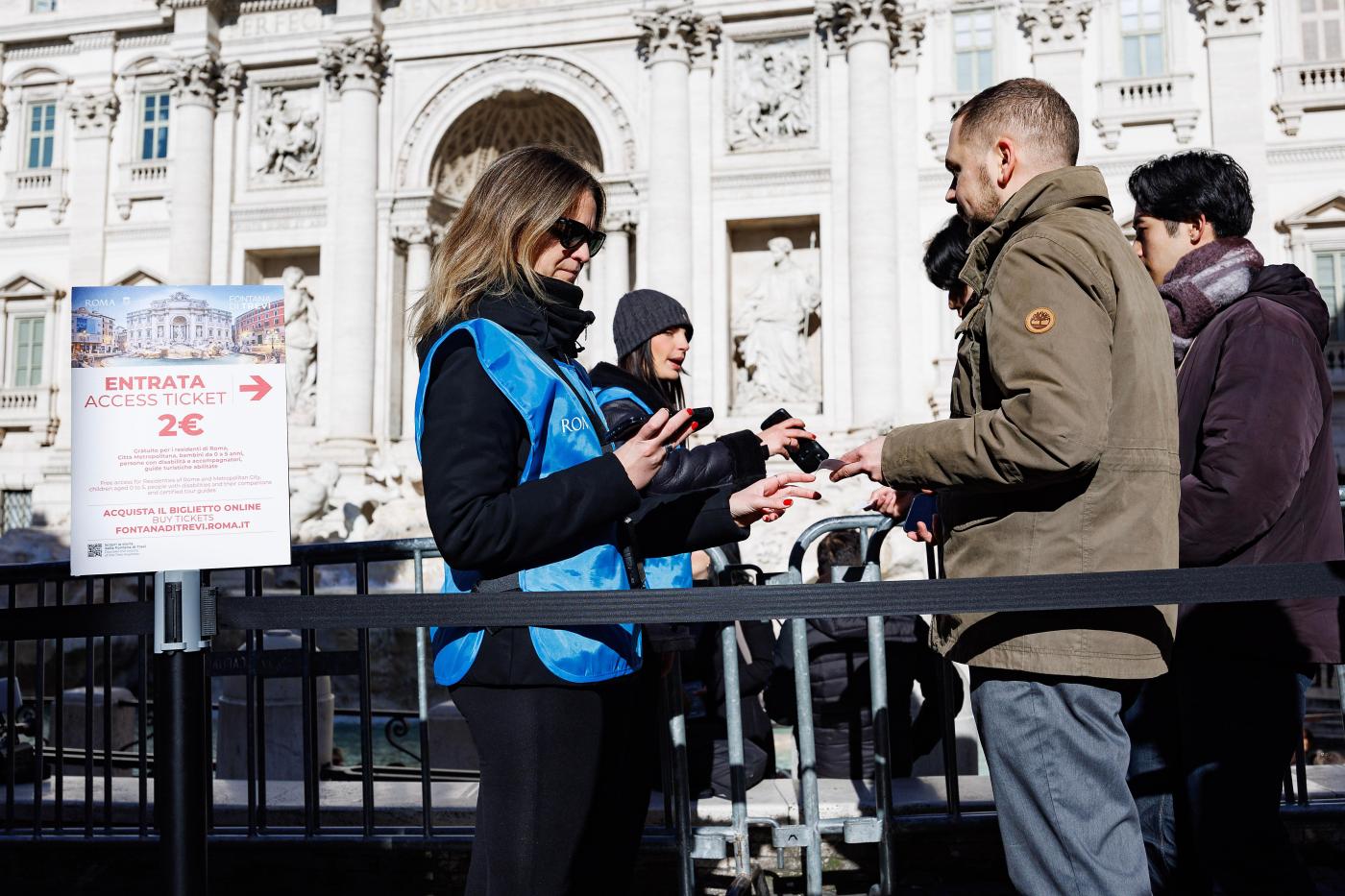
ROME (AP) — Tourists hoping to get close to the Trevi Fountain had to pay 2 euros ($2.35) starting Monday as the city of Rome inaugurated a new fee structure to help raise money and control crowds at the one of the world’s most celebrated waterworks.

Related Articles


Death Valley landmark Scotty’s Castle is reopening for limited tours after years of flood repairs


With Yosemite ditching reservations for firefall, will it be a mess? Here’s what to know


Welcome to Santa Clara! Your one-stop guide to Super Bowl LX


See costumes from the Oscar-nominated wardrobe of ‘Sinners’ at the African American Museum in Philadelphia


Across the forgotten walls of a Hong Kong island, a flock of bird murals rises

The first tourists to pass through the new ticket check seemed nonplussed by the tariff, noting it was a small price to pay for quality access to a fountain made famous by Federico Fellini’s movie “La Dolce Vita.”

“Before, there were problems accessing the fountain. There were a lot of people. Now, it’s very easy,” said Ilhan Musbah, a tourist from Morocco. “You can take photos, you feel good, you’re comfortable, and on top of that 2 euros is not much.”

The tourist fee was rolled out in conjunction with a new 5-euro (nearly $6) tourist ticket fee for some city museums. In both cases, Rome residents are exempt from the fees and the extra revenue will actually expand the number of city-run museums that are free for registered Roman residents.

It’s all part of the Eternal City’s efforts to manage tourist flows in a particularly congested part of town, improve the experience and offset the maintenance costs of preserving all of Rome’s cultural heritage. Officials estimate it could net the city 6.5 million euros ($7.6 million) extra a year.

The city decided to impose the Trevi Fountain fee after seeing positive results already from a yearlong experiment to stagger and limit the number of visitors who can reach the front edge of the basin by imposing lines and pathways for entrance and exit.

“I think tourists were shocked by the fact that the city of Rome is only asking for 2 euros for a site of this level,” Alessandro Onorato, Rome’s assessor of tourism, said Monday. “I believe that if the Trevi Fountain were in New York, they would have charged at least $100.”

The fee follows a similar ticketing system at Rome’s Pantheon monument and the more complicated tourist day-tripper tax that the lagoon city of Venice imposed last year in a bid to ease overtourism and make the city more livable for residents. The Italian fees still pale in comparison to the 45% price hike that French authorities announced for the Louvre Museum for most non-European visitors, where tickets can now run to 32 euros ($37) from 22 euros.

The Trevi fee, which can be paid in advance online, enables tourists to get close to the fountain during prime-time daylight hours. The view for those admiring the late Baroque masterpiece from the piazza above remains free, as it is up close after hours.

The towering fountain features the Titan god Oceanus flanked by falls cascading down the travertine rocks into a shallow turquoise pool, where Marcello Mastroianni and Anita Ekberg famously took their nighttime dip in “La Dolce Vita.”

While bathing is prohibited nowadays, legend has it that visitors who toss a coin over their shoulders and make a wish will return to Rome.


Where are those darn keys? Tricks for remembering where you put things

posted in: All news | 0

By ALBERT STUMM

With a scarf dangling from your coat pocket and those gloves left behind at the coffee shop, there are simply more things to lose in winter. That’s not counting your misplaced keys at home or those exasperated moments looking for your phone when you say, “I just had it!”

Related Articles


Trevi Fountain fee goes into effect as Rome seeks to manage tourist flow at celebrated water feature


Snack like a pro on Super Bowl Sunday with Panko-crusted chicken strips and game-changing sauce


Signs of forced entry found at Arizona home of ‘Today’ show host Savannah Guthrie’s mother


‘The Sound of Music,’ ‘The Outsiders’ and ‘Hamilton’ on tap for new Broadway on Hennepin season


‘Stick Season’ hitmaker Noah Kahan to play Target Field in August

Try not to beat yourself up. Even Mark McDaniel, who has been studying human memory and learning for almost 50 years, left a hat under his chair recently at a restaurant. He doesn’t usually wear hats, so he forgot it.

“I should know how to remember to remember, but at the moment, you don’t think you’re going to forget,” said McDaniel, professor emeritus of psychological and brain sciences at Washington University in St. Louis.

Luckily, there are strategies. If you can remember to implement them, here’s how to stop losing things.

A breakdown in the brain

Daniel L. Schacter, a Harvard University psychology professor and author of “The Seven Sins of Memory,” said losing things is something everyone is prone to, to varying degrees. It depends on life circumstances that pull the mind away from the present.

Rather than having a bad memory, it might be “a breakdown at the interface of memory and attention,” Schacter said. “That’s what’s responsible, based on research, based on personal experience, for a lot of the memory failures that would result in losing things.”

Memory occurs in three phases in the brain: encoding, storage and retrieval. Schacter likened losing your keys to drivers who arrive at their destination safely without remembering how they got there.

In both cases, the memory of the action is not encoded because people were thinking of something else, which makes it harder to retrieve the memory later.

“You have to do a little bit of cognitive work,” Schacter said. “At the time of encoding, you have to focus your attention.”

For things you use regularly

It helps to not have to remember where some things are.

Schacter suggested identifying problem items such as your phone, wallet or keys and creating a structure that becomes automatic with practice. He always leaves his reading glasses in a specific spot in the kitchen. When he goes golfing, his phone always goes into the same pocket in his golf bag.

“Maybe not always, but, you know, a very high percentage of the time,” he said.

If there is a noticeable increase in losing things compared to the recent past, accompanied by other memory problems that interfere with your normal function, it might be time to see a doctor, Schacter said.

For things you don’t use regularly

McDaniel said that the brain does a better job at remembering things when it receives several bits of information that can later be connected. Among memory researchers, it’s known as elaboration.

One way to stop losing objects you don’t habitually use — but often lose, like a hat — is to say out loud where you put it when you put it down. Verbalizing does two things that help with retrieval.

“Saying it out loud creates a better encoding because it makes you pay attention, and the verbalization creates a richer memory,” McDaniel said.

The more detailed the elaboration, the more connections in the brain there will be to help you remember.

An extreme version of elaboration is the “memory palace” that memory competitors use during championships. To remember a series of numbers and other challenges, they visualize a familiar, structured environment like a house or route, imagining the numbers in particular places.

For something like your hat, imagine it in the location and connect it to a reason and a consequence: “I put my hat under the chair because I didn’t want to get it dirty on the table, but I left it behind last time.”

You might not remember to grab it when you leave, but you’ll probably remember where you left it.

EDITOR’S NOTE: Albert Stumm writes about wellness, food and travel. Find his work at https://www.albertstumm.com

For more AP wellness stories, go to https://apnews.com/hub/be-well.

Wall Street drifts in mixed trading as gold and silver prices bounce back

posted in: All news | 0

By STAN CHOE, AP Business Writer

NEW YORK (AP) — The U.S. stock market is drifting through mixed trading on Tuesday, while gold and silver bounce back from their latest sell-off.

Related Articles


Big expenses ruining your budget? Try a sinking fund


Disney parks chief Josh D’Amaro named to succeed Bob Iger as CEO


Paris prosecutors raid X offices as part of investigation into child abuse images and deepfakes


Eddie Bauer to close all North American stores, file for bankruptcy


Musk Inc.? Billionaire combines his rocket and AI businesses before an expected IPO this year

The S&P 500 slipped 0.4% and edged further from its all-time high set last week, even though the majority of stocks within the index rose. The Dow Jones Industrial Average was up 68 points, or 0.1%, as of 10:10 a.m. Eastern time, and the Nasdaq composite was 0.9% lower.

Several influential Big Tech stocks weighed on the market, including drops of 2.5% for Nvidia and 2.2% for Microsoft.

They fell despite a 6.6% climb for Palantir Technologies, which reported bigger profit and revenue for the latest quarter than analysts expected. Its forecast for 61% growth in revenue this year also topped analysts’ expectations, as CEO Alex Karp crowed that his company is unique and that “these numbers prove it.”

The action was stronger, again, in metals markets. Gold’s price climbed 6.2% to $4,939.20 per ounce in its latest swing since its jaw-dropping rally suddenly halted last week.

Silver’s price, which has been whipping though even wilder moves, leaped 14.3%.

Gold and silver prices had been climbing for more than a year as investors looked for safer places to park their cash amid worries about everything from tariffs to a weaker U.S. dollar to heavy debt loads for governments worldwide. Their prices took off in particular last month, and gold’s price at one point had roughly doubled over 12 months.

But those rallies suddenly gave out last week, and gold’s price dropped from close to $5,600 to less than $4,500 on Monday. Silver plunged 31.4% on Friday alone.

Many traders say expectations that President Donald Trump’s nominee to lead the Federal Reserve will keep interest rates high to fight inflation were what turned the momentum initially, though some disagree. Most agree that simple gravity took over afterward.

After gold and silver prices had shot up so much, so quickly, they were bound to fall back at some point, particularly with so many investors piling in to use gold as a way to bet on continued weakness for the U.S. dollar.

“The move underscored how stretched anti-USD positioning had become,” according to volatility strategists at Barclays.

On Wall Street, PayPal dropped 17.5% after reporting weaker results for the latest quarter than analysts expected. It also named a new CEO after it said “the pace of change and execution” over the last two years “was not in line” with the board of directors’ expectations.

Pfizer fell 3.7% even though it reported stronger profit for the latest quarter than analysts expected. The pharmaceutical company gave a forecasted range for profit in 2026 whose midpoint was below analysts’ expectations.

The Walt Disney Co. slipped 1.7% after it said Josh D’Amaro, head of the company’s parks business, will become its next CEO in March.

On the winning side of the market was PepsiCo, which rose 4.7% after the snack and beverage giant’s profit and revenue for the latest quarter nudged past analysts’ expectations. It also said it would cut prices this year on Lay’s, Doritos and other snacks to try and win back inflation-weary customers.

In the bond market, the yield on the 10-year Treasury edged down to 4.28% from 4.29% late Monday.

In stock markets abroad, indexes bounced back in Asia from sharp losses the prior day.

South Korea’s Kospi surged 6.8% for its best day since the wild days of the COVID crash and recovery in early 2020. Just a day earlier, it had tumbled 5.3% from its record for its worst day in almost 10 months. The Kospi is home to many tech stocks, including Samsung Electronics, which surged 11.4%.

Japan’s Nikkei 225 rallied 3.9%, while stocks rose 1.3% in Shanghai and 0.2% in Hong Kong.

Indexes were weaker in Europe, where France’s CAC 40 fell 0.5%.

AP Business Writers Yuri Kageyama and Matt Ott contributed.

Snack like a pro on Super Bowl Sunday with Panko-crusted chicken strips and game-changing sauce

posted in: All news | 0

By KATIE WORKMAN

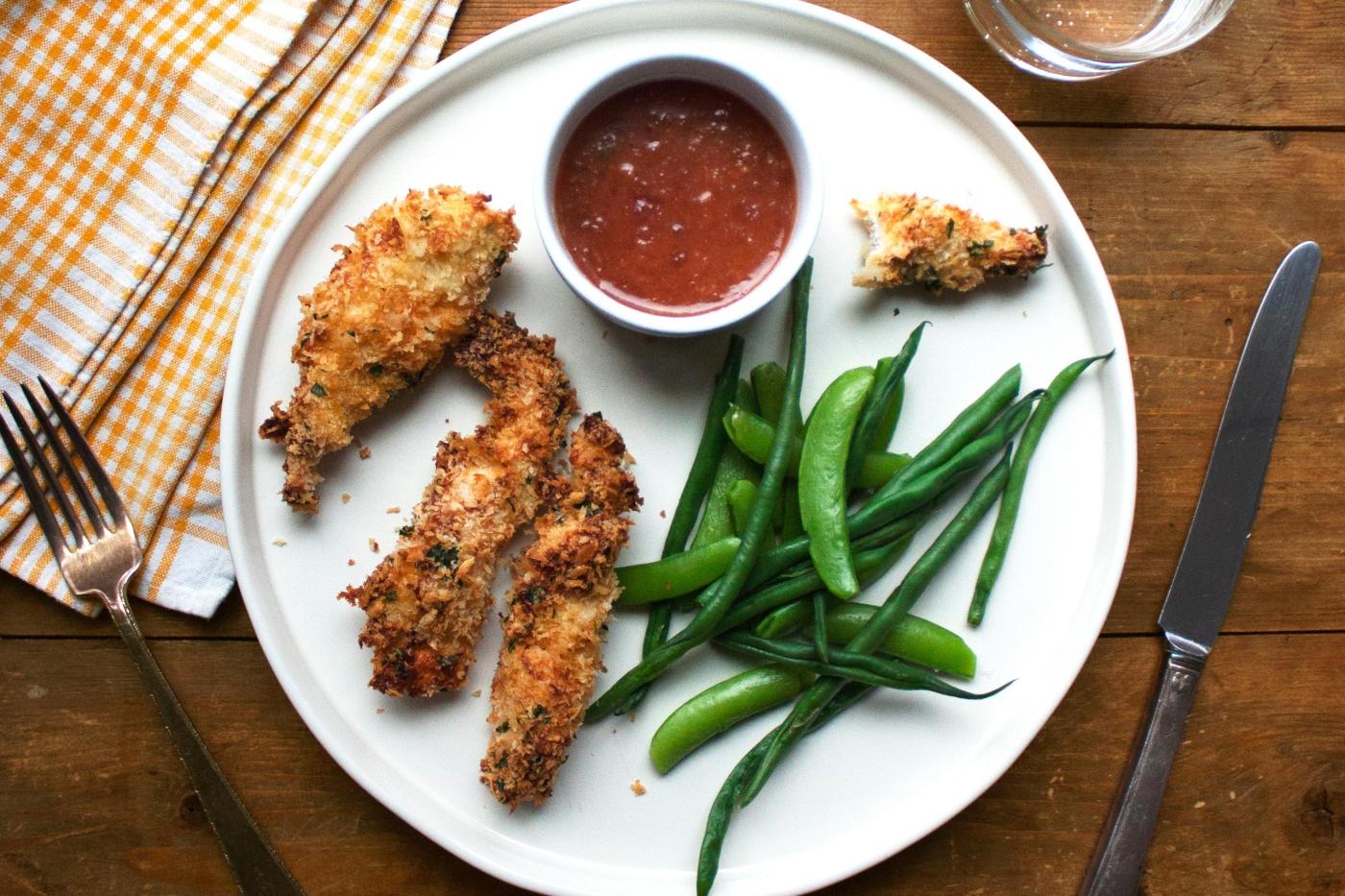
Sometimes a chicken nugget is just a chicken nugget. Sometimes it’s a crisp, panko-crusted strip of chicken breast with a sweet and tangy sauce. This is the latter.

Related Articles


3 Super Bowl recipes from esteemed chefs


5 simple dinners to ease back into cooking in the new year


Gretchen’s table: Cauliflower ‘steaks’ are tender on the inside and crispy on the outside


Even in winter, the sun still shines in these 5 citrus recipes


Resolutions, revived: Five nutritious weeknight dishes

Super Bowl Sunday is snack time at its finest. No one is looking for fancy footwork (at least not in the food realm; we do want to see that on the field). I have hosted more Super Bowl parties than I can (want to) count, and what I can tell you is that the delicate little canapes aren’t going to fly off the buffet as fast as the nachos.

The best Super Bowl food lives in the same realm as the best bar food. And that includes chicken tenders.

If you tend to think of chicken strips as a guilty, kiddie-centric pleasure, give yourself permission to relax and enjoy them. They’re basically fried chicken sans bone.

But these chicken strips bake on a wire rack for maximum crispiness without frying. A little olive oil in the panko makes all the difference. For a spicy kick, add Sriracha to the egg wash.

Now the sauce, simple but game-changing: Melt apricot or orange preserves, stir in Dijon mustard and fresh thyme, and dip away. It’s sweet, tangy and herbaceous, perfect for dunking each golden strip.

Bake, sauce, serve. The platter disappears fast, so consider making a double batch for a larger crowd. Easy enough for a weeknight, special enough for the big game, and guaranteed to impress both kids and adults.

Crispy Chicken Strips with Apricot Mustard Dipping Sauce

Serves 4 to 6

Ingredients:

1/2 cup all-purpose flour
Kosher salt and freshly ground pepper to taste
2 large eggs
1/2 teaspoon Sriracha or other hot sauce, or to taste
1 1/2 cups Panko breadcrumbs
2 tablespoons olive oil
1 1/2 pounds boneless, skinless chicken breasts, cut crosswise into 1-inch thick strips (or use chicken tenders)
1 cup apricot or orange preserves
3 tablespoons Dijon mustard
1/2 teaspoon minced fresh thyme leaves

Directions:

1. Preheat the oven to 400°F. Place a wire cooling rack into a rimmed baking sheet.

2. Place the flour, salt and pepper in a shallow bowl. Whisk together the eggs and Sriracha in a second shallow bowl. Combine the Panko and olive oil in a third bowl.

3. Working in small batches, toss the chicken strips in the flour, shake off any excess, dip them in the egg mixture, allow extra egg to drip back into the bowl, and roll them in the panko. Shake off any excess, then place the strips at least 1 inch apart on the wire rack. (It’s possible you may need to bake these in two batches.)

4. Bake until the chicken strips are golden brown and cooked through, 15 to 18 minutes.

5. While the chicken is cooking, place the preserves in a small saucepan or skillet. Heat over low heat until melted, stirring occasionally, then stir in the mustard and thyme. Transfer the sauce to a small bowl, transfer the chicken strips to a serving platter and serve hot.

Katie Workman writes regularly about food for The Associated Press. She has written two cookbooks focused on family-friendly cooking, “Dinner Solved!” and “The Mom 100 Cookbook.” She blogs at https://themom100.com/. She can be reached at Katie@themom100.com.

For more AP food stories, go to https://apnews.com/hub/recipes