Democrats open their convention transformed by Harris’ ascendance but facing lingering questions

posted in: Politics | 0

By STEVE PEOPLES, ZEKE MILLER and BILL BARROW

CHICAGO (AP) — A refreshed Democratic Party reintroduces itself to a divided nation this week, having been transformed by the money, momentum, relief and even joy that followed Vice President Kamala Harris ‘ rise to the top of its ticket.

The whiplash of the last month culminates in a convention that begins Monday in Chicago. Above all, the four-day gathering of thousands of activists and party leaders from across the nation is designed to celebrate and strengthen Harris as President Joe Biden’s replacement and boost her campaign to defeat Republican Donald Trump in November.

Just beneath the surface, real questions loom about the depth of Harris’ newfound support, the breadth of her coalition and the strength of her movement. Not even a month ago, Democrats were deeply divided over foreign policy, political strategy and Biden himself, who was holding on after his disastrous debate by suggesting he had a better chance than any Democrat — including Harris — of beating Trump.

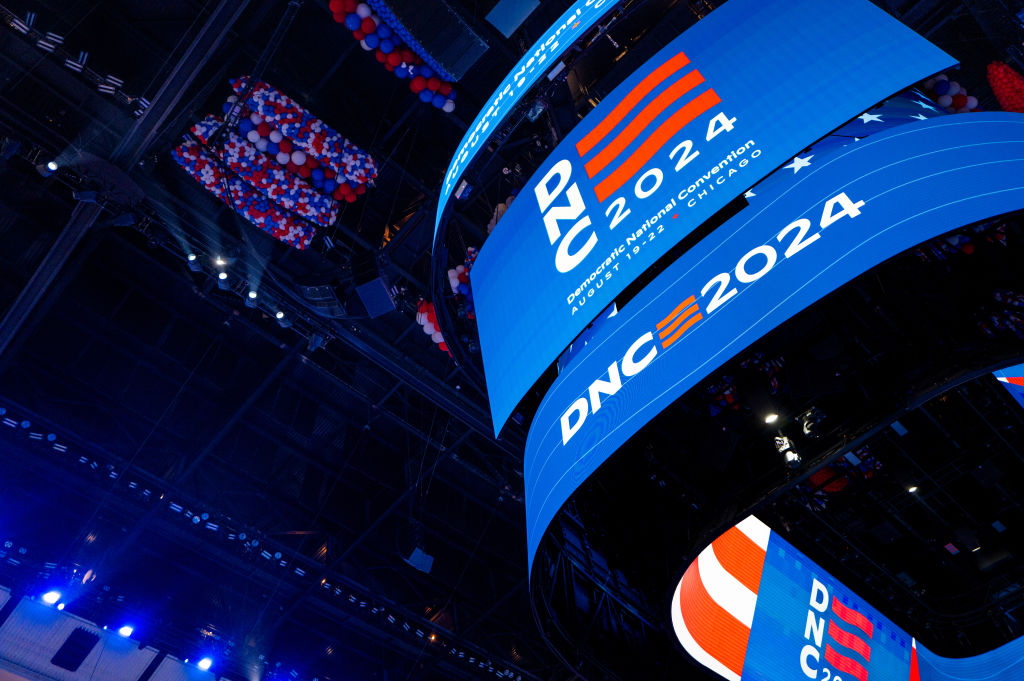
The stage is set at the United Center for the Democratic National Convention on August 15, 2024 in Chicago, Illinois. The convention will be held August 19-22. (Photo by Chip Somodevilla/Getty Images)

Far from the formality that many modern party conventions have become, this week’s event will bring many Americans their first extended look at Harris and her new running mate, Minnesota Gov. Tim Walz. How the Democrats present Harris and Walz will be critical, especially with Trump launching a weeklong effort to cut into their message.

A potential distraction will be thousands of progressive protesters who are expected to descend upon Chicago to decry the Biden-Harris administration’s support for Israel’s war against Hamas in Gaza. Harris’ allies are hopeful that the pro-Palestinian protesters will not overshadow the official program, which features a slate of current and former Democratic stars.

“Democrats are walking into that convention enthused, excited and unified,” said one of those stars, Pennsylvania Gov. Josh Shapiro, who was a finalist to be Harris’ running mate. “And it’s critically important that we prosecute the case against Donald Trump and the chaos that he would bring — and leave that convention even more unified, even more excited, even more enthused for the final 75 or so days of this campaign.”

Shapiro said he welcomed protesters during the convention — “provided the protest is peaceful, provided the protest follows the rules of the community.”

Biden will get his farewell Monday

Part of introducing Harris and Walz will be first giving a graceful exit to the 81-year-old incumbent president, who is slated to deliver the keynote address Monday.

The Democratic Party likely would have been in a far worse state if Biden had continued to cling to the nomination. He faced growing concerns about his mental and physical acuity after struggling to complete sentences at the debate.

Workers drive past a mural of Democratic presidential candidate U.S. Vice President Kamala Harris hanging outside of the United Center, site of the Democratic National Convention on August 17, 2024 in Chicago, Illinois. The convention will be held August 19-22. (Photo by Joe Raedle/Getty Images)

By deciding to step aside and endorse Harris, the 81-year-old president will instead receive a hero’s welcome in his final turn in the spotlight 52 years after being elected to the Senate from Delaware.

Biden is planning to give a lengthy endorsement of Harris and sharply criticize Trump before he leaves Chicago and makes way for the program to focus on the vice president he chose four years ago.

Trump has tried to inflame tensions over Biden’s exit. He called Biden’s Monday speaking slot “convention death valley,” suggesting that the president would get lower ratings than speakers on other nights. And as he has for weeks now, Trump described the convention itself as “rigged” because is was Biden, not Harris, who won 14 million primary votes and collected delegates state by state.

“She got no votes,” Trump said.

A focus on Harris’ firsts — and an open hand to Republicans

The convention will lean into the party’s potential to make history. Harris vies to be the first woman, the first Black woman and the first person of South Asian descent to reach the Oval Office.

“I wasn’t sure I would see this particular moment in my lifetime, to see a Black woman who is now on the cusp of becoming our next president,” said Illinois Lt. Gov. Juliana Stratton, one of the nation’s highest-ranking Black women elected officials.

Stratton recalled Hillary Clinton’s loss to Trump eight years ago, one in which she lost key battlegrounds even as she led the national popular vote.

Mayor of Chicago Brandon Johnson delivers remarks at the stage unveiling ahead of the Democratic National Convention (DNC) at the United Center on August 15, 2024 in Chicago, Illinois. The United Center will host the DNC, which is officially scheduled to kick off on Monday, August 19 and run through Thursday, August 22. (Photo by Kevin Dietsch/Getty Images)

“I remember back in 2016 when we touched the glass ceiling, and the reaction of Republicans was just to start destroying the rights that got us there,” Stratton said. “This is another chance.”

Harris will aim to use the convention to take a share of credit for what she and Biden accomplished while also trying to show that she recognizes voters want more. Heading into Chicago, she unveiled the initial planks of her policy platform focused on addressing the bite of inflation and the costs of food, housing and childcare.

Democrats will keep abortion access front and center for voters, betting that the issue will propel them to success as it has in other key races since the Supreme Court overturned Roe v. Wade two years ago.

Every living Democratic president and first lady will appear this week, except for the ailing Jimmy Carter, along with a long list of federal, state and local officials and activists.

It’s set to be a contrast to last month’s GOP convention in Milwaukee, where former President George W. Bush and former vice president Mike Pence, among other well-known Republicans, stayed away from the event given Trump’s antipathy toward them.

Expected to speak this week is former Rep. Adam Kinzinger, a Republican who investigated Trump’s actions around the Jan. 6 Capitol insurrection and has endorsed Harris.

The presidential race is still very close

With precious few days remaining before early voting begins in some places in September, recent polls show a close race nationally and in battleground states like Pennsylvania, Michigan and Wisconsin. And polls show Trump still has advantages on how Americans view the two of them on core issues like the economy and immigration.

Related Articles

National Politics |


Pro-abortion rights and LGBTQ+ protesters rally ahead of the start of the DNC

National Politics |


The DNC starts Monday in Chicago. Here’s what to know

National Politics |


Can the DNC help reverse Chicago’s national narrative?

National Politics |


Thousands of activists expected in Chicago for Democratic convention to call for Gaza cease-fire

National Politics |


The Democratic National Convention is here. Here’s how to watch it

Terry McAuliffe, a former Virginia governor and longtime operative who will attend his 13th Democratic convention this week, warned that the euphoria Democrats have about Harris’ ascension could obscure the true state of the campaign.

He noted that the Republican convention in Milwaukee was a veritable Trump coronation, with Democrats consumed by anxiety and uncertainty. Now, it’s Trump who seems to be reeling as he searches for the right message to stop Harris’ rise.

The lesson, McAuliffe said, is never to assume the a campaign is settled and always remember the outcome rests on getting 270 Electoral College votes by winning the right battleground states.

The former president is not ceding this week to Democrats. He will go a different swing state each day — starting with Pennsylvania, followed by Michigan, North Carolina, Arizona and Nevada by week’s end.

Trump’s campaign has also dispatched high-profile allies to Chicago to host daily news conferences. The lineup includes Florida Sen. Rick Scott, Wisconsin Sen. Ron Johnson and Florida Rep. Byron Donalds.

“We have four days of messaging that the country will get to look at Kamala Harris, get to look at Tim Walz. We’ll get to look at their agenda, what they stand for, who we are,” McAuliffe said. “It’s going to be a close election. That’s just where our country is today.”

Whatever happens this week, both sides will be watching with anticipation as Harris writes a new chapter in what has already been a precedent-breaking campaign.

Barrow reported from Atlanta. AP writer Michelle L. Price in New York contributed to this report.

Photos: Japanese Obon Festival features performances, lantern lighting

posted in: News | 0

Taiko Drum group performances, paper lanterns and more were the highlights of the Obon Festival at Como Park Zoo.  Pioneer Press photographer John Autey captured photos from the event.

The Marjorie McNeely Conservatory and dozens of lanterns are reflected in the Japanese garden pond during the Japanese Obon Festival at Como Park Zoo and Conservatory in St. Paul on Sunday, Aug. 18, 2024. (John Autey / Pioneer Press)
Enso Daiko Taiko Drum group perform during the Japanese Obon Festival at Como Park Zoo and Conservatory in St. Paul on Sunday, Aug. 18, 2024. (John Autey / Pioneer Press)
Jordan Groom from St. Cloud wears a Japanese hair pin she purchased in Kyoto, Japan, earlier this year while she waits for the lantern ceremony at the Japanese Obon Festival at Como Park Zoo and Conservatory in St. Paul on Sunday, Aug., 18, 2024. (John Autey / Pioneer Press)
A flutist with Enso Daiko Taiko Drum group perform during the Japanese Obon Festival at Como Park Zoo and Conservatory in St. Paul on Sunday, Aug., 18, 2024. (John Autey / Pioneer Press)
Volunteers use long poles to gently lower lanterns into the water during the Japanese Obon Festival at Como Park Zoo and Conservatory in St. Paul on Sunday, Aug., 18, 2024. (John Autey / Pioneer Press)
Spectators watch Taiko drummers during the Japanese Obon Festival at Como Park Zoo and Conservatory in St. Paul on Sunday, Aug., 18, 2024. (John Autey / Pioneer Press)
Lanterns are reflected in the Japanese garden pond during the Japanese Obon Festival at Como Park Zoo and Conservatory in St. Paul on Sunday, Aug., 18, 2024. (John Autey / Pioneer Press)
Cameron Jahn, facing, with Kaishin Dojo, demonstrates Kenjutsu or Japanese sword marital arts at the Japanese Obon Festival at Como Park Zoo and Conservatory in St. Paul on Sunday, Aug., 18, 2024. (John Autey / Pioneer Press)
Classmates Rowan Vietor, 15, Grayson Gerken, 15, and Ha’ani Whitlock, 17, check out Japanese Obon Festival at Como Park Zoo and Conservatory in St. Paul on Sunday, Aug., 18, 2024. The Redwing trio recently spent 2 weeks in Japan and were interested in the differences in how the festivals were celebrated. (John Autey / Pioneer Press)
Phallyni Korng, left and Rhyse Jensen-Gorham, from Lyle, Minn., are dressed up in traditional Japanese outfits as they walk during the Japanese Obon Festival at Como Park Zoo and Conservatory in St. Paul on Sunday, Aug., 18, 2024. The Southern Minnesota couple came to the festival to experience the food and culture. (John Autey / Pioneer Press)
Aidan Graf, 16, from with Kaishin Dojo smashes a watermelon while blindfolded during a demonstration of Kenjutsu or Japanese sword marital arts at the Japanese Obon Festival at Como Park Zoo and Conservatory in St. Paul on Sunday, Aug., 18, 2024. (John Autey / Pioneer Press)
Robert Weatherup with Kaishin Dojo cuts a tatami mat during a demonstration of Kenjutsu or Japanese sword marital arts the Japanese Obon Festival at Como Park Zoo and Conservatory in St. Paul on Sunday, Aug., 18, 2024. (John Autey / Pioneer Press)
The Marjorie McNeely Conservatory and dozens of lanterns are reflected in the Japaneses garden pond during the Japanese Obon Festival at Como Park Zoo and Conservatory in St. Paul on Sunday, Aug., 18, 2024. (John Autey / Pioneer Press)
A drummer with Enso Daiko Taiko Drum group perform during the Japanese Obon Festival at Como Park Zoo and Conservatory in St. Paul on Sunday, Aug., 18, 2024. (John Autey / Pioneer Press)
Enso Daiko Taiko Drum group perform during the Japanese Obon Festival at Como Park Zoo and Conservatory in St. Paul on Sunday, Aug., 18, 2024. (John Autey / Pioneer Press)
Volunteers use long poles to gently lower lanterns into the water during the Japanese Obon Festival at Como Park Zoo and Conservatory in St. Paul on Sunday, Aug., 18, 2024. (John Autey / Pioneer Press)
A flutist with Enso Daiko Taiko Drum group perform during the Japanese Obon Festival at Como Park Zoo and Conservatory in St. Paul on Sunday, Aug., 18, 2024. (John Autey / Pioneer Press)
Lanterns are reflected in the Japaneses garden pond during the Japanese Obon Festival at Como Park Zoo and Conservatory in St. Paul on Sunday, Aug., 18, 2024. (John Autey / Pioneer Press)
Jordan Groom from St. Cloud wears a Japanese hair pin she purchased in Kyoto Japan earlier this year while she waits for the lantern ceremony at the Japanese Obon Festival at Como Park Zoo and Conservatory in St. Paul on Sunday, Aug., 18, 2024. (John Autey / Pioneer Press)
Spectators watch Taiko drummers during the Japanese Obon Festival at Como Park Zoo and Conservatory in St. Paul on Sunday, Aug., 18, 2024. (John Autey / Pioneer Press)
Cameron Jahn, facing, with Kaishin Dojo, demonstrates Kenjutsu or Japanese sword marital arts the Japanese Obon Festival at Como Park Zoo and Conservatory in St. Paul on Sunday, Aug., 18, 2024. (John Autey / Pioneer Press)
Classmates Rowan Vietor, 15, Grayson Gerken, 15, and Ha’ani Whitlock, 17, checkout Japanese Obon Festival at Como Park Zoo and Conservatory in St. Paul on Sunday, Aug., 18, 2024. The Redwing trio recently spent 2 weeks in Japan and were interested in the differences in how the festivals were celebrated. (John Autey / Pioneer Press)
Phallyni Korng, left and Rhyse Jensen-Gorham, from Lyle Minnesota, are dressed up in traditional Japanese outfits as they walk during the Japanese Obon Festival at Como Park Zoo and Conservatory in St. Paul on Sunday, Aug., 18, 2024. The Southern Minnesota couple came to the festival to experience the food and culture. (John Autey / Pioneer Press)
Aidan Graf, 16, from with Kaishin Dojo smashes a watermelon while blindfolded during a demonstration of Kenjutsu or Japanese sword marital arts the Japanese Obon Festival at Como Park Zoo and Conservatory in St. Paul on Sunday, Aug., 18, 2024. (John Autey / Pioneer Press)
Robert Weatherup with Kaishin Dojo cuts a tatami mats during a demonstration of Kenjutsu or Japanese sword marital arts the Japanese Obon Festival at Como Park Zoo and Conservatory in St. Paul on Sunday, Aug., 18, 2024. (John Autey / Pioneer Press)

George Latimer, St. Paul’s longest serving mayor, who oversaw rapid change for the city, dies at 89

posted in: News | 0

As the longest serving mayor of St. Paul, George Latimer publicly embraced the social aspects of his job as much as the political ones, becoming so synonymous with the capital city’s downtown institutions that the Central Library by Rice Park was renamed in his honor and the District Energy system he helped launch in the late 1970s dubbed him director emeritus.

Former St. Paul mayor George Latimer, left, and former Minneapolis mayor Don Fraser reminisce during a celebration of the 40th anniversary of Landmark Center in St. Paul on Thursday, Sept. 27, 2018. Forty years ago this month, the Old Federal Courts Building reopened as St. Paul’s Landmark Center after significant community effort for its preservation. (John Autey / Pioneer Press)

Garrulous and jovial, Latimer – a one-time gubernatorial candidate – could disarm a friend or foe with a self-effacing comment, never letting on that his credentials included a degree from an Ivy League law school, a stint as dean of Hamline University Law School and two years in the mid-1990s as a White House adviser on housing policy.

“He was very bright — he went to Columbia Law — but he never gave you that impression that he was better than the average Jane or Joe,” said longtime friend and labor activist Harry Melander. “And if he goofed up, he was the first one to tell you.”

Latimer, who presided over a downtown building boom while serving as one of the capital city’s first official “strong mayors” from 1976 to 1990, died at his longtime Episcopal Homes residence on University Avenue in St. Paul around 12:30 a.m. Sunday. He was 89 years old.

Latimer was preceded by his wife Nancy, who died in September 2006 of ALS, otherwise known as Lou Gehrig’s Disease. The couple had three sons – George Jr., Philip and Thomas More, and two daughters, Faith Tilsen and Kate Courtney.

Presiding in a time of change

Born in June of 1935 in Schenectady, N.Y., and raised by shop owners, Latimer moved to St. Paul in the early 1960s after attending Columbia Law School. He served on the St. Paul School Board from 1970 to 1974 before making his first run for mayor.

Former St. Paul mayor George Latimer, center, shares stories with state Senate secretary Patrick Flahaven, left, and Fred Norton, a Court of Appeals judge, at a reception in St. Paul following Mike McLaughlin’s funeral service on Friday, Aug. 15, 1997. McLaughlin, 73, died Monday at his home on Summit Avenue, and the wake there on Friday helped his family and friends celebrate little pieces in the life of a man who guided local and national Democratic campaigns for four decades. (Scott Goihl / Pioneer Press)

Bill Mahlum, who became Latimer’s law partner in the late 1960s and would go on to help him launch District Energy, recalled how the secret to Latimer’s political success was canvassing.

“If you know George, he has a skill of being very interested in who you are, what you do and who your children are,” said Mahlum, in an August 2022 interview. “He has a great memory, and he cares. He was a remarkable politician, but he was a more remarkable person.”

As mayor, Latimer presided at a time of changing demographics for the capital city, which became a centerpiece of Hmong refugee migration after the U.S. war in Vietnam and “Secret War” in Laos.

It was also a time of national “white flight” to the suburbs, when many middle class families began abandoning urban living, put off in part by rising crime rates across the country and race riots and unrest during the Vietnam era. In the span of three years or so during the 1980s, an estimated 6,000 jobs left the East Side of St. Paul.

Latimer, however, came into his role with unique authority. The city had transitioned under prior Mayor Larry Cohen to a “strong mayor” system, in which rather than hold a single vote on the city council, the executive appointed department directors and oversaw the entirety of city administration. That left the city council to pass city ordinances, approve the city budget and serve as a check and balance on that authority.

“He defined what a strong mayor in St. Paul looks like,” said Chris Coleman, who served as St. Paul mayor from 2006 to 2018 and had known Latimer since childhood.

William McCutcheon, left, and his wife, Marlene, chat with St. Paul Mayor George Latimer shortly after Latimer named McCutcheon the city’s next police chief on Feb. 8, 1980. (Sully Doroshow / Pioneer Press)

In 1981, Latimer gave the eulogy for Coleman’s father, Nicholas David Coleman, a political ally who served as majority leader in the Minnesota Senate for most of the 1970s.

District Energy. Ordway Center

Rather than give up on downtown St. Paul, Latimer doubled down, teaming with Swedish engineer Hans Nyman to create an energy utility to heat and eventually cool downtown at stable fuel rates. Inspired by Scandinavian design, District Energy – one of the first hot water district energy systems in North America — launched in 1979 with Latimer as chairman. It added cooling in 1993, and later a renewable energy plant fueled by urban tree waste.

Latimer’s tenure also coincided with the development or redevelopment of major downtown office towers and public destinations, including the 38-story Wells Fargo Place, the Ordway Center for the Performing Arts, the first of two Securian Towers at 400 Robert St., the Town Square Tower, UBS Plaza and Landmark Towers.

During his mayoral term, he saw the potential for St. Paul’s Lowertown neighborhood in particular to host residences where law firms, factories, tanneries and retailers once stood, a gradual repositioning of the warehouse district that didn’t hit its stride until Coleman’s administration, long after Latimer left office.

“What George started, Chris Coleman kind of finished, in terms of development,” Melander said. “District Energy is recognized internationally for what it’s done. If you look at what’s happening with energy now, they were way ahead of their time.”

Not all of his projects bore fruit. Under Latimer, St. Paul competed against Los Angeles, Houston, Detroit and Miami to see which city would be the first to launch a “People Mover,” or mini-rail that would circulate in and around downtown from the Minnesota State Capitol and East Seventh Street to the Lafayette Bridge.

The proposal drew the ire of even some of his closest allies, including then-City Council Member Ruby Hunt.

Then-St. Paul Mayor George Latimer, left, talks with Joe Errigo, then head of an affordable housing agency, and then-Archbishop John Roach, in 1980. (Courtesy of CommonBond Communities)

“We clashed over the People Mover — it was a big deal,” said Hunt, interviewed in early August 2022 at the age of 98. “It was going to be running around downtown St. Paul, but people weren’t all that sold on it. Neither were the businesses.”

The project was officially nixed in 1980, but overall, said Hunt, “George did a beautiful job. He was an outstanding mayor. I worked together with him a lot. I had a lot of respect for him, and he had a lot of respect for me.”

“He was a real people person. He knew how to identify with people and get on the same wavelength, so to speak,” Hunt added. “George had the ability to attract and hire the very best people to run the city, and that’s an important trait that isn’t followed today as well as it could be.”

A run for governor

Latimer, then still mayor, took the politically risky move in 1986 of challenging Gov. Rudy Perpich, a member of his own party, only to lose to Perpich in the Democratic-Farmer-Labor primary. He would continue to serve as mayor until 1990.

After leaving office, Latimer served as dean of Hamline University’s law school from 1990 to 1993, and then as a special adviser to Henry Cisneros, President Bill Clinton’s Secretary of Housing and Urban Development, from 1993 to 1995.

Dignitaries posed for a photo during a groundbreaking ceremony for a new concert hall at the Ordway Center for Performing Arts in St. Paul, Minn., on Wednesday, June 19, 2013. From left is then-St. Paul Mayor Chris Coleman, Richard Slade, Jill Irvine Crow, former St. Paul mayor George Latimer, David Lilly Sr., David Lilly Jr. and Bruce Lilly. The new space would replace the soon-to-be-demolished McKnight Theatre and dramatically increase capacity. It has 1,100 seats, as opposed to the McKnight’s 306.

Over the years, Latimer became a visiting professor of urban studies at Macalester College, chief executive officer of the National Equity Fund – which manages low-income housing units in dozens of cities – and a regent with the University of Minnesota. The city renamed the downtown Central Library in his honor in 2014.

Also in 2014, Hunt and Latimer would both go on to take up residence at the Episcopal Homes senior living development on University Avenue near Fairview Avenue, just off the then-newly launched Green Line light rail corridor.

Melander, who befriended the former mayor in the 1990s and came to see him as something of a father figure, said Latimer sometimes reconnected with his older brothers, among others, through what the former mayor deemed “fellowship” and others called afternoon drinks. “I was his delivery boy during COVID, and prior, when he told me to go to Morelli’s (Liquors), if you know what I mean,” he deadpanned.

It was only in late 2022 when Latimer swore off the occasional cocktail and limited what had been his many daily social visits at Episcopal Homes that Melander began to become concerned about his friend’s health. Latimer would be moved to hospice care that year, only to move back out again within months, disenchanted with the notion that the end was nigh.

Changing social mores

During an interview with the Pioneer Press conducted in September 2020, well into the opening year of the COVID-19 pandemic and a few months after the death of George Floyd, a Black man, at the hands of a Minneapolis police officer, Latimer acknowledged that social mores had changed around him.

“There are any number of cultural and political practices that I have fully supported in my career, and now I’m being challenged in my thoughts,” he said at the time, noting his nuanced view of the social landscape.

“I believe there are some wonderful things happening within our culture today. We’re on our way of ridding ourselves of stereotyping people and ‘the other.’

“I think it’s quite beautiful when one of our grandchildren has their friend coming over, and I have no idea what color that person will be, or what gender they have. That isn’t the first thing they think of. People my age, we usually began by thinking, ‘He’s my friend, and he’s a Lutheran …’ Or ‘at the university, I was with a Black guy …’

“Whether we meant it pejoratively or not, it was our way of introducing our knowledge of people. And the younger people are ridding themselves of that. And that’s a plus.”

While acknowledging the racial fault line in police-community relations, he went on to criticize the wholesale rejection of police and policing.

“Racism — including ‘driving while Black’ — has a long history. But for an awful lot of folks as we were growing up, the police were not the enemy. Reform has been occurring, but because we’re a localized police system, it’s very mixed and varied.”

“There are many communities that have done community policing for many, many years,” Latimer said. “Does it mean it ends crime? No. But the trust level between the police and the people they’re protecting is important. This anti-police conduct is not liberal. It’s not democratic.”

In November 2017, Latimer penned a guest editorial in the Pioneer Press dedicated to the mayor-elect, urging whomever won the election to see their role as an ambassador between cultures, as much as a chief executive or technical officer overseeing city departments.

“Too often when people speak of the sense of community, they mean it exclusively, or in an elitist way,” wrote Latimer at the time. “They say whoever was here first is ‘the community’ and whoever comes later ought to stay for only a short while or immediately take on all the characteristics of those who came before them, abandoning any unique culture.”

“There are multiple communities in St. Paul where there are high levels of trust and a great love of the sense of place,” he continued. “An important part of the mayor’s job is to be a bridge builder between all of those wonderful communities.”

Funeral arrangements are yet to be announced.

Related Articles

Local News |


Michael McGuire, ‘the most influential architect in the St. Croix Valley,’ dies at 95

Local News |


Obituary: Karen Hubbard, longtime St. Croix River Valley matriarch, dies

Local News |


Gena Rowlands, acting powerhouse and star of movies by her director-husband, John Cassavetes, dies

Local News |


‘Someone who lived and loved deeply’: Former Pioneer Press, Star Tribune reporter Jennifer Bjorhus dies at 59

Local News |


Obituary: Marine on St. Croix’s Ralph Malmberg, the inspiration for ‘Ralph’s Pretty Good Grocery’

Pro-abortion rights and LGBTQ+ protesters rally ahead of the start of the DNC

posted in: Society | 0

A crowd of hundreds called for abortion and LGBTQ+ rights Sunday evening in downtown Chicago, getting a head start on a week of protests before the Democratic National Convention kickoff Monday.

Starting with a rally on Michigan Avenue and Wacker Drive by the Chicago River, with Trump Tower as a backdrop as the blazing sun set behind the Marina City Towers, demonstrators headed south to the Grant Park monument of Union Army Gen. John Logan, which protesters climbed in an iconic moment during the DNC protests in August 1968.

After an acoustic sing-along by the crowd — “My body, my body/ My choice, my choice,” punctuated by a flute and ukulele — emcee and activist Scout Bratt took the mic to say, “Palestinian liberation is reproductive justice,” a nod to the common thread that ran through speeches and chants during the evening.

“And we reject any political compromises on bodily autonomy,” added Bratt, a spokesperson for Jewish Voice for Peace and a member of the social justice group Avodah. “Today, we are coming together on the eve of the Democratic National Convention to be sure that they don’t even begin … without knowing our demands.”

The rally and march took place a week after the coalition Bodies Outside of Unjust Laws — endorsed by more than 30 local and national organizations — won a permit for a route on Michigan Avenue following a long legal battle with the city. The lawsuit continues in federal court with representation from the American Civil Liberties Union over the city’s security perimeter ordinance.

Other groups have also had difficulties obtaining permits in what they have called a slow and contentious approval process; several have taken the city to court.

The Sunday gathering sought to demand that if Vice President Kamala Harris wins the presidency in November, she will commit to sweeping legislation for abortion access and transgender and LGBTQ+ health care, as well as an end to U.S. aid to Israel and a call for a cease-fire.

They hope national legislation will include no gestational bans or viability limits on abortion and a guaranteed minimum income so children can be raised “in a healthy, nurturing environment.” And as trans people continue being targeted by the far right — which the coalition sees as attacks on the bodily autonomy of all LGBTQ+ people — they also demand equal employment and housing rights enshrined in legislation.

The coalition includes pro-Palestinian groups that emphasize the interconnectedness of human rights struggles in Gaza and at home; for instance, anti-war, women-led grassroots organization CODEPINK has said that discussions of reproductive justice within the Democratic Party must consider Israel’s war in Gaza.

Related Articles

National Politics |


The DNC starts Monday in Chicago. Here’s what to know

National Politics |


Can the DNC help reverse Chicago’s national narrative?

National Politics |


Thousands of activists expected in Chicago for Democratic convention to call for Gaza cease-fire

National Politics |


The Democratic National Convention is here. Here’s how to watch it

National Politics |


Convention delegates will nominate Harris, again. This time, there’s less suspense and more pizzazz

“Reproductive genocide, my comrades and friends, is the eradication and destruction of life-giving and life-sustaining resources such as food, such as water, such as medicine, such as medical care,” said Chicago organizer and community leader Leena Odeh of the Palestinian Feminist Collective.

According to reports from the United Nations, miscarriages in the region have increased by 300%, and a shortage of medical supplies means that women are giving birth without pain relief and children are dying without incubators. The largest fertility clinic in the region has been destroyed by Israeli forces, newborn babies face malnutrition and have no access to clean water, and 690,000 women and girls have no access to menstrual hygiene products.

On more than one occasion, speakers forcefully reminded Harris she has to earn their vote. They also repeatedly called out Democratic leaders for what they see as a disconnect between promises and policies enacted at home and abroad.

“We are at a pivotal moment of recognizing and raising cautiousness about all the ways in which the Democratic Party and its brutal policies violently suppress working-class organization and liberation movements. The main line of the Harris candidacy is to vote for them or face fascism, when in fact, the two parties are two sides of the same coin,” said Sultana Hossain, an Amazon labor union activist and co-facilitator for NYC Labor for Palestine.

Nadine Naber, professor of gender and women’s studies at the University of Illinois Chicago and co-founder of Mamas Activating Movements for Abolition and Solidarity, said, “We are here to fight for our bodies and our hearts. And I believe that any movement guided by radical, collective love is like fire.”

adperez@chicagotribune.com