Will Louie Varland shift to the bullpen again? Twins not sure yet

posted in: News | 0

Right around this time last year, the Twins decided to move Louie Varland to the bullpen, allowing him first to get his feet wet in the role at Triple-A before deploying him as a weapon out of the major league bullpen.

Varland responded to the new challenge, giving up just two earned runs in 12 innings (1.50 ERA) to cap the regular season and making two scoreless playoff appearances. But while it appeared as if Varland could be ticketed for a similar role again late this season, injuries to starters Joe Ryan and Chris Paddack have made the decision harder — and perhaps slightly delayed it.

With rookies Simeon Woods Richardson, David Festa and Zebby Matthews already in the major league rotation pitching important innings, Varland is in Triple-A starting, serving as depth should something happen to anyone currently in the rotation.

“We can’t put ourselves ever in a spot where we run out of capable starters,” Twins manager Rocco Baldelli said. “That is always going to be the first thing that I have to bring up when we talk about Lou and his ultimate landing spot in September as far as how he’s getting his innings.”

If the Twins need another starter, he should be the first in line and shortening him up for a relief role would leave them thin on available options for the rotation.

Varland struggled in the majors earlier this season, losing his rotation spot to Woods Richardson. But he’s made a handful of spot starts in the majors since his bumpy April and performed better. He’s also pitched notably better at Triple-A.

“I don’t know the answer,” Baldelli said of Varland’s future role. “I think you could see it play out both ways.”

Topa progressing

While there’s still a question of whether or not Varland joins the bullpen at some point this year, Justin Topa is hoping to provide the Twins a late-season addition to the relief corps.

Topa has been on the injured list all season, first dealing with knee tendinitis and then elbow soreness after going on a rehab assignment earlier this month which had to be halted.

The reliever played catch at 60 feet on Sunday with no issues, will take Monday off and then return to catch play on Tuesday and Wednesday as he keeps ramping up. He hopes by the end of next week, he can be throwing off the mound.

“It’s been frustrating, getting close and then the setback with the knee the first time,” Topa said. “Knee’s been feeling probably the best it’s felt in over two years and then obviously this pops up. But you just kind of roll with the punches and try to find a silver lining in everything.”

Though Topa is aware of the time crunch — there’s a little more than a month remaining in the regular season — he still believes there’s enough time for him to get back and impact the team down the stretch.

“I think after talking to (athletic trainer) Nick (Paparesta) and everybody, once we get past that point of doing some flat ground work and get on the mound, I think it’s going to be a relatively quick ramp up,” Topa said. “Not in the sense of we’re going to try to overdo it, but in the sense of, I threw enough in St. Paul that first go-around, maybe one or two games there.”

Briefly

Max Kepler was scratched shortly before Sunday’s game with left knee soreness and Baldelli said he spent much of the day in the training room. Baldelli said he would get imaging done on his knee, at which point the team would know more. … Baldelli did not have much of an update on Alex Kirilloff, whom the Twins pulled from his rehab assignment after he experienced what the manager called “residual back soreness.” Kirilloff has been on the injured list since June 13 and played one game in St. Paul on Friday, doubling once in his five at-bats before the Twins paused his rehab assignment.

Related Articles

Minnesota Twins |


Pablo López, Trevor Larnach guide Twins to win over Sonny Gray, Cardinals

Minnesota Twins |


Injured Twins star Carlos Correa ‘trending in the right direction’

Minnesota Twins |


A streak of a different kind: Saints beat Scranton/Wilkes-Barre for third in a row

Minnesota Twins |


Twins’ bats quieted in loss to Cardinals

Minnesota Twins |


Former Twin Sonny Gray returns to Minnesota, set to face off against Pablo López

New fishing regulations possible for Basswood, Birch, Saganaga lakes in northern Minnesota

posted in: Adventure | 0

Anglers who like to fish some of the big, popular lakes in northeastern Minnesota should pay attention to possible rule changes, and now is the chance to give your input on those regulations.

The Minnesota Department of Natural Resources recently announced the possible rule changes with public meetings set for September and written comments accepted until Oct. 7.

For Saganaga and Sea Gull lakes off the Gunflint Trail — and the Seagull River and Gull Lake between them — the DNR is re-evaluating the 10-year-old experimental regulation for walleyes. The current rule allows three fish daily with a 17-inch minimum size and only one fish over 20 inches.

Edmund Isaac, DNR fisheries supervisor in Grand Marais, said he wants to hear public input before deciding whether to keep all, some or none of the current experimental regulations.

“It’s not an all-or-nothing thing; we can take parts of it people like and maybe change others,” Isaac told the News Tribune. “We want to hear what our stakeholders have to say before we put something out there.”

The Saganaga Lake system is known for producing some of the largest walleyes in the state, including the all-time state record at 17 pounds, 8 ounces, caught by LeRoy Chiovitte, of Hermantown, in 1979.

LeRoy Chiovitte holds the state-record walleye he caught May 13, 1979, and weighed on a scale that DNR staff inspected. The DNR is considering changes to the current (2024) special walleye regulations that cover Sea Gull, Saganaga and Gull lakes and the Seagull River, where Chiovitte caught the big fish. (Charles Curtis / Forum News Service)

The new regulations likely will be in effect for the 2025 open-water fishing season starting in May.

In other DNR proposals:

— Basswood Lake’s sunfish limit would become five fish daily, down from the current statewide limit of 20 daily.

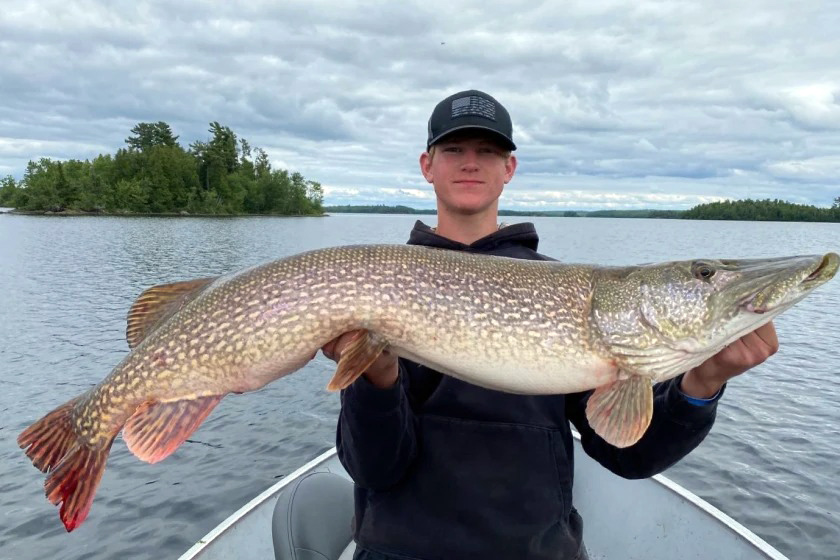
— Basswood Lake’s northern pike regulations would change from the current three-fish limit with a 24- to 36-inch release slot and one fish allowed over 36 inches to the proposed two-fish limit with a 30- to 40-inch release slot and one fish over 40 inches allowed.

— Birch, Farm, South Farm, Garden and White Iron lakes would see lake-specific special regulations for northern pike eliminated (currently three-fish limit with a 24- to 36-inch release slot and one fish over 36 inches) and move to current Minnesota northeast regional northern pike limit (currently two fish daily, with a 30- to 40-inch release slot and one fish allowed over 40 inches. Spearers can take two pike daily but only one may be larger than 26 inches.)

“Our goal is to make the Basswood northern pike regulation simpler while also protecting the trophy northern pike fishery on Basswood Lake,” said Keith Reeves, DNR area fisheries supervisor in Tower.

The DNR is holding public input sessions on the regulations Sept. 20 from 6-8 p.m. in the Sea Gull Community Center and Sep. 24 from 6-8 p.m. at Minnesota North College, Vermilion campus in Ely.

The DNR is also taking input on these proposals via a survey at mndnr.gov/fishregs through Oct. 7. For more details or to comment directly by email, U.S. mail or phone about individual proposals, contact the area fisheries office (find them at mndnr.gov/areas/fisheries) for the proposals on which you wish to comment.

General input may also be submitted to Jon Hansen at jon.hansen@state.mn.us or 651-259-5239 or via U.S. mail to Fishing Regulations/Jon Hansen, Box 20, Minnesota Department of Natural Resources, 500 Lafayette Road, St. Paul, MN 55155.

The regulation proposals also have been posted at the accesses to each lake included in the proposal.

Other lakes in Todd, Stearns and Olmsted counties could also see regulation changes for next year.

Related Articles

Outdoors |


DNA confirms big Lake Superior fish was splake, not record brook trout

Outdoors |


Like to paddle? Marine on St. Croix boat show is for you.

Outdoors |


Lake Superior produces another Minnesota record coho salmon

Outdoors |


Longtime Minnesota DNR Fish and Wildlife director to retire; new director named

Outdoors |


Scandia’s Bone Lake removed from impaired-waters list

A Cottage Grove man raises — and tracks — monarch butterflies from eggs on milkweed leaves to flights to Mexico

posted in: News | 0

As July sunlight pokes through the trees, a butterfly egg rests gently in Wojciech Poreba’s palm as he sifts through milkweed leaves at Hamlet Park in Cottage Grove.

At age 25, Poreba has four years of experience raising monarch butterflies. There is no place for impatience, he said, and being delicate is key for success.

In Poland, where he was born before arriving in the U.S. at 15 with his mother and stepfather, there are no monarchs. Instead he raised spiders and other types of butterflies, like swallowtails. Poreba currently has a giant white knee tarantula and a young sapphire tarantula, along with monarch and swallowtail caterpillars, among his collection in his room.

“I always loved insects. I have always just enjoyed watching or raising them since I was a kid,” said Poreba.

The first he learned about monarchs was through television nature shows, then he gained more knowledge through the Boy Scouts. After doing research, he decided it was time to raise them on his own.

Wojciech Poreba inspects milkweed at Hamlet Park in Cottage Grove while looking for monarch butterfly eggs Wednesday afternoon, Aug. 7, 2024. (Devanie Andre / Pioneer Press)

Raising and releasing

In 2020, Poreba raised 60 monarchs given to him by his sister from the Minnesota State Fair. Last year, after keeping track of butterflies on a spreadsheet, he raised 999 monarchs. He hopes to raise 3,000 by the end of this summer.

With 600 released in early July, Poreba has hundreds more metamorphizing in his bedroom in Cottage Grove.

Poreba collects monarch eggs from milkweed plants along parks and highways that use pesticides or are being cut down. He carefully looks under the leaves of milkweed plants — the only plant that monarch butterflies reproduce on — for white eggs the size of a pencil tip.

In places where he sees monarchs thriving, he leaves the eggs alone.

Wojciech Poreba holds one of approximately 60 monarch caterpillars that he is currently raising at his Cottage Grove home on Wednesday, Aug. 7, 2024. (Devanie Andre / Pioneer Press)

“When you raise them inside, you give them a much higher chance of survival because just 10 percent or less survive to adulthood,” said Poreba. “The number one important thing is to have milkweeds because that is the only plant that the monarch butterflies will reproduce on.”

When he collects eggs, he plucks the leaf off and places it into a bucket with other milkweed leaves. After thoroughly checking the plant, Poreba brings the eggs home to raise.

Caterpillars big and small

Monarch caterpillars big and small crawl along a row of potted milkweed plants by his bedroom window, littering the sill with dried leaves. Along the ledge are replicas of spiders and butterflies.

Related Articles

Outdoors |


Skywatch: Celestial eagle soars high in the sky

Outdoors |


Lake Nokomis beaches remain closed after sanitary sewer spill; here are other swimming options

Outdoors |


Woodbury Days festival to feature fireworks show, parade

Outdoors |


MN State Fair: Here’s what you need to know about hours, deals, parking and more

Outdoors |


Lake Nokomis beaches closed after sewer overflow

On the wall hangs a poster displaying different types of bees. Above a neatly made bed is an old chrysalis, with a new one hanging beside the bedframe. On top of a large drawer are spreadsheets, tagging stickers and dried milkweed leaves holding new eggs. Next to the eggs is an old Kemps ice cream container with a swallowtail caterpillar, next to a small tarantula habitat.

The eggs take about a week to hatch, and off it goes to eat the milkweed leaves. As the larva grows into a striped caterpillar, Poreba moves it to a milkweed plant by his windowsill.

There, the caterpillars are free to roam and eat until they grow to full size, which takes another two weeks.

Poreba lets the caterpillars climb to the top of his window frame as they prepare to form a chrysalis. He likes to keep a close eye on the caterpillars as they decorate the window frame with green cocoons. As the chrysalises form and set, metamorphosis starts — a process that turns the caterpillars into colorful monarch butterflies.

Tagging stickers

Finally, after two to three weeks, the striped caterpillar emerges as a orange-winged butterfly. Once the monarch’s wings are fully dried, Poreba carefully places tagging stickers — just a few centimeters in size — on its wing. The stickers are used to track the butterflies as they travel to Mexico. Eastern monarchs make the journey to Mexico, while western ones travel to coastal California.

Poreba has been doing this process for four years in Minnesota with tags from Monarch Watch, a research, education and monarch butterfly tracking program through the University of Kansas.

Each fall, the group distributes more than a quarter of a million tags to volunteers across North America. The volunteers capture monarchs throughout the migration season, record the tag code, tag date, gender of the butterfly and geographic location, then tag and release them. At the end of the tagging season, this information is submitted to Monarch Watch for their research.

Last year, Poreba became a Boy Scouts Cubmaster and now helps teach young people about insects. By helping Minnesotans raise and learn more about monarch butterflies and their importance to the ecosystem, he hopes that others will be encouraged to plant butterfly gardens and protect natural habitats for them.

Wojciech Poreba observes his milkweed plants that house and feed approximately 60 caterpillars on a windowsill at his home in Cottage Grove on Wednesday, Aug. 7, 2024. (Devanie Andre / Pioneer Press)

“If you don’t have experience raising monarch butterflies, you can just simply plant one milkweed for them. That is extremely helpful for them already and you can learn what they look like so that you know not to pull out milkweeds or spray them with pesticides,” said Poreba.

He hopes to raise enough butterflies to create a public release event in the fall. He said he’d like more people to appreciate them and other insects.

“I would say not to be scared of insects. Not all insects are harmful. Many insects are extremely beneficial for our gardens. Without bees, we wouldn’t be here. Bees are (the) number one insects that pollinate flowers to create forests.”

More about monarchs

Monarch butterflies have bright orange-red wings with black veins that are speckled with white spots along the edges. Monarchs are known to migrate across North America and Canada to Mexico, then return to their homes to reproduce and start the cycle again.

The monarch butterfly is the only butterfly known to make a two-way migration, according to the U.S. Forest Service website.

Butterflies are among many pollinators in nature and though they are not the most efficient pollinators, they are recognizable and well-known. Pollinators come in many shapes and sizes, and are beneficial for the health and reproduction of flowering plants.

Wojciech Poreba finds a monarch butterfly egg on a milkweed plant at Hamlet Park in Cottage Grove on Wednesday, Aug. 7, 2024. (Devanie Andre / Pioneer Press)

In December 2020, the U.S. Fish and Wildlife Service declared monarchs to be “warranted and precluded,” which put the monarch butterfly on the candidate list for endangered species due to higher priority listings. The list is where the status of a species is held under review each year until it is no longer a candidate.

On July 21, 2022, the International Union for Conservation of Nature announced that monarch butterflies have entered the IUCN Red List of Threatened Species as endangered. This is the first time the butterfly was officially declared at risk of extinction.

Milkweeds are vital to the reproduction of monarch butterflies since it is the only food source for larvae. By destroying habitats with milkweed plants, either from pesticides or cutting down natural terrain, the reproduction rates of monarchs decline.

In order to efficiently raise monarchs, it’s important to do research on what they are and how to take care of them. Monarch Joint Venture, a 501(c)(3) organization, is one of many that can provide resources and ways to help monarchs.

Washington County’s efforts recognized

Meanwhile, this summer Washington County’s Public Works Department received two national awards for its efforts to protect monarch butterfly habitat.

The Biggest Adopter Award is given to partners with the most acres using adopted conservation measures. And the Highflyer Award is given to those with the highest percentage of adopted acres above a 2023 target.

The awards were presented to county staff by the Monarch Candidate Conservation Agreement with Assurances Program, a voluntary program working to protect and grow monarch butterfly habitat.

Related Articles

Outdoors |


Over a century and four generations later, Stillwater Motors officially changes hands

Outdoors |


Taylor Swiffer? Sweep Dogg? Help name Woodbury’s new street sweeper

Outdoors |


Stillwater Lift Bridge to close Wednesday for electrical work

Outdoors |


South Washington County Schools board votes to give themselves a raise

Outdoors |


Woodbury: Alamo Drafthouse to reopen Tuesday

Over a century and four generations later, Stillwater Motors officially changes hands

posted in: News | 0

After 102 years with the Raduenz family at the helm, Stillwater Motors is in the rearview mirror and in its place is Cornerstone Chevrolet Stillwater.

Cornerstone Auto Group, which is also a family-owned operation, has five dealership locations near the metro area and its sixth, Cornerstone Chevrolet Stillwater, kicked off its grand opening Tuesday with an official ribbon-cutting ceremony.

“We’re excited to be here and we know this is a great town and we bought a really great store,” Rob Powell, president and CEO of Cornerstone Auto Group, said Tuesday.

While the name on the front of the store has changed, Powell said nearly all of Stillwater Motor’s staff has stayed on and the community has received the new ownership with open arms.

New improvements to the dealership located at 5900 Stillwater Blvd., include software and technology upgrades, and most noteworthy, Powell said, is the inventory which has grown nearly four times thanks to Cornerstone’s other locations.

Family legacy

Founded in 1922 in downtown Stillwater by Arthur Franklin Raduenz, Stillwater Motors would go on to employ four generations of Raduenzes.

Arthur’s son Frank Raduenz ran the dealership for nearly 40 years before passing it on to his son, D.J. Raduenz, in 1995.

D.J., who car enthusiasts will recall purchased Edward “Flaming Eddie” Erickson’s prized 1928 Chevrolet Capitol truck, announced his retirement earlier this year along with the sale of the business to Cornerstone Auto Group.

D.J.’s son, Bobby Raduenz, now carries the family torch as an estimator for Cornerstone.

Gus MacDonald stands outside Stillwater Motors in October 2017, when he was celebrating 68 years on the job. He died on April 24 at the age of 92. (Scott Takushi / Pioneer Press)

In addition to the Raduenz clan, Stillwater Motors employed beloved service manager Gus MacDonald for nearly 70 years before he died in April 2023.

“When I retire, it will (be) because an ambulance has arrived to take me away,” MacDonald told the Pioneer Press in 2015.

It took a few more years but in 2018, at the age of 87, MacDonald’s family was finally able to convince him to retire, but not before he had enough stories to fill a book — literally.

MacDonald’s long service spurred the Raduenz family to commission the book, “The Stillwater Motors Legacy: Yesterday and Today” about the car dealership and MacDonald’s time working with founder Arthur Franklin Raduenz.

As part of the grand opening, Cornerstone Chevrolet Stillwater is offering daily drawings, giveaways and other promotions through Sept. 7.

Why the three-week-long celebration? “This company hasn’t had a grand opening in over a hundred years,” Powell said.

Other Cornerstone Auto Group locations can be found in Monticello and Elk River, Minn.

Related Articles

Business |


Stillwater Lift Bridge to close Wednesday for electrical work

Business |


Michael McGuire, ‘the most influential architect in the St. Croix Valley,’ dies at 95

Business |


Candidate lineups set for Washington County municipal races

Business |


Nicolae Miu gets 20 years for fatally stabbing Stillwater teen Isaac Schuman on Apple River

Business |


Convicted Apple River stabber Nicolae Miu faces sentencing on Wednesday: What to know