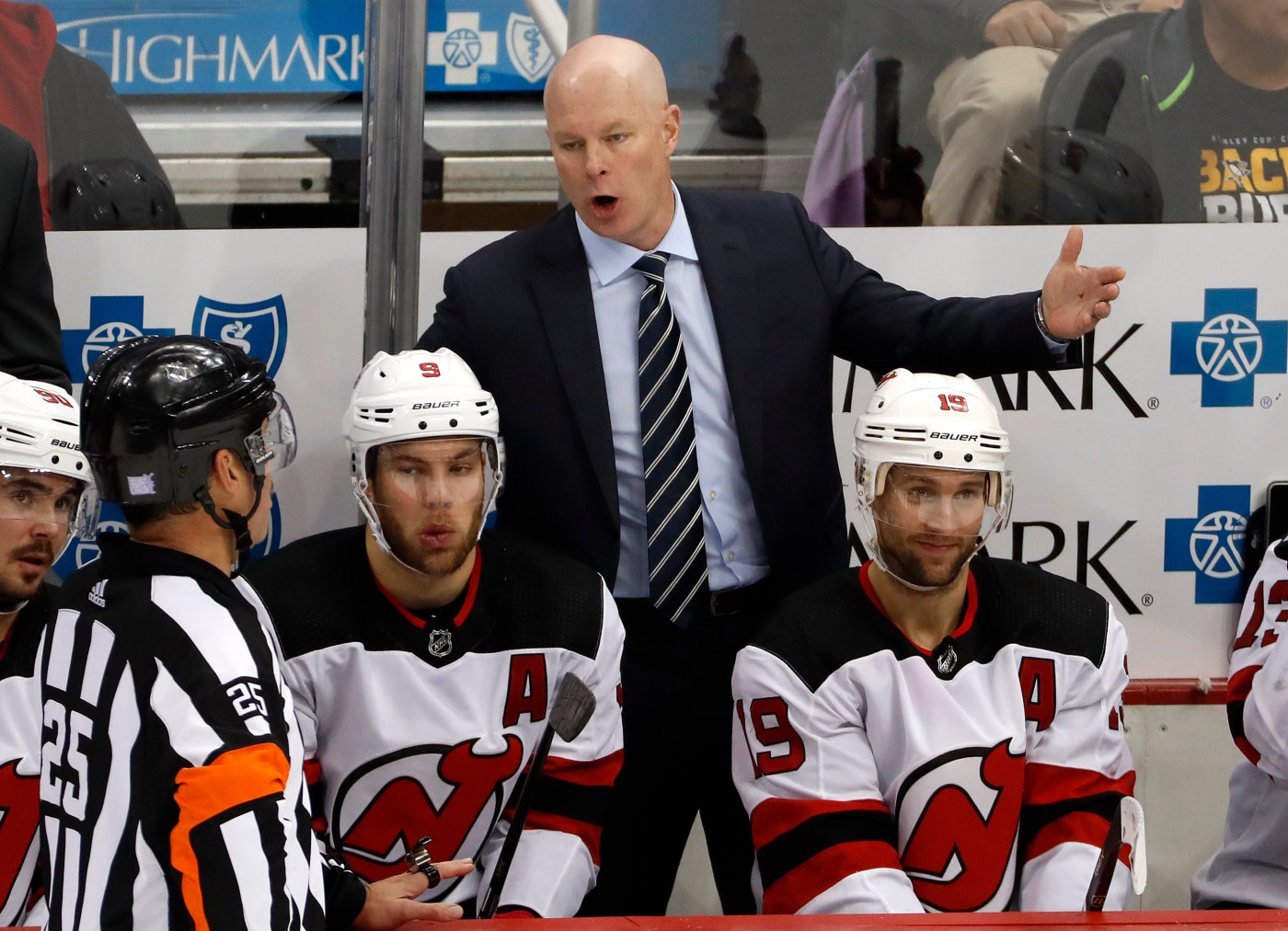
March malaise sets off Wild alarm bells as playoff race tightens

posted in: All news | 0

Less than two weeks ago, the St. Louis Blues came to St. Paul for their final head-to-head meeting with the Minnesota Wild this season. The Wild, at the time, had a comfortable position in the playoff picture, while the Blues — who went through a coaching change in November following a slow start to the season — were on the outside looking in.

Minnesota had won the first three meetings with St. Louis in 2024-25, and a win on March 15 at Xcel Energy Center would effectively have put the Blues in the Wild’s proverbial rearview mirror for the rest of the regular season.

Instead, St. Louis posted a decisive 5-1 victory, and now those objects in the mirror may be closer than they once appeared.

Since returning from the two-week break for the 4 Nations Face-Off in February, Minnesota and St. Louis have each played 17 games. The Wild are 8-8-1 in those contests after losing their last two in a row. The Blues are 13-2-2 in that same stretch, and now are not only solidly in the playoff race, but are pushing to overtake Minnesota for the top Wild Card spot.

With both teams off on Wednesday, St. Louis is just two points behind Minnesota, and for the first time, at least one Wild player is sounding the alarm about the team’s March malaise and what it could mean to their prospects of playing beyond the April 15 regular-season finale.

“Everything can happen in the playoffs, but first we’ve gotta worry about getting (in),” Wild veteran forward Mats Zuccarello said after Tuesday’s 5-1 loss to Vegas.

While others are adopting an optimistic tone about looking forward and embracing the challenge in front of them, Zuccarello spoke of a team not doing enough with what it’s got right now.

“You play a solid game defensively but I think, as of late, not scoring enough, maybe,” he said after Monday night’s loss to the Golden Knights. “I said it before, we’ve gotta make plays. We’ve gotta support each other. We’ve gotta have guys come with speed.

“I don’t know. It’s hard. Today, you can mix and match, back-to-back, but we play against a team that it’s really hard to play against when they play like that, and we don’t play like us.”

The Tuesday loss means Vegas swept the season series with Minnesota, winning twice in St. Paul and once in Nevada. Earlier in the season, Western Conference-leading Winnipeg — which clinched a playoff spot with a home win on Tuesday — swept its season series with the Wild, as well. As the standings look right now, the two Wild Card entrants will have to face either the Golden Knights or the Jets in Round 1.

While goaltending is far and away the most important element in playoff success, the teams that go deep in the postseason generally have three vital pieces: a gritty player who will drop the gloves if needed to defend the skill, a sizable center who will go to the front of the opponent’s net to cause trouble, and a high-skilled star who is a threat to score on every shift.

On Tuesday, the Wild had all three of those players at Xcel Energy Center in the form of Marcus Foligno, Joel Eriksson Ek and Kirill Kaprizov. Notably, all three were wearing suits and ties, watching the game from the press box as the team’s season-long injury saga continued.

Before the Vegas game, when a reporter suggested that the Wild are “reeling” from the number of injuries, Wild coach John Hynes said the word “amassing” is more fitting, and once again offered an optimistic tone about eventually getting healthier at the most vital time of the year.

Kaprizov has played only three games since Christmas yet remains tied for the team lead with 23 goals. Eriksson Ek has played in 42 games, with nine goals and 15 assists, but not since returning from his stint with Team Sweden at the 4 Nations Face-Off in February. Before Monday’s loss, Hynes said he “would anticipate both players will be skating in the very, very near future.”

The Wild have exactly 10 regular-season games remaining, starting Thursday against Alex Ovechkin and the Washington Capitals, the No. 1 team in the Eastern Conference.

“When those guys are ready to come in and help the team, then we’ll expect them to come back at a high level and be ready to compete,” Hynes said.

Exactly when those three key players will return, and what the Western Conference standings will look like if and when they do, is now a growing concern as those objects in the mirror continue to get larger.

Related Articles


No luck when Vegas visits as Wild drop second in a row


Injured Wild forwards could be skating in the “very, very near future”


Winning streak ends with a thud, as Wild are blanked in Dallas


Wild being cautious, gradual with Jonas Brodin’s return


Contenders or pretenders? Wild may find out this week

America’s allies alarmed by a leaked group chat about attack plans

posted in: All news | 0

By JILL LAWLESS, EMMA BURROWS and NICHOLAS RICCARDI, Associated Press

LONDON (AP) — As wake-up calls go, the alarms don’t get much louder.

Allies of the United States see the group chat between top U.S. officials about a planned attack in Yemen that accidentally included a journalist as a jaw-dropping security breach which casts doubt on intelligence-sharing with Washington and the security of joint military operations.

A Yemeni inspects the damage of a destroyed building following U.S. airstrikes in Sanaa, Yemen, Monday, March 24, 2025. (AP Photo)

“Scary” and “reckless” was the verdict of one European diplomat about the discussion on the Signal messaging app about strikes on Houthi rebels. Neil Melvin, a security expert at defense think tank the Royal United Services Institute, called it “pretty shocking.”

“It’s some of the most high-ranking U.S. officials seeming to display a complete disregard for the normal security protocols,” he said.

Beyond the security concerns raised by the leaked chat, U.S. officials addressed the country’s trans-Atlantic allies with disdain as Vice President JD Vance complained about “bailing out” Europe and Defense Secretary Pete Hegseth slammed “pathetic” European “freeloading.”

A Yemeni walks over the debris of a destroyed building following U.S. airstrikes in Sanaa, Yemen, Monday, March 24, 2025. (AP Photo)

The criticism is another blow to a long-standing relationship already strained by President Donald Trump’s blunt “America First” approach and disregard for friendly nations.

Melvin said that for America’s allies, “the alarm clock’s been ringing for a long time.”

In public, however, European officials insisted all was well in the trans-Atlantic relationship.

“We have a very close relationship with the U.S. on matters of security, defense and intelligence,” said British Prime Minister Keir Starmer’s spokesman, Dave Pares. “They are our closest ally when it comes to these matters, have been for many years and will be for many years to come.”

France’s Foreign Ministry said “the United States is our ally, and France intends to continue its cooperation with Washington, as well as with all its allies and European partners, in order to address current challenges — particularly in the area of European security.”

A growing divide

Since taking office, the Trump administration has halted government funding for programs that support democratic principles around the world and presented a less welcoming face to visitors.

U.S. embassies in at least 17 countries have posted warnings for would-be travelers that engaging in behavior deemed harmful by the government could get them deported. Several European countries have issued warnings about visiting the United States after international tourists were caught up in Trump’s border crackdown.

Trump has appalled allies with his repeatedly stated aim of taking over Greenland — an autonomous Danish territory that Vance and second lady Usha Vance are due to visit this week — and his desire to make Canada the 51st state.

FILE – Vice President JD Vance leaves after speaking at the Congressional Cities Conference of the National League of Cities on Monday, March 10, 2025, in Washington. (AP Photo/Mark Schiefelbein, file)

Canadian Prime Minister Mark Carney said his country has to “take greater ownership” of its own defense in the face of threats: “We have to look out for ourselves.”

Nathalie Loiseau, a member of the European parliament, told the BBC that she was “flabbergasted” by the breach.

“If I was (Russian President) Vladimir Putin, I would feel jobless. Russia has nothing more to do. … You don’t even need to spy on the U.S. administration. They leak by themselves,” she said.

U.S. reliability questioned

The European diplomat, who spoke on condition of anonymity to discuss sensitive matters, suggested the security breach could make allies question the reliability of the U.S. as a partner.

The diplomat expressed hope that the Signal lapse was due to a lack of experience in government rather than a deliberate disregard for security.

Asked if he had concerns about sharing intelligence with the U.S. after the Signal incident, Carney said “it’s a serious, serious issue and all lessons must be taken.” He said it would be important to see “how people react to those mistakes and how they tighten them up.”

Sen. Mark Warner, D-Va., vice chair of the Senate Intelligence Committee, left, joined at right by Chairman Tom Cotton, R-Ark., questions Director of National Intelligence Tulsi Gabbard and CIA Director John Ratcliffe about texted war plans for upcoming military strikes in Yemen to a group chat that included the editor-in-chief for The Atlantic, at a hearing on Capitol Hill in Washington, Tuesday, March 25, 2025. (AP Photo/J. Scott Applewhite)

Britain could be particularly exposed by U.S. security breaches. Its intelligence network is entwined with the U.S. in the Five Eyes alliance, and the countries’ militaries work more closely than those of almost any other nations.

Britain’s Royal Air Force provided air-to-air refueling for U.S. planes during the strike on the Houthis, but U.K. Armed Forces Minister Luke Pollard insisted British personnel had not been put at risk by the breach.

“We’ve got high confidence that the measures that we have got with our allies, including the United States, remain intact,” he told lawmakers.

Director of National Intelligence Tulsi Gabbard, center, is flanked by FBI Director Kash Patel, left, and CIA Director John Ratcliffe, as the Senate Intelligence Committee holds its worldwide threats hearing, on Capitol Hill in Washington, Tuesday, March 25, 2025. (AP Photo/J. Scott Applewhite)

Ed Davey, the leader of Britain’s opposition Liberal Democrats, said the lapse showed the Trump administration can’t be trusted to protect its own intelligence and “it could only be a matter of time until our own intelligence shared with them is also leaked.”

“This could put British lives at risk,” he said.

Alex Clarkson, a lecturer in European and international studies at King’s College London, said “the professionals and old hands” who “contained the damage” during Trump’s first term are largely gone.

“So what we’re having now is … a manifestation of tendencies that were held in check that we already saw in the first round,” he said.

American frustration

The U.S. has underpinned European security since World War II, and Trump is not the first president to bristle at the burden.

“From the Obama administration (onward), there’s been quite some frustrations in the U.S. security apparatus about the failure of the Europeans … to step up,” Melvin said.

Britain’s Prime Minister Keir Starmer, right, is greeted by President Donald Trump as he arrives at the White House in Washington, Thursday, Feb. 27, 2025. (AP Photo/Ben Curtis)

Trump has gone much further than his predecessors in upending the decades-old security arrangements. He has long contended the U.S. needs to completely rethink its relationship with the rest of the world, saying other countries have been “taking advantage” of the nation’s military might by not paying enough for their own defense.

Trump has praised autocrats including Putin and sent chills through NATO during last year’s election campaign with his comment that Russia should “do whatever the hell it wants” to members that don’t meet military spending targets.

People participate in a rally in response to U.S. President Donald Trump’s threats to Canadian sovereignty, on Parliament Hill in Ottawa, on Sunday, March 9, 2025. (Justin Tang/The Canadian Press via AP)

“There’s a real sense of divorce, that America is not just disinterested in the trans-Atlantic alliance but views Europe fundamentally as an adversary,” said Max Bergmann, a former State Department official who now works at the Center for Strategic and International Studies.

“It’s very clear at this point, abundantly clear, that it will be next to impossible to count on the United States for the cause of defending democracy in the world,” said Kevin Casas-Zamora, secretary-general of the pro-democracy group International IDEA.

NATO leaders point out that Trump’s criticism and the war in Ukraine have led to a majority of member states meeting the target of spending at least 2% of their gross domestic product on defense.

Related Articles


Canadian Prime Minister Carney says trade war is hurting Americans, noting consumer confidence


Russia and Ukraine accuse each other of breaking ceasefire terms protecting energy sites


NATO leader warns Russia to expect a ‘devastating’ reaction if it ever attacks Poland


Change in itinerary for US Vice President JD Vance brings cautious relief for Greenland and Denmark


Today in History: March 26, report shows Prince had ‘exceedingly high’ levels of fentanyl when he died

Trump’s reelection and rapprochement with Putin has hastened European military plans, with nations scrambling to ramp up weapons production and create their own security structures – including a U.K.- and France-led “coalition of the willing” to help guarantee a future ceasefire in Ukraine.

Clarkson said Europe has more strength than many give it credit for, and severing the trans-Atlantic bond would hurt the U.S., too.

“One shouldn’t underestimate European military industrial capacity,” he said. “There are all kinds of things that can go wrong … but there is an element here also that the Americans are awakening a sleeping giant.”

Riccardi reported from Denver. Associated Press writers Ali Swenson in New York, Chris Megerian in Washington. John Leicester in Paris and Rob Gillies in Toronto contributed.

3D printed and factory-built homes could help tackle housing crisis

posted in: All news | 0

By JESSE BEDAYN, Associated Press/Report for America

DENVER (AP) — As Americans struggle under backbreaking rental prices, builders are turning to innovative ways to churn out more housing, from 3D printing to assembling homes in an indoor factory to using hemp — yes, the marijuana cousin — to make building blocks for walls.

It’s a response to the country’s shortfall of millions of homes that has led to skyrocketing prices, plunging millions into poverty.

“There’s not enough homes to purchase and there’s not enough places to rent. Period,” said Adrianne Todman, the acting secretary of the U.S. Department of Housing and Urban Development under former President Joe Biden.

Modular homes wrapped in plastic await shipping outside of the Fading West factory in Buena Vista, Colo., on Feb. 19, 2025. (AP Photo/Thomas Peipert)

One way to quickly build more is embrace these types of innovations, Todman said. “I can only imagine what our housing situation would be like now if we could have made a decision to be more aggressive in adopting this type of housing” decades ago.

So what are these new ways of building homes? And can they help reduce the cost of new housing, leading to lower rents?

Factory-built housing put together in a week

In a cavernous, metal hall, Eric Schaefer stood in front of a long row of modular homes that moved through the plant, similar to a car on an assembly line.

At a series of stations, workers lay flooring, erected framing, added roofs and screwed on drywall. Everything from electrical wiring to plumbing to kitchen countertops were in place before the homes were shrink-wrapped and ready to be shipped.

A worker inspects the framing of a modular home at the Fading West factory in Buena Vista, Colo., on Feb. 19, 2025. (AP Photo/Thomas Peipert)

The business in the Colorado Rocky Mountains, Fading West, has pumped out more than 500 homes in its just over three years of operation, each taking just five to seven days to build, even in the coldest winter months, Schaefer said.

Once assembled in the plant, the narrow townhouse-style homes with white trim, balconies and front porches, are about 90% done. At their final destination they are move-in ready within six weeks, Schaefer said.

The company works with towns, counties and housing nonprofits to help address the shortage of affordable homes, mostly for workers who’ve been squeezed out by sky-high prices in ritzy mountain towns.

Workers construct modular homes at the Fading West factory in Buena Vista, Colo., on Feb. 19, 2025. ( AP Photo/Thomas Peipert)

That includes Eagle, Colorado, not far from the Vail ski resort, where Fading West worked with Habitat for Humanity to install modular homes at affordable rents for teachers and other school district employees. The homes tend to be on the smaller side, but can be multifamily or single family.

“You can build faster. The faster you build — even at a high quality — means the lower the price,” Schaefer said. “We see this as one of the pieces to the puzzle in helping solve the affordable housing crisis.”

There’s a hefty upfront cost to build the factory, and part of the challenge is a lack of state and federal investment, he said. A patchwork of building codes governing how a structure can be built also makes it difficult, requiring changes to the construction depending on the town or county it is being sent to.

Modular homes built by Fading West are seen in Buena Vista, Colo., on Feb. 19, 2025. (AP Photo/Thomas Peipert)

Manufactured housing is similar to modular housing, but the units are constructed on a chassis — like a trailer — and they aren’t subject to the same local building codes. That’s part of the reason they are used more broadly across the U.S.

Roughly 100,000 manufactured homes were shipped to states in 2024, up from some 60,000 a decade earlier, according to Census Bureau data. Estimates of modular homes built annually often put them below 20,000.

3D printing is innovative but still ‘a long game’

Yes, there’s technology to 3D print homes.

A computer-controlled robotic arm equipped with a hose and nozzle moves back and forth, oozing lines of concrete, one on top of the other, as it builds up the wall of a home. It can go relatively quickly and form curved walls unlike concrete blocks.

Modular homes built by Fading West are seen in Buena Vista, Colo., on Feb. 19, 2025. (AP Photo/Thomas Peipert)

Grant Hamel, CEO and co-founder of VeroTouch, stood inside one of the homes his company built, the wall behind him made out of rolling layers of concrete, distinct to a 3D printer. The technology could eventually reduce labor costs and the time it takes to build an abode, but is farther off than manufactured or modular methods from making a dent in the housing crisis.

It’s “a long game, to start chipping away at those prices at every step of the construction process,” Hamel said.

A worker constructs the window of a modular home at the Fading West factory in Buena Vista, Colo., on Feb. 19, 2025. (AP Photo/Thomas Peipert)

The 3D printers are expensive, and so are the engineers and other skilled employees needed to run them, said Ali Memari, director of the Pennsylvania Housing Research Center, whose work has partly focused on 3D printing. It’s also not recognized by international building codes, which puts up more red tape.

The technology is also generally restricted to single-story structures, unless traditional building methods are used as well, Memari said

It’s “a technology at its beginning, it has room to grow, especially when it is recognized in code,” Memari said. “The challenges that I mentioned exist, and they have to be addressed by the research community.”

Workers construct the flooring of a modular home at the Fading West factory in Buena Vista, Colo., on Feb. 19, 2025. (AP Photo/Thomas Peipert)

A hemp-and-lime mixture called hempcrete has ‘a bright future’

Hemp — the plant related to marijuana — is being used more and more in the construction of walls.

The hemp is mixed with other materials, most importantly the mineral lime, forming “hempcrete,” a natural insulation that’s mold- and fire-resistant and can act as outer wall, insulation and inner wall.

A worker stands inside a framed modular home at the Fading West factory in Buena Vista, Colo., on Feb. 19, 2025. (AP Photo/Thomas Peipert)

Hempcrete still requires wood studs to frame the walls, but it replaces three wall-building components with just one, said Memari, also a professor at Penn State University’s Department of Civil and Environmental Engineering. Memari is now helping oversee research into making hempcrete that doesn’t need the wood studs.

As much as a million hemp plants to be used for hempcrete can grow on one acre in a matter of months as opposed to trees, which can take years or decades to grow.

A worker constructs part of a modular home at the Fading West factory in Buena Vista, Colo., on Feb. 19, 2025. (AP Photo/Thomas Peipert)

The plant is part of the cannabis family but has far less of the psychoactive component, THC, found in marijuana. In 2018, Congress legalized the production of certain types of hemp. Last year, the International Code Council, which develops international building codes used by all 50 states, adopted hempcrete as an insulation.

Related Articles


Developer plans six-story, mixed-use project at Grand Avenue and Victoria Street in St. Paul


US home sales rose in February as mortgage rates eased and more homes put up for sale


Three St. Paul City Council members move to end rent control for new construction


California mini-storage company expands into St. Paul’s Lowertown


St. Paul: Balsam on Broadway opens in Lowertown, one of several housing developments for downtown

Confusion over the legality of growing hemp and the price tag of the machine required to process the plant, called a decorticator, are barriers to hempcrete becoming more widespread in housing construction, Memari said.

Still, he said, “hempcrete has a bright future.”

Associated Press video journalist Thomas Peipert contributed to this report from Buena Vista, Colorado.

Bedayn is a corps member for the Associated Press/Report for America Statehouse News Initiative. Report for America is a nonprofit national service program that places journalists in local newsrooms to report on undercovered issues.

Get ready for a partial solar eclipse across Europe and parts of North America and Africa

posted in: All news | 0

By ADITHI RAMAKRISHNAN, Associated Press

NEW YORK (AP) — The moon will appear to take bites out of the sun this weekend during a partial solar eclipse in the Northern Hemisphere — but make sure to protect your eyes.

The eclipse will be visible Saturday across Europe, western Africa, eastern North America and northern Asia. The sun will shrink the most for the northeastern United States, Greenland and eastern Canada.

During a partial solar eclipse, the moon passes between the sun and Earth. The moon casts a shadow on Earth and only partly blocks the sun, making it appear like a crescent. Unlike a total solar eclipse, there’s no totality so experts say proper eye protection must be worn the whole time.

“Eclipses are just a game of light and shadow that are played by the sun, moon and Earth,” said Auriane Egal with the Planetarium in Montréal.

Solar and lunar eclipses happen anywhere from four to seven times a year, according to NASA. Due to the moon’s tilted orbit around Earth, they tend to come in pairs: a total lunar eclipse turned the moon red mid-March.

To see the eclipse, look on astronomy websites to see when it begins in your area. The spectacle is slotted during sunrise for most of the Americas, late morning for western Europe and Africa and afternoon for eastern Europe and northern Asia.

During the eclipse, the sun will slowly slim to a crescent as the moon appears to cover it and the day may get dimmer.

“It will feel like a particularly cloudy day,” said Juan Carlos Muñoz-Mateos with the European Southern Observatory.

Check weather conditions before heading outside. Clear skies away from tall buildings and city lights are best, especially in the Americas where the sun may be rising during the eclipse.

Grab eclipse glasses ahead of time to spot the sight safely through a local science museum or ordering online from a seller cleared on the American Astronomical Society’s website.

Viewers can also enjoy the spectacle through indirect ways such as making a pinhole projector using household materials. Holding up a colander will produce a similar effect. Peering at the ground under a shady tree can yield crescent shadows as the sunlight filters through branches and leaves.

Another total lunar eclipse and partial solar eclipse will return in September with the best solar eclipse views in Antarctica and New Zealand.

The Associated Press Health and Science Department receives support from the Howard Hughes Medical Institute’s Science and Educational Media Group and the Robert Wood Johnson Foundation. The AP is solely responsible for all content.