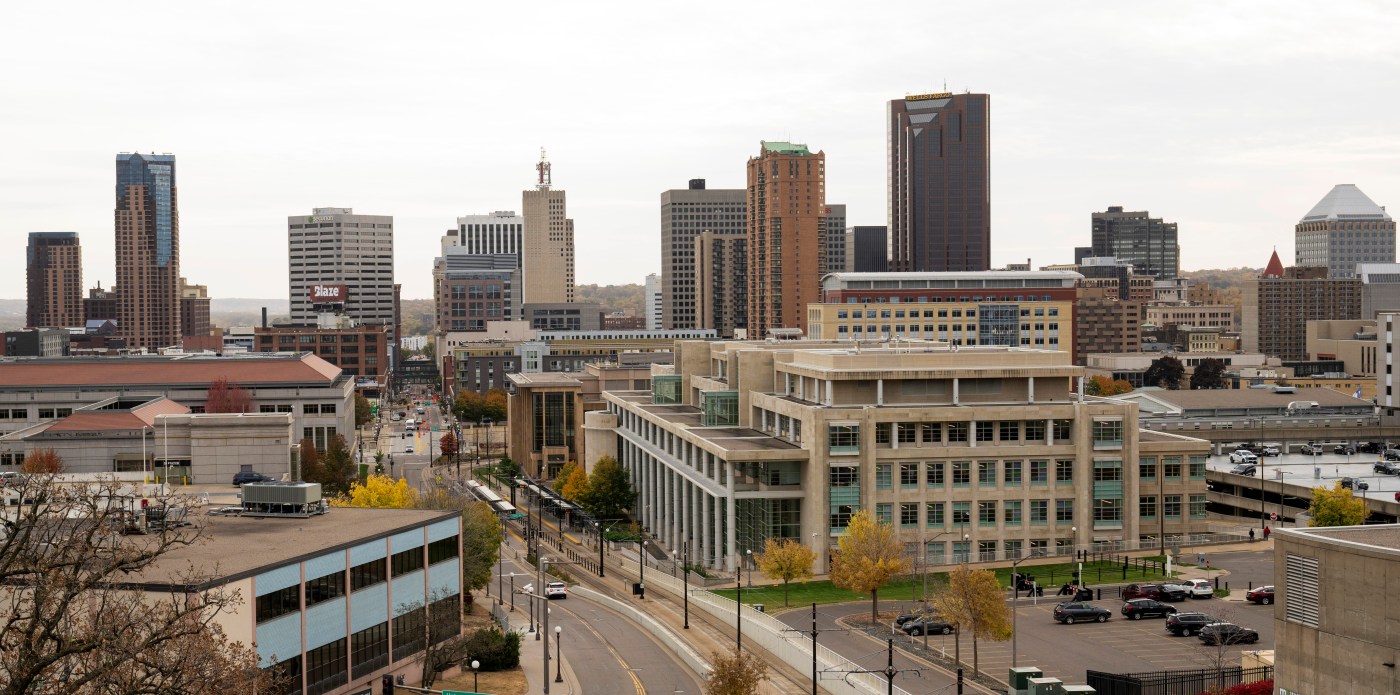
Minnesota Gov. Tim Walz says he will require state employees to report to the office for at least half of their scheduled workdays starting June 1. What does this mean for downtown St. Paul?
“I think this is going to be a tremendously positive thing for downtown,” said Joe Spencer, president of the St. Paul Downtown Alliance. “The state of Minnesota is our largest employer and, as our largest employer, having those workers return is going to have a tremendous impact.”
Around 60% of state employees currently work in-person and did so through the pandemic, according to the Walz administration. About 50,000 people work for Minnesota’s state government, according to the state Department of Management and Budget.
So, how many more people will be headed back to the office? “We think it could be upwards of 20,000 workers,” Spencer estimates.
Downtown hope
“It was a pleasant and needed surprise,” John Perlich, vice president of Government Affairs for the St. Paul Area Chamber, said of Walz’s Tuesday announcement.
“St. Paul has had some distressing news over the last couple of weeks,” Perlich said, referring to the closure of the downtown Lunds and Byerlys and borderline eviction notice given to tenants of the Alliance Bank Center.
“From where we sit, this is a shot in the arm that St. Paul needs,” Perlich said of the return-to-office order. “Is it going to be transformational? I don’t know.”
Having workers return to the office won’t be a “silver bullet,” Spencer said. “But folks don’t realize we’ve had a number of new restaurants open up and old favorites are still in place.”
An influx of people coming into the city is going to add to its viability, Spencer said. For example, shops that are closed on certain weekdays could have a chance to expand their hours and services with more foot traffic.
For some, however, the news is too late.
Cassie’s Deli and Catering, located in the Town Square skyway at 444 Cedar St., will serve its final sandwiches on Friday after opening in 1997, owner Steve Olson said.
“My lease is due and I’ve been losing money for years,” he said.
When asked about the back-to-the-office announcement, Olson said, “It could have helped … but it’s too little and too late.”
Union pushback
Megan Dayton, president of the Minnesota Association of Professional Employees, speaks during a news conference on the steps of the Minnesota Capitol in St. Paul on Thursday, March 27, 2025. Members of the House Democratic Farmer Labor Caucus joined her in pushing back against DFL Gov. Tim Walz’s order for state employees to report back to office on 50% of work days. (Alex Derosier / Pioneer Press)
A pair of state public employee unions that represent a combined 36,000 state workers — the Minnesota Association of Professional Employees and the American Federation of State, County and Municipal Employees — protested the change.
“Unilateral decisions made behind closed doors without the input of the workers that it impacts is irresponsible, it’s disrespectful and it can’t continue,” said AFSCME Council 5 Executive Director Bart Andersen at a rally with labor representatives and state lawmakers on Thursday.
Minnesota loses a net 700 jobs in February, unemployment steady at 3%
Homebuying tips this season for markets hot and cold
US economic growth to slow in the next 30 years, fueled by debt and declining birth rates, CBO says
Got your first job? Here are some tax tips for first-time filers
Trump’s latest auto tariffs explained: What car buyers should know this year
In a news release, MAPE President Megan Dayton said she was “appalled and disgusted” by the governor clawing back telework agreements “under the guise of ‘organic collaboration’ and ‘stewardship of office space.’ ”
Dayton claims the union had little warning about Walz’s decision and no input.
MAPE represents more than 18,500 executive branch employees and is the largest bargaining unit in state government. Many members are office employees who don’t typically have to report to work in person to complete their tasks.
Calling workers back to the office will disrupt lives, union leaders said. Employees who can stay at home with kids will have to find day care or figure out how to balance in-office work with taking kids to and from school.
“We adapted to working remotely with very little prior planning, and we proved that it can work, and we’ve been doing it for five years,” Dayton told reporters on Thursday. “To unleash this kind of chaos on our members at this point is irresponsible and reckless.
MAPE is set to start bargaining its contract with the state on April 15. Union leaders have signaled all options remain on the table, including a lawsuit or a strike. There are already concerns that state employees might leave over changes to the remote work policy.
“Workers are threatening to quit over this,” said State Rep. Luke Frederick, DFL-Mankato. “In conversations with the agencies, there’s questions about how even to implement this, about whether or not there’s even office space.”
Where will they go?
Is there enough office space? That’s hard to answer at this point as state workers report to 15 different buildings in the Capitol area alone, according to the Capitol Area Architectural and Planning Board.
“This creates a leasing problem for the state because they have to make 10-year commitments,” said Mike Marinovich, senior vice president at commercial real estate firm CBRE. “How do you do that while experimenting with your staff life?”
Marinovich, who represents properties like the Great Northern Building at 180 E. Fifth St., where the Department of Employment and Economic Development is a tenant, called Walz’s announcement “a huge improvement.”
Of the roughly 14 million square feet of office space in the St. Paul central business district, government properties account for 34%, according to findings from the Greater St. Paul Building Owners and Managers Association’s annual St. Paul office space market report.
The central business district described in the report goes beyond downtown proper, ranging in boundary from the Minnesota Transportation Museum on Pennsylvania Avenue down to the Wabasha Street Caves, and from the edges of Cathedral Hill to east of the St. Paul Farmers’ Market.
St. Paul downtown: Lunds, Alliance Bank retailers close up shop
St. Paul-to-Chicago Amtrak Borealis sidelined by corrosion
New Broadway at the Ordway season includes ‘Sister Act,’ ‘The Notebook’ and ‘SIX’
Downtown St. Paul: Nonprofit law firm given just days to move up to 50 offices
St. Paul mayor, Wild owner pitch Xcel Energy Center to senate panel
The report also found that 40% of downtown’s competitive office market has been listed for sale, and nearly a third of the competitive, non-owner-occupied office space in and around downtown is empty.
“BOMA members are grateful for this decision and the governor’s leadership by example because the return of state employees to downtown St. Paul will have a significant positive impact on the city’s economy, safety and overall vibrancy,” said Tina Gassman, president of BOMA, in an email.
“More people downtown can lead to a revitalization of commercial real estate, helping to fill vacant office spaces and spurring interest in urban living. This not only helps our commercial real estate industry but could lead to further development of housing, parks, and amenities, making St. Paul a more attractive place to live and work.”