Trump’s reciprocal tariffs will overturn decades of trade policy

posted in: All news | 0

WASHINGTON — President Donald Trump is taking a blowtorch to the rules that have governed world trade for decades. The “reciprocal’’ tariffs that he is expected to announce Wednesday are likely to create chaos for global businesses and conflict with America’s allies and adversaries alike.

Since the 1960s, tariffs — or import taxes — have emerged from negotiations between dozens of countries. Trump wants to seize the process.

“Obviously, it disrupts the way that things have been done for a very long time,’’ said Richard Mojica, a trade attorney at Miller & Chevalier. “Trump is throwing that out the window … Clearly this is ripping up trade. There are going to have to be adjustments all over the place.’’

Related Articles


Trump pardons Navy veteran convicted in Capitol riot


Trump tariff tumult has ripples for sporting goods, puts costly hockey gear in price-hike crosshair


Trump is stronger on immigration and weaker on trade, new poll finds


A DOGE employee is put in charge of the US Institute of Peace, a court filing alleges


Trump’s promised ‘Liberation Day’ of tariffs is coming. Here’s what it could mean for you

Pointing to America’s massive and persistent trade deficits – not since 1975 has the U.S. sold the rest of the world more than it’s bought — Trump charges that the playing field is tilted against U.S. companies. A big reason for that, he and his advisers say, is because other countries usually tax American exports at a higher rate than America taxes theirs.

Trump has a fix: He’s raising U.S. tariffs to match what other countries charge.

The president is an unabashed tariff supporter. He used them liberally in his first term and is deploying them even more aggressively in his second. Since returning to the White House, he has slapped 20% tariffs on China, unveiled a 25% tax on imported cars and trucks set to take effect Thursday, effectively raised U.S. taxes on foreign steel and aluminum and imposed levies on some goods from Canada and Mexico, which he may expand this week.

Economists don’t share Trump’s enthusiasm for tariffs. They’re a tax on importers that usually get passed on to consumers. But it’s possible that Trump’s reciprocal tariff threat could bring other countries to the table and get them to lower their own import taxes.

“It could be win-win,” said Christine McDaniel, a former U.S. trade official now at George Mason University’s Mercatus Center. “It’s in other countries’ interests to reduce those tariffs.”

She noted that India has already cut tariffs on items from motorcycles to luxury cars and agreed to ramp up purchases of U.S. energy.

What are reciprocal tariffs and how do they work?

They sound simple: The United States would raise its tariff on foreign goods to match what other countries impose on U.S. products.

“If they charge us, we charge them,’’ the president said in February. “If they’re at 25, we’re at 25. If they’re at 10, we’re at 10. And if they’re much higher than 25, that’s what we are too.’’

But the White House didn’t reveal many details. It has directed Commerce Secretary Howard Lutnick to deliver a report this week about how the new tariffs would actually work.

Among the outstanding questions, noted Antonio Rivera, a partner at ArentFox Schiff and a former attorney with U.S. Customs and Border Protection, is whether the U.S. is going to look at the thousands of items in the tariff code – from motorcycles to mangos — and try to level the tariff rates out one by one, country by country. Or whether it will look more broadly at each country’s average tariff and how it compares to America. Or something else entirely.

“It’s just a very, very chaotic environment,” said Stephen Lamar, president and CEO of the American Apparel & Footwear Association. “It’s hard to plan in any sort of long-term, sustainable way.’’

How did tariffs get so lopsided?

America’s tariffs are generally lower than those of its trading partners. After World War II, the United States pushed for other countries to lower trade barriers and tariffs, seeing free trade as a way to promote peace, prosperity and American exports around the world. And it mostly practiced what it preached, generally keeping its own tariffs low and giving American consumers access to inexpensive foreign goods.

Trump has broken with the old free trade consensus, saying unfair foreign competition has hurt American manufacturers and devastated factory towns in the American heartland. During his first term, he slapped tariffs on foreign steel, aluminum, washing machines, solar panels and almost everything from China. Democratic President Joe Biden largely continued Trump’s protectionist policies.

The White House has cited several examples of especially lopsided tariffs: Brazil taxes ethanol imports, including America’s, at 18%, but the U.S. tariff on ethanol is just 2.5%. Likewise, India taxes foreign motorcycles at 100%, America just 2.4%.

Does this mean the U.S. been taken advantage of?

The higher foreign tariffs that Trump complains about weren’t sneakily adopted by foreign countries. The United States agreed to them after years of complex negotiations known as the Uruguay Round, which ended in a trade pact involving 123 countries.

As part of the deal, the countries could set their own tariffs on different products – but under the “most favored nation’’ approach, they couldn’t charge one country more than they charged another. So the high tariffs Trump complains about aren’t aimed at the United States alone. They hit everybody.

Trump’s grievances against U.S. trading partners also come at an odd time. The United States, running on strong consumer spending and healthy improvements in productivity, is outperforming the world’s other advanced economies. The U.S. economy grew nearly 9% from just before COVID-19 hit through the middle of last year — compared with just 5.5% for Canada and just 1.9% for the European Union. Germany’s economy shrank 2% during that time.

Trump’s plan goes beyond foreign countries’ tariffs

Not satisfied with scrambling the tariff code, Trump is also going after other foreign practices he sees as unfair barriers to American exports. These include subsidies that give homegrown producers an advantage over U.S. exports; ostensible health rules that are used to keep out foreign products; and loose regulations that encourage the theft of trade secrets and other intellectual property.

Figuring out an import tax that offsets the damage from those practices will add another level of complexity to Trump’s reciprocal tariff scheme.

The Trump team is also picking a fight with the European Union and other trading partners over so-called value-added taxes. Known as VATs, these levies are essentially a sales tax on products that are consumed within a country’s borders. Trump and his advisers consider VATs a tariff because they apply to U.S. exports.

Yet most economists disagree, for a simple reason: VATs are applied to domestic and imported products alike, so they don’t specifically target foreign goods and haven’t traditionally been seen as a trade barrier.

And there’s a bigger problem: VATs are huge revenue raisers for European governments. “There is no way most countries can negotiate over their VAT … as it is a critical part of their revenue base,’’ Brad Setser, senior fellow at the Council on Foreign Relations, posted on X.

Paul Ashworth, chief North America economist for Capital Economics, says that the top 15 countries that export to the U.S. have average VATs topping 14%, as well as duties of 6%. That would mean U.S. retaliatory tariffs could reach 20% — much higher than Trump’s campaign proposal of universal 10% duties.

Tariffs and the trade deficit

Trump and some of his advisers argue that steeper tariffs would help reverse the United States’ long-standing trade deficits.

But tariffs haven’t proven successful at narrowing the trade gap: Despite the Trump-Biden import taxes, the deficit rose last year to $918 billion, second-highest on record.

The deficit, economists say, is a result of the unique features of the U.S. economy. Because the federal government runs a huge deficit, and American consumers like to spend so much, U.S. consumption and investment far outpaces savings. As a result, a chunk of that demand goes to overseas goods and services.

The U.S. covers the cost of the trade gap by essentially borrowing from overseas, in part by selling treasury securities and other assets.

“The trade deficit is really a macroeconomic imbalance,” said Kimberly Clausing, a UCLA economist and former Treasury official. “It comes from this lack of desire to save and this lack of desire to tax. Until you fix those things, we’ll run a trade imbalance.”

AP Retail Writer Anne D’Innocenzio in New York contributed to this story.
Recipes: Eggs too expensive? Here’s how to bake without them

posted in: All news | 0

Growing up on a walnut orchard in the San Fernando Valley had its advantages. We kept a flock of chickens, as well as a few geese and ducks. I was taught that their eggs were a culinary treasure, valued for flavor and nutritional value. My late mother, a disciple of the egg-loving nutritional guru of the day, Adele Davis, would not have approved of what I’ve been up to. I’ve been experimenting with an egg substitute.

Mom couldn’t have imagined the record high cost of eggs. According to the USDA, egg prices are projected to increase by 41.1% in 2025, largely due to the ongoing avian flu outbreak impacting egg-laying chicken populations.

Testing out Bob’s Red Mill Egg Replacer has been the focus of my trials. There are other approaches to egg substitutes, but this approach uses a product that is widely available and very easy to use. A 12-ounce package provides the equivalent of 32 eggs; the price at a local Sprouts was $4.99. The product is made with potato starch, tapioca flour, baking soda, and psyllium husk. To use it, it is combined in a 1:2 ratio with water. Easy.

I started my experiment with muffins and cupcakes, then ventured into pancakes. I’m happy to report that for the most part, I was successful. I chose baked goods with flavorful add-ins, muffins spiked with fresh ginger and dried apricots, and cupcakes filled with jam.

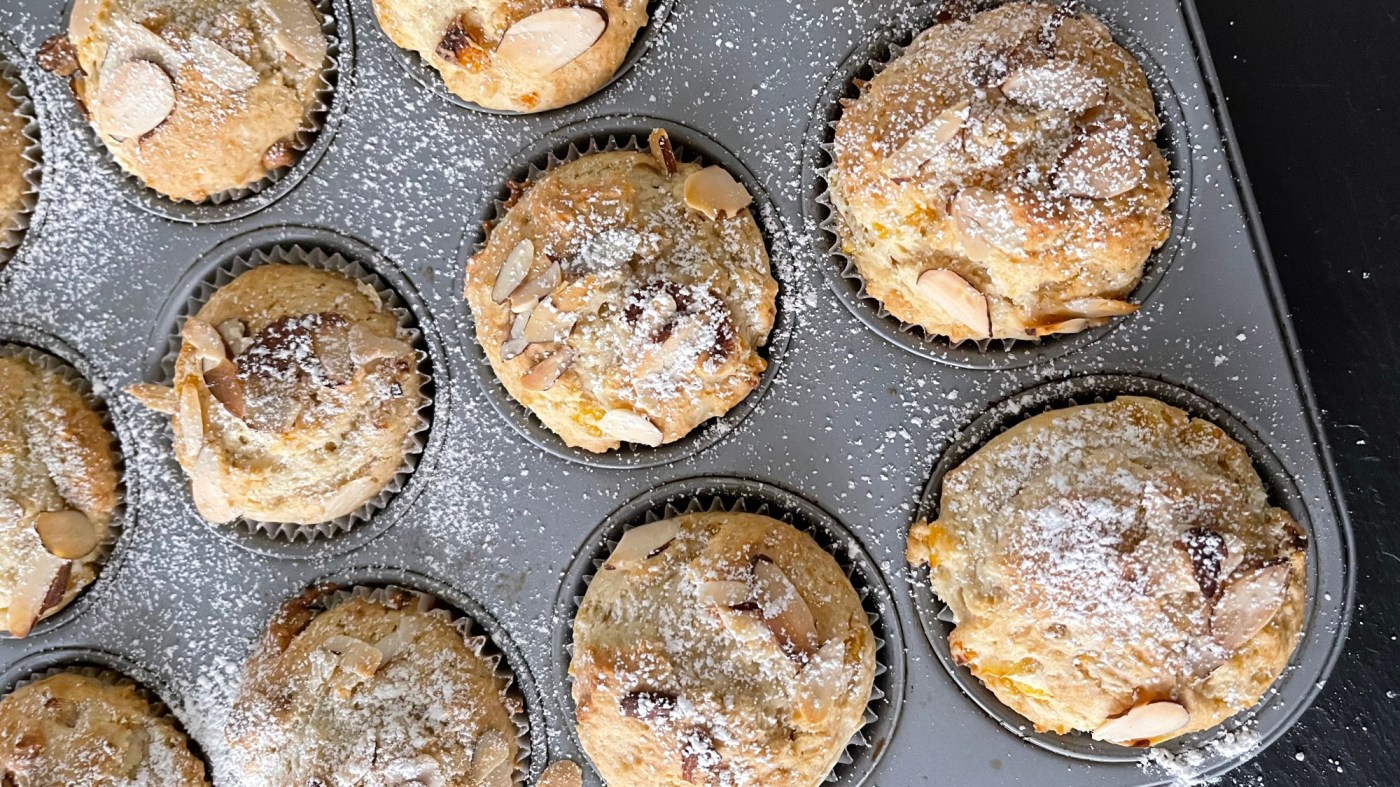
This recipe for Ginger Apricot Muffins is from the cookbook “Sweet Tooth” by Sarah Fennel, but modified to replace the two eggs called for with an egg substitute. (Photo by Cathy Thomas)

Ginger Apricot Muffins

Fresh ginger and chopped dried apricots, plus a scattering of thinly sliced almonds add pizzazz to these muffins. I substituted the egg replacer for the 2 eggs called for in the recipe from “Sweet Tooth” by Sarah Fennel (Clarkson Potter). The recipe mixed the batter by hand, but I used a stand mixer because I wanted to make sure the egg replacer was equally distributed and any lumps in that mixture were broken down.

Yield: 12 muffins

INGREDIENTS

2 tablespoons Bob’s Red Mill Egg Replacer

4 tablespoons water

Paper cupcake liners

Nonstick cooking spray

1/2 cup (1 stick) unsalted butter, melted

1/2 cup granulated sugar

1/2 cup packed light brown sugar

1 tablespoon peeled and grated fresh ginger (or 2 teaspoons ground ginger)

1 teaspoon vanilla extract

6 tablespoons full fat sour cream

6 tablespoons buttermilk (shake before measuring)

1 cup chopped dried apricots

2 cups all-purpose flour

1 tablespoon baking powder

1/2 teaspoon salt

1 cup sliced almonds

Optional: powdered sugar

DIRECTIONS

1. In a small bowl, combine egg replacer and water; stir to combine and set aside.

2. Preheat oven to 425 degrees. Line a standard muffin tin with paper muffin liners, then spray the muffin liners and top of the tin with nonstick cooking spray.

3. In a large bowl of electric stand mixer, combine melted butter, granulated sugar, and brown sugar. Mix on low speed until combined. Stir egg replacement. Add egg replacement mixture, ginger, vanilla extract, sour cream and buttermilk. Mix at a medium speed until combined. Add apricot and mix on low speed until just combined.

4. Add flour, baking powder, and salt. Mix until combined on low speed, scraping sides and bottom of the bowl with a silicone spatula as needed. Do not overmix.

5. Scoop batter into prepared muffin cups. It’s easiest to do this with an ice cream scoop that is a little less than 1/4 cup, filling the cups about 3/4 full. Top with almonds.

6. Bake for 5 minutes at 425 degrees, then reduce heat to 375 degrees. Continue baking until tops of the muffins are golden brown and spring back to the touch, about 18 to 20 minutes more. Place the muffin tin on a cooling rack and allow the muffins to cool slightly in the pan before dusting the tops with powdered sugar. Easiest way to dust with powdered sugar is to place powdered sugar in a handled small sieve and shake over the muffins.

Source: Adapted from ”Sweet Tooth” by Sarah Fennel (Clarkson Potter)

The recipe for Bob’s Buttermilk No Egg Pancakes comes from Bob’s Red Mill Natural Foods, which manufactures an egg substitute. (Photo by Cathy Thomas)

Bob’s Buttermilk No Egg Pancakes

I started my recipe experiment with my mother’s recipe for cottage cheese spiked pancakes. After disappointing results, I turned to the maker of the egg replacer, Bob’s Red Mill Natural Foods. Their eggless buttermilk pancakes were scrumptious.

Yield: 7 to 8 pancakes

INGREDIENTS

1 tablespoon Bob’s Red Mill Egg Replacer

2 tablespoons water

1 1/4 cups all-purpose flour

1 tablespoon granulated sugar

1 1/4 teaspoons baking powder

1/4 teaspoon salt

1 to 1 1/2 cups buttermilk (shaken before measuring), divided use

2 tablespoons melted butter

DIRECTIONS

1. In a medium-large bowl, combine egg replacer and water; mix to combine and set aside.

2. In a medium bowl stir to combine flour, sugar, baking powder, and salt; set aside.

3. Add 1 cup buttermilk and melted butter to egg replacement mixture; mix well (I use a silicone spatula and ensure that the sides and bottom of the bowl are scaped so that everything comes together). Adjust to desired consistency with the additional 1/2 cup of buttermilk, stirring to combine.

4. Heat griddle or nonstick skillet on medium. (The recipe doesn’t designate oiling the pan or griddle, but I brush a smidgen of vegetable oil on the griddle or skillet.) Using about 1/4 cup of batter per pancake, portion batter onto preheated griddle or skillet. (I use a 1/4 cup ice cream scoop and after the batter is dropped, I use the back of the scoop to spread out the batter a little to make pancakes with a diameter of 4 inches.) Cook until bubbles form on the surface and the edges begin to set, about 3 to 4 minutes. Flip and continue to cook on the second side about 2 to 3 minutes more. Serve warm or hold in a 200-degree oven for up to 15 minutes.

Source: Bob’s Red Mill Natural Foods

These Jelly Donut Cupcakes were made with Duncan Hines Butter Golden cake mix but without eggs. (Photo by Cathy Thomas)

Jelly Donut Cupcakes

I love the idea of piping jelly into the center of a cupcake, then frosting it with buttercream frosting. The first batch of Jelly Donut Cupcakes made with the egg replacer were slightly concave and a crunchy crust formed on the tops. So, never say die, I remembered a baking lecture I heard many years ago in which the food chemist said that packaged cake mixes were foolproof; she said that even haphazard mistakes didn’t keep the mixes from turning out a successful cake. So I bought a box of Duncan Hines Butter Golden cake mix and gave it a whirl. Bingo.

Yield: About 14 to 18

Cook’s notes: If the cake mix calls for 1 egg, substitute 1 tablespoon Bob’s Red Mill Egg Replacer mixed with 2 tablespoons water. If cake the mix calls for 2 eggs, substitute 2 tablespoons Bob’s Red Mill Egg Replacer mixed with 4 tablespoons water.

INGREDIENTS

Cupcakes:

For cake mix that calls for 3 eggs, combine 3 tablespoons egg replacer with 6 tablespoons water, see cook’s notes

1 (15.25-ounce) yellow cake mix, such as Duncan Hines Butter Golden

Ingredients listed on cake mix box, eggs omitted

1/2 cup seedless raspberry jam, or seedless strawberry jam, or mixed berry jam

Piping bag fitted with 3/8-inch plain tip

A frosted cupcake is opened to reveal the jelly filling inside. (Photo by Cathy Thomas)

Frosting:

1 1/2 sticks (12 tablespoons) unsalted butter, room temperature

3 cups powdered sugar

Pinch of salt

2 teaspoons vanilla extract

2 tablespoons milk

DIRECTIONS

1. Make the cupcakes: Adjust oven rack to middle position. Line 1 1/2 standard muffin pans with liners. Prepare cake mix according to package directions, omitting eggs and substituting Bob’s Red Mill Egg Replacer.

2. Scoop batter into prepared cups. It’s easiest to do this with an ice cream scoop that is a little less than 1/4 cup, filling the cups about 3/4 full. Bake according to cake mix directions (I found because they were larger, they needed an extra 5 to 7 minutes of baking). Cool for 5 minutes in muffin pan, then transfer to cooling rack. Cool completely.

3. With a paring knife, cut a 1-inch wide slit in the top of each cupcake, slicing about halfway down. Place jam in the piping bag. Insert the piping bag into slit and pipe in the jam.

4. Prepare frosting: Beat the butter, powdered sugar, and salt in a large bowl of an electric stand mixer; beat on medium speed until just combined. Add vanilla and beat on medium-high speed until creamy, about 3 minutes. Beat in milk until fluffy, about 1 minute scraping down sides of bowl as needed. Drop a generous tablespoon of frosting in center of each cupcake and spread it to cover the top.

Source: Adapted from “Baking For Fun” from the Food Network magazine

Award-winning food writer Cathy Thomas has written three cookbooks, including “50 Best Plants on the Planet.” Follow her at CathyThomasCooks.com.

Related Articles


Recipe: When life gives you strawberries, makes preserves with balsamic vinegar


The cookbook ‘Pakistan’ serves up recipes for mutton pulao, garlic chutney and sweet seviyan


7 ways to make your roasted broccoli better


As Ramadan ends, a new cookbook sheds light on Pakistan’s varied cuisine


Blend your way to better chicken vindaloo

FCS football: St. Thomas to play national champion North Dakota State

posted in: All news | 0

St. Thomas will end its 2025 football regular season at reigning FCS national champion North Dakota State on Nov. 22, the Tommies announced Monday when it released the team’s full schedule.

The Tommies also will play at Idaho, which finished ranked No. 8 in the final FCS AFCA coaches ranking, on Sept. 6. All of the Tommies home games will kick off at 1 p.m. and the homecoming game will be Oct. 4 against Butler.

Season tickets are now on sale at www.tommiesports.com/tickets with bench seating starting at $75.

2025 St. Thomas Football

Aug. 28 — Lindenwood, 7 p.m.
Sept. 6 — at Idaho, TBA
Sept. 13 — at Northern Michigan, TBA
Sept. 27 — at San Diego, TBA
Oct. 4 — Butler, 1 p.m. (HC)
Oct. 11 — at Davidson*, TBA
Oct. 18 — Valparaiso, 1 p.m.
Oct. 25 — at Stetson, TBA
Nov. 1 — Marist, 1 p.m.
Nov. 8 — at Drake, TBA
Nov. 15 — Presbyterian, 1 p.m.
Nov. 22 — North Dakota State

Related Articles


WBIT semifinals: Gophers vs. Florida


Two Gophers recruits back out of men’s basketball program


Gophers hockey: Was refs’ decision to sit Liam Souliere the right one?


Niko Medved’s path to Gophers included steering him off hockey rinks


Men’s hockey: UMass rallies to knock Gophers out of NCAA tournament in OT

Boys with cancer can face infertility as adults. Can storing their stem cells help?

posted in: All news | 0

WASHINGTON — A man who battled childhood cancer has received the first known transplant of sperm-producing stem cells, in a study aimed at restoring the fertility of cancer’s youngest survivors.

Related Articles


Party with gas, play with fire: The dangerous renaissance of ‘whippets’ in the music scene


States try to rein in health insurers’ claim denials, with mixed results


The Colorado psychedelic mushroom experiment has arrived


The fate of addiction treatment hangs in the balance with Kennedy’s HHS overhaul


Nurse can’t shake COVID-19’s unrelenting grip: ‘I have lost relationships’

Jaiwen Hsu was 11 when a leg injury turned out to be bone cancer. Doctors thought grueling chemotherapy could save him but likely leave him infertile. His parents learned researchers at the University of Pittsburgh Medical Center were freezing testicular cells of young boys with cancer in hopes of preserving their future fertility — and signed him up.

Hsu, now 26, is the first to return as an adult and test if reimplanting those cells might work.

“The science behind it is so incredibly new that right now it’s kind of a waiting game,” said Hsu, of Vienna, Virginia. “It’s kind of eagerly crossing our fingers and hoping for the best.”

It may seem unusual to discuss future fertility when a family is reeling from the diagnosis of a child’s cancer. But 85% of children with cancer now survive to adulthood and about 1 in 3 are left infertile from chemotherapy or radiation.

Young adults with cancer can bank sperm, eggs or sometimes embryos ahead of treatment. But children diagnosed before puberty don’t have that option because they’re not yet producing mature sperm or eggs.

Boys are born with stem cells inside spaghetti-like tubes in the testes, cells that start producing sperm after puberty sparks a rise in testosterone. With funding from the National Institutes of Health, Pitt reproductive scientist Kyle Orwig studies how to preserve and potentially use testicular cells to restore fertility.

It starts with a biopsy-like removal of a small amount of testicular tissue that contains millions of cells – some of them precious sperm-producing stem cells. Since 2011, Orwig’s team has frozen samples from about 1,000 prepubertal boys.

It’s impossible to tell if enough stem cells are in each tiny sample to matter. But in 2019, Orwig used preserved testicular tissue from a young male monkey that, in an animal version of IVF, led to the birth of a healthy baby monkey.

By 2023, Orwig was ready to reimplant now-grown cancer survivors’ cells when Hsu — not ready to start a family yet but curious about his long-ago study participation — reached out.

“We’re not expecting a miracle result,” cautioned Orwig, whose colleagues transplanted Hsu’s thawed cells in November 2023.

In a paper posted online this week, Orwig reported the injection, guided by ultrasound to the right spot, was safe and easy to perform. His work has not yet been reviewed by other scientists.

And Orwig said it’s too soon to know if the experiment worked and standard tests likely won’t tell, as animal testing found assisted reproduction techniques were needed to detect and retrieve small amounts of sperm. Still, he hopes the ongoing research will alert more families to consider fertility preservation so they’d have the option if it eventually pans out.

Belgian researchers announced a similar experiment in January, implanting pieces of testicular tissue rather than cells in a childhood cancer survivor.

“These developments are of great importance,” said researcher Ellen Goossens of Vrije Universiteit Brussel. While animal research “was very promising, transplantations in humans will be the only way” to tell if this really works.

Similar research with immature ovarian tissue is underway for female childhood cancer survivors, too, noted Dr. Mahmoud Salama, who directs the Oncofertility Consortium at Michigan State University.

Hsu said even if his experimental transplant doesn’t work, it will guide further research. He’s grateful his parents years ago “made a call that gave me the option to make the choice for myself today.”

The Associated Press Health and Science Department receives support from the Howard Hughes Medical Institute’s Science and Educational Media Group and the Robert Wood Johnson Foundation. The AP is solely responsible for all content.