RFK Jr. says he plans to tell CDC to stop recommending fluoride in drinking water

posted in: All news | 0

By HANNAH SCHOENBAUM and MIKE STOBBE

SALT LAKE CITY (AP) — U.S. Health Secretary Robert F. Kennedy Jr. on Monday said he plans to tell the Centers for Disease Control and Prevention soon to stop recommending fluoridation in communities nationwide. Kennedy also said he’s assembling a task force to focus on the issue.

Related Articles


Maine sues the Trump administration over funding freeze after dispute over transgender athletes


Ohtani, Betts and World Series champion Dodgers visit Trump at the White House


Appeals court restores DOGE access to sensitive information at US agencies


Immigration crackdowns disrupt the caregiving industry. Families pay the price


Bogus report on tariff pause briefly lifted markets before White House denied it

Also on Monday, the U.S. Environmental Protection Agency announced it is reviewing “new scientific information” on potential health risks of fluoride in drinking water.

Kennedy told The Associated Press of his plans after a news conference in Salt Lake City.

Utah last month became the first state to ban fluoride in public drinking water, pushing past opposition from dentists and national health organizations who warned the move would lead to medical problems that disproportionately affect low-income communities.

Republican Gov. Spencer Cox signed legislation barring cities and communities from deciding whether to add the cavity-preventing mineral to their water systems. Water systems across the state must shut down their fluoridation systems by May 7.

Kennedy praised Utah for emerging as “the leader in making America healthy again.” He was flanked by Utah legislative leaders and the sponsor of the state’s fluoride law. “I’m very, very proud of this state for being the first state to ban it, and I hope many more will,” he said.

EPA Administrator Lee Zeldin, who appeared with Kennedy at the news conference, said his agency was launching a renewed examination of scientific studies on the potential health risks of fluoride in drinking water to help inform any changes to the national standards.

“When this evaluation is completed, we will have an updated foundational scientific evaluation that will inform the agency’s future steps,” Zeldin said. “Secretary Kennedy has long been at the forefront of this issue. His advocacy was instrumental in our decision to review fluoride exposure risks and we are committed to working alongside him, utilizing sound science as we advance our mission of protecting human health and the environment.”

Fluoride strengthens teeth and reduces cavities by replacing minerals lost during normal wear and tear, according to the CDC. In 1950, federal officials endorsed water fluoridation to prevent tooth decay, and in 1962 set guidelines for how much should be added to water.

Kennedy, a former environmental lawyer, has called fluoride a “dangerous neurotoxin” and said also it’s been associated with arthritis, bone breaks, and thyroid disease. Some studies have suggested such links might exist, usually at higher-than-recommended fluoride levels, though some reviewers have questioned the quality of available evidence and said no definitive conclusions can be drawn.

Fluoride can come from a number of sources, but drinking water is the main one for Americans, researchers say. Nearly two-thirds of the U.S. population gets fluoridated drinking water, according to CDC data. The addition of low levels of fluoride to drinking water was long considered one of the greatest public health achievements of the last century.

About one-third of community water systems — 17,000 out of 51,000 across the U.S. — serving more than 60% of the population fluoridated their water, according to a 2022 CDC analysis. The agency currently recommends 0.7 milligrams of fluoride per liter of water.

But over time, studies have documented potential problems. Too much fluoride has been associated with streaking or spots on teeth. Studies also have traced a link between excess fluoride and brain development.

A report last year by the federal government’s National Toxicology Program, which summarized studies conducted in Canada, China, India, Iran, Pakistan and Mexico, concluded that drinking water with more than 1.5 milligrams of fluoride per liter — more than twice the recommended level in the U.S. — was associated with lower IQs in kids.

Stobbe reported from New York.

St. Paul condemns, closes downtown Capital City Plaza parking ramp

posted in: All news | 0

The city of St. Paul has condemned the downtown Capital City Plaza parking ramp by the troubled Alliance Bank Center, shuttering another Madison Equities property and its skyway connection.

A notice of immediate condemnation was posted following an inspection on April 2. The notice orders all drivers and vehicles to vacate the premises.

The mayor’s office publicly announced the condemnation and closure of the ramp at 50 Fourth St. in a statement on Monday, noting a lack of maintenance and long-term non-compliance with code enforcement “threaten the public health and safety of guests and neighboring properties.”

Among areas of concern, city inspectors found blocked exits, exposed electrical circuits, inoperable equipment and water leaks. The city also noted that Madison Equities failed to routinely test its fire suppression systems, the structural integrity of the ramp and the water backflow prevention system, which separates contaminated water from clean water. The lack of testing, according to the city, poses a risk to the shared potable water supply for all nearby properties.

The closure of the skyway connection will begin at Fourth Street and end at the Press House at Fifth Street, according to the statement from the mayor’s office. The intersecting skyway to the Ramsey County Sheriff’s office on Cedar Street also will be closed. There are no businesses or direct street access routes within the two connections and residents of nearby towers will not be impacted, it reads.

St. Paul Mayor Melvin Carter noted in the statement that Madison Equities, previously considered downtown’s largest property owner, has lost or neglected a number of properties in recent months, and “their chronic neglect has caused serious harm that will impact our city for years.”

The Capital City Plaza ramp is located near the Alliance Bank Center, which Madison Equities continues to own but stopped maintaining last month. Without a property owner paying for maintenance, utilities and security, all tenants have relocated and the city has stepped in to cover essential services and keep its skyway open weekdays.

Angie Wiese, director of the St. Paul Department of Safety and Inspections, said in the statement her department is working with “impacted community groups to ensure our community remains safe and welcoming.”

Madison Equities and its lender has also been ordered to get the parking ramp up to code, according to the city.

Related Articles


St. Paul now oversees utilities, skyway access at Alliance Bank Center


Cue the FalconCam: Downtown peregrine falcons are starting to lay eggs


Downtown St. Paul: Alliance Bank Center now vacant


Folk rock trio Mumford and Sons will play St. Paul’s Xcel Energy Center in October


Back-to-office order could be ‘shot in the arm’ for downtown St. Paul

John Shipley: Wild’s prospects, near and far, depend on Kirill Kaprizov

posted in: All news | 0

It’s a testament to the NHL’s three-point standings system that the Wild were able to just about reverse the narrative on their season Sunday with a big overtime victory over the Dallas Stars at Xcel Energy Center.

After hemorrhaging points for nearly two weeks and playing without two of its best forwards for longer, Minnesota appeared to be stumbling toward playoff elimination (0-4-2) with the season winding down.

But the Wild answered the bell on Sunday, beating their traditional Central Division nemesis without forwards Kirill Kaprizov and Joel Eriksson Ek, and blue line anchor Jake Middleton, 3-2, on an OT power play.

Back to six points up on closest competitor Calgary for the eighth and final Western Conference playoff spot with four regular-season games remaining, the Wild appear all but a lock to return to postseason play after missing the playoffs last season.

In the immediate wake of Marco Rossi’s game-winning deflection of a typically preternatural feed from Mats Zuccarello — and with four regular-season games remaining against teams currently out of playoff position — confidence in the Wild dressing room was high.

“It’s been a grind, but we’re excited we’re still in the driver’s seat,” said veteran winger Marcus Foligno, who scored the Wild’s second goal. “Our fate’s in our hands.”

Pro Hockey Reference had the Wild’s postseason chances at 92.3 percent on Monday, and Playoffstatus.com had it at 96 percent, which seems about as good as it can get for a team that has been playing without two of its best forwards for months, and now has one of its best defenseman day to day after going head-first into the boards last Friday.

To be any good this season, the Wild had to avoid injuries; instead, it couldn’t have been much worse. They haven’t had Kaprizov, a Hart Trophy candidate before we went down, since early January. Eriksson Ek hasn’t played since he returned from the Four Nations Faceoff in mid-February, and defenseman Jonas Brodin on and off all season.

Fortunately, they were really good when the team was intact.

Minnesota finishes the regular season with four games in seven days starting Wednesday against San Jose at the X, and if the Wild close out a playoff spot, John Hynes should be a finalist for the Jack Adams Award. What they do there will depend largely on whether Kaprizov and/or Eriksson Ek will be available. Their presences dictate the team’s ability to ice two legitimate scoring lines, and whether they’re the No. 7 or No. 8 seed, the Wild will play either Winnipeg (0-3-0) or Dallas (2-2-0) in the first round.

The Wild were off Monday and it’s assumed Kaprizov will practice with the team Tuesday at TRIA Rink, but the Wild have been sensitive about the superstar’s status since they acknowledged in January that the left wing needed surgery — he had it on Jan. 31 — and Hynes has understandably given up estimating on either player, both of whom are skating but still on injured reserve.

“You know why I don’t like to give timelines; because it changes every day,” he said Sunday. “I truly do not have one. I can’t give you one.”

This has been the burning question for months now, and it will remain until one or both are back.

One wonders what has been going through Kaprizov’s mind the past few months. Has he watched the team flounder without him and die a little inside because he can’t help? Or does he wonder if the Wild will ever be deep enough that the team’s fortunes won’t completely rely on his health?

Kaprizov has one more year on a deal that will pay him $45 million over five years but he can sign an extension this summer. Minnesota will get a $22 million windfall they can use to get Kaprizov some help in July, and what general manager Bill Guerin does with it will likely be the biggest factor in whether the Russian sniper stays or looks elsewhere for his Stanley Cup.

Kaprizov will get handsomely wherever he goes. The successful suitor will be the one that convinces him he will play in a lot of playoff games, for big stakes, for the next several years.

Related Articles


Jake Middleton latest Wild regular sidelined by injury


Wild GM Bill Guerin: ‘It’s up to the guys in that locker room’


Wild return to NHL duty still missing their best player


Wild about to receive a salary cap windfall of roughly $22 million


Wild shutting Kirill Kaprizov down again

Maine sues the Trump administration over funding freeze after dispute over transgender athletes

posted in: All news | 0

By PATRICK WHITTLE

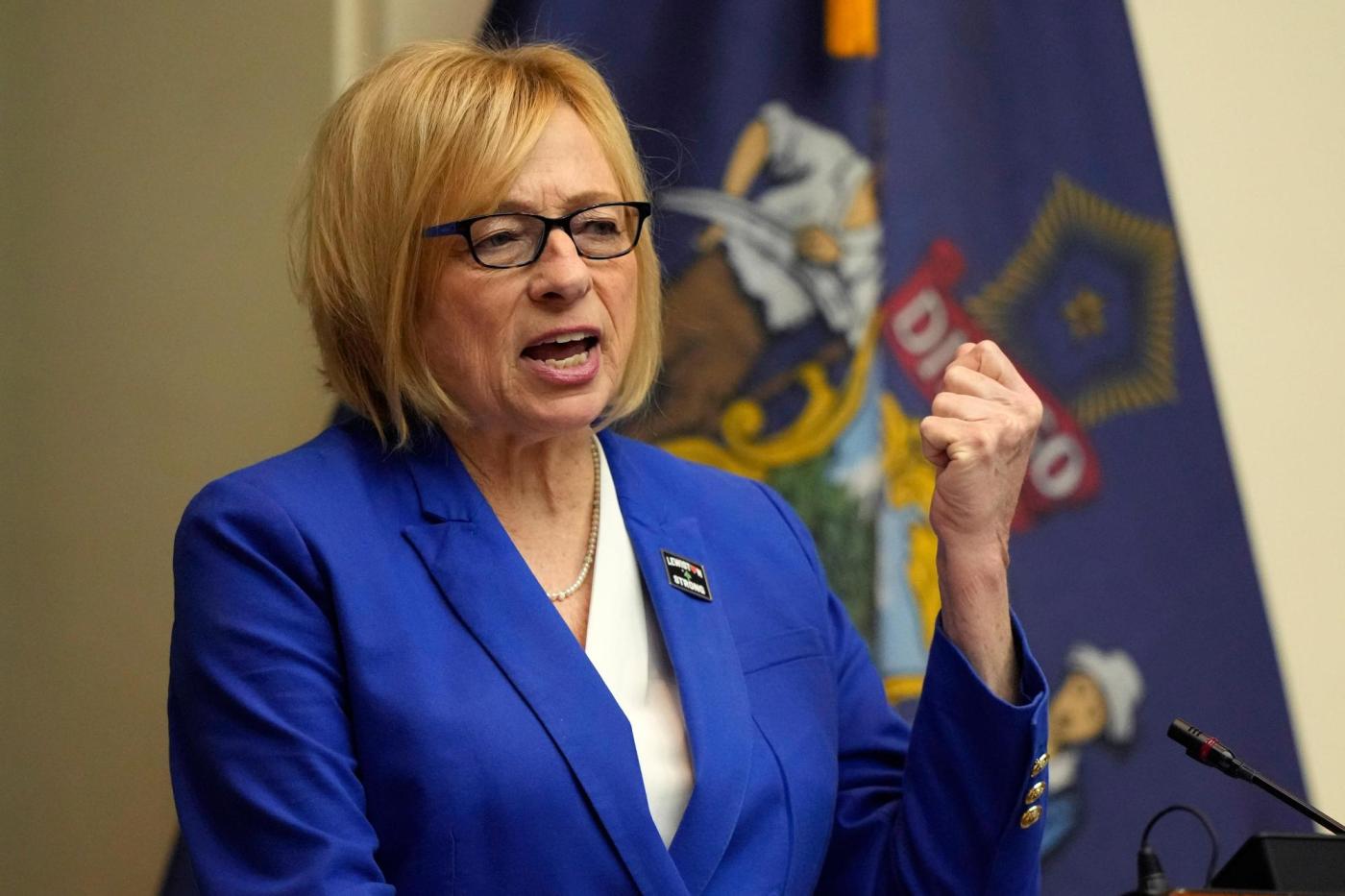
SCARBOROUGH, Maine (AP) — Maine officials sued the administration of President Donald Trump on Monday to try to stop the government from freezing federal money in the wake of a dispute over transgender athletes in sports.

Related Articles


Ohtani, Betts and World Series champion Dodgers visit Trump at the White House


Appeals court restores DOGE access to sensitive information at US agencies


Immigration crackdowns disrupt the caregiving industry. Families pay the price


Bogus report on tariff pause briefly lifted markets before White House denied it


No state has axed its income tax on wages in 45 years. Now 2 Southern states are on a path to do so

Trump and Maine, which is controlled by Democrats, are in the midst of a weeks long dispute about the Title IX anti-discrimination law and the participation of transgender students in high school sports. U.S. Secretary of Agriculture Brooke Rollins said earlier this month that the U.S. Department of Agriculture was pausing some funds for Maine educational programs because of what she described as Maine’s failure to comply with the Title IX law.

Maine Attorney General Aaron Frey filed a complaint in federal court on Monday that described the pause as “illegally withholding grant funds that go to keeping children fed.” The lawsuit seeks a temporary restraining order preventing the USDA from withholding money until a court is able to hear the case.

In a statement, Frey said, the president and his Cabinet “secretaries do not make the law and they are not above the law, and this action is necessary to remind the president that Maine will not be bullied into violating the law.”

The child nutrition program of the Maine Department of Education is unable to access several sources of funding at the moment because of the funding pause, Frey said. The money is used to feed children in schools, childcare centers and after-school programs and is also used to benefit disabled adults in congregate settings, he said.

The lawsuit states that the child nutrition program received or was due to receive more than $1.8 million for the current fiscal year. Prior year funds that were awarded but are currently inaccessible total more than $900,000, the lawsuit states. The lawsuit also says that the program was anticipating about $3 million that is typically awarded every July for summer meal program sponsor administration and meal reimbursement.

USDA officials did not return a request for comment.

Rollins said in a letter to Maine Gov. Janet Mills on April 2 that the state “cannot openly violate federal law against discrimination in education and expect federal funding to continue unabated.” The letter said the funding pause did not impact federal feeding programs.

“In order to continue to receive taxpayer dollars from USDA, the state of Maine must demonstrate compliance with Title IX’s protection of female student athletes from having to compete with or against or having to appear unclothed before males,” Rollins’ letter said.

Tensions between Maine and the Trump administration have simmered since February when Trump threatened to pull funding from Maine if the state does not comply with his executive order barring transgender athletes from sports. Mills, who was present at the White House for a meeting of governors, told the president: “We’ll see you in court.”

The Trump administration has vowed to cancel more federal funding if Maine does not bar transgender athletes from sports participation soon.