LONDON (AP) — British police on Friday charged comedian Russell Brand with rape and sexual assault after an investigation sparked by complaints from several women.
London’s Metropolitan Police force said Brand, 50, faces one count of rape, one of indecent assault, one of oral rape and two of sexual assault.
The alleged offenses took place between 1999 and 2005.
In September 2023, British media outlets Channel 4 and the Sunday Times published claims by four women of being sexually assaulted or raped by Brand. The accusers have not been identified.
Known for his unbridled and risqué standup routines, Brand hosted shows on radio and television, wrote memoirs charting his battles with drugs and alcohol, appeared in several Hollywood movies and was briefly married to pop star Katy Perry between 2010 and 2012.
In recent years, Brand has largely disappeared from mainstream media but has built up a large following online with videos mixing wellness and conspiracy theories. He recently said he had moved to the United States.
Police said Brand is due to appear in a London court on May 2.
Related Articles
Eagan native Eva Erickson joins an alliance of muscle on ‘Survivor’
Classic rock station KQRS’ reboot focuses on Gen X listeners and Minnesota acts
Review: Naomi Watts and a Great Dane mourn Bill Murray in ‘The Friend’
Josh Brolin, Francis Ford Coppola and Michael Mann pay tribute to Val Kilmer after his death
Val Kilmer, ‘Top Gun’ and Batman star with an intense approach, dies at 65
By ADRIAN SAINZ, GEORGE WALKER IV and JOHN SEEWER, Associated Press
LAKE CITY, Ark. (AP) — Parts of the Midwest and South faced the possibility of torrential rains and life-threatening flash floods Friday, while many communities were still reeling from tornadoes that destroyed whole neighborhoods and killed at least seven people.
Forecasters warned of catastrophic weather on the way, with round after round of heavy rains expected in the central U.S. through Saturday. Satellite imagery showed thunderstorms lined up like freight trains to take the same tracks over communities in Arkansas, Tennessee and Kentucky, according to the national Weather Prediction Center in Maryland.
The National Weather Service’s Oklahoma-based Storm Prediction Center warned of a moderate risk of severe thunderstorms Friday along a corridor from northeast Texas through Arkansas and into southeast Missouri. That area, which has a population of about 2.3 million, could see clusters of severe thunderstorms in the late afternoon and evening, with the potential for some storms to produce strong to intense tornadoes and very large hail.
Those killed in the initial wave of storms that spawned powerful tornadoes on Wednesday and early Thursday were in Tennessee, Missouri and Indiana. They included a Tennessee man and his teen daughter whose home was destroyed, and a man whose pickup struck downed power lines in Indiana. In Missouri, Garry Moore, who was chief of the Whitewater Fire Protection District, died while likely trying to help a stranded motorist, according to Highway Patrol spokesperson Sgt. Clark Parrott.
Tennessee Gov. Bill Lee said entire neighborhoods in the hard-hit town of Selmer were “completely wiped out” and said it was too early to know whether there were more deaths as searches continued. He warned people across the state to stay vigilant with more severe weather predicted.
Gov. Bill Lee speaks about the storm damage during a news conference Thursday, April 3, 2025, in Selmer, Tenn. (AP Photo/George Walker IV)
“Don’t let your guard down,” he said during a Thursday evening news conference. “Don’t stop watching the weather. Don’t stop preparing yourself. Have a plan.”
With flattened homes behind him, Dakota Woods described seeing the twister come through Selmer.
“I was walking down the street,” Woods said Thursday. “Next thing you know, I look up, the sky is getting black and blacker, and it’s lighting up green lights, and it’s making a formation of a twister or tornado.”
Flash flood threat looms over many states
By late Thursday, extremely heavy rain was falling in parts of southeastern Missouri and western Kentucky and causing “very dangerous/life threatening flash flooding” in some spots, according to the National Weather Service.
Heavy rains were expected to continue there and in other parts of the region in the coming days and could produce dangerous flash floods capable of sweeping away cars. The potent storm system will bring “significant, life-threatening flash flooding” each day, the National Weather Service said.
Water rescue teams and sandbagging operations were being staged across the region, and the Federal Emergency Management Agency was ready to distribute food, water, cots and generators.
Water rescues were already underway in flooded parts of Nashville, Tennessee, where the rain could persist for days after an unnerving period of tornado warnings that drained the batteries of some city sirens, the fire department said.
Western Kentucky prepared for record rain and flooding in places that normally do not get inundated, Gov. Andy Beshear said. At least 25 state highways were swamped, mostly in the west, according to a statement from his office Thursday.
Flash flooding is particularly worrisome in rural areas of the state where water can quickly rush off the mountains into the hollows. Less than four years ago, dozens died in flooding across eastern Kentucky.
Extreme flooding across the corridor that includes Louisville, Kentucky, and Memphis, which have major cargo hubs, could also lead to shipping and supply chain delays, said Jonathan Porter, chief meteorologist at AccuWeather.
Forecasters attributed the violent weather to warm temperatures, an unstable atmosphere, strong wind shear and abundant moisture streaming from the Gulf.
Tornadoes leave path of damage, and more could be coming
Under darkened skies Thursday morning, the remains of a used car dealership in Selmer stood roofless and gutted, with debris scattered across the car lot and wrapped around mangled trees. Some homes were ripped to their foundations in the Tennessee town, where three tornadoes were suspected of touching down.
In an aerial view the interior of a damaged business is seen at the Triad Building, a business plaza, after severe weather passed through on Thursday, April 3, 2025, in Louisville, Ky. (AP Photo/Jon Cherry)
A shipping and receiving bay door is damaged along with the interior of the Gordon-Hardy building after severe weather passed through an industrial industrial park on Thursday, April 3, 2025, in Jeffersontown, Ky. (AP Photo/Jon Cherry)
A home is in ruins after severe weather passed through Lake City, Ark., on Thursday, April 3, 2025. (AP Photo/Adrian Sainz)
People remove debris from a damaged business in the Triad Building, a business plaza, after severe weather passed through on Thursday, April 3, 2025, in Louisville, Ky. (AP Photo/Jon Cherry)
Debris and goods are removed from damaged businesses in the Triad Building, a business plaza, after severe weather passed through Thursday, April 3, 2025, in Louisville, Ky. (AP Photo/Jon Cherry)
1 of 5
In an aerial view the interior of a damaged business is seen at the Triad Building, a business plaza, after severe weather passed through on Thursday, April 3, 2025, in Louisville, Ky. (AP Photo/Jon Cherry)
The Tennessee Highway Patrol released video of lightning illuminating the sky as first responders scoured the ruins of a home, looking for anyone trapped.
In neighboring Arkansas, a tornado near Blytheville lofted debris at least 25,000 feet high, according to weather service meteorologist Chelly Amin. The state’s emergency management office reported damage in 22 counties from tornadoes, wind, hail and flash flooding.
The home where Danny Qualls spent his childhood but no longer lives was flattened by a tornado in northeast Arkansas.
“My husband has been extremely tearful and emotional, but he also knows that we have to do the work,” Rhonda Qualls said. “He was in shock last night, cried himself to sleep.”
Workers on bulldozers cleared rubble along the highway that crosses through Lake City, where a tornado with winds of 150 mph sheared roofs off homes, collapsed brick walls and tossed cars into trees.
Mississippi’s governor said at least 60 homes were damaged. And in far western Kentucky, four people were injured while taking shelter in a vehicle under a church carport, according to the emergency management office in Ballard County.
Walker IV reported from Selmer, Tennessee, and Seewer from Toledo, Ohio. Associated Press writers Andrew DeMillo in Little Rock, Arkansas; Jonathan Mattise in Nashville, Tennessee, Seth Borenstein in Washington; Isabella O’Malley in Philadelphia; Kathy McCormack in Concord, New Hampshire; Bruce Schreiner in Louisville, Kentucky; Jeff Martin in Atlanta; Hallie Golden in Seattle; and Ed White in Detroit contributed.
Global markets slid further and Wall Street was on track for another day of crushing losses Friday after China responded to U.S. President Donald Trump’s latest set of tariffs with some of their own.
Futures for the S&P 500 fell 3.6% before the bell, while futures for the Dow Jones Industrial Average shed 3.4%, falling below the 40,000 mark. Nasdaq futures tumbled 4%.
That follows Thursday’s losses for the three major U.S. indices, which ranged between 4% and 6%. Thursday’s wipeout was Wall Street’s worst day in five years.
Markets in Europe were having an even rougher time Friday. By midday, Germany’s DAX had lost 5%, the CAC 40 in Paris slipped 4.2% and Britain’s FTSE 100 gave up 3.8%.
The new tariff matches the rate of the U.S. “reciprocal” tariff of 34% on Chinese exports Trump ordered this week.
The U.S. exports an array of goods to China, including machinery, soy, corn and aerospace products. Shares in companies that stand to suffer from China’s tariffs include Deere & Co., which fell 4.7% in premarket; and Boeing, which slid 6%.
Apple saw its shares decline 4.7%.
The Commerce Ministry in Beijing also said that it will impose more export controls on rare earths, which are materials used in high-tech products such as computer chips and electric vehicle batteries.
The Chinese government is also subjecting 27 additional U.S. companies to trade sanctions or export controls and filed a lawsuit with the World Trade Organization over the tariffs.
Everything from crude oil to Big Tech stocks to the value of the U.S. dollar against other currencies has fallen since Trump’s tariff announcement Wednesday afternoon. Even gold, a traditional safe haven that recently hit record highs, pulled lower.
Trump announced a minimum tariff of 10% on global imports, with the tax rate running much higher on products from certain countries like China and those from the European Union. Smaller, poorer countries in Asia were slapped with tariffs as high as 49%.
Economists say the tariffs increases the risk of a potentially toxic mix of weakening economic growth and higher inflation.
It’s “plausible” the tariffs altogether, which would rival levels unseen in more than a century, could knock down U.S. economic growth by 2 percentage points this year and raise inflation close to 5%, according to UBS.
Yields on Treasurys tumbled in part on rising expectations for coming cuts to rates, along with general fear about the health of the U.S. economy. The yield on the 10-year Treasury fell to 3.89% from 4.01% late Thursday and from roughly 4.80% in January. The last time it had fallen below 4% was in October.
U.S. benchmark crude oil shed $5.32 to $61.63 a barrel, its lowest level since mid-2021. Brent crude, the international standard, was down $5.26 at $64.88 a barrel.
Shares of Exxon Mobil slid 4.2% and Chevron fell an even 4%.
Markets in Shanghai, Taiwan, Hong Kong and Indonesia were closed for holidays, limiting the scope of Friday’s sell-offs in Asia.
Tokyo’s Nikkei 225 lost 2.8% to 33,780.58, while South Korea’s Kospi sank 0.9% to 2,465.42.
The two U.S. allies said they were focused on negotiating lower tariffs with Trump’s administration.
Australia’s S&P/ASX 200 dropped 2.4%, closing at 7,667.80.
In other trading early Friday, the U.S. dollar fell to 144.89 Japanese yen from 146.06. The yen is often used as a refuge in uncertain times, while Trump’s policies are meant in part to weaken the dollar to make goods made in the U.S. more price competitive overseas. The euro rose to $1.1074 from $1.1055.
By PAUL WISEMAN, Associated Press Economics Writer
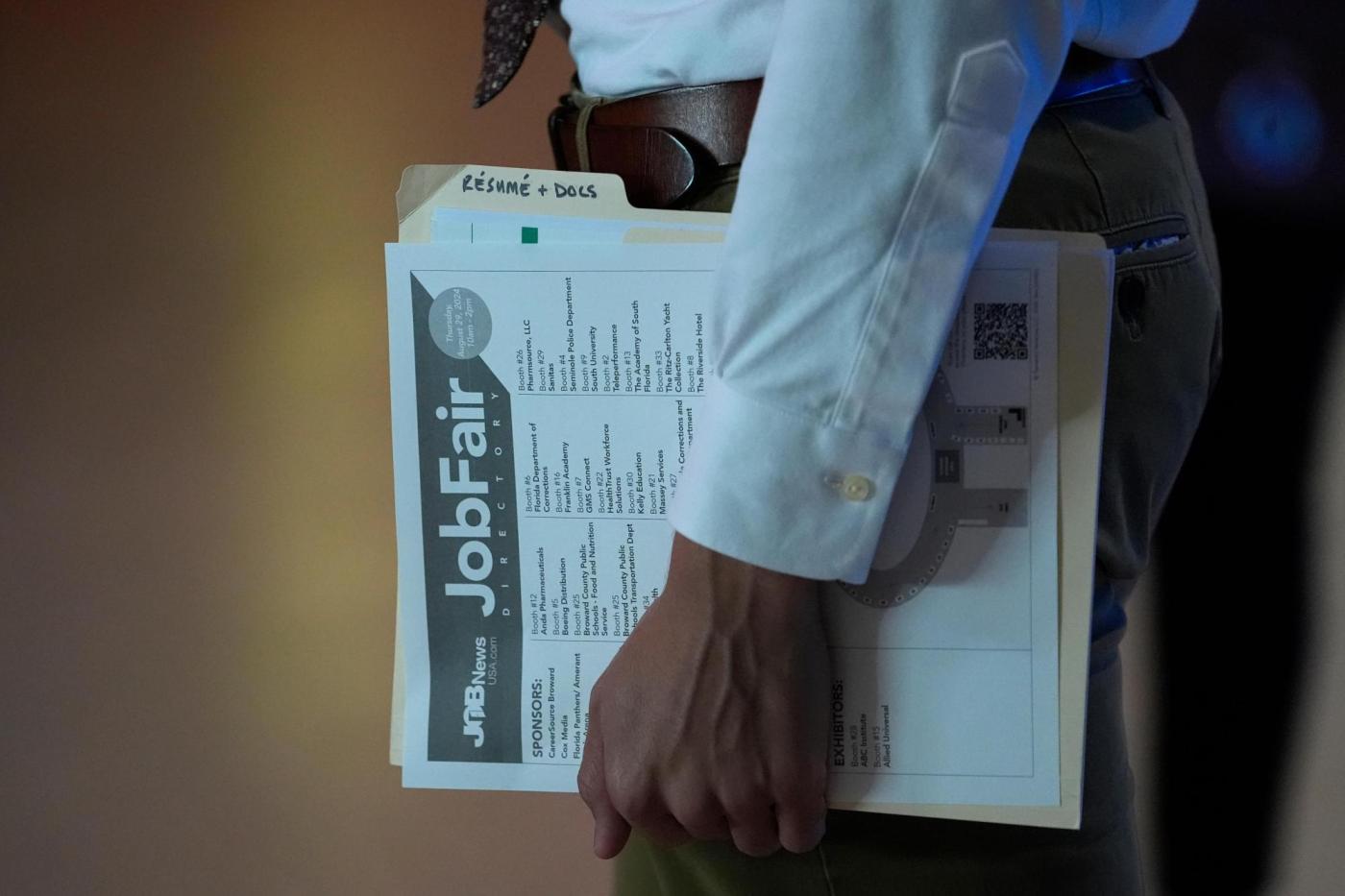
WASHINGTON (AP) — The U.S. job market is slowing at a time when Americans are increasingly anxious about what President Donald Trump’s trade wars are going to do to the economy.
When the Labor Department releases employment numbers for March on Friday, they are expected to show that U.S. businesses, government agencies and nonprofits added 130,000 jobs last month, down from 151,000 in February, according to a survey of forecasters by the data firm FactSet. The unemployment rate is forecast to tick up to 4.2% in March from 4.1% in February.
Those would unspectacular but not terrible hiring numbers. But the fear is that things might get worse from here.
President Donald Trump’s trade wars – including the sweeping “Liberation Day’’ import taxes he announced Wednesday – threaten to drive up prices, disrupt commerce and invite retaliatory tariffs from America’s trading partners.
Another threat comes from the president’s promise to deport millions of immigrants who are working in the United States illegally. In the past several years, those workers have eased labor shortages and helped the economy keep growing. If they’re deported or frightened out of the job market, companies could have to cut back on what they do or increase wages and raise prices, potentially feeding inflation.
Likewise, purges of the federal workforce by Elon Musk’s Department of Government Efficiency (DOGE) to threaten weigh the labor market and push up unemployment.
Still, the impact of Musk’s firings is only starting to show up.
“We do not expect DOGE-driven job cuts to be a sizable drag” in the overall March hiring numbers, Shruti Mishra, economist at Bank of America, wrote in a commentary. “The numbers are too small to move the needle on the broader labor market.’’
Mishra forecasts 185,000 new jobs last month, considerably higher than economists’ consensus, partly because she expects hiring at leisure and hospitality companies like hotels and restaurants to rebound after being pushed down by unusually cold weather in January and February.
The job market has cooled from the red-hot hiring days of 2021-2023. Employers added 151,000 jobs in February and 125,000 in January. Not bad but down from monthly averages of 168,000 last year, 216,000 in 2023, 380,000 in 2022 and a record 603,000 in 2021 as the economy surged back from COVID-19 lockdowns.
The economy has been remarkably durable in the face high interest rates.
In 2022 and 2023, the Federal Reserve raised its benchmark interest rate 11 times to combat inflation. Economists expected the higher borrowing costs to tip the United States into recession. But they didn’t. Consumers kept spending, employers kept hiring and the economy kept growing.
Inflation came down – allowing the Fed to cut rates three times last year. But then progress against inflation stalled, forcing the Fed to put off more rate cuts this year.
Now there are increasing worries about the health of the economy. The University of Michigan’s consumer sentiment survey last month showed that two-thirds of American consumers expected unemployment to rise over the next year — the highest reading in 16 years.
“The U.S. economy is in good shape at the start of the second quarter, but the ongoing trade war has increased the risk of near-term recession dramatically,” Ershang Liang of PNC Economics wrote in a commentary Thursday.
Still, the slowdown, if one is coming, may not show up in Friday’s job numbers.
Thomas Simons, chief economist at Jefferies, says the March numbers may be inflated by seasonal adjustments and end up getting revised lower in coming months. “After we see more data, and eventually a number of revisions, this period of time in the labor market will probably look quite a bit worse than it does now,” he wrote in a commentary Thursday.