Nearly four years have passed since Jasmine Sturm and her brother Matthew Pettus were murdered along with two friends in an SUV in St. Paul. For their mother, Angela Sturm, the healing process really began a year ago.
“I started some grief counseling, and that has worked wonders,” Sturm said, adding she also created a podcast that focuses on grief. “It’s really helped me kind of process through some things, and just speak them out loud.”
Much of that first year after the September 2021 killings was a blur, she said. She was consumed with caring for three young grandchildren who suddenly lost a parent and being a mom to her youngest son, Zachary Pettus, who was 24 and lost his two best friends.
Nitosha Lee Flug-Presley, Loyace Foreman III, Matthew Pettus and Jasmine Sturm, from left to right, were found fatally shot in a Dunn County, Wis., cornfield on Sept. 12, 2021. (Courtesy photos)
Then came the two-week jury trial of Antoine Suggs, who in May 2023 was convicted in the murders of Pettus, 26, Sturm, 30, Loyace Foreman III, 35, and Nitosha Flug-Presley, 30.
Suggs, who had dumped his SUV with their bodies in a western Wisconsin cornfield, was given a 103-year prison term at sentencing.
Through it all, Sturm said, a constant source of support came from a small group within the Ramsey County Attorney’s Office called the victim-witness advocate unit, one she now acknowledges she “didn’t even know existed.”
Her introduction began with a phone call from victim advocate Curtis Bakken, then from his co-worker Becky Redetzke Field, who joined the case because of its magnitude.
“They’re the one thing that’s steady,” Sturm said, adding they helped guide three families through the court process and still keep in touch. “They’re the one thing that’s like an anchor.”
Sturm and three victim advocates shared their stories with the Pioneer Press as part of National Crime Victims’ Rights Week, which is being observed through Saturday. The week, which has been held every April since 1981, raises awareness and educates the public about the rights and resources available to victims and survivors.
‘An awesome responsibility’
Bakken and Redetzke Field started on the same day in January 2017 and are now among the longest-tenured of the 13 victim-witness advocates at the attorney’s office. Seven are full time, averaging 240 cases at any given time and working to ensure that victims are receiving the services defined under the Minnesota Crime Victim Bill of Rights.
The legislation, enacted in 1983, includes rights for victims to participate in the prosecution process, be notified when an offender is released from jail or prison and be eligible for restitution.
“I like to say that our job is sort of a strange customer service position of the criminal justice system,” Redetzke Field said. “We’re the ones who answer, and I think a lot of the victims and witnesses that we work with know that.”
The criminal justice system can be complicated, slow and frustrating for victims, Bakken said. “They want to know why there’s another continuance,” he said. “They want to know why we’re resolving a case the way we’re resolving a case.”
In that regard, he said, communication and building trust are essential.
“It’s an awesome responsibility to be in this role, because you are working with really vulnerable people,” he said. “And so to be able to navigate that and hope that at the end of the day you made the process better, that’s what’s so rewarding about the job.”
Bakken was an intern at the attorney’s office while studying pre-law in college, then left to be a juvenile probation officer in Dakota County. He liked working with kids, but missed the courtroom.
New MN office for missing, murdered Black women and girls aims to build awareness
Forest Lake looks at cryptocurrency ATM registration after series of scams
Minnesota man with white nationalist ties convicted of gun charges, feds say
14-year-old arrested in fatal stabbing of 19-year-old in St. Paul
St. Paul man gets 22-year prison sentence for fatal North End shooting
“There’s something about the impact that you have with people who are pretty much going through the worst time in their life,” he said. “And so it’s a huge honor to be able to walk through that space with them and try to make it a little bit better.”
Redetzke Field studied cinema, media culture and anthropology in college, yet went on to work as a confidential advocate for nine years at the Aurora Center, the University of Minnesota’s on-campus resource for victims of sexual assault and related violence.
“We have other folks who came from similar backgrounds as me,” she said of her work with victims of sexual assault. “And we have advocates who came from very different, diverse jobs. But all had some kind of customer service component.”
‘Fighting for the victim’
From left, Ramsey County Attorney’s Office victim-witness advocates Bill Kubes, Becky Redetzke Field and Curtis Bakken, along with certified facility dog Norie, at the Ramsey County Attorney’s Office in downtown St. Paul on March 28, 2025. (Nick Ferraro / Pioneer Press)
Bill Kubes spent 14 years as a Minneapolis police officer before joining the victim-witness advocate unit in June 2017.
“I wish I would have jumped into this right away in my career,” he said. “It’s amazing. I love coming to work.”
As an officer, he went from call to call without learning about the outcome. Now he works with victims and witnesses for months, sometimes over a year.
“We’re fighting for the victim,” he said. “And what I really think is awesome about this is the relationship we have with people here is so good that I’m able to go to a prosecutor and say, ‘Hey, you know, here’s the victim’s input on this.’”
In every case, he said, he asks himself what his family would want to know and how they would want to be treated.
“I tell them to call me anytime, ‘I’m there for you.’ So my gratitude is knowing I helped them through that process,” he said. “And sometimes it’s a good closure, sometimes it isn’t. But you do the best you can.”
Kubes has a partner, Norie, the unit’s golden retriever, that offers up soothing support to victims at meetings or before testimony in high-trauma court cases. The attorney’s office brought the certified facility dog into the mix in 2019.
Norie, who turns 8 next week, has her own trading card, which Kubes passes out to kids.
“I use her for almost all my cases,” said Kubes, who cares for Norie when she’s off duty. “But I make sure the person wants her. Is it necessary? No. But as soon as they meet her, they’re like, ‘Oh my gosh, thank you for doing this.’”
Last year, Norie worked her first court trial in a juvenile criminal sexual conduct case, sitting right at the victim’s feet while she testified.
Increased caseload
Victim advocate caseloads have more than doubled over the past seven years, from 94 in 2017 to 233 last year, according to attorney’s office data.
Tami McConkey, director of the Victim, Witness and Postconviction Justice Division, said the reasons for the surging caseload include increases in the number of people charged with crimes and a big upswing in Rule 20 cases, which involve a psychiatrist providing an opinion about whether the defendant qualifies for a mental-illness defense.
“Rule 20 cases have just skyrocketed since the pandemic, like 200% or something,” McConkey said. “And so for all of our advocates, the challenge is that those cases don’t resolve because we keep waiting to see if the defendant becomes competent, and the victims then remain on their caseload.”
Despite the influx of cases, feedback the attorney’s office receives from victims after they are resolved is encouraging, said Amy Hansen, who supervises the advocate unit.
“The feedback we get is, ‘They were there for me, they understood me,’ even if they didn’t get the result that they wanted,” said Hansen, who was a victim advocate for 23 years. “They talk about their professionalism and their empathy.”
The attorney’s office has been intentional about hiring decisions so it mirrors the diverse community it serves, she said. A Karen-speaking advocate was just hired, joining others who speak Hmong, Spanish and Somali.
“We’ve learned so much about Hmong funerals, about how to attend a meeting with a Karen individual,” she said. “How to maybe not shake a hand or look someone in the eye. How to make someone comfortable when they don’t know the system, don’t know the language. They work with interpreters so closely.”
When the cases are resolved, victims are often referred to nonprofits that deal with grief and healing, such as Survivor Resources. Its St. Paul roots go back to 1995, when it was called the Victim Intervention Project.
“What we found is that in the court case, a lot of families, they’re not really grieving,” said Colleen Luna, executive director of Survivor Resources, which has offices at the St. Paul and Minneapolis police departments. “Your grief is put on hold while you deal with this foreign body that is the criminal justice system.”
Survivor Resources offers weekly support groups for families and loved ones who are suffering a similar loss from a homicide, suicide, an accident or overdose death. They’re held in North St. Paul, Forest Lake, Apple Valley and St. Louis Park, as well as virtual.
“So we do the follow up,” said Luna, a former St. Paul police commander who joined the nonprofit in 2016. “It’s great to hold someone accountable for the death of your loved one, but that doesn’t make the grief go away.”
‘I was able to let it go’
Angela Sturm felt as though she could not even cry until the trial of her children’s killer was over. When it was, she felt the void.
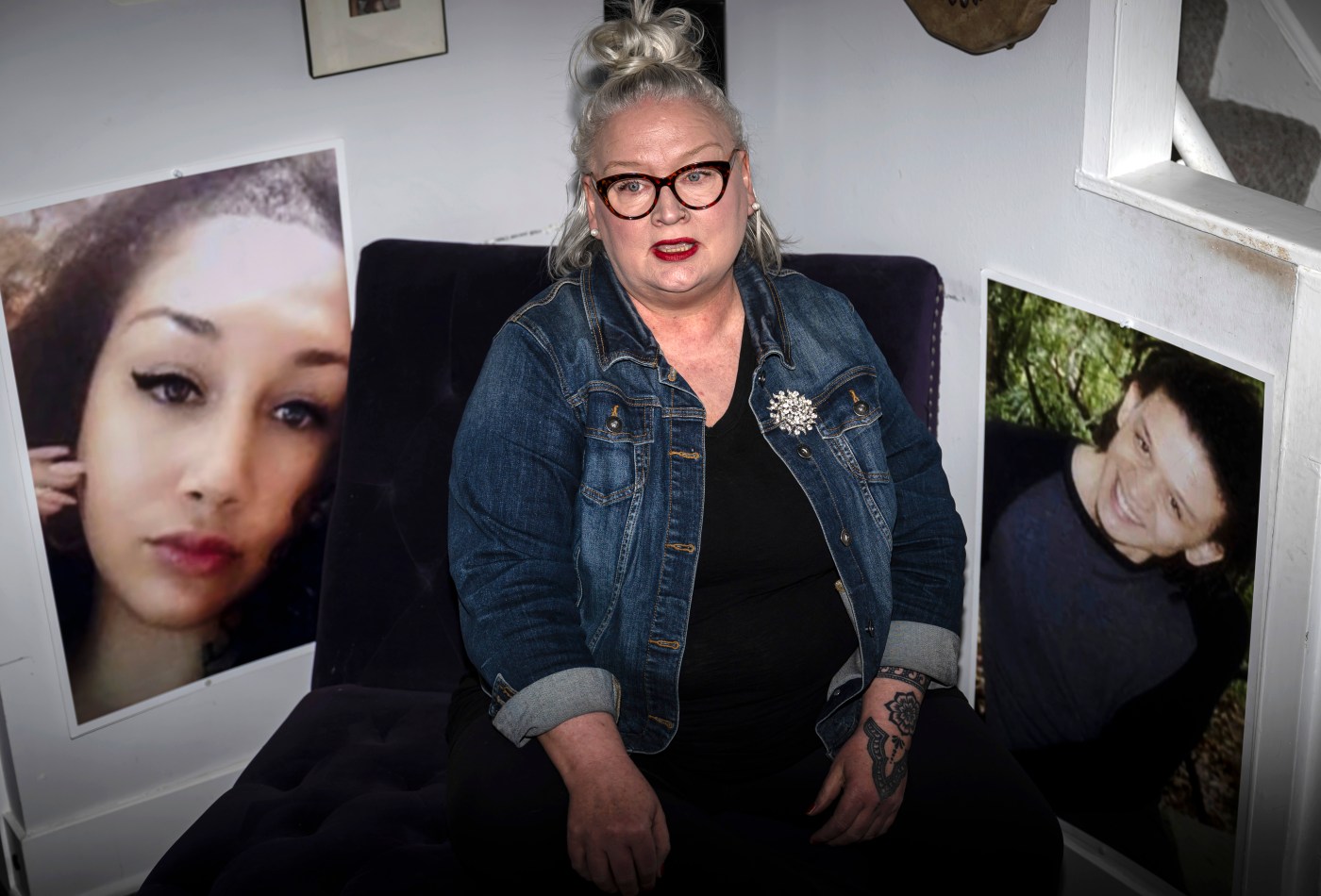
Angela Sturm at her Columbia Heights home. Sturm has found comfort in grief counseling and in hosting a podcast on grieving. (John Autey / Pioneer Press)
“Once we got through that, and then there was nothing left for me to do, you kind of just sit with yourself,” she said. “I myself began to spiral, and I was like, ‘I’m not doing well.’ ”
She leaned on weekly grief counseling.
“I found a therapist that works with me that understands my personality and thinks the same,” said Sturm, whose mother died two months before her children. “I’m science-y, so I don’t want to read self-help books. I want science to be like, ‘Why does your brain respond like this? Why do we feel like this?’ All the whys will never really be answered, but just to have somebody that kind of takes the place of my kids and my mom to talk to is really, really helpful.”
And she started her podcast “Beyond Goodbye” that “empowers listeners to engage with death and grief in a healthy and transformative way.” Her first episode, “Bodies in a Cornfield” tells the story of her children’s murders and tackles the difference between grief and grieving. Her son, Zachary, was the guest.
Sturm said she started the podcast, which she records and produces from her home in Columbia Heights, to honor her children and mother. It has evolved into hearing stories of others who’ve lost someone.
St. Paul City Council establishes new public safety committee
New MN office for missing, murdered Black women and girls aims to build awareness
Forest Lake looks at cryptocurrency ATM registration after series of scams
Have a REAL ID? If not, prepare for travel delays, MAC says.
‘Painful shock’: Twin Cities restaurateurs remember David Burley
Sturm has had podcast conversations with former Red Sox pitcher John Trautwein, whose teen son died by suicide, and Damone Presley, father of Nitosha Flug-Presley, who died alongside Sturm’s children. Sturm and Presley talked about forgiveness.
Sturm is partial to Native and Indigenous practices. She realized that if she wanted to heal and move forward in her “walk” of healing and grieving, she had to “release” her children’s killer from her head.
“And so I was able to let it go,” she said. “Within months, I started to heal, and everything that went wacko was coming back to normal. A Christian would say, forgive. For me, it’s release.”
For more information on crime victim resources across Minnesota, including 24-hour hotlines, go to dps.mn.gov/resources-for/crime-victim-resources.