US jobless benefit claims fall last week as labor market remains strong despite recession fears

posted in: All news | 0

By MATT OTT, Associated Press Business Writer

WASHINGTON (AP) — U.S. applications for jobless benefits fell again last week as the labor market continues to hold up despite fears of a tariff-induced recession.

Jobless claim applications fell by 9,000 to 215,000 for the week ending April 12, the Labor Department said Thursday. That’s well below the 225,000 new applications analysts forecast.

Weekly applications for jobless benefits are considered a proxy for layoffs, and have mostly stayed between 200,000 and 250,000 for the past few years.

The four-week average of applications, which can soften some of the week-to-week swings, fell by 2,500 to 220,750.

The total number of Americans receiving unemployment benefits for the week of April 5 jumped by 41,000 to 1.89 million.

A California judge is set to decide whether the Menendez brothers deserve reduced sentences

posted in: All news | 0

By JAIMIE DING, Associated Press

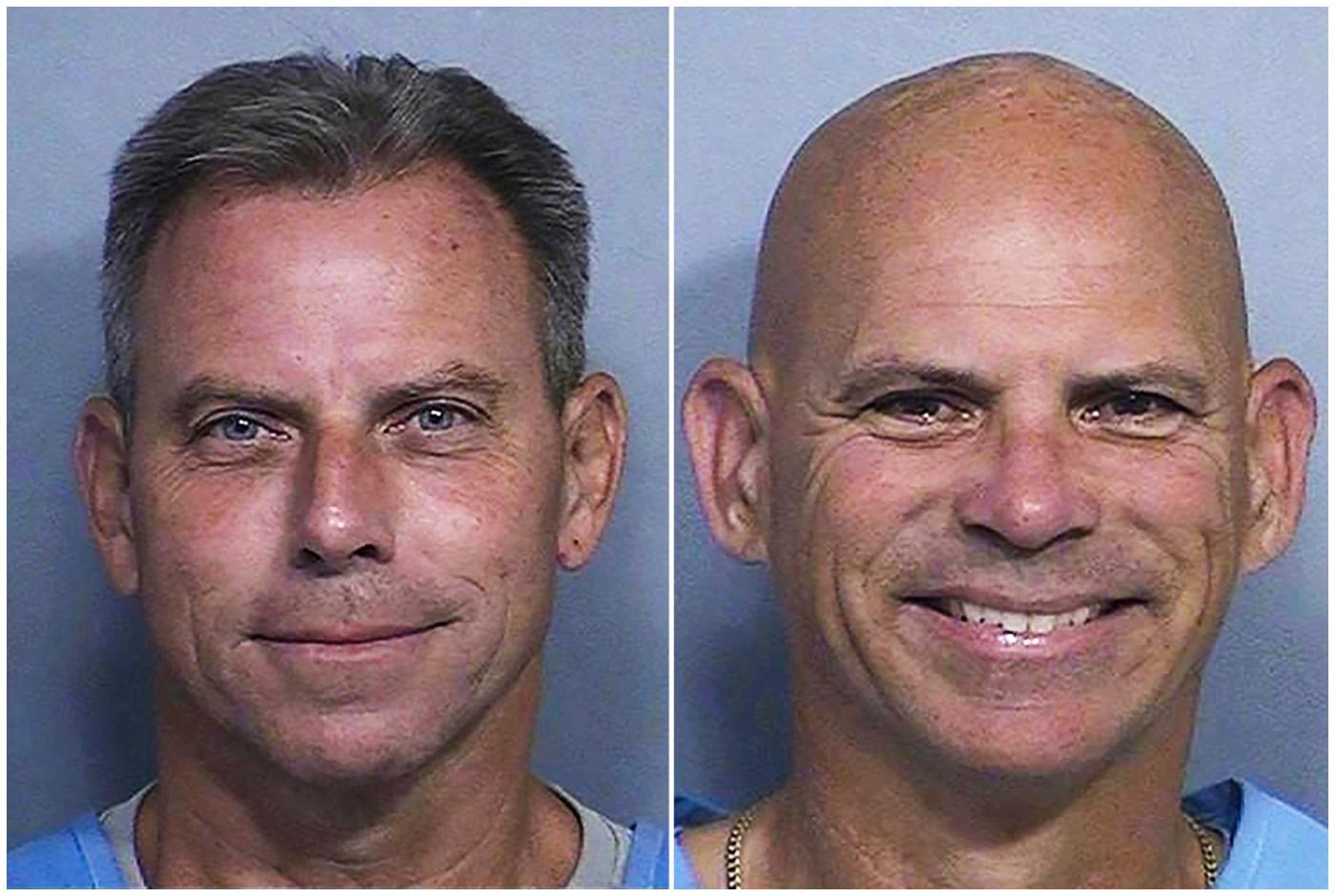
LOS ANGELES (AP) — Erik and Lyle Menendez could learn this week whether they’ll get reduced sentences — and the chance for freedom — nearly 30 years after they were convicted of murdering their parents.

A Los Angeles judge will preside over the resentencing hearing expected to last two days starting Thursday. The judge could make a verbal decision during the hearing or rule later with a written decision. If he shortens their sentences, the brothers would still need approval from the state’s parole board to get out of prison.

They were sentenced in 1996 to life in prison without the possibility of parole for murdering their entertainment executive father Jose Menendez and mother Kitty Menendez in their Beverly Hills home in 1989. The brothers were 18 and 21 at the time of the killings. While defense attorneys argued the brothers acted out of self-defense after years of sexual abuse by their father, prosecutors said the brothers killed their parents for a multimillion-dollar inheritance.

The case has captured the public’s attention for decades, and the Netflix drama “ Monsters: The Lyle and Erik Menendez Story ” and documentary “The Menendez Brothers” have been credited with bringing new attention to the case. Supporters of the brothers have flown in from across the country to attend rallies and hearings in the past few months.

The resentencing hearing will center on whether the brothers have been rehabilitated in prison and deserve a lesser sentence of 50 years to life. That would make them eligible for parole under California’s youthful offender law because they committed the crime under the age of 26.

Former Los Angeles District Attorney George Gascón asked a judge last year to reduce the brothers’ sentences. He lost reelection to Nathan Hochman, who moved to withdraw the resentencing request and has argued the brothers have not taken full responsibility for their crimes.

A resentencing petition laid out by Gascón focuses on the brothers’ accomplishments and rehabilitation. The brothers’ attorneys say their clients have worked hard over the decades to better themselves and give back to the prison community. The extended Menendez family, with the exception of an uncle who died last month, has said they fully forgive the brothers for what they did and want them to be freed.

With Hochman in charge, prosecutors argued last Friday they could not support the brothers’ resentencing. Los Angeles County Superior Court Judge Michael Jesic ruled the resentencing hearings could continue despite their opposition.

Prosecutors have said the brothers have not admitted to lies told during their trial about why they killed their parents, or that they asked their friends to lie for them in court. Hochman’s office has also said it does not believe that the brothers were sexually abused by their father and that by speaking about their childhood abuse, they have not taken complete responsibility for the crime.

Tennessee’s GOP leads the fight to deny public education to children without documents

posted in: All news | 0

By KIMBERLEE KRUESI and KRISTIN M. HALL, Associated Press

NASHVILLE, Tenn. (AP) — Damian Felipe Jimenez has many dreams about his future — he could be a restaurant owner, a scientist or maybe something else. As he works through sixth grade, he knows education will be critical in making his dreams a reality, but he’s increasingly worried that option could soon disappear for some of his classmates.

Related Articles


Stephen Mihm: The atomic bomb set the stage for the college funding fight


Thomas Friedman: Trapped in a woke right-wing ideology


What happens next after judge warns of possible contempt prosecution over deportation flights order


DOGE wanted to assign staff to the nonprofit Vera Institute of Justice because it got federal funds


Health secretary Robert F. Kennedy Jr. says US autism cases are climbing at an ‘alarming rate’

Felipe Jimenez is one of hundreds of children who have packed the Tennessee Capitol this year to oppose legislation designed to upend the long-standing U.S. constitutional right to free public education for children, regardless of immigration status. It’s a protection established by the landmark 1982 U.S. Supreme Court decision in Plyler v. Doe, which struck down a Texas law that sought to deny enrollment to any student not “legally admitted” into the country.

“I am the son of immigrant parents who have shown me to respect and value everyone,” Felipe Jimenez told lawmakers earlier this year, speaking on behalf of the impact the bill would have on his peers. “Just like me and all the kids in this country, we have the right to dream and make those dreams come true. The right to an education should not be taken away from us because of our immigration status.”

A growing number of conservative leaders are pushing states to overturn Plyler v. Doe — including the conservative think tank The Heritage Foundation. This year, Tennessee’s Republican lawmakers appear the most willing to take up the cause by advancing legislation that directly contradicts the Supreme Court’s decision and would spark a legal battle that supporters hope will not only go before the high court but also allow justices to reverse the ruling.

GOP-led states have introduced a plethora of anti-immigration bills following President Donald Trump’s reelection and his subsequent moves to aggressively deport immigrants who have entered the U.S. illegally. But few have followed Tennessee’s lead to focus on revoking public education from children, and none have made it out of committee.

An uphill fight but a different Supreme Court

The Republican-controlled Tennessee Senate has approved a proposal requiring proof of legal residence to enroll in public K-12 public schools and allowing schools to either turn away students who fail to provide proper documentation or charge them tuition. The House version differs by letting public schools check immigration status, rather than requiring it.

The two versions will need to be reconciled before they can head to Republican Gov. Bill Lee’s desk. If it passes, the legislation is all but certain to face a lawsuit.

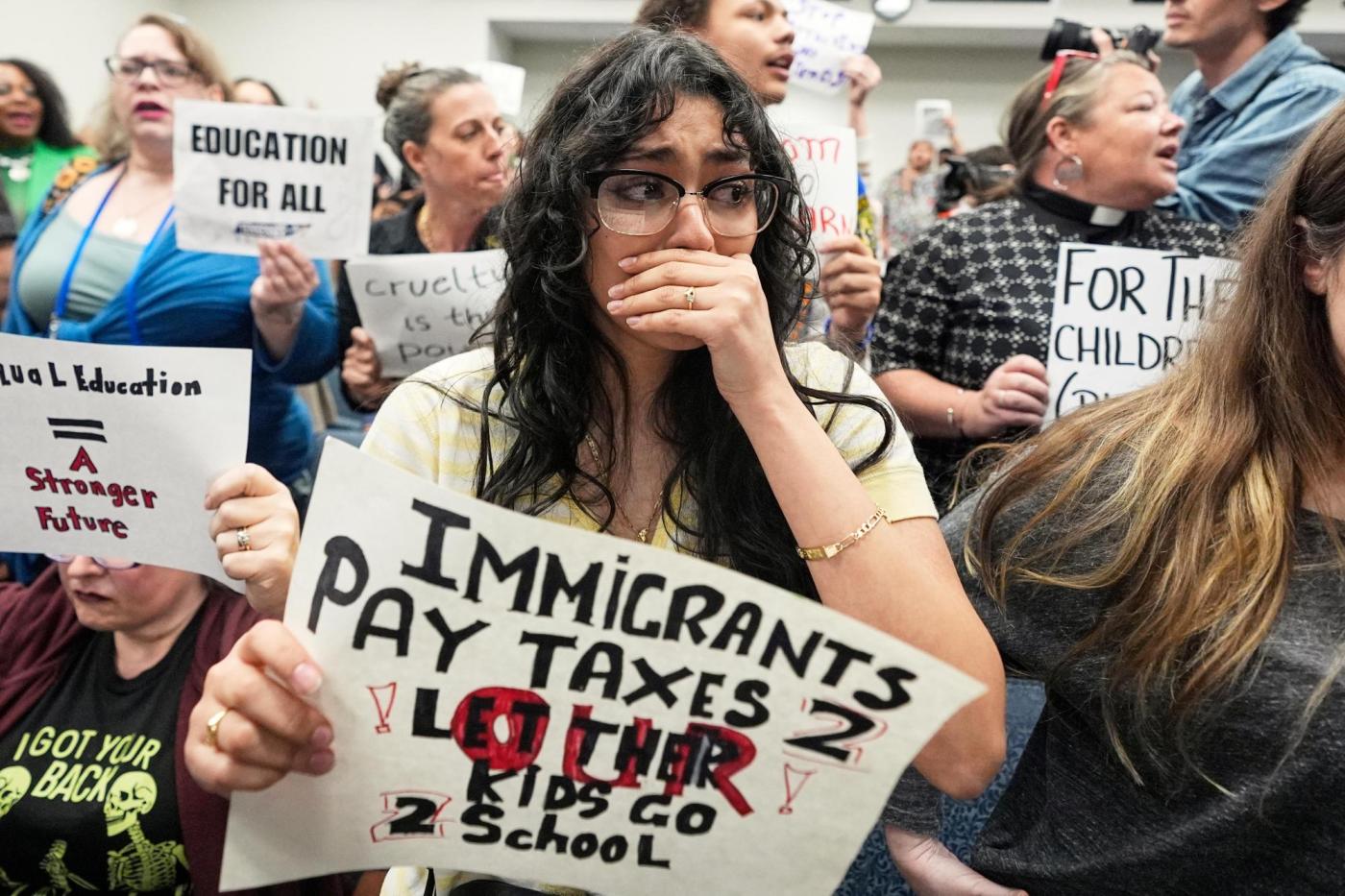
FILE – Gisselle Huerta, left, yells against a bill that would allow public and charter schools to deny immigrant students from enrolling during a House meeting of the Education K-12 subcommittee, in Nashville, Tenn., March 11, 2025. (AP Photo/George Walker IV, File)

The sponsors of the proposal have largely downplayed denying children the right to education, but instead have focused on the fiscal impact states are facing in educating children residing in the U.S. illegally.

“It’s been argued that undocumented illegal aliens pay sales tax and property tax,” said Republican Sen. Bo Watson, the backer of the bill in the Senate. “True. But one doesn’t know if those payments come close to offsetting the additional costs. We argue they do not.”

It’s unknown how many undocumented children live in Tennessee, and it’s unclear if the proposal would result in any savings. When Texas made similar economic arguments in the Plyler case, it was rejected by the court.

Lawmakers and other conservative supporters repeatedly point to the 5-4 vote that determined Plyler in 1982, stressing the narrow decision means there is wiggle room to overturn the precedent — particularly under the current Supreme Court that has been open to reversing legal precedent, including on the right to abortion.

“It doesn’t take one too long to figure out that there’s a strong appetite by the conservatives on the Supreme Court to overturn precedent,” said Brett Geier, a professor of educational leadership at Western Michigan University. “And where does it come from? It starts with the states.”

The first test against the Plyler decision came in 1994 in California. Voters there approved a proposition prohibiting immigrants in the country without legal authorization from receiving public health care, education or other social services. That law was overturned.

In 2011, the Plyler precedent was challenged again after Alabama lawmakers required schools to determine student immigration status. That statute was eventually blocked after a legal challenge resulted in a settlement.

“I don’t see real debates about this. I see symbolic measures that are supported by some groups of Republican legislators,” said Thomas Saenz, president of the law firm Mexican American Legal Defense and Educational Fund, which successfully defended the plaintiffs before the Supreme Court in the Plyler case.

“They do trot up same old arguments from the 1970s about the burden of the costs, etc., etc.,” Saenz added. “They never balance that against the benefit of taxes being paid by these kids and their parents.”

For children, the fight turns personal

For months, as GOP lawmakers have defended the legislation, the tone of those who have shown up to fight against the bill has often turned emotional. Students have broken down in tears, distraught over their classmates being removed from their school and worries over who might be next.

FILE – A woman embraces her child outside a House hearing room during protests against a bill that would allow public and charter schools to deny immigrant students from enrolling for classes in Nashville, Tenn., March 11, 2025. (AP Photo/George Walker IV, File)

As the Senate voted earlier this month, 12-year-old Silvestre Correa Del Canto stood outside in the crowded second floor of the Capitol with his mother, alarmed that the legislation could hurt children who don’t make the decisions about where they live and could impact their lives for years.

His family brought him to Nashville when he was 3 from Santiago, Chile. He now attends a public middle school that was originally a segregated school for African Americans. He connected that legacy to the Tennessee legislation.

“I feel like we’ve worked a lot to be connected again, people with people and going to school together,” Correa Del Canto, a sixth grader, said. “And I feel like that would be just going steps back, just going back in time and like losing all that we’ve worked for.”

Associated Press writer David Lieb contributed from Jefferson City, Missouri.

Global shares trade are mixed, US futures gain as investors await next steps in Trump’s trade war

posted in: All news | 0

By YURI KAGEYAMA, Associated Press Business Writer

TOKYO (AP) — European shares opened lower on Thursday after a day of gains in Asia as investors awaited the next steps in President Donald Trump’s trade war.

The European Central Bank was expected to cut interest rates given worries over the potential impact of Trump’s trade policies.

France’s CAC 40 dipped 0.6% to 7,282.82, while the German DAX lost 0.2% to 21,267.50. Britain’s FTSE 100 shed 0.7% to 8,216.80.

The future for the S&P 500 jumped 0.9%, while that for the Dow Jones Industrial Average was up 0.8%.

In Asia, Japan’s benchmark Nikkei 225 gained 1.4% to finish at 34,377.60 after Trump joined Treasury Secretary Scott Bessent and Commerce Secretary Howard Lutnick in the talks with a Japanese delegation in Washington.

Afterward, Trump wrote in a social media post that it was: “A Great Honor to have just met with the Japanese Delegation on Trade. Big Progress!”

There was no immediate indication of what progress that might be.

Shares in Honda Motor Co. jumped 1.9% after the Japanese automaker said it plans to move its production of the five-door Civic hybrid electric vehicles for the U.S. market from Japan to the company’s plant in Indiana.

Honda Motor Co. didn’t say the move was in response to Trump’s tariff policies but stressed it moves production to where there is demand. Production of the U.S.-bound five-door Civic HEV began at the Yorii plant outside Tokyo in February. So far 3,000 vehicles have been produced there for the U.S. market.

Also Thursday, Japan’s Finance Ministry reported that the nation recorded a trade deficit i n its fiscal year through March, but racked up a surplus with the U.S. For the month of March, Japan recorded a trade surplus of $4 billion. Exports climbed nearly 4% from a year earlier, for the sixth straight month of gains, although the increase was slower than in February.

Australia’s S&P/ASX 200 gained 0.8% to 7,819.10. South Korea’s Kospi edged up 0.9% to 2,470.41. Hong Kong’s Hang Seng added 1.6% to 21,395.14, while the Shanghai Composite edged up 0.1% to 3,280.34.

On Wednesday, U.S. stocks fell after Nvidia warned new restrictions on exports to China will cost it billions of dollars. The S&P 500 sank 2.2% and the Dow shed 1.7%. The Nasdaq composite lost 3.1%.

Many investors are bracing for a possible recession because of Trump’s tariffs, which he has said he hopes will bring manufacturing jobs back to the United States and trim how much more it imports from other countries than it exports. A survey of global fund managers by Bank of America found expectations for recession are at the fourth-highest level in the last 20 years.

In energy trading, benchmark U.S. crude rose 50 cents to $62.33 a barrel. Brent crude, the international standard, gained 45 cents to $66.30 a barrel.

In currency trading, the U.S. dollar rose to 142.73 Japanese yen from 141.88 yen. The euro cost $1.1371, down from $1.1401.