Some places across the country are still getting frost in the morning; other climes are sunny and warm already. No matter. Let’s move on to springtime in the kitchen.
We need renewal and the green promises. And if it means cheating a little — asparagus from elsewhere, peas from the freezer — so be it. It’s been a long winter.
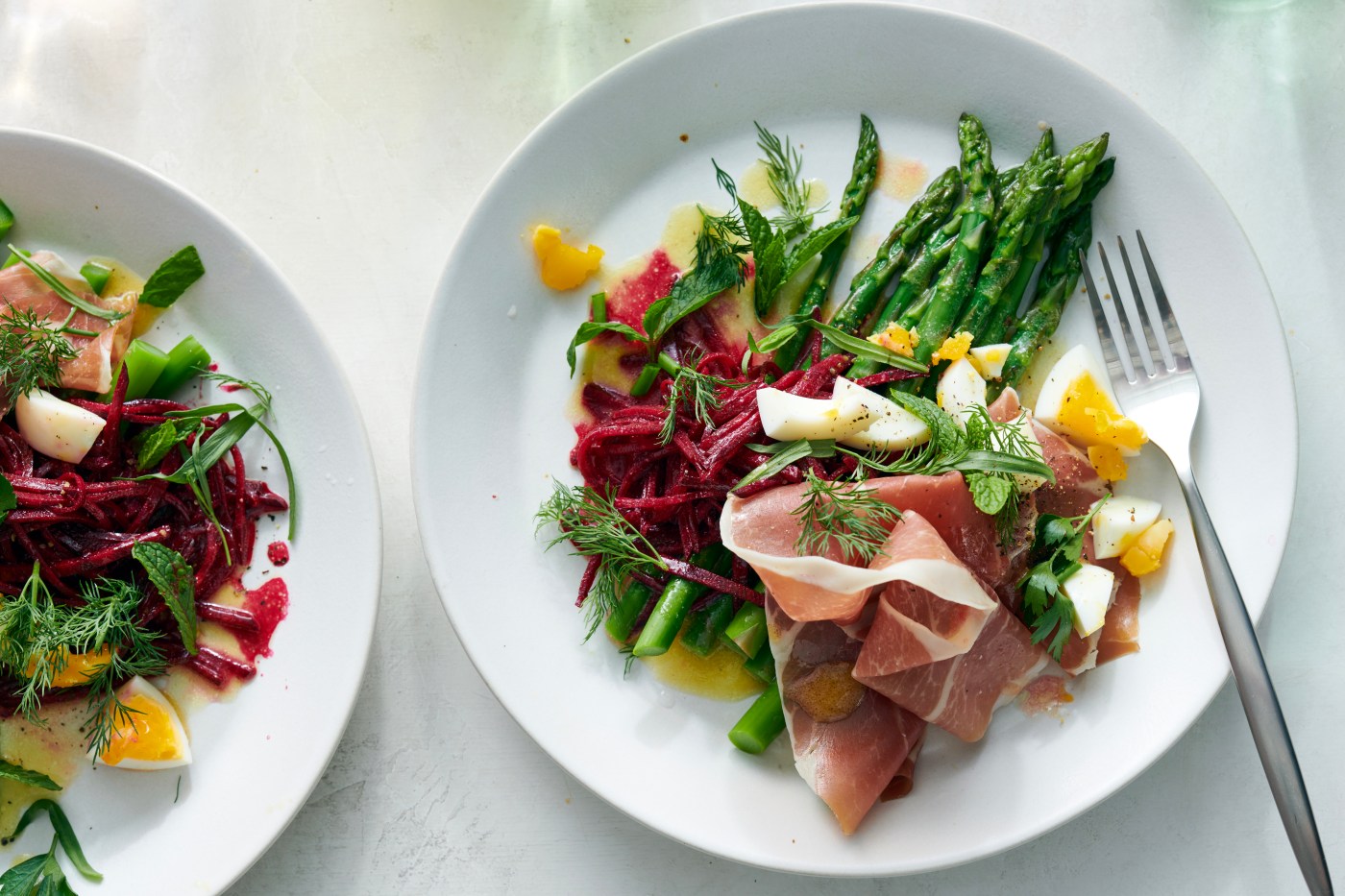
Asparagus absolutely qualifies as a signal of spring, and what better way to celebrate the season than a salad of them. A platter of green spears, bathed in a mustard-tinged vinaigrette, would be perfectly fine. But for a celebratory dinner, it’s nice to dress things up a bit, with finely slivered raw beets, a shower of dill, parsley and mint leaves, and chopped (or quartered) soft-cooked egg. A few thin slices of prosciutto complete the colorful assembly.
For the best flavor, look for the freshest firm, shiny asparagus available, whether pencil thin, medium or hefty, then give them a few minutes in simmering salty water before letting them cool to room temperature on a clean towel.
For carnivores, springtime and lamb are synonymous, so in honor of the season, I braised a succulent lamb shoulder with white wine and aromatics. A braise is practical too, since it can be prepared well in advance of serving, even a day ahead.
Though boneless roasts can be found at most butchers, you could also braise thick-cut, bone-in shoulder chops, tied together. But could you roast a leg of lamb or a couple of lamb racks instead? Yes, or you could cook chops on the grill or under the broiler, especially since the real star of this main is a mélange of greens (chard, kale or large spinach) and beans, punched up with rosemary, hot pepper and orange zest.
It’s thrilling if you can find fresh fava beans. If not, frozen, peeled favas are available at Middle Eastern groceries. Or use frozen edamame, baby limas, green peas or a combination. If none of those are options where you are, toss the cooked greens with lentils or small white beans for an extremely pleasing combination.
For dessert, a bowl of strawberries and cream is always a winner. But consider a lemony spongecake, topped with strawberries and cream, which may well generate applause. It’s worth seeking out smaller strawberries, which tend to be riper and sweeter than the large, white-shouldered type.
The cake is doused with a syrupy lemon glaze made from lemon juice, limoncello and powdered sugar. Lacking limoncello, use triple sec or an orange liqueur. Get the cake good and soggy, and take care when whipping the cream. As with so many of life’s instances, leaving it on the looser side keeps it luxurious.
Herby Asparagus Salad With Beets and Prosciutto
Asparagus is absolutely a symbol of spring, so what better way to celebrate the season than by centering them in a salad. A platter of green spears, bathed in a mustard-tinged vinaigrette, would be perfectly fine, but for something more celebratory, it’s nice to dress things up, with finely slivered raw beets, a shower of dill, parsley and mint leaves, and chopped (or quartered) soft-cooked egg. A few slices of prosciutto complete the colorful assembly. For the best flavor, look for the freshest firm, shiny asparagus available, whether pencil thin, medium or hefty.
By David Tanis
Yield: 4 servings
Total time: 45 minutes
INGREDIENTS
For the vinaigrette:
2 tablespoons lemon juice
1 tablespoon white wine vinegar
1 tablespoon Dijon mustard
Salt and black pepper
1/4 cup extra-virgin olive oil
For the salad:
1 bunch medium asparagus (about 16 to 20 spears)
1 medium red beet, raw, peeled and julienned
3 tablespoons tarragon leaves (from 3 sprigs)
3 tablespoons dill sprigs (from 3 stems)
About 3 tablespoons parsley leaves (from 6 or so stems)
About 3 tablespoons mint leaves (from 1 to 2 large sprigs)
2 (8-minute) boiled eggs, peeled and roughly chopped
8 thin slices of prosciutto
DIRECTIONS
1. Make the vinaigrette: Put lemon juice and vinegar in a small bowl. Stir in mustard to dissolve. Add a good pinch of salt and some freshly ground pepper. Slowly whisk in the olive oil.
2. Prepare the salad: Snap off the tough ends of the asparagus. In a large pot, bring abundantly salted water to a low boil. Add asparagus and cook until just tender, 2 to 4 minutes, depending on their width. Remove and spread out on a kitchen towel to cool. Set aside.
3. Divide cooked asparagus spears among 4 plates. Put beets in a small bowl, season with a pinch of salt and 1 tablespoon vinaigrette. Top asparagus with dressed beet. Scatter herbs over each plate, then sprinkle with chopped egg. Drizzle vinaigrette over everything.
4. Tear prosciutto into wide ribbons; drape ribbons over each plate. Serve.
Lamb Shoulder With Greens and Beans
Lamb Shoulder with Greens and Beans. This lamb braise is a great option for hosts, since it can be prepared up to a day ahead. Food Stylist: Rebecca Jurkevich. (David Malosh/The New York Times)
Spring and lamb are synonymous, so in honor of the season, make this succulent lamb shoulder braised with white wine and aromatics. While the lamb is, of course, a showstopper, the real star is a mélange of greens (chard, kale or large spinach) and beans, punched up with rosemary, hot pepper and orange zest. Look for fresh favas, or substitute the peeled frozen variety (found at Middle Eastern grocery stores), frozen edamame, baby limas, green peas or a combination. An ideal dinner party main, every part of this dish can be prepared hours (or a day) ahead and reheated just before serving.
By David Tanis
Yield: 4 to 6 servings
Total time: 3 hours
INGREDIENTS
1 (4-pound) boneless lamb shoulder roast or 4 to 6 thick bone-in lamb shoulder chops (3 to 4 pounds)
Salt and black pepper
1 teaspoon ground fennel
1/4 cup extra-virgin olive oil, plus more as needed
1 medium onion, diced
4 garlic cloves, roughly chopped
1 bay leaf, fresh or dried
1 tablespoon tomato paste
1 cup dry white or red wine
4 cups chicken or lamb broth
1 pound sturdy leafy greens, such as chard, kale or spinach, ribs removed, leaves cut into wide ribbons
1 tablespoon grated orange zest
2 teaspoons roughly chopped rosemary
Pinch of red-pepper flakes
2 cups fava beans, shucked, blanched and peeled, or use a mix of edamame and peas
DIRECTIONS
1. Generously season lamb all over with salt and pepper and rub with ground fennel. (If using chops, stack them, and tie together tightly with twine into the shape of a roast.)
2. Set a rack in the middle of the oven and heat to 350 degrees. Place a Dutch oven over medium-high heat, and add 2 tablespoons oil. When it shimmers, add diced onion and a pinch of salt. Cook, stirring until softened and lightly browned, about 8 minutes. Add garlic, bay leaf and tomato paste, and cook for 1 minute, stirring continuously, then add wine and simmer briskly for 1 minute. Add broth and bring to a hard boil. Set lamb in the pot, cover and bake on the middle rack until quite tender, 1 1/2 to 2 hours.
3. As the lamb bakes, add 2 tablespoons olive oil to a large skillet over medium-high. Add the greens, working in batches if necessary and stirring as they cook down, then season with salt and cook, stirring, until wilted, about 3 minutes. Add orange zest, rosemary and red-pepper flakes, and stir to incorporate. Turn off heat. Taste and adjust seasoning, then set greens aside. When cool, squeeze out excess water.
4. When lamb is done, remove from the Dutch oven. (If using chops, place the bundle on a cutting board and remove twine.) Bring cooking liquid to a boil and reduce by half, spooning off any fat that rises to the surface. Turn off heat. Put lamb back in reduced cooking liquid, cover and keep warm.
5. Return greens and fava beans to the skillet over medium-high heat for a few minutes to heat through, then transfer to plates. Cut lamb into thick slices or chunks and set on top of vegetables. (If using a chop, set a single chop on each plate.) Spoon cooking liquid over each dish and serve.
Lemon Cake With Strawberries and Cream
Lemon Cake with Strawberries and Cream. A lemony spongecake topped with strawberries is a joyous way to end the meal. Food Stylist: Rebecca Jurkevich. (David Malosh/The New York Times)
For dessert, a bowl of strawberries and cream is always a winner. But instead, consider this lemony spongecake topped with strawberries and cream, which may well generate applause. It’s worth seeking out smaller strawberries, which tend to be riper and sweeter than the large, white-shouldered type. The spongecake may be baked in advance, up to 2 days ahead. It’s fun to hide the strawberries under a thick layer of whipped cream, but you can serve the cream on the side if preferred.
By David Tanis
Yield: 8 servings
Total time: 1 hour 15 minutes, plus cooling time
INGREDIENTS
For the cake:
1 tablespoon unsalted butter
1 1/3 cups/140 grams sifted cake flour, plus more for the pan
6 large eggs
3/4 cup/150 grams granulated sugar
1 teaspoon grated lemon zest
1/2 teaspoon vanilla extract
Pinch of salt
For the glaze:
3/4 cup/92 grams powdered sugar
2 tablespoons lemon juice
2 tablespoons limoncello or triple sec
1 cup/240 milliliters heavy cream
1/2 pound/225 grams ripe strawberries, hulled, rinsed and thickly sliced, quartered or halved
DIRECTIONS
1. Heat oven to 350 degrees. Butter and flour a 9-inch springform pan and set aside.
2. Prepare the cake: Place the flour in a large bowl and set aside. In a stand mixer fitted with the whisk attachment, beat eggs at medium speed. Add granulated sugar, lemon zest, vanilla extract and salt. Beat until mixture is quite thick and nearly holds peaks, about 10 minutes. Quickly fold into the flour.
3. Pour the batter into the prepared pan, smoothing the top. Bake until a skewer emerges cleanly when inserted into the middle of the cake, 20 to 25 minutes. Cool on a rack in the pan. (It’s fine to make the cake a day or two in advance.)
4. Flip the cake onto a platter, leaving the flat surface on top.
5. Make the glaze: Stir together 1/2 cup powdered sugar, 1 tablespoon of the lemon juice and the limoncello until all the sugar has dissolved. Brush all of the glaze over the cake.
6. Whip cream and 2 tablespoons of the remaining powdered sugar to form very soft peaks — don’t overwhip.
7. In a medium bowl, toss strawberries with remaining tablespoon lemon juice and the remaining 2 tablespoons powdered sugar.
8. Spoon strawberries on the cake and top with whipped cream to cover the berries. Refrigerate for 2 to 3 hours, if desired. Cut into wedges to serve.
Recipes: Four fresh ideas for spring lettuce
Pork and asparagus stir-fry with spicy cucumber salad
This rustic dish of baked beans and smoked sausages is packed with deep, aromatic flavors
There’s a new kind of American whiskey, and distillers are buzzing about it
Dining Diary: FoodSmith goulash, Russell’s chicken, Soul Lao crispy rice