F.D. Flam: Geoengineering’s risks need to be studied more

posted in: All news | 0

More than a dozen private companies around the world are looking to profit from extreme measures to combat global warming — filling the sky with sunlight-blocking particles, brightening clouds or changing the chemistry of the oceans. We live in precarious times when it’s not hard to find the technology and the money to change the Earth’s climate. The problem is that nobody knows how to control the unintended consequences.

Some scientists who’ve studied and modeled the complexity of Earth’s oceans and atmosphere say any “geoengineering” scheme big enough to affect the climate could put people at risk of dramatic changes in the weather, crop failures, damage to the ozone layer, international conflict and other irreversible problems.

Environmental lawyer David Bookbinder is more afraid of geoengineering than he is of climate change. “The consequences of geoengineering could happen a lot faster and with much less warning,” he said. “And could provoke a really bad geopolitical crisis.”

He said the world lacks the legal or regulatory framework to ensure no single government or private entity takes a risky initiative. At the same time, “there’s a clamor for tech solutions, and it’s only going to grow.”

Experts are debating whether such a framework should restrict so-called geoengineering across the board or allow some small-scale experiments.

The world got an early warning about this Wild West situation in 2022 when a small startup called Make Sunsets caused a scandal by launching a small balloon-borne experiment over Mexico to spray sulfur dioxide into the atmosphere. Now, it’s joined by richer, more serious players, including a company based in Israel called Stardust, which is researching a plan to dim the skies with a particle of undisclosed chemistry.

In theory, sulfur dioxide or similar chemicals would cool the planet by forming suspended particles of sulfuric acid that act to scatter sunlight. When I wrote about the Make Sunsets incident, the company’s founder said he thought they could profit by selling carbon credits under the belief that their actions would offset emissions.

They won’t. Such a particle release does nothing but mask the effect of the carbon buildup in the atmosphere. If those releases are abruptly stopped, the temperature could rise suddenly in what’s been called “termination shock.”

Despite obvious risks, experts have envisioned a scenario where people are dying from a prolonged summer heat dome and demand action. Bookbinder said the president, governors or even private individuals might be authorized to make the decision. “Right now, anyone can … There are literally no rules.”

He warned that if a cooling scheme initiated in one country coincided with floods, droughts or crop failures in another, the affected country might retaliate without direct evidence that the geoengineering caused the problem.

Mark Z. Jacobson, an atmospheric modeler at Stanford University, said we’ve already seen the results of several natural experiments. Some forms of air pollution have been cooling the planet by about 1 degree C,  but that same pollution also kills millions of people from respiratory illnesses. In 1815, the eruption of Tambora injected so many particles into the atmosphere that 1816 was dubbed “the year without a summer.” People died from crop failure and famine.

One justification for geoengineering comes from the 2015 Paris Agreement, which included an imperative to keep warming below 1.5 degrees C. We’ve already surpassed that mark. Preventing us from reaching even more dangerous temperatures will require more than just stopping carbon emissions. We might need to find a way to pull carbon out of the atmosphere on a global scale.

That was the stated goal of California businessman Russ George back in 2012 when he released iron into the Pacific Ocean off the coast of British Columbia. The iron, in theory, would fertilize algae, which would absorb carbon. There was never any documented scientific evidence that it helped.

Now, several companies, such as Canadian startup Planetary Technologies and U.S. startup Vesta, are beginning to dump chemicals into the oceans in an attempt to increase the pH of the water. This should, in theory, trigger more carbon uptake from the atmosphere. Planetary Technologies has found a way to make money by selling carbon credits.

With for-profit organizations already releasing chemicals into the oceans, it’s important for scientists with no financial stake in this industry to collect data, said geochemist Adam Subhas of the Woods Hole Oceanographic Institute. He’s planning to set sail off the coast of Massachusetts this summer with a team of experts for a small scale experimental release of sodium hydroxide traced with a fluorescent dye.

He said they’ll measure temperature, salinity, carbon dioxide concentration, alkalinity and other chemical properties, phytoplankton, zooplankton and fish larvae. An expert will be on board to monitor the effects on marine mammals. The American Geophysical Union believes monetary gains should not be prioritized in small-scale research either.There’s a catch, said Stanford’s Jacobson. Small-scale experiments won’t detect damage that might ensue if the projects were scaled up enough to actually affect global warming. In Jacobson’s view, we aren’t coming close to realizing the world’s potential to switch our energy needs to renewable resources.

He convincingly argues that it makes no sense to resort to exotic and dangerous solutions when we haven’t fully exploited what we know is safe and clean.

Right now, some of these companies have sunk millions of dollars in investor money, giving them incentives to convince the public and politicians that their particular brand of geoengineering is necessary. What we need instead is more scientific data and some rules to protect us all from rash decisions and unintended consequences.

F.D. Flam is a Bloomberg Opinion columnist covering science. She is host of the “Follow the Science” podcast.

Related Articles


Thomas Friedman: How I describe myself politically these days


Nafees Alam: Democrats are choosing ideology over electability


Lawson, Mitchell: How Trump’s tariffs affect US economic freedom, and why that matters


Michael Eric Dyson: Hegseth purged two of my books on race. Did he actually read them?


Andreas Kluth: The US has Greenland (and foreign policy) exactly upside down

Jace Frederick: Chris Finch believes the NBA has lost the plot on playoff physicality

posted in: All news | 0

The physicality allowed in the NBA playoffs is what draws many casual basketball fans to the sport. The pushing and grabbing is viewed as effort, intensity and want to.

It’s an expectation by now of players and coaches that the way the postseason is officiated will be a major departure from what’s allowed during the 82-game regular season.

It is what it is.

But Timberwolves coach Chris Finch couldn’t help but watch Game 2 of the Warriors-Rockets series on Wednesday and wonder if it’s all gone too far.

The headline on USA Today writer Jeff Zillgitt’s dispatch from Houston was that the Rockets won a “football game on basketball court.”

On The Kevin O’Connor Show, Yahoo Sports writer Tom Habestroh said of the way that series is being called: “I don’t think it’s legal,” citing the way the Rockets are “manhandling” Golden State on and off the ball.

“To me, they’ve gone way too far on the physicality,” Finch said this week.

And the coach isn’t complaining about Minnesota’s series against the Lakers,

“I’m just saying in general, I would think it’s gone too far. It feels like it’s physicality without purpose. It’s disrupted the flow. If there’s not a fight in that Houston-Golden State series, I’d be surprised,” Finch said. “That thing feels like it’s on the edge every single time.”
Warriors wing Jimmy Butler left the game in the first quarter of Game 2 after he was undercut by Houston wing Amen Thompson after Thompson went to the deck amid a tussle with Golden State forward Draymond Green for rebounding position.

Butler has a deep gluteal muscle contusion and is questionable for Game 3 on Saturday.

Grizzlies guard Ja Morant left Game 3 in Memphis and didn’t return after a reckless contest on his transition dunk by Thunder guard Lu Dort.

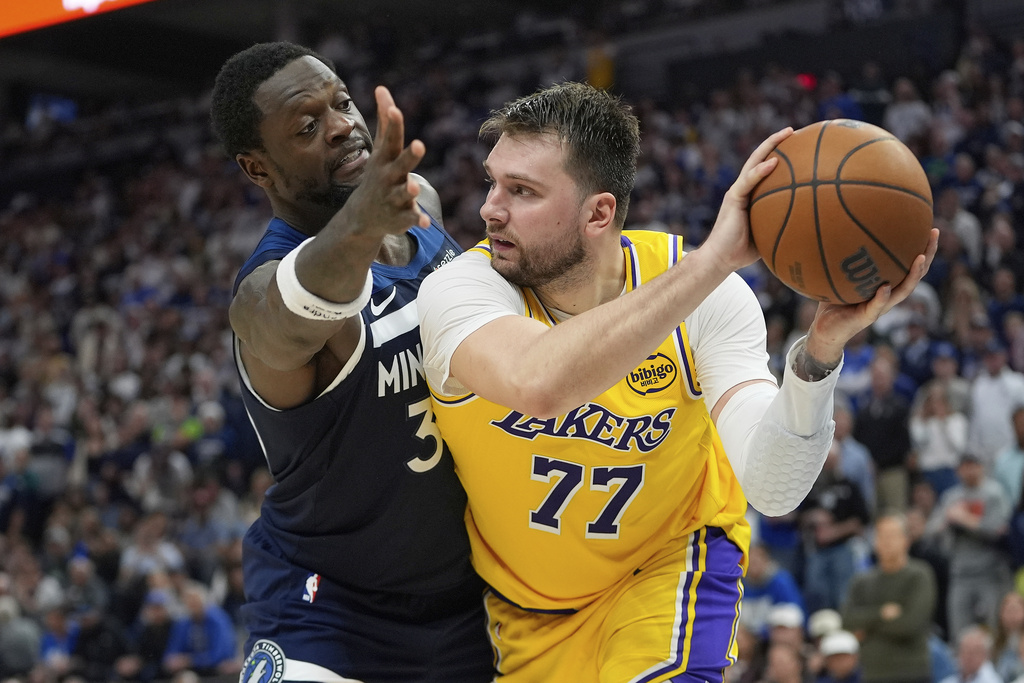
Luka Doncic didn’t get injured in Game 2, but he went down to the deck after Jaden McDaniels tripped him up with a leg lock.

Who knows what else is to come. None of those plays are directly linked to a loosened playoff whistle, but it’s all far more likely so when so much is allowed. Players are getting fouled, but the “playoff whistles” aren’t recognizing the illegal contact. At that point, players will continue to push the boundaries to see exactly what is allowed, or they can grow frustrated and make a reckless decision out of sheer emotion that they otherwise may not make.

No one is going to complain about fewer hand check calls on the perimeter. And people don’t mind that the offensive flopping and gamesmanship — which is supposed to be cleaned up during the regular season, as well — frequently isn’t recognized in the postseason.

You certainly do not want officials to determine playoff games, but when they repeatedly ignore illegal contact that inhibits the offense from executing, that too is determining the outcome.

Frankly, excessive grabbing and holding sometimes removes skill from the equation. If mugging is allowed, suddenly anyone can defend. At that point, the true art of good defense is minimized.

Even in a physical game, it shouldn’t be difficult to differentiate basketball from wrestling.

“All these things bother you if you let them,” Finch said. “My problem with it right now is it feels out of context. It feels like it’s not the right type of physicality that we’re trying to integrate into our game. We’ll just have to keep working through it.”

If the NBA is even motivated to do so. Finch noted this is what the league seems to want. Though perhaps the NBA’s will may change as more star players miss marquee games because of seemingly preventable injuries. How games are officiated this weekend, and moving forward in these playoffs, will be telling.

“You play 82 games in a certain way and then they flip switch,” Finch said. “And I do worry about the ability to be able to control that.”

Related Articles


Target Center was a house of horrors for Timberwolves in last year’s playoffs. Can they turn that around?


One game into the series, the Timberwolves threw away their offensive blueprint. Can they get it back?


Rudy Gobert continues to drive Wolves’ defensive success against Lakers


Lakers bamboozled Anthony Edwards and Minnesota again. What’s the solution?


Timberwolves can’t match Lakers’ physicality in Game 2 defeat

Justice Department to resume issuing subpoenas to journalists as part of leaks crackdown, Bondi says

posted in: All news | 0

By ERIC TUCKER and ALANNA DURKIN RICHER

WASHINGTON (AP) — The Justice Department is poised to crack down on leaks of information to the news media, authorizing prosecutors to issue subpoenas to news organizations as part of leak investigations, serve search warrants when appropriate and force journalists to testify about their sources.

New regulations, announced by Attorney General Pam Bondi in a memo to the workforce obtained by The Associated Press on Friday, rescind a Biden administration policy that protected journalists from having their phone records secretly seized during leak investigations — a practice long decried by news organizations and press freedom groups.

The new regulations assert that news organizations must respond to subpoenas “when authorized at the appropriate level of the Department of Justice” and also allow for prosecutors to use court orders and search warrants to “compel production of information and testimony by and relating to the news media.”

The memo says members of the press are “presumptively entitled to advance notice of such investigative activities,” and subpoenas are to be “narrowly drawn.” Warrants must also include “protocols designed to limit the scope of intrusion into potentially protected materials or newsgathering activities,” the memo states.

“The Justice Department will not tolerate unauthorized disclosures that undermine President Trump’s policies, victimize government agencies, and cause harm to the American people,” Bondi wrote.

The regulations come as the Trump administration has complained about a series of news stories that have pulled back the curtain on internal decision-making, intelligence assessments and the activities of prominent officials such as Defense Secretary Pete Hegseth. Tulsi Gabbard, the director of national intelligence, said Wednesday that she was making a trio of referrals to the Justice Department over disclosures to the media.

The policy that Bondi is rescinding was created in 2021 by then-Attorney General Merrick Garland in the wake of revelations that the Justice Department officials ls alerted reporters at three news organizations — The Washington Post, CNN and The New York Times — that their phone records had been obtained in the final year of the Trump administration.

Related Articles


Judge blocks Trump administration from nixing collective bargaining for most federal employees


19 states sue Trump administration over push to end diversity programs in public schools


Trump keeps contradicting himself on tariffs, making a fragile world economy nervous


Environmental groups fear Trump’s order to speed deep-sea mining will harm ecosystems


How the public’s shift on immigration paved the way for Trump’s crackdown

The new regulations from Garland marked a startling reversal concerning a practice that has persisted across multiple presidential administrations. The Obama Justice Department, under then-Attorney General Eric Holder, alerted The Associated Press in 2013 that it had secretly obtained two months of phone records of reporters and editors in what the news cooperative’s top executive called a “massive and unprecedented intrusion” into newsgathering activities.

After blowback, Holder announced a revised set of guidelines for leak investigations, including requiring the authorization of the highest levels of the department before subpoenas for news media records could be issued.

But the department preserved its prerogative to seize journalists’ records, and the recent disclosures to the news media organizations show that the practice continued in the Trump Justice Department as part of multiple investigations.

With Game 4 ahead, a quartet of keys for the Wild

posted in: All news | 0

The Wild were leading their last two first-round playoff series 2-1, in 2022 against St. Louis and 2023 against Dallas. Something they didn’t do in either series was win Game 4, and they wound up losing both in six games.

Up 2-1 on Vegas, Minnesota has a chance to change that narrative on Saturday at Xcel Energy Center.

“We were up 2-1 the last two playoff series we were in,” Wild forward Matt Boldy said following the team’s optional skate on Friday afternoon at TRIA Rink. “It doesn’t matter. It’s that time of year where every goal, every play, every puck matters.”

So with Game 4 looming as a pivot point between a massive 3-1 advantage in the series and a 2-2 tie which would hand the home ice advantage back to the Golden Knights, here are a quartet of keys that will likely matter on Saturday afternoon in St. Paul.

1) Stay healthy

After a regular season defined by injuries — most notably the losses of Kirill Kaprizov and Joel Eriksson Ek for what amounted to nearly a full campaign of man-games — the Wild have been healthy for almost ⅔ games in the playoffs. A hard hit on second line winger Marcus Johansson on Thursday kept him off the ice for much of the third period, and head coach John Hynes didn’t have an update on Friday.

“I would say questionable right now,” Hynes said. “We’ve just had some initial talks on (how we’d respond) because I’m not sure that he is going to be out. So, I’ll wait until we get a little bit more feedback from the trainers here.”

Johansson has been a key player on a penalty kill that has been very good in the playoffs after a regular season filled with struggles. Replacement options include Liam Ohgren and Devin Shore.

2) Gus the guardian

With the Wild leading 2-0 in the first period on Thursday, Filip Gustavsson allowed a regrettable that he regretted and let the Knights grab back some momentum. After that, he was spectacular, finishing with 30 saves in a 5-2 victory.

“I was a little mad at myself after that first period, but I got it back and the guys helped out by scoring early and having the momentum and riding that wave throughout the game,” he said. “You can say ‘I’m pretty stupid’ and stuff like that first, and then it’s not going to help, mourning about it. Now it’s just next shot, and the next shot came down and I got it in the stomach there and never looked back.”

Gustavsson has been vital, while Vegas made an in-game goalie change on Thursday. Riding a hot goalie is the surest route to Round 2 for either team.

3) Feed off the energy

Gustavsson said he was blown away by the Game 2 crowd in St. Paul.

“It’s very fun. You know, you can’t hear anything,” Gustavsson said. “They’re screaming there at the end of the game and the puck comes down and you have no clue what the D’s going to do. Usually we talk to each other, and you hear nothing — just screaming from the crowd.

“It was a big difference from going to Vegas. I didn’t think that building was as loud as I expected it to be and then you come here and you can’t hear anything, so it’s very fun.”

Saturday will be the first time in this series that the third period will end before most Minnesotans’ bedtime, and a spring day in the State of Hockey should mean plenty of home crowd energy once again.

4) Keep Vegas reeling

After winning the Pacific Division with a deep team that can roll four lines without much drop-off, the Golden Knights were a popular pick among the wagering crowd to hoist the Stanley Cup for the second time in three years.

Trailing by a goal in the second period Thursday night, the Knights pushed and pushed and pushed, and it looked as if a tie game was imminent. Instead, Gustavsson kept them off the board long enough for Boldy to make it 3-1 on a massive hustle play, and Kirill Kaprizov scored a power-play goal with 1.3 seconds left in the period to make it 4-1.

“We’re going into the room as a team and it’s like, ‘We’re down 4-1 after that period? What the hell just happened?’” Knights coach Bruce Cassidy said. “But that’s hockey some nights. We’ve got to re-group and create (our) own breaks. They did and took advantage of them.”

The Wild haven’t won a first-round playoff series since 2015. Taking a 3-1 series lead back to the desert would go a long way toward changing that.

Related Articles


Wild jump Vegas early in Game 3 to take a 2-1 series lead


Knights, Wild coaches balance stats and video with gut feelings


NHL playoffs: Wild’s top line has gotten better of Knights


Wild dominate Vegas early, even series 1-1


Wild want ‘shot mentality’ to foil Vegas’ block party