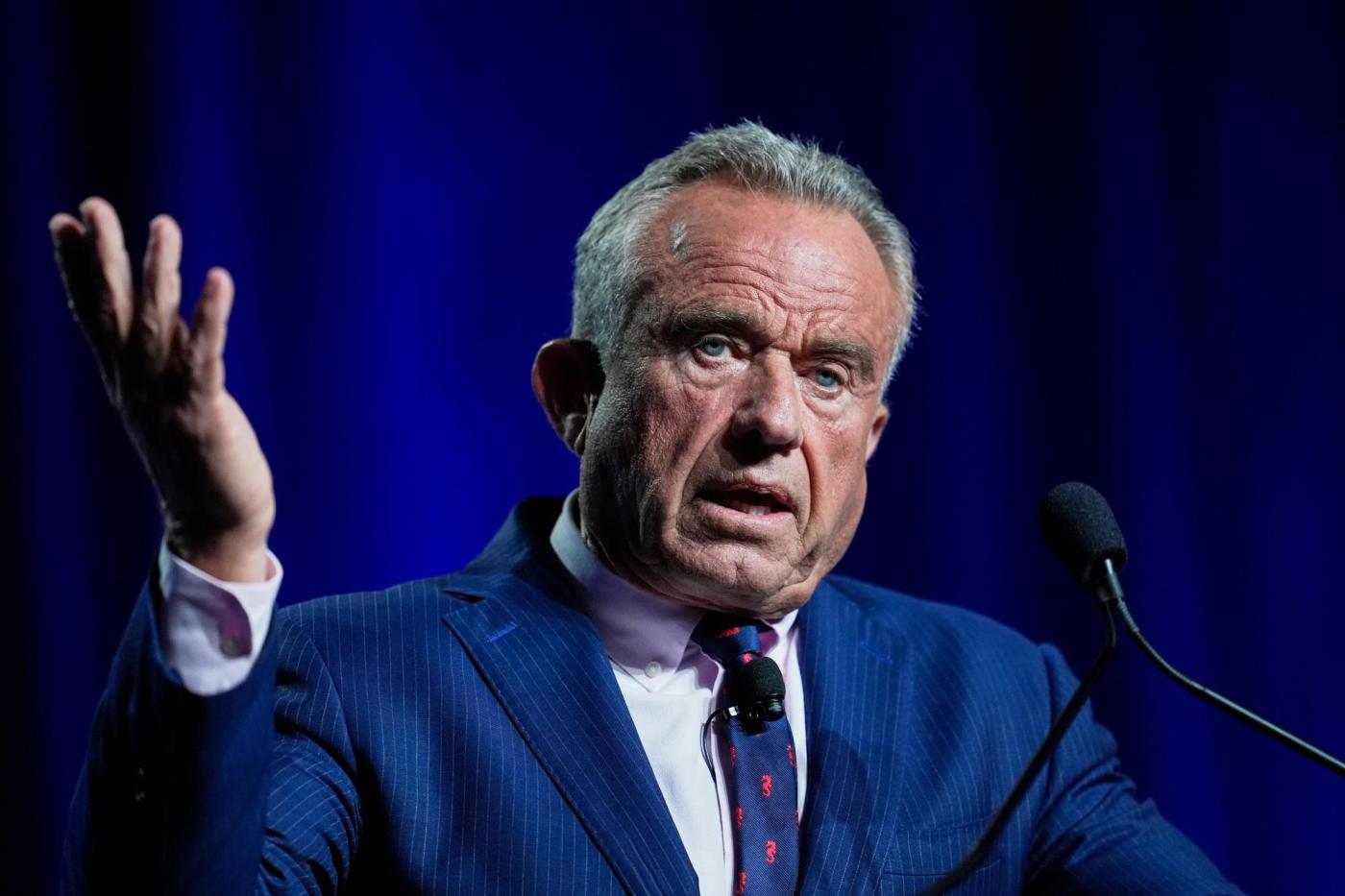
David French: Donald Trump thinks he won’t have enough power?

posted in: Politics | 0

These are the times that try a constitutional conservative’s soul.

Donald Trump and his allies have proposed two legal maneuvers that could have profound consequences for the function of the federal government. He has proposed confirming presidential appointments through an abuse of his power to make recess appointments, and his allies have proposed reviving a mostly banned practice called impoundment, under which the president can refuse to spend money appropriated by Congress.

These proposals together would gut core constitutional functions of Congress and could make Trump our nation’s most imperial peacetime president.

You can’t fully comprehend how pernicious these proposals are without knowing Congress’ intended role in our republic. If you read the Constitution carefully, you see that the United States was not intended to have coequal branches of government. Instead, it is clear that the branch of government closest to the people, Congress, was given more power than any other.

While other branches can check Congress’ power — the president can veto bills and the Supreme Court can use the power of judicial review to invalidate statutes passed by Congress, to give the most obvious examples — Congress’ enumerated powers surpass those of both the president and the court.

Article I, Section 7 of the Constitution says, “All Bills for raising Revenue shall originate in the House of Representatives.” This constitutional provision is particularly important, given that in the original Constitution the House was the only part of the federal government chosen directly by the people. The power of the purse is inseparable from democratic rule.

Congress has the sole constitutional power to declare war, even if presidents frequently usurp that authority. It can fire the president, executive officers and judges through impeachment and conviction. It can override presidential vetoes, and the Senate can reject presidential appointees.

But if Trump gets his way, he will have the power to nullify congressional enactments, even if they’re passed with veto-proof majorities. He’ll destroy the Senate’s advice and consent authority. He’ll make the executive the most powerful branch of government by far, creating a version of monarchical government that the founders despised.

In Federalist No. 1, Alexander Hamilton warned that “of those men who have overturned the liberties of republics, the greatest number have begun their career by paying an obsequious court to the people; commencing demagogues, and ending tyrants.” A similar pattern is playing out here — claiming a popular mandate, Trump is now threatening to further diminish American democracy.

In one version of a Trump recess plan, Trump could pressure the Republican majority in the Senate to agree with the House to adjourn, granting Trump the ability to make immediate recess appointments. This is the clear message of Trump’s post on the subject on Truth Social. He wants the Republican leader to agree to an adjournment, thus forfeiting the Senate’s constitutional role.

But if the Senate holds firm, Trump theoretically has another option. He could conspire with the speaker of the House, Mike Johnson, to request that Congress enter into a recess. If the Senate refuses a recess, then he’ll rely on Article II, Section 3 of the Constitution — which provides that the president can adjourn Congress “to such time as he shall think proper” if the two chambers disagree about the timing of a recess — and then use his constitutional power to make recess appointments without the Senate‘s advice or consent.

The recess appointments wouldn’t be permanent. They’d lapse at the beginning of the next congressional term, but he could have his handpicked team for up to two years, and there is nothing the Senate could do about it, at least according to Trump’s theory.

The compelling purpose of ‘advice and consent’

The founders never intended for Article II, Section 3 to permit the president to shut down Congress and name his Cabinet without Senate approval. Recess appointments were created to permit presidents to fill vacancies when Congress was out of session in a large nation, when travel was often slow and difficult.

When legislators were traveling by horseback to Washington, permitting recess appointments made a degree of sense. It could be weeks before Congress could assemble. But now it takes hours, less when they assemble online.

There is no meaningful question about whether Trump’s scheme violates the spirit of the Constitution. Advice and consent exists precisely because the founders believed that a president should not possess unchecked power to name his team.

In Federalist No. 76, Hamilton wrote that the advice and consent power is “an excellent check upon a spirit of favoritism in the president, and would tend greatly to prevent the appointment of unfit characters from state prejudice, from family connection, from personal attachment, or from a view to popularity.”

In fact, a key purpose of the power is to prevent the confirmation of exactly the kind of obsequious yes men with whom Trump surrounds himself. Hamilton warned against the selection of nominees who have “no other merit” than “being in some way or other personally allied to him, or of possessing the necessary insignificance and pliancy to render them the obsequious instruments of his pleasure.”

Justice Scalia’s reasoning

Trump’s potential scheme violates the letter of the Constitution as well. In a 2014 case called National Labor Relations Board v. Noel Canning, the Supreme Court unanimously rejected President Barack Obama’s recess appointment of three members of the National Labor Relations Board. A majority of the court held that even when the Senate was in a mere “pro forma” session — when no formal business was conducted — it was not technically “in recess,” and thus the recess appointment power wasn’t available to the president.

Four members of the court, however, went further. In a persuasive concurrence, Justice Antonin Scalia argued that the recess appointments clause covered only the space between congressional sessions, not breaks within the session. Chief Justice John Roberts, Justice Samuel Alito and Justice Clarence Thomas all joined with Scalia.

According to this reasoning, even if Trump engineered a disagreement between the House and the Senate and forced a recess, his recess appointment power wouldn’t attach because the recess occurred after the congressional term started.

Yes, that’s a concurrence — and concurrences aren’t binding law — but the current court’s jurisprudence is far more aligned with Scalia’s than it is with that of Justice Stephen Breyer, the author of the Canning majority. It is highly unlikely that a Roberts-led court would abandon Scalia’s logic and rubber-stamp an obvious end-run around one of the Senate’s core constitutional powers.

‘Impoundment’

Now let’s talk about impoundment. During earlier periods of American history, presidents would sometimes refuse to spend money appropriated by Congress. This process, which came to be called impoundment, could give presidents the ability to nullify acts of Congress, even if the act passed with a veto-proof majority.

Imagine that Congress passed a statute mandating the construction of a new bridge across the Potomac, at a cost of $200 million. If impoundment were a real option, the president could simply choose not to spend the money, block construction of the bridge and frustrate the will of Congress.

American presidents periodically used impoundment to block the use of appropriated funds until 1974, when Congress largely banned the practice through the Impoundment Control Act. The act was passed after Richard Nixon frustrated Congress by impounding funds more than his predecessors, blocking spending for multiple programs across several federal agencies.

The constitutional justification is obvious. It prevents the president from exercising an unconstitutional version of a veto. Nonetheless, in a Wall Street Journal essay last week, Elon Musk and Vivek Ramaswamy — the two men Trump named to lead his new Department of Government Efficiency — raised the prospect of reviving impoundment. They suggested it was the Impoundment Control Act itself that was unconstitutional.

Russ Vought, Trump’s former director of the Office of Management and Budget (and the man Trump has chosen to choose to lead the OMB again), is an enthusiastic supporter of impoundment. The Center for Renewing America, which Vought founded in 2021, has published a raft of materials attacking the constitutionality of the Impoundment Control Act.

I very much want to limit the growth of government spending, but not at the expense of our constitutional structure. There is no authority for impoundment in the text of the Constitution. The president’s principal check on Congress is the veto, and the process for vetoes (and for overriding them) is plainly detailed in the text.

A consequence of Congress’s abdication

Related Articles

Opinion |


Jamelle Bouie: It’s a republican form of government, not a monarchy. With explicit intent

Opinion |


Nolan Finley: Musk hopes to make budget cutting cool

Opinion |


Other voices: Senate shouldn’t abdicate its authority over presidential nominees

Opinion |


Matthew Yglesias: There’s a better way to fix school problems than abolishing the Education Department

Opinion |


Sean Higgins: To solve burgeoning retail theft problem … more machines? Probably not

One of the reasons American democracy is under duress is that Congress has spent decades abdicating its power to the president. Congressional inaction has created a power vacuum that presidents and courts have been only too eager to fill.

Unilateral executive action elevates the power of the presidency, increases the stakes of each presidential election and sidelines our nation’s most democratic branch of government. According to Trump and his team, however, Congress has not abdicated enough power. They want the president to get the yes men and women he wants in government, no matter how corrupt or unqualified. They want the president to block government spending, no matter if Congress has mandated the expenditure.

Trump isn’t in office yet. We don’t know whether he’ll follow through on his threats and try to engineer a recess or impound funds. But his threats are still destructive. He’s trying to cow Congress into becoming an extension of his own will and desires. And if the Republican-led Congress capitulates, the party that long prided itself on constitutional fidelity will become an instrument of its decline.

David French writes a column for the New York Times.

Today in History: November 26, Mumbai terror attacks of 2008 begin

posted in: Society | 0

Today is Tuesday, Nov. 26, the 331st day of 2024. There are 35 days left in the year.

Today in history:

On Nov. 26, 2008, teams of heavily armed militants from the terrorist group Lashkar-e-Taiba stormed luxury hotels, a popular restaurant and a crowded train station in Mumbai, India, leaving at least 175 people dead (including nine of the attackers) in a rampage spanning four days.

Also on this date:

In 1791, President George Washington held his first full cabinet meeting; in attendance were Secretary of State Thomas Jefferson, Secretary of the Treasury Alexander Hamilton, Secretary of War Henry Knox and Attorney General Edmund Randolph.

Related Articles


Today in History: November 25, John F. Kennedy laid to rest at Arlington


Today in History: November 24, Jack Ruby shoots Lee Harvey Oswald


Today in History: November 23, former KGB spy and Putin critic dies in London


Today in History: November 22, John F. Kennedy is assassinated in Dallas


Today in History: November 21, Las Vegas hotel fire claims 85 lives

In 1864, English mathematician and writer Charles Dodgson presented a handwritten and illustrated manuscript, “Alice’s Adventures Under Ground,” to his 12-year-old friend Alice Pleasance Liddell; the book was later turned into “Alice’s Adventures in Wonderland,” published under Dodgson’s pen name, Lewis Carroll.

In 1917, the National Hockey League was founded in Montreal, succeeding the National Hockey Association.

In 1941, U.S. Secretary of State Cordell Hull delivered a note to Japan’s ambassador to the United States, Kichisaburo Nomura (kee-chee-sah-boor-oh noh-moo-rah), setting forth U.S. demands for “lasting and extensive peace throughout the Pacific area.” The same day, a Japanese naval task force consisting of six aircraft carriers left the Kuril Islands, headed toward Hawaii.

In 1942, the film ‘Casablanca,’ starring Humphrey Bogart and Ingrid Bergman, premiered at the Hollywood Theater in New York City.

In 1973, President Richard Nixon’s personal secretary, Rose Mary Woods, told a federal court that she’d accidentally caused part of the 18-1/2-minute gap in a key Watergate tape.

In 2000, Florida Secretary of State Katherine Harris certified George W. Bush the winner over Al Gore in the state’s presidential balloting by a 537-vote margin.

Today’s Birthdays:

Impressionist Rich Little is 86.
Football Hall of Famer Jan Stenerud is 82.
Author Marilynne Robinson is 81.
Bass guitarist John McVie (Fleetwood Mac) is 79.
Football Hall of Famer Art Shell is 78.
Sen. Shelley Moore Capito, R-W.Va., is 71.
Football Hall of Famer Harry Carson is 71.
NASCAR Hall of Famer Dale Jarrett is 68.
Country singer Linda Davis is 62.
Actor-TV personality Garcelle Beauvais is 58.
Actor Peter Facinelli is 51.
DJ-music producer DJ Khaled (KAL’-ehd) is 49.
Country musician Joe Nichols is 48.
Pop singer Natasha Bedingfield is 43.
Actor-singer-TV personality Rita Ora is 34.

Winnipeg wins another round in its on-going battle with Wild

posted in: News | 0

Alongside the normal postgame announcements encouraging fans to check around their seats for misplaced items, and to drive safely on the way home from the rink, the Xcel Energy Center public address announcer would have been wise to offer this disclaimer about the hot and getting hotter rivalry between the Minnesota Wild and Winnipeg Jets:

“To be continued … ”

Winnipeg rallied for a 4-1 win on Monday night in a wildly entertaining sprint to the final horn between the top two teams in the Western Conference – and featuring arguably the world’s best goalie right now. Jets puck-stopper Connor Hellebuyck was the story, as he denied all but one of the Wild’s 44 shots on goal, and solidified his credentials as the driving force behind Winnipeg’s ascension to the top of the NHL standings.

These Central Division foes will have one more border battle a few days before Christmas in Winnipeg, and they seem predestined to meet again in the spring when the NHL playoffs roll around.

On Monday the Wild took an early lead on defenseman Jake Middleton’s fourth goal of the season, and they got 30 saves of their own from Filip Gustavsson. But the advantage was short-lived, as Winnipeg forged a tie, killed penalties and stopped rush after rush by Minnesota, taking the lead in the second period and locking things down for the final 20 minutes.

“We came out flying. We threw the kitchen sink at him, … and it’s disappointing. But there’s positives we can take from it,” Middleton said.

Former Minnesota Duluth standout Alex Iafallo scored his 99th and 100th career goals for the Jets, icing things with a power-play marker in the late stages of the third.

Hellebuyck, who is from suburban Detroit and was named college hockey’s best goalie after his 2013-14 season at Massachusetts-Lowell, made his NHL debut nearly nine years ago to the day with a win over the Wild in Minnesota, and has continued that habit throughout his career. Monday’s game marked his fifth straight victory over the Wild, as Winnipeg opened up a six-point lead in the Central Division standings.

“It’s always tight games against these guys, I feel like,” Wild forward Marcus Johansson said. “And you know, we wanted to get the upper hand tonight and show that we can play with everyone. But I mean, even though we did show that, we didn’t get the two points. We didn’t get the win, and that’s frustrating.”

Both goalies were tested early and often, with the Wild opening the scoring when Jake Middleton fired home the rebound of a Johansson shot. Winnipeg answered a short time later when Iafallo backhanded a puck past Gustavsson.

The Wild recorded 22 shots in the first, which was one shy of the team record, set in 2018, also versus Winnipeg.

“I think the shot guy fell asleep on the button. Minnesota, they throw a lot of pucks to the net front. I mean, we went and looked at our scoring chances, and it certainly didn’t reflect what all of the shots that were coming,” Jets coach Scott Arniel said. “But they are a team that likes to throw pucks there, with bodies around there. I thought we did do a really good job there of finding a lot of the rebounds and kind of clearing them out.”

The shots, and Hellebuyck’s saves, kept coming in the second, as the Winnipeg goalie held Minnesota off the board and former Wild forward Nino Neiderreiter popped a backhander over Gustavsson’s left shoulder to give the Jets their first lead.

Then the Wild offense cooled, and they needed more than seven minutes in the third to test Hellebuyck again. The Wild managed just five shots in the third period, as Adam Lowry added an empty-net goal with 63 seconds remaining.

“I think we gotta take some things out of it. I think there’s more good than bad out of the game, but you gotta take lessons out of everything,” Wild coach John Hynes said. “Each game is an opportunity to test yourself in different situations. I thought we did lots of good things. There’s some things we can grow from the game. We got a lot of hockey this week, too, so we gotta put this one behind us.”

Perhaps the best news of the night for Wild fans came before the game ever started, when scoring star Kirill Kaprizov returned to the lineup following a one-game absence.

Injured by a nasty knee-on-knee hit in Minnesota’s 5-3 win in Edmonton last Thursday, Kaprizov missed the Wild’s 4-3 shootout loss in Calgary two days later, but no serious injury was found when he was evaluated by team doctors upon returning from the road trip. Forward Marat Khusnutdinov, also injured in Edmonton, missed his second consecutive game and has been classified as day-to-day with a lower body ailment.

Wild forward Jakub Lauko left Monday’s game early with a lower body injury as well. Hynes said he did not immediately know Lauko’s status for their Wednesday game in Buffalo, but noted that reserve forward Travis Boyd is available if needed.

Following the one-game road trip to face the Buffalo Sabres, the Wild have back-to-back home games with Chicago on Friday and Nashville on Saturday.

Related Articles

Minnesota Wild |


Jets showdown an early season preview of the playoffs?

Minnesota Wild |


Snowy sprint in Calgary helps Travis Boyd’s childhood dream come true

Minnesota Wild |


Without Kirill Kaprizov, Wild rally to salvage a point in Calgary

Minnesota Wild |


We’re quickly moving beyond ‘hot start’ territory

Minnesota Wild |


Marc-Andre Fleury’s game still blooms in new Wild role

HDPAC FILED A BILLION-DOLLAR LAWSUIT AGAINST THE AMERICAN RED CROSS FOR MISMANAGEMENT OF HAITI EARTHQUAKE RELIEF FUNDS

posted in: News | 0

Washington, DC  – On Monday, November 25, 2024, the law firm of Morris Legal, LLC in Miami filed a billion-dollar lawsuit against The American Red Cross and related entities on behalf of the Haitian Diaspora Political Action Committee (HDPAC), along with individual plaintiffs representing millions of donors and beneficiaries. (click here to Read Complaint)

The class action lawsuit filed in the United States District Court for the Southern District of Florida came 14 years after the Red Cross had collected nearly half a billion dollars on behalf of the 2010 earthquake victims in Haiti and built six homes.  

The lawsuit alleges that the American Red Cross, the International Red Cross, and related entities, including their leadership, mismanaged and misappropriated over $500 million in funds raised for Haiti’s 2010 earthquake recovery efforts, and from 2010 to 2024, the American Red Cross continued to raise money on behalf of Haiti under false pretenses.

The plaintiffs assert that these funds were diverted for unrelated projects and administrative expenses, contrary to the promises made to donors, the people of Haiti, and the public at large.

The Complaint claims that despite raising significant funds for Haiti’s recovery, the defendants failed to deliver on commitments to rebuild critical infrastructure, such as homes, schools, and hospitals. The lawsuit alleges that the funds were instead used to cover existing organizational deficits and other non-Haiti-related initiatives, with limited or no tangible impact on the affected communities.

Key Allegations in the Complaint include:

Mismanagement of Donor Contributions: The Complaint asserts that most of the $500 million raised for Haiti’s earthquake recovery did not benefit the intended recipients or projects.Deceptive Fundraising Practices: The lawsuit alleges that the defendants misrepresented the intended use of the funds by appealing to donors through emotionally charged campaigns that promised direct assistance to Haitians.Conspiracy to Defraud Donors and Beneficiaries: According to the Plaintiffs, the Red Cross conspired with its partners and other subsidiaries to defraud both the donors and beneficiaries of the funds. From 2010 to 2024, the Red Cross continued to publish false information designed to cover the conspiracy.Failure to Account for Funds: According to the plaintiffs, the Red Cross and affiliated entities still need to provide a transparent accounting of how the funds were spent.

The plaintiffs seek over 750 million dollars in compensatory damages, $250 million in punitive damages, and a complete accounting of every penny raised for Haiti.

The Complaint also requests injunctive relief to ensure that future fundraising campaigns by the defendants are conducted with transparency and accountability. The lawsuit emphasizes the importance of holding large international organizations accountable for fulfilling their commitments to vulnerable communities and ensuring that donor trust is not abused.

“The Red Cross and other NGOs are poverty pimps who get rich out of the misery and misfortune of the Haitian people. I am tired of these organizations taking advantage of Haiti and its people. The Red Cross raised half a billion dollars for Haiti and built six homes. We need to know where the money went. The Haitian people deserve an explanation. The donors deserve to know how their money was spent. Every single penny raised on behalf of Haiti must be accounted for. The Red Cross needs more transparency in how they raise and spend money on behalf of poor communities.” Emmanuel Roy, Director of Communications, HDPAC.

About the Haitian Diaspora Political Action Committee (HDPAC):

HDPAC is a political advocacy organization representing Haitian Americans and the global Haitian Diaspora. The group is dedicated to promoting justice, accountability, and sustainable development for Haiti and its people.

HDPAC is the most active Haitian Diaspora organization, having organized the Louisiana Unity Summit in 2021, and more recently, the organization was invited by the Organization of American States (OAS) to participate in a discussion on how the Haitian Diaspora can participate in the next elections in Haiti. The Haitian government invited HDPAC to take the lead on Diaspora participation in the next elections. HDPAC has been leading the charge to protect the interests of the Haitian Diaspora and the people of Haiti. In September 2024, HDPAC filed a lawsuit against Donald Trump and JD Vance for conspiracy to violate the civil rights of Haitian immigrants living in Springfield, Ohio (click here for a copy of the Complaint).

For more information about HDPAC, visit their website at www.hdpac.org.