
The next pope will inherit Pope Francis’ mixed legacy with Indigenous people

posted in: All news | 0

By PETER SMITH

Whoever succeeds Pope Francis will inherit his momentous and controversial legacy of relations with Indigenous people throughout the Americas.

Related Articles


Liberals won the election in Canada. Here’s what to know and what comes next


If Trump abandons Ukraine, can Europe help Kyiv fight on? The clock is ticking to answer that


Ukraine says Russia hits civilians again as Kyiv derides Putin’s 3-day truce offer


What is a conclave? What to know about the secretive process to elect the next pope


Disgraced Cardinal Becciu formally withdraws from participation in conclave to elect pope

Some found Francis to be a reconciling figure, others a disappointment. Even those who applauded the actions he took during his 12-year papacy said they were just a beginning, and that his successor will need to continue to work toward healing.

Francis, who died April 21, at age 88 issued a historic apology for the “catastrophic” legacy of residential schools in Canada and oversaw the repudiation of the “Doctrine of Discovery” — the collective name given to a series of 15th-century papal decrees that legitimized colonial-era seizure of Native lands.

But some Indigenous leaders criticized him as slow to fully recognize the traumatic impact of Catholic missionary efforts and for canonizing Junipero Serra, the 18th-century missionary accused of mistreating Native people in present-day California.

Even Francis’ admirers says his work is unfinished

“It’s 150 years of trauma. It’s going to take us a bit of time to recover,” said Wilton Littlechild, a residential school survivor and former Grand Chief of the Confederacy of Treaty Six First Nations in Canada. “He put us on a real strong path to reconciliation, but it can’t stop.”

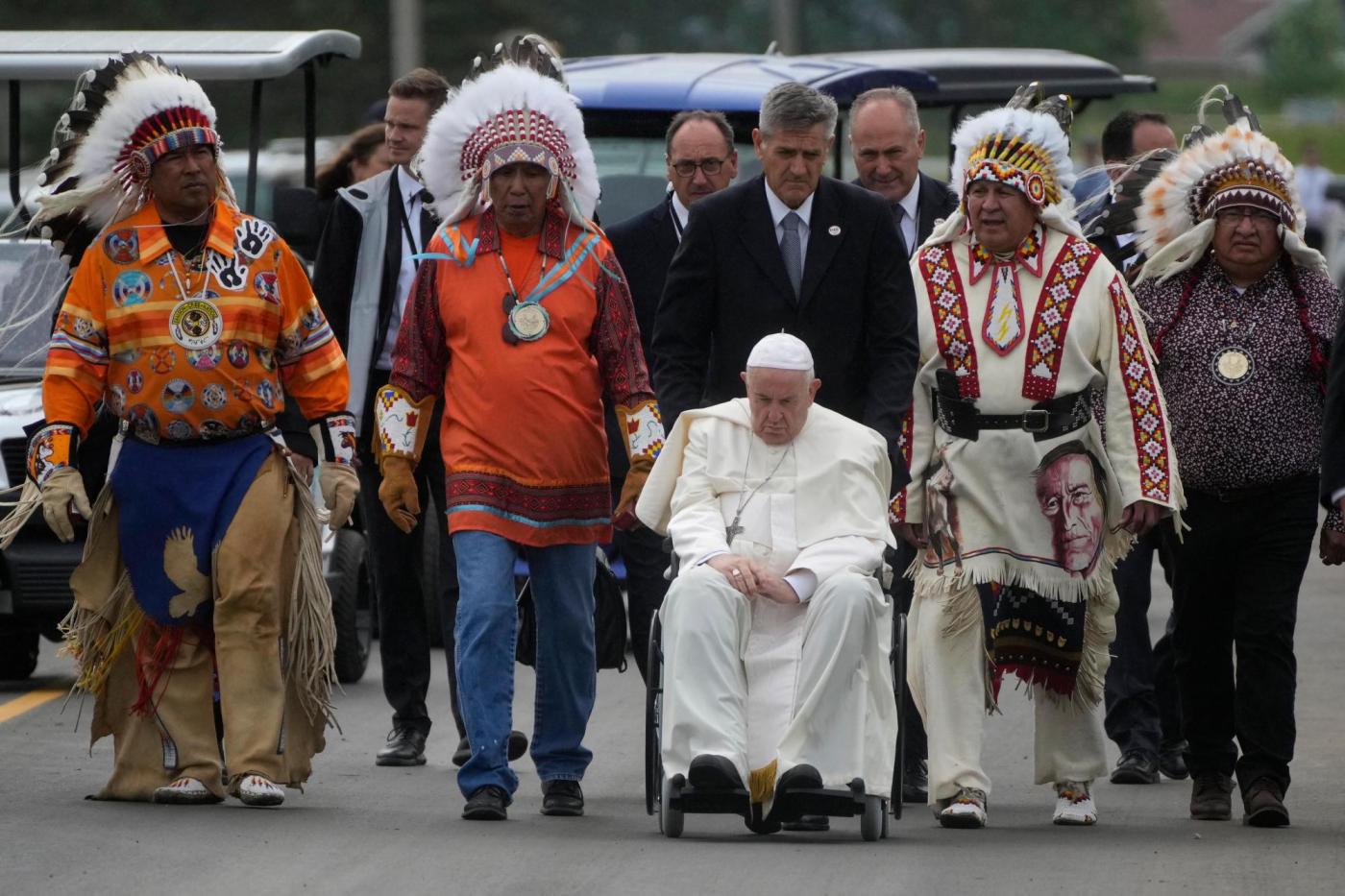
Perhaps the most dramatic of Francis’ encounters with the Indigenous community occurred on a July day in 2022 in Maskwacis, a small town in the Canadian province of Alberta and the hub of four Cree nations.

There, Pope Francis paid respects at a cemetery near a former residential school for Indigenous children. He then delivered a long-sought apology for Catholic complicity in the 19th- and 20th-century residential school system for the First Nations, Metis and Inuit people of Canada.

“I am deeply sorry, sorry for the ways in which, regrettably, many Christians supported the colonizing mentality of the powers that oppressed the Indigenous peoples,” Francis said.

The Rev. Cristino Bouvette recalled being unexpectedly emotional at that moment.

Bouvette, an Alberta priest of Cree and Metis heritage who was liturgical coordinator for the pope’s Canada visit, recalled hearing the applause and seeing some onlookers weeping.

Bouvette said his late grandmother had attended a residential school and never felt the pope needed to apologize — but he, too, began to weep.

“My thoughts immediately turned to my grandmother,” he said. “I think she would have been deeply touched had she been alive to hear those words herself, despite her not thinking it needed to happen.”

The first pope from the Americas also offered an apology in Bolivia for Catholic complicity in colonialism and he supported the use of Indigenous languages and customs at Catholic liturgies in Mexico.

Francis “was a human being who tried to love and respect and honor people,” advocating for the poor and migrants, said Valentin Lopez, chairperson of the Amah Mutsun Tribal Band in California. “But regarding the Native Americans specifically, there’s a number of negative items that were pretty much totally ignored by the pope, and for that we’re disappointed.”

Kenneth Deer — a Mohawk activist from Canada who was part of a Native delegation that urged Francis in 2016 to rescind the Doctrine of Discovery — saw Francis as “very progressive, and he could have been more progressive if the Vatican wouldn’t hold him back.”

Deer noted that while the church was unwilling to state that the residential schools were an act of genocide, Francis was willing to say that in personal remarks.

“That’s who you want to listen to, the unscripted Pope Francis,” Deer said.

Francis’ successor will need “to continue working, continue to evolve,” said Deer. “You have to change.”

Mixed messages? Some activists said that was a problem

Visiting Bolivia in July 2015, Francis asked forgiveness “not only for the offenses of the church herself, but also for crimes committed against the Native peoples during the so-called conquest of America.”

Later that year in his only U.S. visit, Francis officially declared Serra to be a saint.

Many Native activists lambasted the canonization, calling the missionary priest a prime culprit in what Francis had just apologized for in Bolivia — complicity with destructive colonization.

Serra founded California’s historic missions, where thousands of Native Americans were converted. But some were also whipped for misbehaving or trying to flee. The missions became centers for horrific disease outbreaks, with mass fatalities.

“Saintly people are supposed to live lives that we are supposed to emulate,” Lopez said. “How can those actions be considered saintly?”

Lopez, whose Amah Mutsun Tribal Band includes descendants of those who lived in the spheres of influence of two California missions, had written multiple times to Pope Francis, unsuccessfully urging him to cancel the canonization.

Defenders of Serra’s canonization said he wasn’t perfect but had exemplary qualities. Francis contended that Serra actually defended “the dignity of the Native community” from the threat of worse treatment by secular Spanish colonial authorities.

Historic Canada trip

In 2022, Francis addressed the Catholic Church’s operation of residential schools, which shattered Indigenous children’s ties to family and culture in the 19th and 20th centuries. Canada’s National Centre for Truth and Reconciliation documented more than 4,000 child deaths at residential schools, and some experts believe the number is much higher.

Della Lizotte, whose parents attended a residential school, welcomed Francis’ apology.

“For me, it felt genuine,” said Lizotte, an elder in Sacred Heart Church of the First Peoples in Edmonton, Alberta, which the pope also visited. “I just wish it had been sooner, because my parents had already passed away and they would have really appreciated hearing that.”

The event sparked controversy when Littlechild presented Pope Francis with a ceremonial headdress. Historically, the headdress has been a symbol of respect, worn by Native American war chiefs and warriors. Some Native commentators found the image jarring.

Littlechild said the pope’s apology enabled him to forgive the church for his own experiences during 14 years in a residential school.

“When I gave him the headdress as a gift from our people, I told him, ‘I forgive for what happened to me as a child,’” he said. “And many people have told me since then that it was a new journey for them to heal from the traumas.”

Doctrine of Discovery

In 2023, the Vatican formally repudiated the Doctrine of Discovery, which legitimized colonial-era seizure of Native lands by Spain and Portugal. The concept forms the basis of some property laws today in the United States.

The Vatican said the related decrees, or papal bulls, “did not adequately reflect the equal dignity and rights of Indigenous peoples” and have never been considered expressions of the Catholic faith.

Fernie Marty, an elder in Sacred Heart Church of the First Peoples, a parish that uses Native language and customs, said the action showed the pope was moving from words to deeds — what Marty called “reconcili-action.”

“I thought, wow, this is another proof that he’s on the right track,” he said.

But Lopez said Francis didn’t go far enough by not rescinding the papal bulls. To Lopez, that means they’re still technically on the books.

Not only do Native people have historical traumas, Lopez said, but the church itself needs healing from the “soul wound” of this legacy. But it has to fully make amends, he said.

“We have trouble with the papal bulls, we have trouble with Junipero Serra, we have trouble with Pope Francis not wanting to listen to or ignoring this devastating history and impact on Indigenous people,” he said.

AP writer Graham Lee Brewer contributed from New York.

Associated Press religion coverage receives support through the AP’s collaboration with The Conversation US, with funding from Lilly Endowment Inc. The AP is solely responsible for this content.
What is a conclave? What to know about the secretive process to elect the next pope

posted in: All news | 0

By NICOLE WINFIELD

What is a conclave?

VATICAN CITY (AP) — A conclave is the centuries-old election of a pope that derives its name from the Italian “con clave” (with a key) to underscore that cardinals are sequestered until they find a winner.

Cardinals have no contact with the outside world after the master of liturgical ceremonies utters the words “Extra Omnes” the Latin phrase for “all out,” to ask all those present except the cardinal electors to leave the Sistine Chapel to begin the voting process.

In between votes, the cardinals will be staying at the Domus Santa Marta hotel in Vatican City and possibly another nearby Vatican residence, since there are more cardinal electors than Santa Marta hotel rooms.

How will it work?

The conclave begins May 7, in the afternoon.

The day begins with Mass celebrated in the morning by the dean of the College of Cardinals, Cardinal Giovanni Battista Re.

In the afternoon, the cardinals process into the Sistine Chapel and take their seats. A priest delivers a meditation and the cardinals take an oath. After the “Extra Omnes,” the conclave begins.

Unless there are any outstanding questions or problems, cardinals take a single vote the afternoon of May 7, seeking a two-thirds majority. If they don’t find a winner on the first ballot, they retire for the evening and return to the Sistine Chapel the following morning.

They can take up to two votes each morning, and two each afternoon until they have a winner.

Who gets to be part of the conclave?

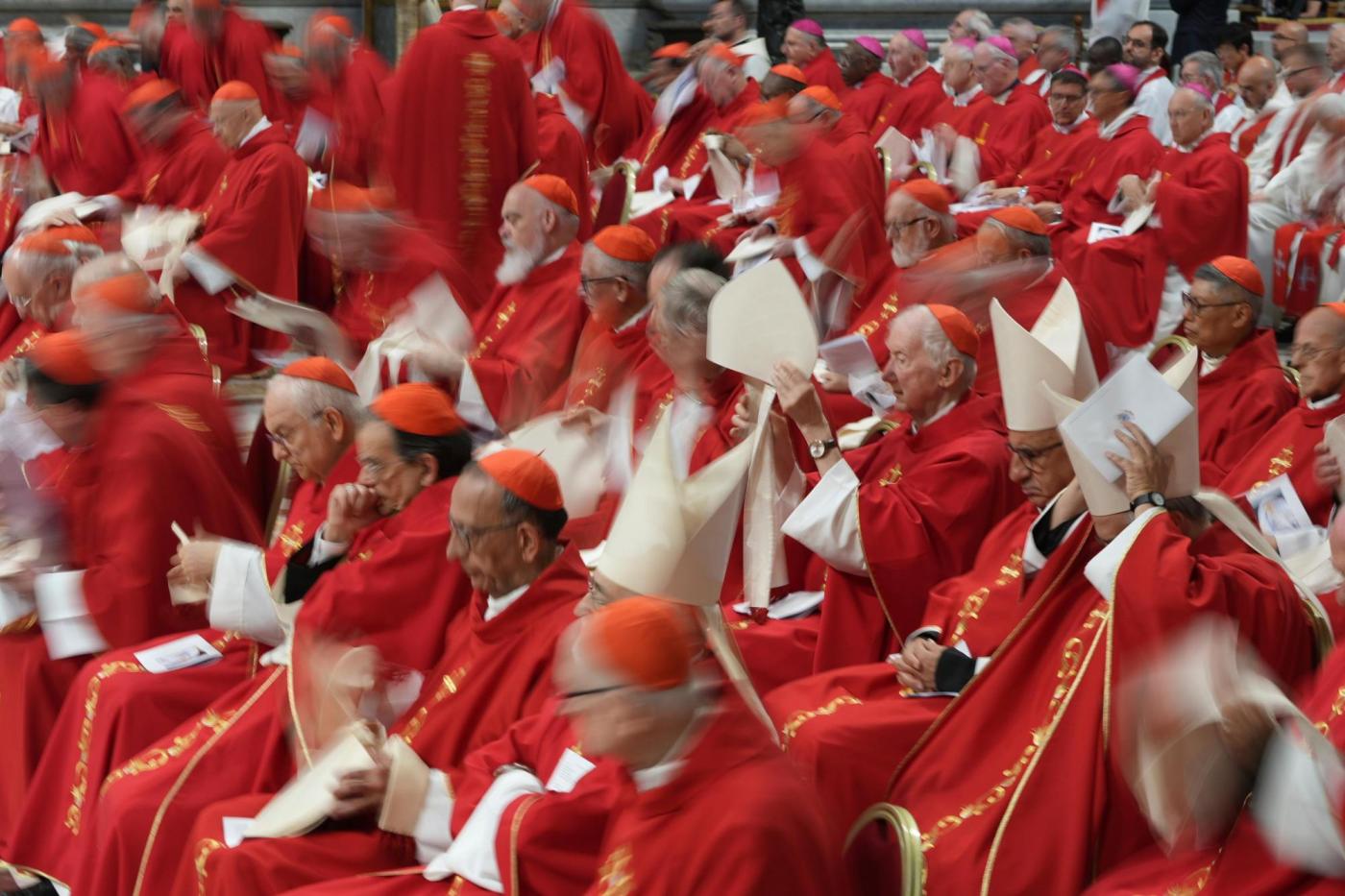
Only cardinals under age 80 are eligible to vote. Current regulations notionally limit the number of electors to 120, but popes often exceeded that ceiling and today there are 135 who are eligible.

Those cardinals who are over 80 can’t vote but can participate in pre-conclave meetings, known as general congregations, in which church problems are discussed. It was in these meetings in 2013 that then-Cardinal Jorge Mario Bergoglio spoke about the need for the church to go to the “existential peripheries” to find those who suffer — an off-the-cuff speech that helped his election.

Are there major differences between this conclave and previous ones?

St. John Paul II rewrote the regulations on papal elections in a 1996 document that remains largely in force today, though Pope Benedict XVI amended it twice before he resigned.

Francis didn’t introduce any changes into the conclave itself, though his influence will surely be felt given he named 108 of the 135 cardinal-electors who are eligible to vote.

Benedict’s most notable change to the original 1996 document was to exclude the possibility that a pope could be elected by a simple majority if voting was stalemated. Benedict decreed that a two-thirds majority is always needed, no matter how long it takes. He did so to prevent cardinals from holding out for the 12 days foreseen by John Paul and then pushing through a candidate with a slim majority.

If the conclave lasts that long, the top two vote-getters go to a runoff, with a two-thirds majority required to win. Neither of the top two candidates casts a ballot in the runoff.

Who is eligible to be elected pope?

Any baptized Catholic male is eligible to be pope, but since 1378, only cardinals have been selected. Cardinals over age 80 can be elected pope, even if they can’t be in the room to cast a ballot.

Why aren’t women part of the process?

Francis and popes before him have upheld the ban on ordaining women as priests, which precludes them from being pope. Under Catholic doctrine, the priesthood is reserved for men because Christ chose only men as his 12 apostles. The teaching is considered divinely inspired and infallible.

St Peter’s Basilica is seen in the background as a cardinal arrives for a college of cardinals’ meeting, at the Vatican, Monday, April 28, 2025. (AP Photo/Gregorio Borgia)

So, the voting process is a secret?

Benedict tightened the oath of secrecy in the conclave, making clear that anyone who reveals what went on inside faces automatic excommunication.

In John Paul’s rules, excommunication was always a possibility, but Benedict revised the oath that liturgical assistants and secretaries take to make it explicit, saying they must observe “absolute and perpetual secrecy” and explicitly refrain from using any audio or video recording devices.

Related Articles


Disgraced Cardinal Becciu formally withdraws from participation in conclave to elect pope


Spain and Portugal focus on the cause of the huge blackout after power is almost fully restored


Today in History: April 29, Los Angeles riots after Rodney King verdict


Mark Carney wins new term as Canada’s prime minister on anti-Trump platform


Mark Carney wins full term as Canada’s prime minister on anti-Trump platform

They now declare: “I take this oath fully aware that an infraction thereof will incur the penalty of automatic excommunication reserved to the Apostolic See. So help me God and these Holy Gospels, which I touch with my hand.”

How does the conclave announce that they’ve selected a new pope?

After the ballots are pierced, they are burned in a cylindrical stove at the end of the voting session. Black smoke from the Sistine Chapel chimney means no decision; white smoke signals the cardinals have chosen a pope and that he has accepted.

Chemical cartridges are added to ensure there is no confusion over the color. To produce black smoke, a cartridge containing potassium perchlorate, anthracene — the component of coal tar — and sulfur is burned with the ballots. For white smoke, a cartridge of potassium chlorate, lactose and chloroform resin is burned with the ballots.

Bells also are rung to signal the election of a pope, for further clarity.

The new pope is introduced from the loggia overlooking St. Peter’s Square with the words, “Habemus Papam!” (“We have a pope!”) and his chosen papal name. The new pope then emerges and gives his first blessing.

Associated Press religion coverage receives support through the AP’s collaboration with The Conversation US, with funding from Lilly Endowment Inc. The AP is solely responsible for this content.
UPS to cut 20,000 jobs, close some facilities as it reduces amount of Amazon shipments it handles

posted in: All news | 0

By MICHELLE CHAPMAN, AP Business Writer

UPS is looking to slash about 20,000 jobs and close more than 70 facilities as it drastically reduces the amount of Amazon shipments it handles.

The package delivery company said Tuesday that it anticipates making the job cuts this year. It anticipates closing 73 leased and owned buildings by the end of June. UPS said that it is still reviewing its network and may identify more buildings to be shuttered.

“The actions we are taking to reconfigure our network and reduce cost across our business could not be timelier,” CEO Carol Tomé said in a statement on Tuesday. “The macro environment may be uncertain, but with our actions, we will emerge as an even stronger, more nimble UPS.”

Related Articles


Trump administration launches race-based discrimination investigations against Harvard Law Review


Mexico and US reach deal on Rio Grande water sharing


On air, ’60 Minutes’ reporter says ‘none of us is happy’ about changes that led top producer to quit


At least 11 people killed after driver plows into street party in Vancouver


F.D. Flam: Geoengineering’s risks need to be studied more

In January UPS announced that it had reached a deal with Amazon, its biggest customer, to lower its volume by more than 50% by the second half of 2026.

During UPS’ fourth-quarter earnings conference call in January, Tomé said that the company had partnered with Amazon for almost 30 years and that when its contract came up this year, UPS decided to reassess the relationship.

“Amazon is our largest customer but it’s not our most profitable customer,” Tomé said at the time. “Its margin is very dilutive to the U.S. domestic business.”

Tomé said that UPS considered various options and determined that the volume reduction was the best alternative.

The company employs about 490,000 workers, according to FactSet.

United Parcel Service Inc. also reported its first-quarter financial results on Tuesday. The Atlanta-based company earned $1.19 billion, or $$1.40 per share, in the quarter ended March 31.

Stripping out certain items, earnings were $1.49 per share. That’s better than the $1.44 per share that analysts polled by Zacks Investment Research were calling for.

Revenue totaled $21.55 billion, beating Wall Street’s estimate of $21.06 billion.

UPS said that it wasn’t providing any updates to its previously announced full-year outlook, given current macroeconomic uncertainty. The company previously said that it expected 2025 revenue of approximately $89 billion.

Shares of UPS rose slightly in morning trading.

Related Articles


Major companies face a difficult task in estimating the impact of tariffs on their business


Trump to offer automakers some relief on his 25% tariffs, after worries they could hurt US factories


US job openings fall to 7.2 million in March, the lowest level since September


US consumer confidence plunges to lowest in 5 years on tariff worries


‘Nowhere to turn’: Small businesses dependent on imports from China are feeling more desperate

Major companies face a difficult task in estimating the impact of tariffs on their business

posted in: All news | 0

By DAMIAN J. TROISE, AP Business Writer

NEW YORK (AP) — Executives at some of the world’s biggest companies are faced with the tricky task of explaining how President Donald Trump’s tariffs are impacting their business as they discuss the latest financial results. Some are making their best estimate based on what they know at the moment; others are pulling their outlooks altogether.

The only certainty is that they’ll use a variation of the phrase “uncertain times” at least once as they speak with analysts.

Trump has imposed tariffs against key U.S. trading partners, while also postponing other tariffs to give companies a chance to negotiate. The process has left business and consumers uncertain amid a constantly shifting landscape. Over the last few months, tariffs have been announced and in some cases withdrawn within days.

Here’s what some of those companies are saying:

Kraft Heinz

Kraft Heinz is cutting its earnings forecast for the year, citing a volatile environment.

The maker of food staples, including its namesake ketchup and boxed macaroni & cheese, is under pressure along with other food companies as inflation continues squeezing consumers. Tariffs could force companies to raise prices on consumer staples and food products, further fueling inflation.

“We’re closely monitoring the potential impacts from macro-economic pressures such as tariffs and inflation,” said Kraft Heinz CEO Carlos Abrams-Rivera, in a statement.

JetBlue Airways

JetBlue Airways pulled its financial forecast for the year over worries about slowing travel demand as consumer confidence weakens.

The travel sector, including airlines, faces an indirect impact from tariffs. Tariffs threaten to raise prices on a wide range of consumer goods, worsening inflation and squeezing consumers. Discretionary spending on travel is often among the first budget items that households consider trimming or cutting completely in order to deal with higher costs elsewhere.

“In the first quarter we saw booking strength from January deteriorate into February and worsen into March,” said Marty St. George, JetBlue’s president, in a statement.

JetBlue said it is considering capacity reductions, fleet retirement and other costs savings to help boost profits and preserve cash.

A report from the Conference Board Tuesday showed that Americans’ confidence in the economy slumped for the fifth straight month to the lowest level since the onset of the COIVD-19 pandemic.

Coca-Cola

Coca-Cola said the impact of tariffs on its business is likely to be “manageable.”

Still, the beverage giant moderated expectations for its full-year profit. It now expects full-year adjusted earnings to grow 7% to 9%, down from 8% to 10% previously. Coke earned $2.88 per share in 2024.

Coke and other beverage makers are facing a 25% tariff on the aluminum they use for cans, among other items. The company has said that it could shift aluminum suppliers, rely more heavily on plastic or glass bottles and take other measures to counteract the tariffs. Last week, rival PepsiCo lowered its full-year earnings expectations due to the impact of tariffs.

General Motors

General Motors is reassessing its expectations for 2025 due to auto tariffs.

Related Articles


Trump to offer automakers some relief on his 25% tariffs, after worries they could hurt US factories


US job openings fall to 7.2 million in March, the lowest level since September


US consumer confidence plunges to lowest in 5 years on tariff worries


‘Nowhere to turn’: Small businesses dependent on imports from China are feeling more desperate


Wall Street drifts as corporate profits pile higher along with uncertainty about Trump’s trade war

The automaker is pushing back its conference call to discuss its guidance and quarterly results until Thursday, so that it can assess potential changes to the Trump tariffs. On Tuesday, the White House said Trump will sign an executive order to relax some of his 25% tariffs on autos and auto parts.

GM’s current forecast for earnings of $11 to $12 per share doesn’t consider the potential impact of tariffs.

The auto tariffs could be particularly painful because major carmakers have production spread throughout North America. Parts and the assembly process often cross multiple borders several times before a car is complete. Carmakers face higher costs and that could mean higher prices for consumers, prompting them to delay or forgo purchases.

AP Business writers Dee-Ann Durbin and Michelle Chapman contributed to this report.