Real World Economics: GDP is important, but must be kept in context

posted in: All news | 0

Edward Lotterman

The Commerce Department’s Bureau of Economic Analysis last week released its “advance estimate” of U.S. Gross Domestic Product for the first quarter of 2025.

GDP measures the total market value of all final goods and services produced in the country over a period of time and is one of the key indicators of how an economy is performing. Despite acknowledged one-off data anomalies, it showed a very slight decline from the start of the year.

This is not good news, it means the nation’s economy contracted, but the response to it has been overwrought.

If instead of a 0.3% decline in output, it had been a 0.3% increase, the hubbub would be much less.

Of the four basic elements to GDP, consumption, investment, government spending and net exports, the three most closely related to domestic production were all positive. The decline came from a sharp increase in imports clearly driven by fear of President Donald Trump’s forthcoming tariffs. Companies that import supplies were stocking up before the higher prices kicked in. The anomaly is how the bureau factors in the impact of these imports into its estimate of overall GDP.

The quarter ended a month ago. The tariffs are now kicking in. This rise above usual import levels almost certainly has already flipped to a sharp drop that will worsen, and be reflected in the second-quarter estimate come July.

Let it be clear. Trump’s overall economic policies are bad. They will harm our nation. His trade policies are the worst of these. The odds that we are sliding into recession — defined generally as two consecutive quarters of negative growth — are high. Any recession is likely to be severe. But this most preliminary of three estimates of a quarter’s GDP shows little that is definite.

This coming Tuesday, May 6, will bring us a report on “U.S. International Trade in Goods and Services, March 2025.” The more reliable “second estimate” of January-to March GDP comes out May 29. April’s “U.S. International Trade in Goods and Services” will be out a week after that. These will all tell us more about where we are headed. However, we then need to wait until July 30 for the advance report on second-quarter GDP. That will give us even more certainty on how well our goose is being cooked.

In the meantime, if you want to understand events that are unfolding, begin by understanding GDP.

First, it is a measure of the value of output. That is important to remember. Don’t make it bigger than it is. Journalists have gushed, “Economists agree that GDP is by far the most important indicator of how an economy is doing.” Over 44 years in this field, I have never heard any economist say that nor seen it in any textbook. GDP is an important indicator, taken together with several others. Full stop.

Second, GDP has distinct limitations. Every 19-year-old taking intro macroeconomics at the U must memorize these by the second week. They are detailed in every textbook. Yet one constantly hears complaints like “but people don’t realize that GDP ignores ___________ !” The blank is filled with one of the limitations that are detailed in every macro textbook. Here are the important ones to remember:

GDP is a measure of the value of new things produced. It does not subtract things produced in previous periods that are thrown away. Do that and you get “net domestic product.”

GDP is a measure of flow, not a balance sheet of assets and liabilities. It measures new lumber, gasoline or steel cranked out, but is not adjusted for trees cut down, oil pumped or iron ore mined.

GDP is not adjusted for external effects, either positive or negative. If producing something harms health or the environment, that is bad, unless such damages can be measured in monetary terms, such as medical bills, they must be accounted for in other ways. If a product benefits people beyond those who bought it, that’s great. But again, this positive side effect must be measured some other way.

GDP makes no value judgement about the inherent goodness or badness of any good or service. You may think sports activities for disadvantaged teens do more for society than strip clubs, or that yoga classes are better than shooting ranges, or vice versa, but what goes into GDP is the money paid for each activity.

Some “goods” may reflect societal “bads.” If more people get drunk and drive and crash, then we will spend more money on tow trucks, body shops, ambulances, emergency rooms, orthopedic surgeons, undertakers and tombstones, all of which will add to GDP. A crime wave may force people to spend money on pepper spray, triple door locks, car and home alarms, safe rooms and self-defense classes. All will add to GDP.

Do these limitations mean that GDP is useless? No, not at all. It remains vital information. But again, it must be taken in context with other data.

Now understand what is counted.

Econ students memorize that “GDP equals consumption plus investment plus government spending on goods and services plus net exports.” All these involve “final goods,” ones that need no more handling before being used.

So purchases of food, clothing, shelter, medical care and so on make up consumption by households, the largest component of GDP. This includes “consumer durables,” things like appliances or vehicles that serve for years, but does not attempt to factor in the lifelong value these goods supply beyond the period in which they were purchased.

Purchases of expendable items, like parts, by businesses are different, since most go into goods or services ultimately bought by households. It is important to avoid double counting these. So most business spending falls into “investment.” These are “physical investments” by which economists refer to equipment, machines and infrastructure used in production that last a long time. Understand that this “investment” component of GDP does not refer to “financial investment,” such as putting money into stocks, bonds, mutual funds or bank accounts.

The government category includes all government spending on goods: patrol cars, aircraft carriers, locks and dams, school buildings and school supplies and compensation of government employees. Importantly, it does not include “transfer payments” of money to individuals via Social Security, SSI, SNAP or student aid grants.

For both consumption and physical investment, the value component used is the market price of the good or service in question. What did we pay for the underpants, yoga lessons or locomotives that we bought? But there is no market value for students educated or protection afforded by the USS Harry Truman. So government spending in GDP comes from the amount spent itself with no estimate of its value to society. This results in anomalies. In Nebraska, I-80 parallels the Union Pacific’s triple-tracked main line. The rail line produces millions in revenue each day for the UP, but I-80 supposedly produces no measurable monetary value to society beyond Nebraska DOT spending on maintenance.

“Net exports” or “exports minus imports” are the final category, and here’s where we get what happened in last week’s initial first-quarter estimate. If we produce bulldozers or airplanes sold abroad, that is part of our nation’s production. But when we import cars or toys, those are the production of some other nation. So we need to calculate the net amount. Whenever we import more goods and services than we export, we have a “trade deficit on goods and services.” That equals negative net exports.

Whenever imports climb, GDP shrinks. The new Kia car or LG TV produced abroad counts in household consumption, but it wasn’t produced here, so we need to subtract it off in the net exports category to get an accurate estimate of what we did produce.

Imports jumped in the past quarter in the weeks after Trump amped up his tariff talk. Importers rushed to get product here and through customs before the tariffs were actually charged. The big jump in imports made a big drop in net exports and hence the 0.3% drop in overall GDP.

Our nation and the world are in very troubled waters. And important data points to come out later will reflect this. People naturally want to know what is happening. But the information we use to justify our perceptions needs to be kept in context.

Related Articles


Real World Economics: The buck stops Trump, or so it appears


Ed Lotterman: What if the Fed set a trap for Trump?


Real World Economics: Powell hits first; Trump hits back


Real World Economics: The Minneapolis Fed was right all along


Real World Economics: The flaws in Trump’s ‘liberation’ reasoning on tariffs

St. Paul economist and writer Edward Lotterman can be reached at stpaul@edlotterman.com.

Trump, in a new interview, says he doesn’t know if he backs due process rights

posted in: All news | 0

By AAMER MADHANI

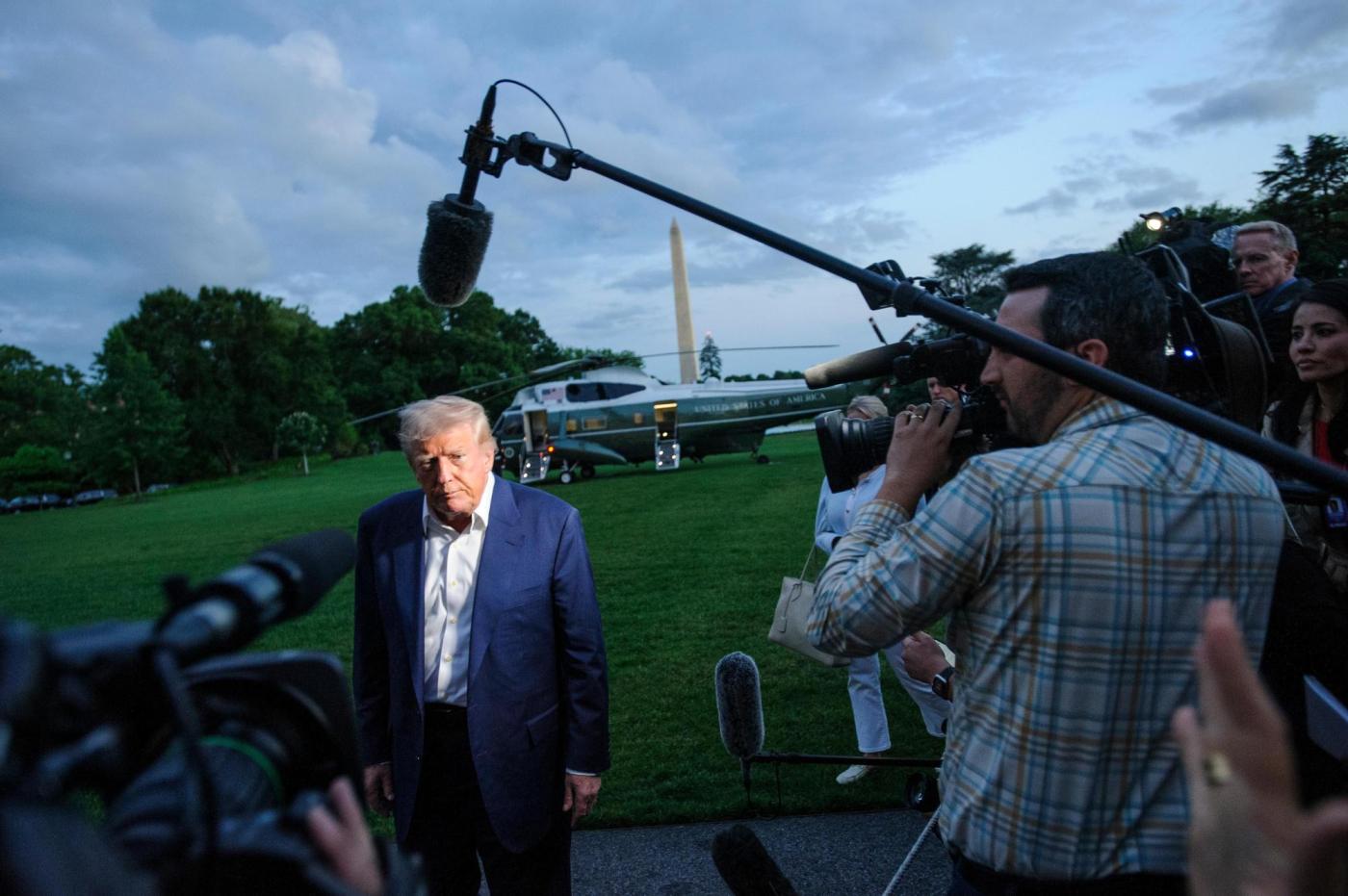
WEST PALM BEACH, Fla. (AP) — President Donald Trump is circumspect about his duties to uphold due process rights laid out in the Constitution, saying in a new interview that he does not know whether U.S. citizens and noncitizens alike deserve that guarantee.

He also said he does not think military force will be needed to make Canada the “51st state” and played down the possibility he would look to run for a third term in the White House.

The comments in a wide-ranging, and at moments combative, interview with NBC’s “Meet the Press” came as the Republican president’s efforts to quickly enact his agenda face sharper headwinds with Americans just as his second administration crossed the 100-day mark, according to a recent poll by The Associated Press-NORC Center for Public Affairs Research.

Trump, however, made clear that he is not backing away from a to-do list that he insists the American electorate broadly supported when they elected him in November.

Here are some of the highlights from the interview with NBC’s Kristen Welker that was taped Friday at his Mar-a-Lago property in Florida and aired Sunday.

Trump doesn’t commit to due process

Critics on the left have tried to make the case that Trump is chipping away at due process in the United States. Most notably, they cite the case of Kilmar Abrego Garcia, a Salvadoran man who was living in Maryland when he was mistakenly deported to El Salvador and imprisoned without communication.

Trump says Abrego Garcia is part of a violent transnational gang. The Republican president has sought to turn deportation into a test case for his campaign against illegal immigration despite a Supreme Court order saying the administration must work to return Abrego Garcia to the U.S.

Asked in the interview whether U.S. citizens and noncitizens both deserve due process as laid out in the Fifth Amendment of the Constitution, Trump was noncommittal.

“I don’t know. I’m not, I’m not a lawyer. I don’t know,” Trump said when pressed by Welker.

The Fifth Amendment provides “due process of law,” meaning a person has certain rights when it comes to being prosecuted for a crime. Also, the 14th Amendment says no state can “deny to any person within its jurisdiction the equal protection of the laws.”

Trump said he has “brilliant lawyers … and they are going to obviously follow what the Supreme Court said.”

He said he was pushing to deport “some of the worst, most dangerous people on Earth,” but that courts are getting in his way.

“I was elected to get them the hell out of here, and the courts are holding me from doing it,” Trump said.

Military action against Canada is ‘highly unlikely’

The president has repeatedly threatened that he intends to make Canada the “51st state.”

Before his White House meeting on Tuesday with newly elected Canadian Prime Minister Mark Carney, Trump is not backing away from the rhetoric that has angered Canadians.

Trump, however, told NBC that it was “highly unlikely” that the U.S. would need to use military force to make Canada the 51st state.

He offered less certainty about whether his repeated calls for the U.S. to take over Greenland from NATO-ally Denmark can be achieved without military action.

“Something could happen with Greenland,” Trump said. “I’ll be honest, we need that for national and international security. … I don’t see it with Canada. I just don’t see it, I have to be honest with you.”

President bristles at recession forecasts

Trump said the U.S. economy is in a “transition period” but he expects it to do “fantastically” despite the economic turmoil sparked by his tariffs.

He offered sharp pushback when Welker noted that some Wall Street analysts now say the chances of a recession are increasing.

“Well, you know, you say, some people on Wall Street say,” Trump said. “Well, I tell you something else. Some people on Wall Street say that we’re going to have the greatest economy in history.”

He also deflected blame for the 0.3% decline in the U.S. economy in the first quarter. He said he was not responsible for it.

“I think the good parts are the Trump economy and the bad parts are the Biden economy because he’s done a terrible job,” referring to his Democratic predecessor, Joe Biden.

Trump doubled down on his recent comments at a Cabinet meeting that children might have to have two dolls instead of 30, denying that is an acknowledgment his tariffs will lead to supply shortages.

“I’m just saying they don’t need to have 30 dolls. They can have three. They don’t need to have 250 pencils. They can have five.”

Trump plays down third-term talk

The president has repeatedly suggested he could seek a third term in the White House even though the 22nd Amendment of the Constitution says that “No person shall be elected to the office of the President more than twice.”

Trump told NBC there is considerable support for him to run for a third term.

“But this is not something I’m looking to do,” Trump said. “I’m looking to have four great years and turn it over to somebody, ideally a great Republican, a great Republican to carry it forward.”

Trump’s previous comments about a third term sometimes seem more about provoking outrage on the political left. The Trump Organization is even selling red caps with the words “Trump 2028.”

But at moments, he has suggested he was seriously looking into a third term. In a late March phone interview with NBC, Trump said, “I’m not joking. There are methods which you could do it.”

So JD Vance in 2028? Marco Rubio? Not so fast.

Trump said in the interview that Vice President JD Vance is doing a “fantastic job” and is “brilliant.” Secretary of State Marco Rubio, whom Trump last week tasked to simultaneously serve as acting national security adviser, is “great,” the president said.

But Trump said it is “far too early” to begin talking about his potential successor.

He is confident that his “Make America Great Again” movement will flourish beyond his time in the White House.

“You look at Marco, you look at JD Vance, who’s fantastic,” Trump said. “You look at — I could name 10, 15, 20 people right now just sitting here. No, I think we have a tremendous party. And you know what I can’t name? I can’t name one Democrat.”

Adrian Wooldridge: The arc of history does not simply bend toward justice

posted in: All news | 0

Ronald Reagan was wrong. The nine most terrifying words in the English language are not “I’m from the government, and I’m here to help.” They are: “The arc of the moral universe bends towards justice.”

This is a pretty phrase that was invented by a good person, Theodore Parker, and revived by another good one, Martin Luther King Jr. But it’s terrifying because it produces unjustified confidence that history is on your side, and this has consequences. Donald Trump might well not be in the White House if progressives hadn’t been so convinced that the moral universe was bending in their direction.

The phrase presumes that history has a pre-determined direction. But Karl Popper demonstrated that such historical determinism is based on a fallacy: The direction of history is clearly shaped by inventions (the internet or AI), and we cannot predict what these will be.

Every day brings yet more evidence that the liberal vision of history is wrong. In the 1990s, liberals predicted that, thanks to the “moral arc,” democratic capitalism would triumph globally. Great sociologists such as Max Weber and Emile Durkheim predicted that modernity would bring bureaucratization and secularization in its wake.

But the first defining act of the 21st century was the destruction of the World Trade Center by 19 religious fanatics hijacking airplanes. Today, democracy is in retreat, strongmen are on the rise, and Trump is dismantling the rules-based global order. These leaders are recreating patrimonial regimes in which the governments are more like royal courts and the state is treated as family property. This is much more Vladimir Putin’s world than the political scientist Francis Fukuyama’s benevolent “end of history.”

Economic productivity has certainly improved since the mid-18th century (though more sluggishly in recent decades), but the idea that this produces moral or aesthetic progress is nonsense. Hitler took power in Europe’s best educated and most culturally sophisticated country. The reality is, progress in one area often brings regress in another.

The illusion of history begetting justice is terrifying for two reasons.

The first is it encourages a false sense of confidence that is often counterproductive.

The Democrats’ confidence that history was on their side led them to underestimate Trump so badly that they stuck with Joe Biden even though it was obvious that his powers were fading. This confidence also led the party to endorse a collection of unpopular causes, which might be conveniently lumped together as “wokery,” on the grounds that they were the contemporary equivalent of the civil rights movement. To hell with the people who question these causes even if they happen to be the numerical majority.

Before that, the same confidence persuaded the U.S. establishment, Republican as much as Democrat, to embrace China with open arms, subcontracting much of America’s manufacturing to the People’s Republic, even though the Leninists who ran the regime were determined to replace the U.S. as the world’s leading military and industrial power.

The second reason it’s terrifying is it encourages people to subcontract their moral judgments to history.

Most progressives did not treat the problem of transgender people’s rights as a nuanced moral issue that involved the careful balancing of the rights of biological women against those of trans women or an even more careful consideration of the potential harms of powerful drugs or invasive surgery. They simply rushed to be on “the right side of history.” The notion of the moral arc encourages groupthink and all the blindness and bullying that comes with it.

It is far healthier to treat history as an open-ended process that is made by individuals who have to wrestle with their own moral judgments rather than go with the supposedly progressive flow. “History is all things to all men,” as Herbert Butterfield put it in his great critique of the idea of history as progress, The Whig Interpretation of History. “She is in the service of good causes and bad.”

Progress is something that is made rather than predetermined — and thinking that you are on the winner’s side too early often puts you at a disadvantage.

The last group of “progressives” who thought they knew the direction of history were the Marxists who preached the inevitable triumph of Communism even as Communism was visibly collapsing. The danger is that today’s progressives will preach the triumph of progressivism even as — thanks in part to their arrogance and incompetence — strongmen dig themselves deeper into power across the world. Events only move in your direction if you put in the work to steer them that way.

Adrian Wooldridge is the global business columnist for Bloomberg Opinion. A former writer at the Economist, he is author of “The Aristocracy of Talent: How Meritocracy Made the Modern World.”

Related Articles


Zeynep Tufekci: When the police have no faces


Daniel Moss: Is America alone? Not yet, but it’s trying


Sheldon H. Jacobson: TSA isn’t perfect, but it’s way better than the alternatives


Lee Fang: Is your favorite influencer’s opinion bought and sold?


Javier Blas: It’s electricity realism, not climate denialism

Literary calendar for week of May 4

posted in: All news | 0

TAMARA DEAN: Introduces her essay collection “Shelter and Storm: A Home in the Driftless,” about her experiences living in the area of Wisconsin that was not touched by glaciers, leaving a landscape of steep hills and deeply carved valleys, forests and streams.

(Courtesy of the University of Minnesota Press)

The author and her husband bought an old farm and built their house of earthen blocks. Not sure of how she wanted to farm, Dean meanwhile kept a huge garden, researching the best ways to use the land while confronting prairie fires, floods and tornadoes, and the ravages of climate change.

The couples’ aim was to find ways to a more sustainable way to live. Her book is filled with adventure, hard work, history of farms and farming, and always consideration for what she and some of the neighboring farmers can do for the land, including hard choices such as whether to destroy a beaver dam that helps the environment but hurts farmers, or letting blown-down trees rot in place to provide animal habitat instead of selling to loggers.

In conversation with Jeannine Ouellette. 6 p.m. Tuesday, Next Chapter Booksellers, 38 S. Snelling Ave., St. Paul.

HERMAN DIAZ: Pulitzer Prize-winning author of “Trust” is hosted by Friends of the Hennepin County Library’s Pen Pals series. 7:30 p.m. Monday, 11 a.m. Tuesday, Hopkins Center for the Arts. In-person programs sold out; virtual only. Go to supporthclib.org.

Jason Reynolds (Courtesy of the Guthrie Theater)

CLARK/ELLIS: Crime writers Tracy Clark and David Ellis, both from the Chicago area, team up for Totally Criminal Cocktail Hour. Ellis, whose latest book is “The Best Lies,” is an Edgar-winning author of 10 crime novels and eight books co-written with bestselling author James Patterson. “The Best Lies” features a diagnosed pathological liar who’s also a crusading attorney. Clark is a two-time Sue Grafton Memorial Award winner whose latest book, “Echo,” concludes her Det. Harriet Foster series. Hosted by Valley Bookseller of Stillwater. 5 p.m. Wednesday, Lowell Inn, 102 Second St. N., Stillwater. $10. Go to valleybookseller.com.

JASON REYNOLDS: An Afternoon With Jason Reynolds features the award-winning author of popular novels for young people in lively conversation with Minnesota writer Shannon Gibney joined by South High ninth-graders Boisey Corvah and Asher Parks. Free. 1 p.m. Thursday, Guthrie Theater, 818 S. Second St., Mpls. Presented by More Than a Single Story and Hennepin County Library.

Related Articles


Readers and writers: Surprising facts about St. Paul’s parks in an adult coloring book


How a surprising Shakespeare discovery was found in a letter used as scrap paper


Literary pick for week of May 4


Book Review: From incels to trad wives, culture critic probes 21st century backlash against feminism


Why ‘Chronology of Water’ author Lidia Yuknavitch revisits the past in ‘Reading the Waves’