Trump threatens a 100% tariff on foreign-made films, saying the movie industry in the US is dying

posted in: All news | 0

By JILL COLVIN and JAKE COYLE, Associated Press

NEW YORK (AP) — President Donald Trump is opening a new salvo in his tariff war, targeting films made outside the U.S.

In a post Sunday night on his Truth Social platform, Trump said he has authorized the Department of Commerce and the Office of the U.S. Trade Representative to slap a 100% tariff “on any and all Movies coming into our Country that are produced in Foreign Lands.”

“The Movie Industry in America is DYING a very fast death,” he wrote, complaining that other countries “are offering all sorts of incentives to draw” filmmakers and studios away from the U.S. “This is a concerted effort by other Nations and, therefore, a National Security threat. It is, in addition to everything else, messaging and propaganda!”

Related Articles


Adrian Wooldridge: The arc of history does not simply bend toward justice


Zeynep Tufekci: When the police have no faces


Letters: Actually, it IS about President Trump


Trump draws criticism with AI image of himself as the pope ahead of the papal conclave


Daniel Moss: Is America alone? Not yet, but it’s trying

It wasn’t immediately clear how any such tariff on international productions could be implemented. It’s common for both large and small films to include production in the U.S. and in other countries. Big-budget movies like the upcoming “Mission: Impossible — The Final Reckoning,” for instance, are shot around the world.

Incentive programs for years have influenced where movies are shot, increasingly driving film production out of California and to other states and countries with favorable tax incentives, like Canada and the United Kingdom.

Yet Trump’s tariffs are designed to lead consumers toward American products. And in movie theaters, American-produced movies overwhelming dominate the domestic marketplace.

China has ramped up its domestic movie production, culminating in the animated blockbuster “Ne Zha 2” grossing more than $2 billion this year. But even then, its sales came almost entirely from mainland China. In North America, it earned just $20.9 million.

In New Zealand, where successive governments have offered rebates and incentives in recent years to draw Hollywood films to the country, the film industry has generated billions of dollars in tourism revenue driven by the “Lord of the Rings” and “Hobbit” films, which featured the country’s pristine and scenic vistas. More recently, the blockbuster “Minecraft” movie was filmed entirely in New Zealand, and U.S. productions in 2023 delivered approximately $777 million to the country in return for about $119.6 million in subsidies, according to government figures.

New Zealand Prime Minister Christopher Luxon said he was awaiting more details of Trump’s measures before commenting on them but would continue to pitch to filmmakers abroad, including in India’s Bollywood. “We’ve got an absolutely world class industry,” he said. “This is the best place to make movies, period, in the world.”

The Motion Picture Association, which represents major U.S. film studios and streaming services, didn’t immediately respond to messages Sunday evening.

The MPA’s data shows how much Hollywood exports have dominated cinemas. According to the MPA, the American movies produced $22.6 billion in exports and $15.3 billion in trade surplus in 2023.

Trump, a Republican, has made good on the “tariff man” label he gave himself years ago, slapping new taxes on goods made in countries around the globe. That includes a 145% tariff on Chinese goods and a 10% baseline tariff on goods from other countries, with even higher levies threatened.

By unilaterally imposing tariffs, Trump has exerted extraordinary influence over the flow of commerce, creating political risks and pulling the market in different directions. There are tariffs on autos, steel and aluminum, with more imports, including pharmaceutical drugs, set to be subject to new tariffs in the weeks ahead.

Trump has long voiced concern about movie production moving overseas.

Shortly before he took office, he announced that he had tapped actors Mel Gibson, Jon Voight and Sylvester Stallone to serve as “special ambassadors” to Hollywood to bring it “BACK — BIGGER, BETTER, AND STRONGER THAN EVER BEFORE!”

U.S. film and television production has been hampered in recent years, with setbacks from the COVID-19 pandemic, the Hollywood guild strikes of 2023 and the recent wildfires in the Los Angeles area. Overall production in the U.S. was down 26% last year compared with 2021, according to data from ProdPro, which tracks production.

The group’s annual survey of executives, which asked about preferred filming locations, found no location in the U.S. made the top five, according to the Hollywood Reporter. Toronto, the U.K., Vancouver, Central Europe and Australia came out on top, with California placing sixth, Georgia seventh, New Jersey eighth and New York ninth.

The problem is especially acute in California. In the greater Los Angeles area, production last year was down 5.6% from 2023 according to FilmLA, second only to 2020, during the peak of the coronavirus pandemic. Last, October, Gov. Gavin Newsom, a Democrat, proposed expanding California’s Film & Television Tax Credit program to $750 million annually, up from $330 million.

Other U.S. cities like Atlanta, New York, Chicago and San Francisco have also used aggressive tax incentives to lure film and TV productions. Those programs can take the form of cash grants, as in Texas, or tax credits, which Georgia and New Mexico offer.

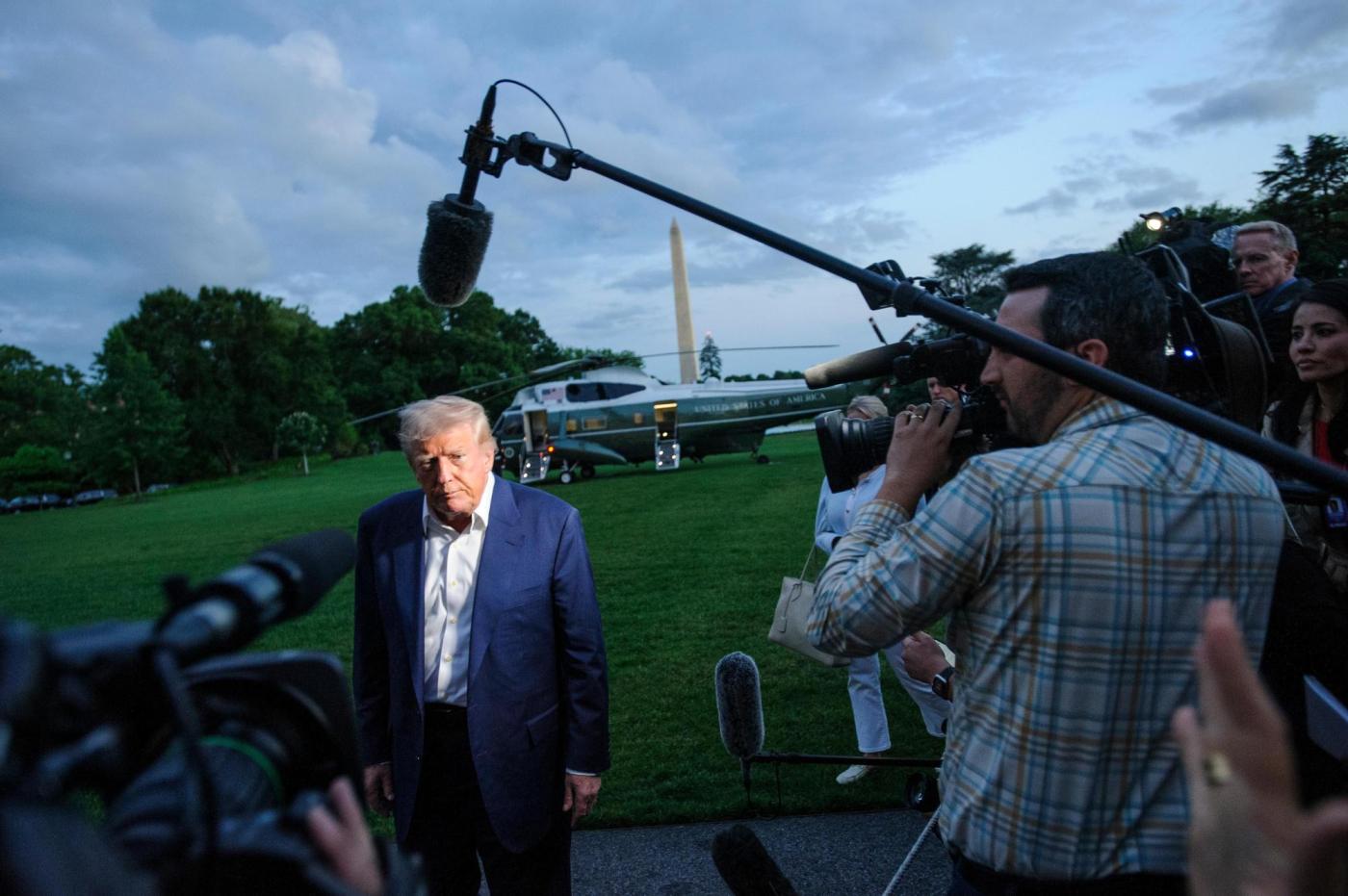
“Other nations have been stealing the movie-making capabilities from the United States,” Trump told reporters at the White House on Sunday night after returning from a weekend in Florida. “If they’re not willing to make a movie inside the United States we should have a tariff on movies that come in.”

Associated Press writers Gary Field in Washington and Charlotte Graham-McLay in Wellington, New Zealand, contributed to this report from Washington.
Europe launches a drive to attract scientists and researchers after Trump freezes US funding

posted in: All news | 0

By CATHERINE GASCHKA and LORNE COOK, Associated Press

PARIS (AP) — The European Union launched a drive on Monday to attract scientists and researchers to Europe with offers of grants and new policy plans, after the Trump administration froze U.S. government funding linked to diversity, equity and inclusion initiatives.

“A few years ago, no one would have imagined that one of the biggest democracies in the world would cancel research programs under the pretext that the word diversity was in this program,” French President Emmanuel Macron said at the “Choose Europe for Science” event in Paris.

“No one would have thought that one of the biggest democracies in the world would delete with a stroke the ability of one researcher or another to obtain visas,” Macron said. “But here we are.”

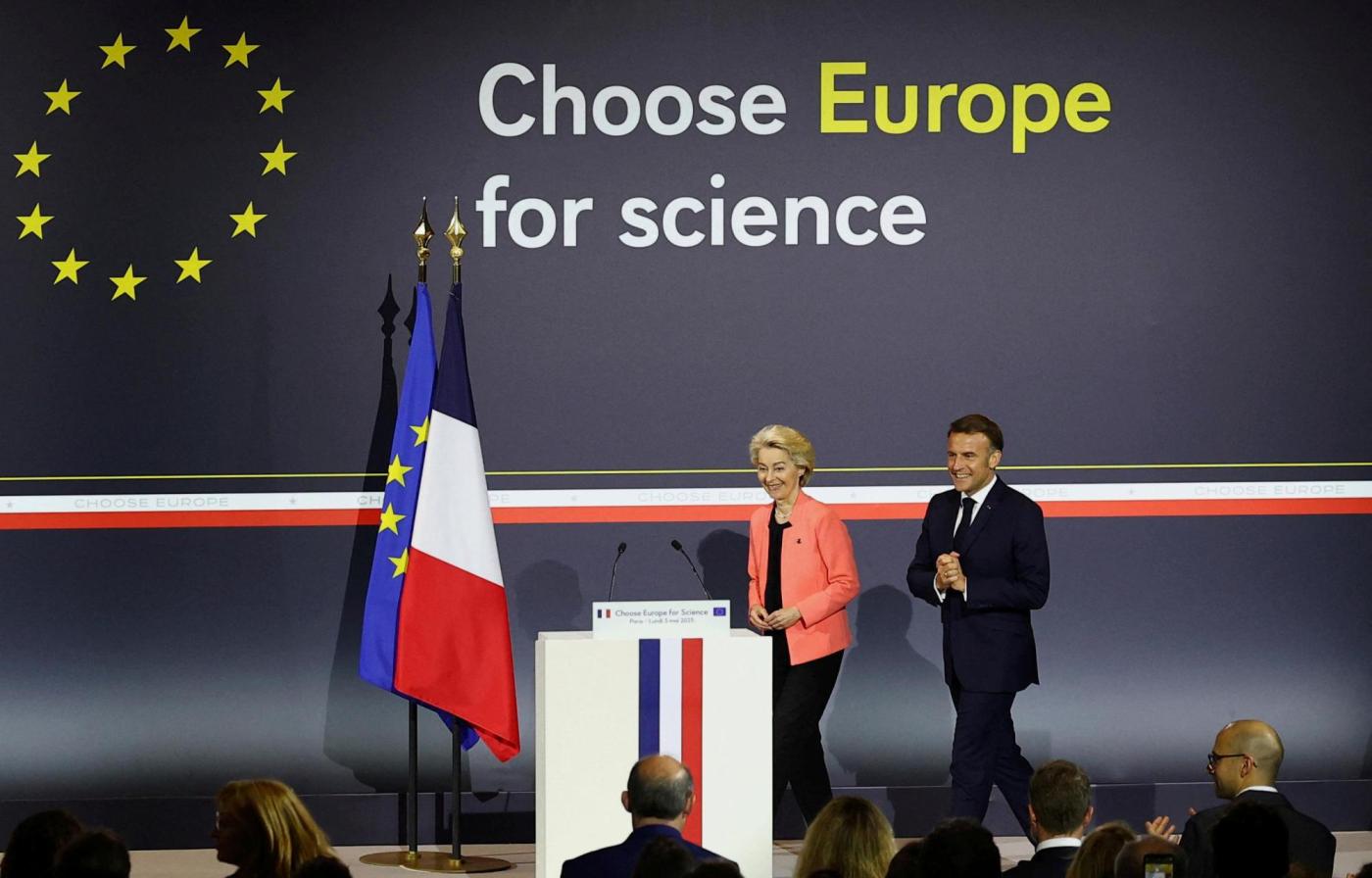
French President Emmanuel Macron welcomes European Commission President Ursula Von der Leyen as she arrives at the “Choose Europe for Science” event, to encourage researchers and scientists from all over the world to practice in Europe, at the Sorbonne University in Paris, Monday, May 5, 2025.(Gonzalo Fuentes/Pool via AP)

Taking the same stage at the Sorbonne University, European Commission President Ursula von der Leyen said that the EU’s executive branch would set up a “super grant” program aimed at offering “a longer-term perspective to the very best” in the field.

She said that approximately $566 million will be put forward in 2025-2027 “to make Europe a magnet for researchers.” It would be injected into the European Research Council, which already has a budget of more than $18 billion for 2021-2027.

Von der Leyen said that the 27-nation EU intends “to enshrine freedom of scientific research into law” with a new legal act. As “the threats rise across the world, Europe will not compromise on its principles,” she said.

Macron said that the French government would also soon make new proposals to beef up investment in science and research.

Last month, hundreds of university researchers in the United States had National Science Foundation funding canceled to comply with U.S. President Donald Trump’s order to end support to research on diversity, equity and inclusion, as well as the study of misinformation.

More than 380 grant projects have been cut so far, including work to combat internet censorship in China and Iran and a project consulting with Indigenous communities to understand environmental changes in Alaska’s Arctic region.

Some terminated grants that sought to broaden the diversity of people studying science, technology and engineering. Scientists, researchers and doctors have taken to the streets in protest.

While not mentioning the Trump administration by name, von der Leyen said that it was “a gigantic miscalculation” to undermine free and open research.

“We can all agree that science has no passport, no gender, no ethnicity, no political party,” she said. “We believe that diversity is an asset of humanity and the lifeblood of science. It is one of the most valuable global assets and it must be protected.”

Von der Leyen’s drive to promote opportunities in Europe in the field of science and take advantage of U.S. policy shifts dovetails with the way that she has played up the potential for trade deals with other countries since Trump took office in January and sparked a tariff war last month.

The former German defense minister, and trained doctor, vowed that the EU would also address some of the roadblocks that scientists and researchers face, notably excessive red tape and access to businesses.

Macron said that science and research must not “be based on the diktats of the few.”

Macron said that Europe “must become a refuge” for scientists and researchers, and he said to those who feel under threat elsewhere: “The message is simple. If you like freedom, come and help us to remain free, to do research here, to help us become better, to invest in our future.”

Lorne Cook reported from Brussels.

Met Gala: Fashion’s biggest night of the year is here. Here’s how to follow along

posted in: All news | 0

By LEANNE ITALIE, Associated Press

NEW YORK (AP) — Pharrell Williams has high hopes for the Met Gala, the first to focus exclusively on Black designers, and the first in more than 20 years to have a menswear theme.

“I want it to feel like the most epic night of power, a reflection of Black resiliency in a world that continues to be colonized, by which I mean policies and legislation that are nothing short of that,” he recently told Vogue.

“It’s our turn.”

Indeed. And welcome to the first Monday in May.

How to watch the 2025 Met Gala

Vogue will livestream the gala starting at 6 p.m. Eastern on Vogue.com, its YouTube channel and across its other digital platforms. Teyana Taylor, La La Anthony and Ego Nwodim will host the stream. Emma Chamberlain will also do interviews on the carpet.

The Associated Press will livestream celebrity departures from the Mark Hotel beginning at 5 p.m. Eastern and will stream the gala carpet on delay beginning at 6:30 p.m. The feeds will be available on YouTube and APNews.com.

E! will begin live coverage at 6 p.m. on TV. The livestream will be available on Peacock, E! Online and YouTube, along with the network’s other social media feeds.

Who’s hosting the 2025 Met Gala?

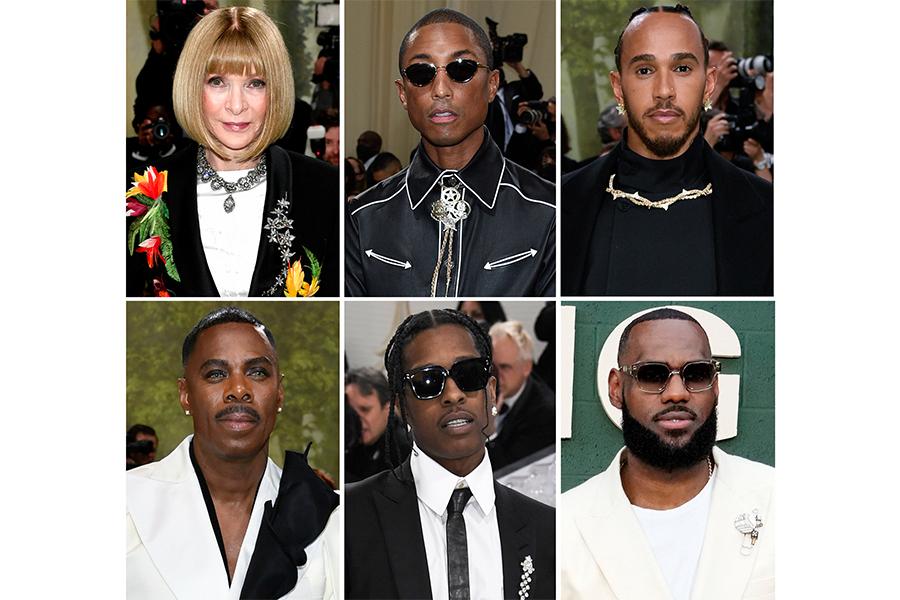
This year, the fundraising gala at the Metropolitan Museum of Art is hosted by a group of Black male celebrities, including Williams, the musical artist and Louis Vuitton menswear director, and Lewis Hamilton, Colman Domingo, and A$AP Rocky, with NBA superstar LeBron James as honorary chair. They’re joined by Vogue’s Anna Wintour, the mastermind behind the gala, considered the year’s biggest and starriest party.

This combination photo shows various fashion worn by rapper A$AP Rocky. (AP Photo)

Also guaranteed to show up is a second tier of hosts from a variety of worlds: athletes Simone Biles and husband Jonathan Owens; Angel Reese and Sha’Carri Richardson; filmmakers Spike Lee, Tonya Lewis Lee and Regina King; actors Ayo Edebiri, Audra McDonald and Jeremy Pope; musicians Doechii, Usher, Tyla, Janelle Monáe and André 3000; author Chimamanda Ngozi Adichie; artists Jordan Casteel, Rashid Johnson and Kara Walker; playwrights Jeremy O. Harris and Branden Jacobs-Jenkins; and fashion figures Grace Wales Bonner, Edward Enninful, Dapper Dan and Olivier Rousteing.

The gala raises the bulk of the curation budget for the museum’s Costume Institute.

This year’s Met Gala dress code is…

It’s more like a firm suggestion. From Wintour. This year, it’s about tailoring and suiting as interpreted through the history and meaning of Black dandyism across the Atlantic diaspora. The theme is inspired by the annual spring exhibition, which this year is based in large part on “Slaves to Fashion: Black Dandyism and the Styling of Black Diasporic Identity,” a book written by Monica L. Miller. She is guest curator of the exhibit.

Related Articles


For Black men, fashion has been a tool of self-expression — and a way they’ve been judged


Anxious about the world? Cow cuddling or bee buzzing might help ease your stress


Farmstand chic? Décor is awash in fruit and vegetable motifs


Bluebells and other spring flowers can be nature’s antidote to stressful times


A 6-hour morning routine? First, try a few simple habits to start your day

“Historical manifestations of dandyism range from absolute precision in dress and tailoring to flamboyance and fabulousness in dress and style,” Miller writes in the exhibit catalog. “Whether a dandy is subtle or spectacular, we recognize and respect the deliberateness of the dress, the self-conscious display, the reach for tailored perfection, and the sometimes subversive self-expression.”

How the dress code goes, in terms of taste and style, is anyone’s guess. Wintour has a hand in virtually all things gala, so the presumption is things can’t go too far off the rails. She recently knocked down the rumor that she approves all looks, telling “Good Morning America” she’ll weigh in if asked.

The exhibit, “Superfine: Tailoring Black Style,” draws on other sources beyond Miller’s book. It’s organized into 12 sections. Each symbolizes a characteristic of dandy style as defined by Zora Neale Hurston in her 1934 essay, “Characteristics of Negro Expression.”

Among them: ownership, presence, distinction, disguise, freedom, respectability and heritage. Presumably, for gala guests who do deep-dive research (or have stylists to do it), some of these factors will play out on the museum steps that serve as the event’s red carpet.

Who else is going to show up?

The guest list amounts to about 450 high-profile people from tech, sports, art, entertainment and more. The mix, Williams said, is a must.

This combination of photos shows Janelle Monae’s fashion outfits at The Metropolitan Museum of Art’s Costume Institute benefit gala across several years. (AP Photo)

“It’s so important to me to have successful Black and brown people of every stripe in the room: not just athletes and actors and actresses, entertainers, but also authors, architects, folks from the fintech world,” he told Vogue. “We’ve got to invest in each other. We’ve got to connect with each other, because it’s going to take everybody to coalesce the force of Black and brown genius into one strong, reliable force.”

Minnesotans, lawmakers in St. Paul protest federal cuts to disability funding

posted in: All news | 0

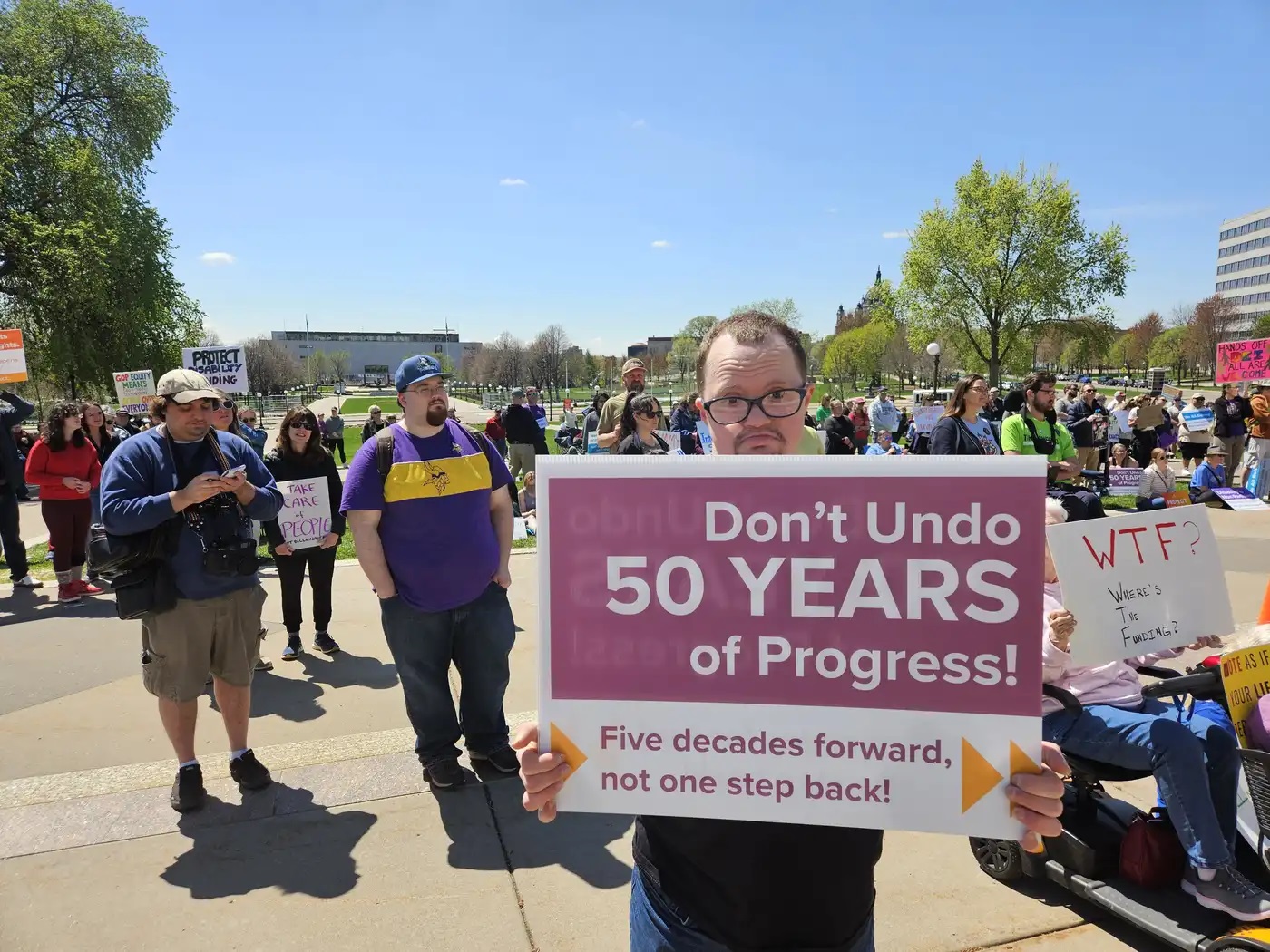
Disability rights advocates rallied at the Minnesota Capitol on Saturday to protest cuts to programs and services.

Demonstrators said President Donald Trump has proposed actions that would jeopardize access to housing, health care and education for people with disabilities.

“This is an attack on human rights,” said Rep. Kim Hicks, a DFLer from Rochester. “It is an attack that is coordinated to ensure that people with disabilities go away. We’re staying in the community, and we’re going to fight for the support we need to do that.”

The rally was organized by Arc Minnesota, a nonprofit dedicated to supporting people with intellectual and developmental disabilities. The group worries budget cuts could impact or eliminate the Governor’s Council on Developmental Disabilities, the Minnesota Disability Law Center, the Institute on Community Integration at the University of Minnesota, and Head Start.

“All of these institutions have been built up over decades to help people with disabilities live a more independent life,” said Maren Christenson Hofer, an Arc Minnesota board member. “And what we’re seeing now is really this tidal wave of cuts to programs that is moving us in the wrong direction.”

‘This is not a political matter’

Sen. Jim Abeler, a Republican from Anoka, also spoke at the rally. He is one of several lawmakers committed to bipartisanship around funding disability services and programs.

“This is not a political matter,” he said. “It’s a matter of priorities.”

Several people with disabilities echoed concerns that Trump’s actions will roll back progress made since the passage of the Americans with Disabilities Act in 1990. A specific concern is around the dismantling of the Administration on Community Living, a federal agency that supports community living for older adults and people with disabilities. Prior to its existence, people with disabilities had few options outside large, state-run institutions.

‘We just want to be respected’

Claudia Fuglie, of Robbinsdale, attended the rally with two friends. They all have spina bifida, a condition affecting the spine.

“There’s a lot of times society does not respect us, and all we’re trying to do is be a part of the society,” she said. “We’re not doing anything different. We don’t want anything different. We just want to be respected.”

From left, Kari Sheldon, Linda Bailey and Claudia Fuglie hold signs at a disability rights rally Saturday, May 3, 2025, at the state Capitol in St. Paul. (Feven Gerezgiher / MPR News)

Sumukha Terakanambi serves on the Governor’s Council on Developmental Disabilities. He was diagnosed with Duchenne muscular dystrophy at a young age and requires assistance with most physical tasks.

“It is really tiring to constantly have this conversation about how important these programs are and how they promote the well-being, independence and inclusion of people with disabilities,” he said.

Related Articles


Trump Administration Slashes Research Into LGBTQ+ Health


New tax cuts mostly favor the rich across states this year


Mexico’s president says she rejected Trump’s plan to send US troops across the border


Trump draws criticism with AI image of himself as the pope ahead of the papal conclave


Debate on unemployment benefits for school workers derails key MN budget piece

Terakanambi said that on top of the proposed cuts, the disability community has already been harmed by cuts to investments like rare disease research and special education.

“These threats signal to us that some of our leaders in Washington believe that we are expendable, that we do not matter,” he said.

“Instead of letting these emotions stop us, we have decided to take a stand and come together and send a clear message to these federal lawmakers that people with disabilities do matter and we deserve to live a life, a fulfilling life with dignity.”