At an April 2017 committee hearing in a meeting room tucked away in the Capitol’s underground extension, state Senator Paul Bettencourt, a bespectacled Houston Republican, touted a proposal of his then called Senate Bill 1882.
The bill was meant to “turn around” public schools the state had deemed failing by tapping nonprofit charter school operators to take over and implement “innovative practices,” Bettencourt promised. The new system would be a “model of efficiency,” New Braunfels Republican Donna Campbell added to a chorus of bipartisan support. Co-author José Menéndez, a San Antonio Democrat, later told the Texas Observer that he aimed to tap into charter operators’ “highest expertise.”
At the hearing, one public school advocate warned of the proposal’s high cost and lack of accountability, and another requested more protections for public school employees, but their testimonies were largely ignored, and SB 1882 passed.
Since then, 27 school districts across Texas have struck deals under the statute, allowing nonprofit organizations and a few public universities to collect taxpayer dollars to operate 129 public schools. Some cash-strapped school districts were simply motivated to participate by extra funding made available under the program, while others avoided impending state takeovers by inking their contracts. Under a 2015 law (strengthened in 2021), the Texas Education Agency (TEA) can depose an elected school board and take over a district if even one of its schools receives a failing rating (F, D, or Improvement Required) for five consecutive years in the state’s “A-F Accountability” system. SB 1882 created an escape hatch for districts—if they turned over their failing schools.
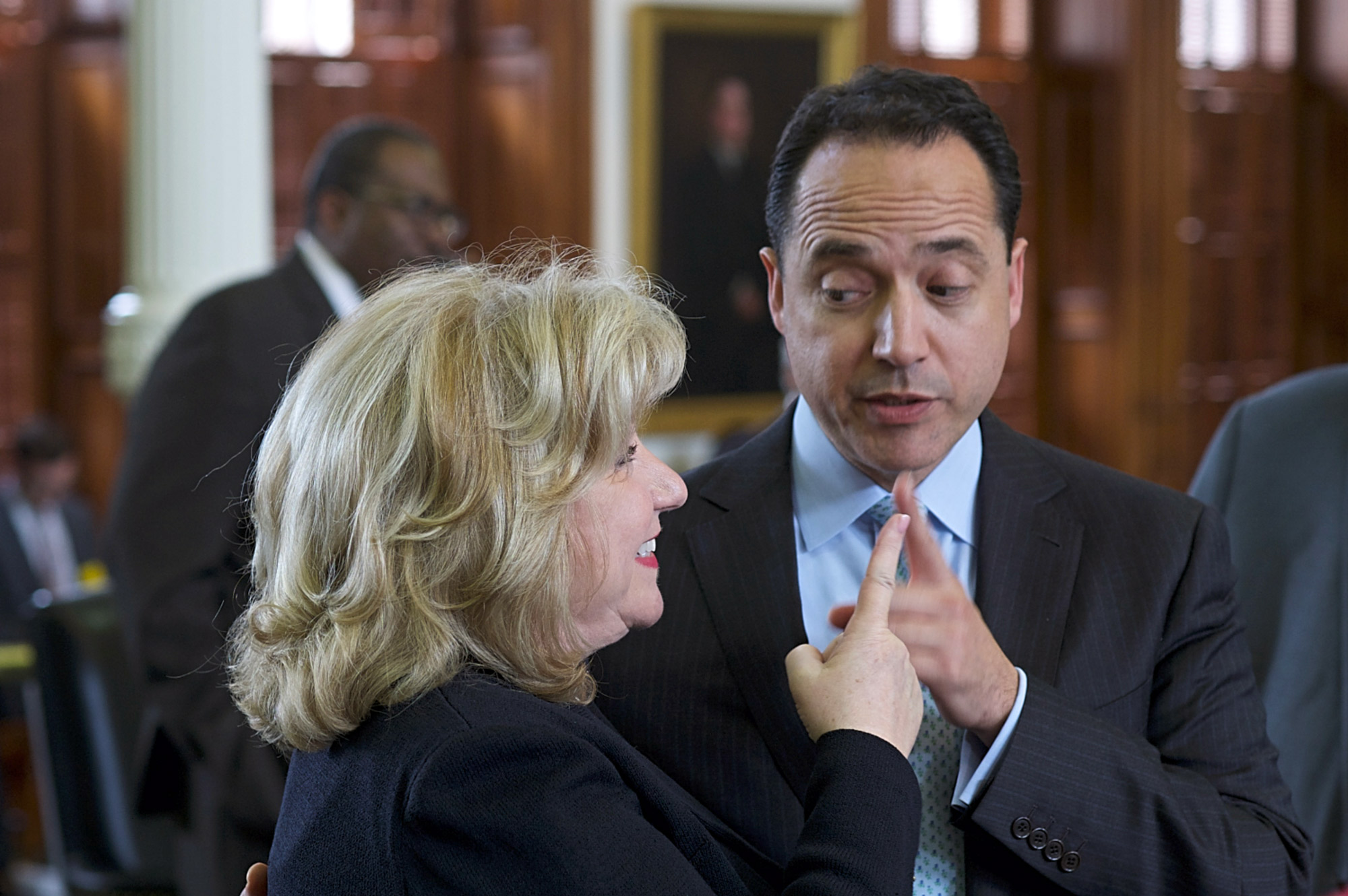
José Menéndez (right) on the Senate floor in 2017 (Sam DeGrave)
So far, 48 charter operators—which are required to be nonprofits, governmental entities, or higher education institutions—have received at least $735 million in state and federal funds (passed through the school districts) under the program SB 1882 inaugurated, which came to be called “Texas Partnerships.” These operators largely control the budgets and operations of the public schools they helm.
Per student, Texas ranks among the bottom 10 states for average public education spending: around $12,000 in 2023-2024, roughly $5,000 less than the national average, according to data from the National Education Association. The state’s “basic allotment,” the core building block of that per-student spending, remained stagnant from 2019 to 2025 at just $6,160. (The Legislature now looks poised to increase this figure somewhat.) But Texas Partnerships unlock additional per-student funding from the state. Since 2019, districts have collectively received, and mostly disbursed to charter operators, $284 million more for students in these partnership schools than they would typically get for the same number of students, TEA records show.
Seven years into the costly experiment that is Texas Partnerships, the Observer has carried out a wide-ranging investigation into whether these state-backed charter arrangements have actually benefited Lone Star State kids in struggling schools. Overall, the Observer found that school districts have so far ended contracts covering 44 campuses, a third of Texas Partnership schools, with the contracts covering 30 of those schools being terminated early.
The Observer obtained and examined contracts, school evaluations, financial reports, and tax filings relating to all operators whose contracts have been terminated early or were non-renewed. From 2018 through 2024, these 22 operators collectively ran 44 schools in Austin, Beaumont, Dallas, Ector County, Fort Worth, Grand Prairie, Hearne, Lubbock, Midland, San Antonio, Snyder, Victoria, and Waco school districts. These entities received at least $393 million in state and federal funds, more than half the total awarded to all operators under the Texas Partnership program so far, based on district records.
The stated mission of Texas Partnerships is to help turn around struggling schools. But the operators have achieved mixed results. Of those 44 campuses, 14 are preschools, which are not subject to the same state ratings system as K-12 schools. Twelve of those preschools also lack complete academic performance data since they only operated during the COVID-19 pandemic, when the state did not enforce end-of-year academic assessment requirements. Of the remaining 30 schools, 18 ended their time under private management with failing state overall accountability ratings, according to an Observer analysis of TEA ratings and academic performance reports. Eleven posted worse ratings in at least one of their two final contract years than those schools did in the year before the private partnerships began. And 24, including the two preschools with complete academic data, did not meet ratings goals set by school districts in their partnership contracts in at least one of the final two school years of those contracts, according to public records and interviews with district officials.
Some operators also had financial issues. For example, four did not submit annual financial reports to school districts, as required by their district contracts, for one or more years. Three ended at least one of their contract years in the red despite contractual language requiring them respectively to “operate within available funding,” to retain “a positive net asset amount,” or to ensure “total expenditures does not exceed total revenues.” One operator was accused by a district of diverting funds to a campus it operated in another district.
Some school district officials told the Observer that they voted to end contracts after seeing lackluster results. Thomas Sigee, a board member of Beaumont ISD, which has already terminated partnerships with three different operators early, told the Observer that he doesn’t understand why the district would partner with private operators when “the results are not any better.” Sigee added, “Charter schools have not proven to be better than [traditional public schools].”
Other experts expressed broader doubts about the state’s investment in the partnership charter program at a time when other public school funding has been flat. Paul Colbert, a school finance expert and former Democratic state representative, told the Observer, “We’re giving public dollars to institutions over which we don’t really have oversight as to how [the dollars are] going to be spent, whether or not it’s a necessary amount of money to give them to spend, whether or not they’re being used wisely, and there’s no particular recourse on it because there’s nobody looking over their shoulder.”
As part of this investigation, the Observer sought comment from all 13 school districts where partnerships ended. Eight school districts confirmed the Observer’s findings regarding their partnership schools.
Five other districts provided limited information or did not respond. A Victoria ISD spokesperson told the Observer the district did not collect information on academic or financial goals for its preschool partnership because “the enrollment projections triggered the clause to terminate the partnership.” A spokesperson for Waco ISD said the district was “unable to confirm the data … because Transformation Waco operated the school,” and a spokesperson from Snyder ISD said that current district leaders did not have knowledge of the details of the partnership. The spokesperson for Lubbock ISD did not respond. A spokesperson for Dallas ISD—which signed contracts in July 2019 with five operators to run 10 preschool partnerships—said that operators “were not paid under SB 1882” because “in December 2019, the Dallas ISD Board of Trustees voted to switch the payment method to utilize district and federal funds.”
Comment from private school operators was also sought and is included where applicable.
Only one of the 22 operators examined for this story continues to run partnership schools in Texas: Third Future Schools-Texas (TFS-Texas), the nonprofit previously run by current state-imposed Houston ISD Superintendent Mike Miles. A TFS-Texas contract with Ector County ISD was not renewed, and the nonprofit has said it plans to end its partnership with Beaumont ISD for three schools there at the end of the school year, but it still operates four other schools in Midland, Jasper, and Austin ISDs.
In total, 27 organizations, including private nonprofits and public universities, still operate more than 80 partnership schools in Texas today.
As legislators this year approved a proposal to send even more funding to private entities—through school vouchers—public education advocates say that the issues with Texas Partnerships offer a glimpse of what happens when state dollars are handed to private operators with few strings attached.
Patty Quinzi, legislative counsel for the Texas American Federation of Teachers—a union representing teachers and other school staff—and a former state Legislative Budget Board analyst, was the only person to officially testify against SB 1882 at the 2017 committee hearing, and she worries that the problems with the partnership program will only get worse.
“We’re giving away hundreds and hundreds of millions of dollars without any real accountability,” she told the Observer, “then it’s no surprise that performance isn’t going to improve, and that there’s going to be financial improprieties.”
After SB 1882 took effect in June 2017, districts were slow to contract partners for struggling schools. Following the program’s second year, the Texas Tribune reported that only five had inked partnerships: Austin, Ector County, Hearne, San Antonio, and Waco. The start was rocky: Seven of the first 12 participating campuses reported lower state accountability scores in the 2018-19 school year than they did in the 2017-18 school year, based on published ratings.
But San Antonio school district leaders continued to dive in headfirst. The San Antonio ISD (SAISD) school board gave private operators 10-year contracts for five campuses in 2018, plus 18 more the next year. Over time, the district granted nine private entities and two public colleges control over 33 campuses, more than a third of its schools and the most of any district.
Two smaller districts have ceded control of more than half their public schools to private operators or a public university: Longview ISD in East Texas has 13 of 14 schools participating, and Edgewood ISD—a poor district within San Antonio known for a landmark case calling for an equitable state school funding system—has 10 of 18.
Statewide, a third of the 48 total Texas Partnership organizations—which include out-of-state charter management organizations, college education programs, and homegrown nonprofits—were nonprofits incorporated shortly before taking over campuses. In San Antonio ISD, five of the 11 operators running partnership schools were brand new.
Jake Kobersky, a TEA spokesperson, told the Observer that, in the 2022-23 school year, the education agency began requiring that Texas Partnership operators “must have existed for at least three years, have managed multiple campuses for multiple years, and demonstrate a track record of managing campuses to academic success or have significantly improved the academic performance of campuses.”
In a written statement, TEA added: “70% of all partnerships have experienced some form of academic growth or maintained acceptable performance. By choosing carefully selected partners to operate schools through a rigorous vetting process and quality authorizing practices, districts can leverage external expertise and introduce innovative practices and targeted supports, which shows improved student performance.”
Sarah Sorensen, a San Antonio ISD parent and now a school board trustee, became alarmed when she first heard that the board was planning to sign a raft of private partnership agreements. She started doing research, and she was astonished to see so many new nonprofit groups, freshly incorporated in Texas and with no prior experience, apply for the complex job of running a public school. “Literally, these were created almost overnight,” she told the Observer.
Then-SAISD Superintendent Pedro Martinez, who had pushed for SB 1882, urged board members to approve partnerships. Martinez, now CEO of Chicago Public Schools, did not respond to the Observer’s request for comment.
San Antonio (Shutterstock)
Teachers fought back when the district announced it was contracting Democracy Prep—a 20-year-old New York City-based charter management organization that runs more than a dozen schools in New York and Nevada—to operate Stewart Elementary. Stewart, which had previously received failing ratings from TEA, had recently “met standards” and been recognized by TEA as among the top 25 percent of Texas schools for academic growth in 2018, when the school was handed to Democracy Prep.
That same year, San Antonio Alliance of Teachers and Support Personnel, a union representing 2,700 employees including 33 teachers at Stewart, sued San Antonio ISD leaders over the takeover. Alejandra Lopez, a teacher at Stewart who is now the union president, told the Observer she and others had been hired by the principal to turn around the school and “were working incredibly hard to get the school up to standard.”
Employees, represented by the San Antonio Alliance, alleged in the lawsuit that the district violated SB 1882 by contracting with Democracy Prep “without consulting with the campus staff.”
But the union lost its case. In April 2019, the Texas Fourth Court of Appeals dismissed the lawsuit, ruling that SB 1882’s consultation requirement “applies only to an open-enrollment charter school,” a category that excludes nearly all Texas Partnerships, which are a legally distinct type of charter school.
Martha Owen, the attorney representing the San Antonio Alliance, told the Observer she didn’t believe the ruling reflected the intention of the law but rather “sloppy drafting” in the legislative process. “It was clear that they intended that particular requirement, the consultation requirement, to apply to everybody.”
Texas has many older “open-enrollment” charter schools, like KIPP or IDEA, which are governed by a subchapter of the state education code that outlines numerous financial and academic requirements. Texas Partnerships generally fall under a different subchapter, for in-district charter schools, which contains few guardrails regarding hiring or finances and minimizes state oversight; instead, these partnerships are largely governed by individual contracts between districts and charter operators, as confirmed in a recent TEA report. (In March, Democratic state Senator Borris Miles filed a bill that would make in-district charters subject to the same financial requirements as open-enrollment charters, but the bill has not received a hearing.)
Open-enrollment charters typically own or rent their own school buildings and are open to students across the district through a lottery system. Texas Partnership operators typically run existing public schools, and some have a district-wide lottery system while others enroll only zoned students like traditional neighborhood schools.
“The lack of regulations allows for things to get worse than they might just under a traditional ISD or an open-enrollment charter school,” said Monty Exter, director of governmental relations at the Association of Texas Professional Educators, adding that a lack of state control means that problematic operators can try to simply jump from district to district. “You see these contracts getting closed … but it doesn’t stop the entity from going somewhere else and running a campus in the state.”
Under most Texas Partnership contracts, school districts retain the responsibility to maintain facilities, furniture, and equipment, offer transportation and meals to students, and provide special education services, but they give up control over administration, curriculum, and budgets.
After the San Antonio teachers sued in 2018, San Antonio ISD began writing more protections into its Texas Partnership contracts, including that the district would pay employees at partnership campuses directly rather than passing payment through the operators. Spokespeople from a few other districts, including Waco and Fort Worth, told the Observer their districts also directly pay teachers and staff at partnership schools. Some districts, however, use contracts based on TEA’s boilerplate contract, which includes no such provision.
SIGN UP FOR TEXAS OBSERVER EMAILS
Get our latest in-depth reporting straight to your inbox.
In San Antonio, Sorensen continued to protest what she considered the district’s giveaway of public schools and funds to private operators and won her school board seat in 2021. She said she doesn’t believe there’s much difference in the academic performance of partnership schools. “The test scores at these schools are not any better. The experience[s] of students at these schools aren’t necessarily any better,” she said, adding: “Sometimes the partners are actually performing more poorly than our district-managed schools.”
At a time when shrinking tax revenue, inflation, and flat state funding have left public schools in dire financial straits, Sorensen questions whether any private operator should receive public money to experiment with the district’s schools. “We just need every penny that we get,” Sorensen said.
In 2024, SAISD shuttered 13 schools in order to close budget gaps. Still, the district projected a $40.8 million deficit by the end of the current school year. Meanwhile, it’s disbursed $42.7 million in public funding to private partnership operators since 2018.
SAISD has already terminated Texas Partnerships early for nine campuses for various reasons, including failure to submit a financial audit, failure to meet academic goals, and misuse of funds, according to an Observer review of board meeting minutes, district records, and interviews.
“Our charter partners receive more funding, and therefore they are expected to outperform district-managed schools. We hold our charter school partners to a greater accountability standard for student achievement and outcomes. If a partner-run school is not performing, we do have the framework in our contract agreement to pursue probation and/or revocation,” Laura Short, an SAISD spokesperson, told the Observer via email.
The idea behind Texas Partnerships was that charter operators, with the help of extra funding, would lift struggling schools with failing state ratings up into passing territory. But the Observer found that, of 30 K-12 schools where partnerships have ended, 18 concluded their time under private control with failing state accountability ratings.
In addition, partnership operators entered into district agreements with specific academic goals—including promising to improve state accountability ratings and students’ standardized test scores, often with specific benchmarks. The Observer found that 24 schools, including two preschools, did not meet their contractual academic goals in at least one of the last two years of their agreements. (Twelve preschools where partnerships ended lack academic performance data.)
In Beaumont ISD, four campuses concluded their Texas Partnerships with failing state ratings—and three of those partnerships were launched when the district was already under state control.
In 2014, TEA took over Beaumont ISD, appointing a state conservator to replace the superintendent and a board of managers to replace elected trustees, after a TEA investigation found district leaders mismanaged funds. By 2018, TEA started to phase in elected board members. Under state control, the district had cleaned up its finances, but some schools in high-poverty communities were still failing or had dropped in ratings—including Martin Luther King Middle School, a 61-year-old campus in the predominantly Hispanic neighborhood known as “The Avenues.”
In 2019, a year before the state takeover fully ended, Beaumont ISD leaders contracted Phalen Leadership Academies to run two campuses and Responsive Education Solutions to run another.
“We chose charter schools based on what TEA told us we could use. We made decisions based on what they allowed us to do,” said Sigee, who was permitted by TEA to join the board as a locally elected trustee in 2019. “When you bring on a charter school to take over or partner with a public school, and you have limited options, it kinda puts us in a corner.”
In December 2020, Beaumont ISD’s then-fully elected board also voted to sign a contract with the Los Angeles-based charter management organization Green Dot Public Schools to run Martin Luther King Middle School. But Sigee told the Observer that he and other board members got a list of potential partners from TEA and lacked time to vet them.
Kobersky, the TEA spokesperson, insisted that districts have always been in charge of selecting operators. “While the agency can’t speak to individual board members’ comments, there may be some confusion around the discussions TEA had with the superintendent about operating partners,” he said. “In the early days of these partnerships, TEA would facilitate connections between districts and operating partners who met the specific criteria outlined in rule at that time, but again the decision-making authority has always rested with the district. For SB 1882 partnerships, TEA does not approve who the district selects but the manner in which they approved the operating partner.”
Under its 2020 contract, the district gave Green Dot’s affiliate Green Dot Southeast Texas “initial, final, and sole authority over all matters involving academic curriculum and the instruction program and related expenditures”—similar language to that found in most partnership agreements reviewed by the Observer. Green Dot’s deal stated it would receive about $11,000 in state and federal money annually for each of its roughly 560 students, while local dollars still separately covered other expenses including maintenance and meals.
Prior to incorporating its Texas nonprofit, Green Dot Public Schools had a history of claims of problems in other states, including allegations of high staff attrition rates in California and school closures in Washington, according to press reports and an online post written by a former Green Dot teacher. Sigee said he was unaware of those allegations at the time of his vote.
Green Dot did not respond to the Observer’s requests for comment.
After two years under Green Dot control, Martin Luther King—a campus that serves mostly Black and brown students—was still failing, according to projected ratings the district released in 2024. The board terminated its contract early in June 2024.
Board members then felt forced into closing the school, Sigee said. “Had we not closed it, with having failed for seven years in a row, then we would have run the risk of having the state take over our district [again].”
In response to an Observer question about the Beaumont school’s academic performance, a spokesperson for Green Dot Public Schools noted via email that its related organization, Green Dot Public Schools Southeast Texas, ran the school and was dissolved in June 2024, adding: “We do not have additional background or context that we can provide.”
Beaumont ISD’s leaders chose a different path for their other three Texas Partnership schools. As of 2023, this trio still had failing ratings after three years under private control, reviving the possibility of another state takeover. In March 2023, the school board chose to hand the schools over to a different private operator: TFS-Texas, earning another two-year reprieve from sanctions. TFS-Texas is part of a network under a Colorado-based parent nonprofit, Third Future Schools, that operates schools in four states.
In August 2024, Beaumont ISD reported its projected ratings for the prior school year, revealing that two of the three campuses TFS-Texas runs—Fehl-Price and Jones-Clark Elementary—were still failing, which meant it could still face the threat of another state takeover if test scores didn’t improve.
“Despite the failures of previous partners, I was hopeful that TFS would succeed where others had not,” Superintendent Shannon Allen wrote in a March op-ed.
On March 1, Third Future Schools announced it was ending its partnership with Beaumont ISD early, at the end of the 2024-25 school year, saying the district was not passing along enough revenue to the nonprofit.
In her op-ed, Allen wrote that the charter network was demanding $1 million more this school year and $2 million more the next when the district had already “made financial concessions” after entering into an agreement to pay the organization $8.27 million. She wrote, “Beaumont ISD will not be pressured. … Instead, we embrace the opportunity to take back control, strengthen these schools, and build a future that is in the best interest of our community.”
Per its contract with the nonprofit, Beaumont ISD pays at minimum for the costs of building maintenance, student transportation, food services, some special education services, security, and accounting personnel for the three district campuses that TFS-Texas runs.
In a statement, Third Future Schools wrote: “These high revenue holdbacks prevent TFS from delivering its educational programming to the excellent standard that the students and teachers expect.”
Some charter operators’ struggles to “turn around” schools may stem from the same challenges faced by public school districts to begin with: systemic inequalities, a teacher shortage, and the system of high-stakes testing that determines ratings.
For years, parents and teachers have protested the state’s accountability rating system, which Quinzi called an “oversimplification based entirely on the test score.” With the threat of state takeover tied to these scores, many district leaders have been pushing back on how the state grades schools. TEA paused ratings in 2020 and 2021 during the height of the pandemic, then released numerical ratings in 2022 but did not assign an official letter grade for failing schools. Later, several districts sued TEA blocking the agency from releasing ratings for the 2022-23 and 2023-24 school years, though some districts have published their own projected ratings for those years. After a state appeals court ruled the 2022-23 ratings could be released, TEA released those ratings on April 24.
Shelly Haney, a longtime educator, turned Midland ISD’s Goddard Junior High from an F-rated to a C-rated school as principal from 2013 to 2019. That’s why, in 2019, then-superintendent Orlando Riddick asked her, while she was still Goddard’s principal, to start a nonprofit and apply for a Texas Partnership contract to run the school in addition to Bunche Elementary School and later other elementaries, Haney said. The charter organization would be called the REACH Network.
“That’s money that’s not being spent on the students.”
Bunche Elementary had gone through ups and downs since the campus reopened in a new building in 2015 to accommodate a growing low-income Hispanic population in southeast Midland. In its first year, it failed state standards. It improved, but it was failing again by the time Riddick approached Haney, according to state accountability reports. The idea was to apply Haney’s successful methods from Goddard, which included providing small-group support for struggling students.
Haney brought in a full-time family liaison, a crisis counselor, reading interventionists, and chess and mariachi programs for students, efforts that helped increase attendance, Haney said.
But Haney ran into the same obstacles that her predecessors at Bunche had faced: community poverty, low teacher retention, and then COVID-19. There were early signs of trouble when Bunche’s new principal quit in September 2019, four weeks after the school year started. Three more principals left during the four years REACH was in operation. Amid teacher shortages that got worse during the pandemic, Midland ISD waived certification requirements —as allowed under state law—and there were fewer experienced teachers available in the district’s hiring pool to help carry out reforms, Haney told the Observer.
Standardized test scores didn’t improve enough to stave off Midland ISD’s fears of a state takeover. Haney told the Observer that some other Texas Partnership schools have a “process of weeding out your students” through applications, while hers admitted all students zoned to the school, which made bringing scores up more difficult: “The goal was just to serve the neighborhood students. … I don’t want it to sound like excuses. Ultimately, we didn’t meet our goals.”
In the 2022-23 and 2023-24 school years, Bunche received an F, based on TEA and district ratings. Even Goddard, which Haney had boosted to a C-rated school under district control, declined, receiving a D and F in those years. Midland ISD did not renew its contract with REACH after the 2023-24 school year.
Texas Partnership agreements are typically light on financial requirements, often requiring little more than that operators supply annual financial statements and “unqualified audit opinions”—clean audits free of adverse comments or disclaimers about the organization’s finances—in addition to operating in the black.
Still, four operators did not provide any financial statements or audits in one or more contract years, as their agreements required, according to public records requests and districts’ emailed responses.
Three operators finished at least one year with a deficit, according to their 990 tax forms, even though their agreements required them to “operate within available funding,” ensure “statements reflect a positive net asset amount,” or maintain expenditures that “do not exceed total revenues for the fiscal year.”
Colbert, the school finance expert and former legislator, said that school districts aim to ensure that organizations operate without a deficit because: “You have to have enough money to be able to do what you contractually promised you were going to do. And if you don’t have enough money to be able to do that, we don’t have the confidence that you can fulfill your contract.”
Prior to being contracted by SAISD in 2019 to run two preschools—the Caroll and Tynan Early Childhood centers—the Michigan-based nonprofit HighScope Educational Research Foundation focused on research and developing preschool curriculum.
As first reported by the San Antonio Report, HighScope failed to submit a financial statement to the district in the 2021-22 school year—a requirement in its partnership agreement—for its preschool operations. The organization’s contract also required the campus to maintain “a balanced budget and stable cash flow.” HighScope began its San Antonio partnership with an unrelated operating deficit of $766,000, and it did not come out of its deficit until two years into the partnership in 2021, according to its IRS Form 990s.
At a December 2022 school board meeting, San Antonio ISD Chief Strategy Officer John Norman told board members that HighScope “did not meet any of their goals” and was “below district average for both [parent and teacher satisfaction]” for Carroll. TEA data shows the percentage of students proficient in literacy had declined at both schools. In 2023, SAISD terminated the contract early.
The Observer also could not find incorporation filings for HighScope in the Texas Secretary of State database of entities doing business in Texas, and the state comptroller’s taxable entity database indicates the organization never registered with the secretary of state. Darren Moore, a nonprofit lawyer and Baylor Law School professor, said that Texas law requires nonprofit corporations that do business in the state to register. HighScope’s president Alejandra Barraza did not respond to the Observer’s request for comments.
School Innovation Collaborative, which was contracted by San Antonio ISD in 2019 to run four schools, formed as a nonprofit in 2019 but was required to forfeit its existence for failure to pay taxes in 2021 (before being reinstated in 2022 and forfeiting existence again in 2024), per the secretary of state. There’s also no record that School Innovation Collaborative applied for federal tax-exempt status in the Internal Revenue Service database. San Antonio ISD terminated its contract early with the organization in 2023. CEO Doug Dawson did not respond to the Observer’s request for comment.
Colbert described those kinds of paperwork issues as red flags. “These are public tax dollars that are going to pay these people, and there are requirements of the law that they’re not meeting,” he said.
Statewide, public school districts spend an average of 4 percent on administrative or non-program expenses, according to the Texas Association of School Boards. The 22 Texas Partnership operators whose contracts ended generally reported spending more than that on their overhead. But because some operators ran other programs besides partnership schools and some districts paid the bulk of program expenses for partnership campuses directly, it’s difficult to determine an average overhead expense rate.
HighScope reported on its Form 990s spending more than half its total expenses on overhead costs during the three years it operated the two San Antonio preschools, but it did not separate out its Texas Partnership spending from its unrelated operations. Its president, Barraza, received a salary of over $200,000 a year in both 2022 and 2023, according to the 990s.
TFS-Texas also reported spending more than half its expenses on administrative costs in its 990s from 2021 to 2023. Mike Miles, CEO of the Third Future Schools network for most of that time, was paid an annual salary between $230,000 and $260,000 by the Colorado parent organization. For fiscal year 2023, TFS-Texas reported a negative $2.7 million year-end balance in net assets—even though its contracts with Ector County ISD and Austin ISD required a “positive net asset amount” or “positive cash flow at the end of the year.” TFS-Texas only runs Texas Partnership schools and has no other operations in the state.
“That’s money that’s not being spent on the students,” Colbert said of TFS-Texas’ high administrative costs.
Mike Miles in September 2023 in Houston (Karen Warren/Houston Chronicle via AP)
A spokesperson for Third Future Schools declined in November to explain the source of the 2023 deficit to the Observer and did not respond to the outlet’s questions for this story about the source of its deficit and high overhead. TFS-Texas faced media scrutiny last year from the Observer and other outlets over out-of-state fund transfers—though the TEA cleared the nonprofit of wrongdoing in an investigation—and the Observer recently reported on accusations the organization failed to teach required classes in Midland.
Quinzi, who reviewed a summary of the Observer’s findings in this story, believes the Texas Partnership program is failing: “These charter operators are not proven turnaround models.”
Regarding Texas Partnership operators in general, Quinzi, the teachers union legal counsel, said: “They’re going to put as much money into their pockets and the least amount of money in the classroom.”
She said the state has “rigged” the system by forcing school boards to choose between closing schools or contracting private operators to avoid state takeover.
“It’s the TEA that decides the ‘A-F’ ratings. It’s the [TEA] that determines what the standardized test scores have to be to get those ratings,” Quinzi said. “Then it’s also TEA that takes over public school districts because they’re low-rated. So it’s just a self-interested circle. The intent was never on improving schools.”
In 2019, SB 1882 co-author Menéndez filed another bill attempting to make partnership operators more accountable to the public by requiring districts to consult with campus personnel and to get 75 percent of parents to approve a contract before it was signed. But the bill never received a committee hearing.
This legislative session, Democratic Senator Nathan Johnson and Republican Representative Gary VanDeaver introduced what could be an alternative to the Texas Partnership program. Instead of handing off a failing campus to a private operator, Senate Bill 235 and its House companion bill would give school districts a two-year reprieve from state takeover if they turn the campus into a “community school.” Under that model, parent, campus, and school district representatives would work together to create a turnaround plan. Both bills are languishing in committee.
“The findings on SB 1882 partnerships highlight serious concerns regarding financial accountability, transparency, and educational outcomes,” Johnson told the Observer. “Despite what may have been the best of intentions and assumptions that appeared reasonable at the time, the SB 1882 outcomes clearly indicate the need for a different approach.”
Menéndez told the Observer that the Texas Partnerships program has deviated from his original goal.
“We seem to be building a duplicate public school system with charter schools, which I don’t think was ever the intention,” he said. “I don’t believe that this system has worked. What I think it’s been doing, it’s been taking already very limited resources—because the state has refused to expand its investment in our community-based public schools, and it’s just dividing it further.”
The post Texas Already Gives Public Ed Dollars to Private Operators. Here’s How That Worked Out. appeared first on The Texas Observer.