Trump’s Middle East visit comes as his family deepens its business, crypto ties in the region

posted in: All news | 0

By WILL WEISSERT, Associated Press

WASHINGTON (AP) — It’s not just the “gesture” of a $400 million luxury plane that President Donald Trump says he’s smart to accept from Qatar. Or that he effectively auctioned off the first destination on his first major foreign trip, heading to Saudi Arabia because the kingdom was ready to make big investments in U.S. companies.

It’s not even that the Trump family has fast-growing business ties in the Middle East that run deep and offer the potential of vast profits.

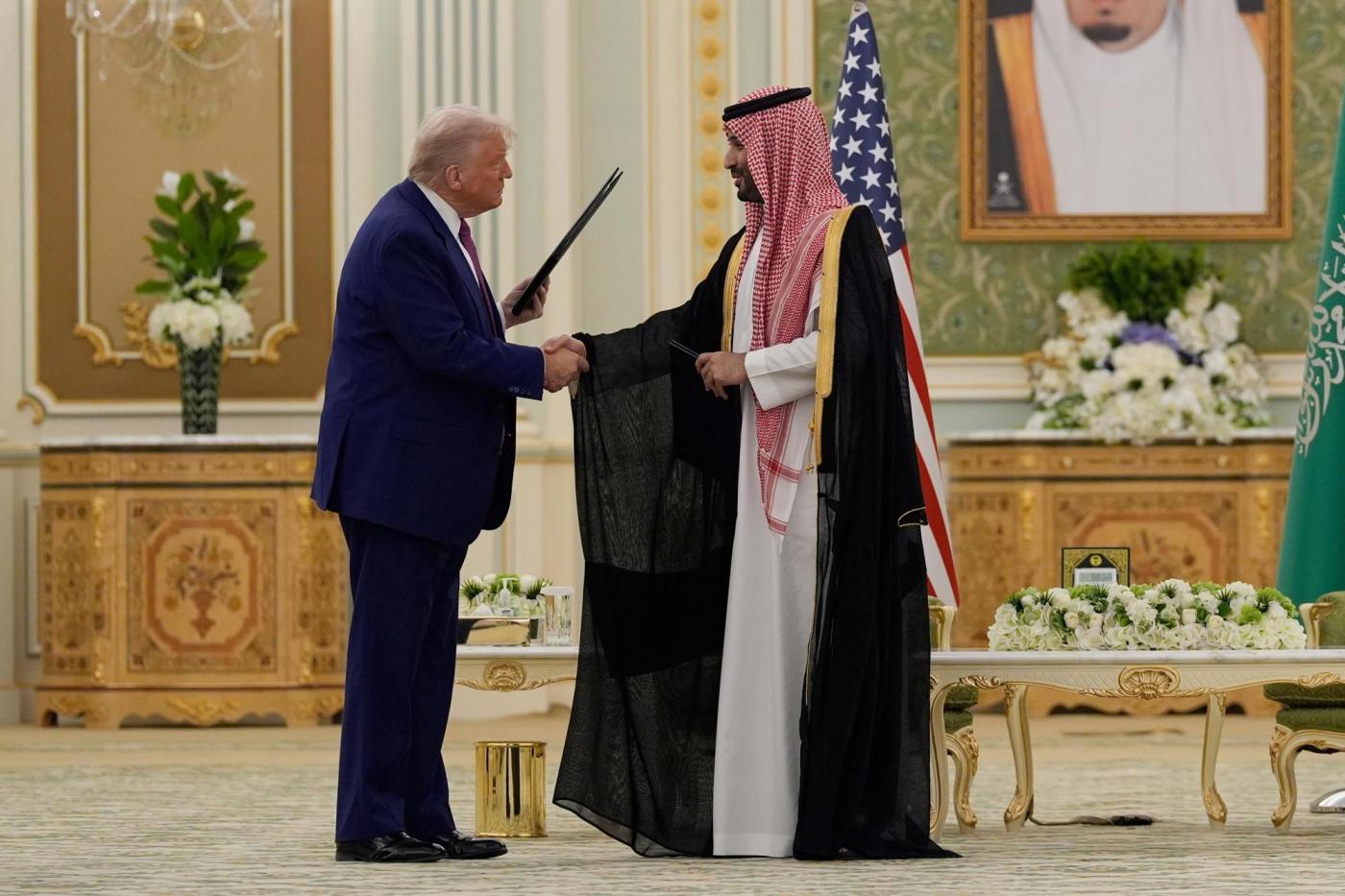
President Donald Trump and His Royal Highness, Mohammed bin Salman al Saud, Crown Prince and Prime Minister, Kingdom of Saudi Arabia, tour the Diriyah/At-Turaif UNESCO World Heritage Site, Tuesday, May 13, 2025, in Riyadh, Saudi Arabia. (AP Photo/Alex Brandon)

Instead, it’s the idea that the combination of these things and more — deals that show the close ties between a family whose patriarch oversees the U.S. government and a region whose leaders are fond of currying favor through money and lavish gifts — could cause the United States to show preferential treatment to Middle Eastern leaders when it comes to American affairs of state.

Before Trump began his visit to Saudi Arabia, Qatar and the United Arab Emirates, his sons Eric and Donald Jr. had already traveled the Middle East extensively in recent weeks. They were drumming up business for The Trump Organization, which they are running in their father’s stead while he’s in the White House.

Eric Trump announced plans for an 80-story Trump Tower in Dubai, the UAE’s largest city. He also attended a recent cryptocurrency conference there with Zach Witkoff, a founder of the Trump family crypto company, World Liberty Financial, and son of Trump’s do-everything envoy to the Mideast, Steve Witkoff.

“We are proud to expand our presence in the region,” Eric Trump said last month in announcing that Trump Tower Dubai was set to start construction this fall.

The presidential visit to the region, as his children work the same part of the world for the family’s moneymaking opportunities, puts a spotlight on Trump’s willingness to embrace foreign dealmaking while in the White House, even in the face of growing concerns that doing so could tempt him to shape U.S. foreign policy in ways that benefit his family’s bottom line.

Nowhere is the potential overlap more prevalent than in the Middle East

The Trump family’s business interests in the region include a new deal to build a luxury golf resort in Qatar, partnering with Qatari Diar, a real estate company backed by that country’s sovereign wealth fund. The family is also leasing its brand to two new real estate projects in Riyadh, Saudi Arabia’s capital, in partnership with Dar Global, a London-based luxury real estate developer and subsidiary of private Saudi real estate firm Al Arkan.

The Trump Organization has similarly partnered with Dar Global on a Trump Tower set to be built in Jeddah, Saudi Arabia, and an upcoming Trump International Hotel and luxury golf development in neighboring Oman.

During the crypto conference, a state-backed investment company in Abu Dhabi announced it had chosen USD, World Liberty Financial’s stablecoin, to back a $2 billion investment in Binance, the world’s largest cryptocurrency exchange. Critics say that allows Trump family-aligned interests to essentially take a cut of each dollar invested.

“I don’t know anything about it,” Trump said when asked by reporters about the transaction on Wednesday.

President Donald Trump speaks at the Saudi-U.S. Investment Forum at the King Abdulaziz International Conference Center in Riyadh, Saudi Arabia, Tuesday, May 13, 2025. (AP Photo/Alex Brandon)

Then there’s the Saudi government-backed LIV Golf, which has forged close business relationships with the president and hosted tournaments at Trump’s Doral resort in South Florida.

“Given the extensive ties between LIV Golf and the PIF, or between Trump enterprises more generally and the Gulf, I’d say there’s a pretty glaring conflict of interest here,” said Jon Hoffman, a research fellow in defense and foreign policy at the libertarian think tank the Cato Institute. He was referring to Saudi Arabia’s Public Investment Fund, which has invested heavily in everything from global sports giants to video game maker Nintendo with the aim of diversifying the kingdom’s economy beyond oil.

Trump said he did not talk about LIV Golf during his visit in Saudi Arabia.

The president announced in January a $20 billion investment for U.S. data centers promised by DAMAC Properties, an Emirati company led by billionaire Dubai developer Hussain Sajwani. Trump bills that as benefiting the country’s technological and economic standing rather than his family business. But Sajwani was a close business partner of Trump and his family since long before the 2016 election.

White House bristles at conflict of interest concerns

Asked before he left for the Middle East if Trump might use the trip to meet with people tied to his family’s business, White House press secretary Karoline Leavitt said it was “ridiculous” to “suggest that President Trump is doing anything for his own benefit.”

“The president is abiding by all conflict of interest laws,” she said.

Related Articles


Trump administration rescinds curbs on AI chip exports to foreign markets


What to expect at RFK Jr.’s first Senate hearing as health secretary


House works into the night as Republicans push ahead on Trump’s big bill


Trump tells Gulf leaders Iran must cease support of proxy groups as part of any nuclear deal


Trump meets with Syria’s insurgent-turned-leader in Saudi Arabia

Administration officials have brushed off such concerns about the president’s policy decisions bleeding into the business interests of his family by noting that Trump’s assets are in a trust managed by his children. A voluntary ethics agreement released by The Trump Organization also bars the firm from striking deals directly with foreign governments.

But that same agreement still allows deals with private companies abroad. In Trump’s first term, the organization released an ethics pact prohibiting deals with both foreign governments and foreign companies.

The president, according to the second-term ethics agreement, isn’t involved in any day-to-day decision-making for the family business. But his political and corporate brands remain inextricably linked.

“The president is a successful businessman,” Leavitt said, “and I think, frankly, that it’s one of the many reasons that people reelected him back to this office.”

Timothy P. Carney, senior fellow at the conservative American Enterprise Institute, said he doesn’t want to see U.S. foreign policy being affected by Trump’s feelings about how other countries have treated his family’s business.

“Even if he’s not running the company, he profits when the company does well,” Carney said. “When he leaves the White House, the company is worth more, his personal wealth goes up.”

Promises of US investment shaped Trump’s trip

His family business aside, the president wasn’t shy about saying he’d shape the itinerary of his first extended overseas trip on quid pro quo.

Trump’s first stop was Saudi Arabia, just as during his first term. He picked the destination after he said the kingdom had pledged to spend $1 trillion on U.S. companies over four years. The White House has since announced that the actual figure is $600 billion. How much of that will actually be new investment — or come to fruition — remains to be seen.

The president is also stopping in the UAE, which has pledged $1.4 trillion in U.S. investments over the next 10 years, and in Qatar, where Trump says accepting the gift of a Boeing 747 from the ruling family is a no-brainer, dismissing security and ethical concerns raised by Democrats and even some conservatives.

Trump’s Middle East business ties predate his presidencies

Trump’s first commercial foray in the Middle East came in 2005, during just his second year of starring on “The Apprentice.” A Trump Tower Dubai project was envisioned as a tulip-shaped hotel to be perched on the city’s manmade island shaped like a palm tree.

It never materialized.

Instead, February 2017 saw the announced opening of Trump International Golf Club Dubai, with Sajwani’s DAMAC Properties. Just a month earlier, Trump had said that Sajwani had tried to make a $2 billion deal with him, “And I turned it down.”

“I didn’t have to turn it down, because as you know, I have a no-conflict situation because I’m president,” Trump said then.

This January, there was a beaming Sajwani standing triumphantly by Trump’s side at Trump’s Mar-a-Lago estate in Florida, to announce DAMAC’s investment in U.S. data centers.

“It’s been amazing news for me and my family when he was elected in November,” Sajwani said. “For the last four years, we’ve been waiting for this moment.”
Trump administration rescinds curbs on AI chip exports to foreign markets

posted in: All news | 0

NEW YORK (AP) — After a week of promises to alter the policy, the U.S. Department of Commerce has rescinded a Biden-era rule due to take effect Thursday that placed limits on the number of artificial intelligence chips that could be exported to certain international markets without federal approval.

Related Articles


What to expect at RFK Jr.’s first Senate hearing as health secretary


House works into the night as Republicans push ahead on Trump’s big bill


Trump tells Gulf leaders Iran must cease support of proxy groups as part of any nuclear deal


Trump meets with Syria’s insurgent-turned-leader in Saudi Arabia


Other voices: DOGE’s damage makes way for serious government reform

“These new requirements would have stifled American innovation and saddled companies with burdensome new regulatory requirements,” the Commerce Department stated in its guidance.

The Biden administration had established the export framework in an attempt to balance national security concerns about the technology with the economic interests of producers and other countries. While the United States had already restricted exports to adversaries such as China and Russia, some of those controls had loopholes and the rule would have set limits on a much broader group of countries.

Commerce Undersecretary Jeffery Kessler said Tuesday that the Trump administration work to replace the now-rescinded rule.

“The Trump Administration will pursue a bold, inclusive strategy to American AI technology with trusted foreign countries around the world, while keeping the technology out of the hands of our adversaries.”

Wall Street wobbles ahead of new retail sales data and public appearances by Fed officials

posted in: All news | 0

By YURI KAGEYAMA and MATT OTT, Associated Press Business Writers

Wall Street bounced between small gains and losses in meek trading early Wednesday ahead of the new retail sales numbers this week and any hints from Federal Reserve officials about the U.S. central bank’s future interest rate decisions.

Futures for the S&P 500 rose 0.2% before the bell, while futures for the Dow Jones Industrial Average were flat. Futures for the tech-heavy Nasdaq rose 0.4%.

There’s still some relief in markets after the U.S. and China agreed Monday to a 90-day pause in their trade war to allow for negotiations. How that pause will influence the Fed’s next interest rate decision remains cloudy.

In light of Tuesday’s data showing that inflation cooled for third straight month in April, Fed officials would have likely been leaning toward restarting interest rate cuts in the absence of tariffs. The fed cut its benchmark rate three times last year but has since frozen rates while it awaits further evidence of how the tariffs and other policy changes — such as immigration restrictions and potential tax cuts — affect the economy.

Investors and economists will be paying close attention to a public appearances by two Fed officials Wednesday, Fed governor Christopher Waller and Philip Jefferson, the Fed’s vice chair and a top lieutenant to Jerome Powell, followed by a speech by Powell himself at a conference in Washington on Thursday.

Also Thursday, the government reports its latest data on retail sales in the U.S. and Walmart, the world’s biggest retailer, reports quarterly earnings. Investors may be more interested in the retail giant’s forecast than its results as many companies withdraw their financial guidance for 2025 due to uncertainty over President Donald Trump’s tariffs.

American Eagle Outfitters became the latest retailer to do so late Tuesday, which sent its shares tumbling more than 14% before the opening bell Wednesday. The retailer said it would write down $75 million in spring and summer merchandise and that it expects first-quarter revenue to slide 5%, or more than $1 billion.

In Asian trading, Chinese markets rallied on expectations of another rush in export orders during the 90-day grace period for China-U.S. tariffs.

Hong Kong’s Hang Seng jumped 2.3% to 23,640.65, while the Shanghai Composite gained 0.9% to 3,403.95.

Chinese tech companies made big gains, with games and entertainment giant Tencent Holdings up 3%, search engine company Baidu up 4% and e-commerce giant Alibaba Group Holdings advancing 3.4%.

Japan’s benchmark Nikkei 225 lost 0.1% to finish at 38,128.13. Australia’s S&P/ASX 200 rose 0.1% to 8,279.60.

South Korea’s Kospi surged 1.2% to 2,640.57.

The relief over the trade truce between the U.S. and China is tepid among global businesses and investors given uncertainty over how long it might last and where tariffs might go in the months ahead.

The hope is that Trump will ease his stiff tariffs on trading partners worldwide before they create a recession and send inflation spiking higher.

In Europe at midday, France’s CAC 40 slipped 0.5%, while Germany’s DAX fell 0.4%. Britain’s FTSE 100 was essentially unchanged.

Benchmark U.S. crude fell 77 cents to $62.90 a barrel following a four-day rally. Brent crude, the international standard, declined 75 cents to $65.88 a barrel.

The U.S. dollar edged down to 146.02 Japanese yen from 147.21 yen. The euro cost $1.1225, up from $1.1188.

The hottest amenity coming to an airport near you is a rooftop bar

posted in: All news | 0

By Lebawit Lily Girma, Bloomberg News

Sterile hallways, basic options for food and shopping, no glimpse of the outside world: This is what we often think about U.S. airports.

But as outdated facilities turn into swanky terminals, spending more time at the airport has grown tolerable, if not moderately pleasant. Upgraded concession programs have made for better meals— both sit-down and grab-and-go — while credit card companies have vastly improved the airport lounge game, and you can even get robot manicures from the types of airport “spas” that were once limited to 10-minute chair massages.

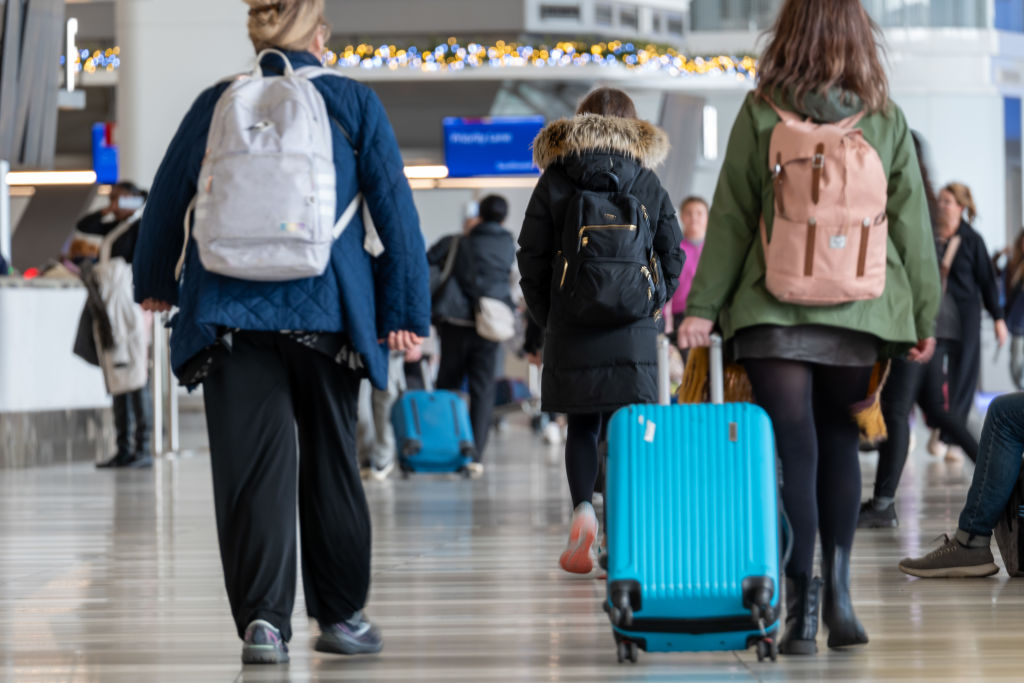
Now a new chapter of airport enhancement is kicking off. U.S. airports coast to coast are lately adding all sorts of outdoor spaces for the general flying public to enjoy—regardless of airline status or seat assignment. They include post-security observation decks, open-air lounges and microbrewery-inspired drinking holes that let you relax a bit before boarding your next flight.

Matt Needham, who leads aviation projects for global design and architecture firm HOK, says the trend is a way for airlines to address the increased stress of air travel. Carriers are increasingly thinking about airports as part of their own customer experience, he says, so they’re also signing the checks for these outdoor chill zones. “It makes a difference,” he says, if you can get “a little bit of sunshine and some breeze in your hair before you have to get on that pressurized tube.”

Related Articles


It’s the end of cheap flying as Americans tire of budget airlines


Bed & breakfasts are making a comeback, and here are some of the best towns to find them


The new rules of airline loyalty programs


Planning a trip abroad? Here’s how to protect the data on your devices at U.S. border searches


How cruise ship passengers can stay safe from the latest version of norovirus

Needham is just one of the architects at the forefront of this trend. His team’s most recent projects include such spaces at Salt Lake City International Airport — where the Delta Sky Lounge has an open-air patio with fans and heaters — as well as at LaGuardia Airport’s Terminal B, where the new Capital One Landing lounge will feature an outdoor terrace when it opens later this year. Other firms, like Gensler, are also working on al fresco airport spaces across the country.

Currently, Needham is overseeing Monterey Airport’s new Terminal 1 in California, set to break ground this year and reach completion in late 2027. After travelers pass through its Transportation Security Administration lanes, they’ll find an outdoor terrace with views of the runways, which here are surrounded by towering Monterey pine trees.

But in some places, these outdoor spots can offer far more than a concrete terrace with runway views. In September, San Diego’s Terminal 1 is expected to unveil $3.8 billion in improvements that include a new terminal building, improved roadways, a parking plaza and — you guessed it — a giant outdoor terrace jointly created by Gensler and Turner-Flatiron. Its 5,000 square feet will be accessible from the new terminal’s food court, with a terrace, a complimentary lounge and an outdoor restaurant. And all of it will have sweeping views of San Diego’s harbor, downtown and the mountains to the east.

“If you were in a hotel room with that same view, that would be a $3,000-a-night penthouse suite,” says Terence Young, principal and design director at Gensler. “The sunlight, the sky, the view of the sunset over the masts of the boats — it’s pretty insane.”

Other designs are similarly taking into account a sense of place. By year’s end, four green terraces at Pittsburgh International Airport will evoke the woodsy landscapes of western Pennsylvania with more than 20 native and adaptive plant species such as Red Maple and Quaking Aspen trees. Their arrival comes with a new terminal, the focus of a $1.7 billion airport modernization project.

“We felt this biophilic design would be important for travelers as well as for staff,” says Christina Cassotis, chief executive officer at the airport.

Other major airports have added similar fresh air spaces in the past three years. They include the al fresco Nueces Brewing Bar at Corpus Christi International Airport in Texas, which serves specialty beers and cocktails, and a trio of decks at Denver International Airport — one in each concourse — all with fire pits, runway views and pet-friendly areas.

Given that airports tend to be tight on space and funding but replete with regulatory hurdles, there’s a limit to how far the trend can grow. But Young says airports are increasingly willing to fund these types of improvements for their staff as well as their passengers, especially as awareness grows around mental health and the needs of neurodivergent travelers.

Expect more greenery to make its way inside terminals too. Rooftop bars and outdoor terraces will soon be complemented by koi gardens and indoor greenhouses, say all the designers. Young even imagines farm-to-table airport dining, with the farm onsite. “And you could make it so that it is actually quiet,” he says, dreaming aloud, “even though you’re still at an airport.”

©2025 Bloomberg L.P. Visit bloomberg.com. Distributed by Tribune Content Agency, LLC.