Olympic men’s hockey: Late goal lets Slovakia advance

posted in: All news | 0

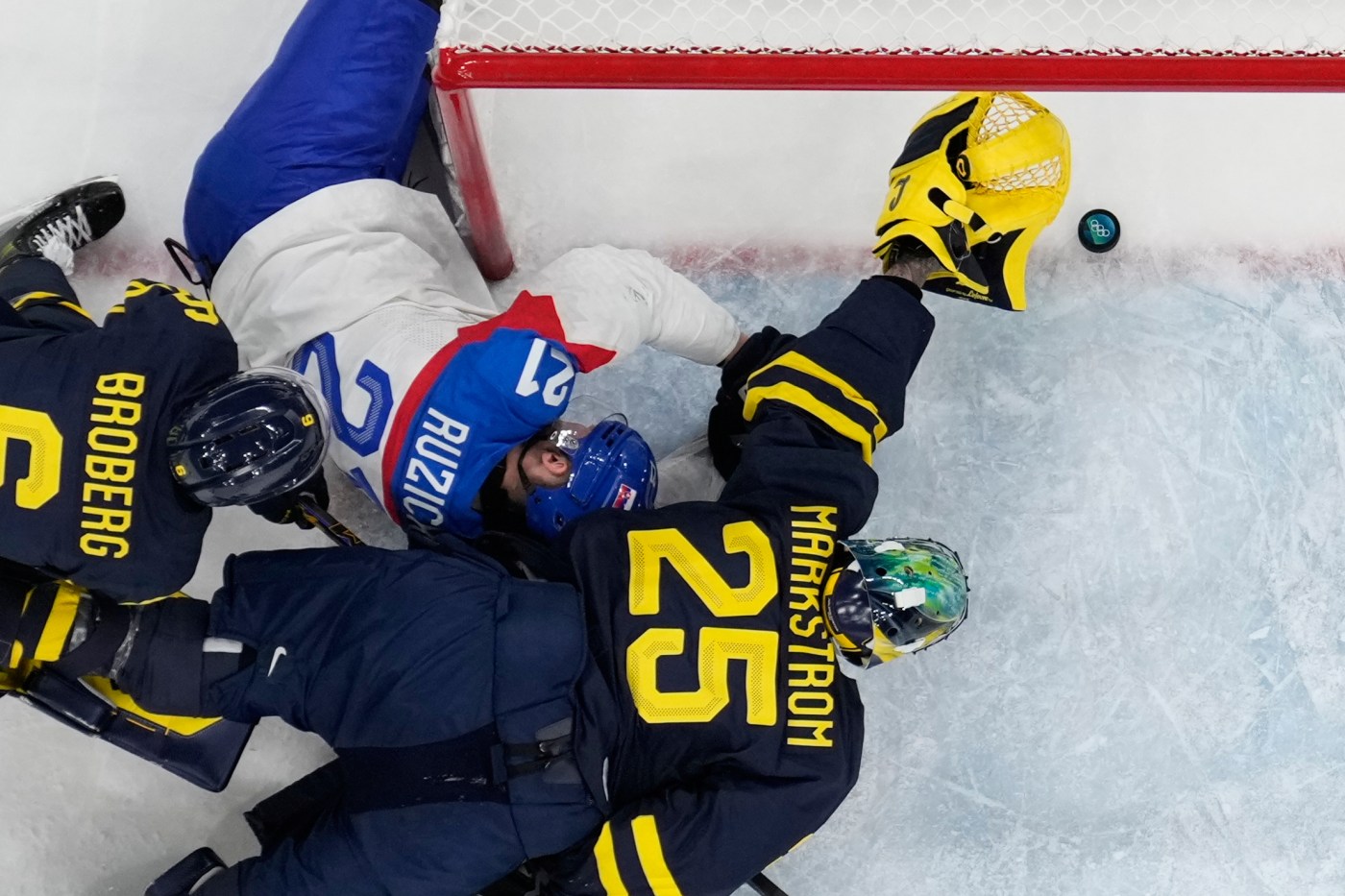
MILAN — Dalibor Dvorsky’s goal with 39 seconds sent Slovakia to the quarterfinals in men’s hockey at the Olympics as the winner of the group in a tiebreaker even after losing to Sweden 5-3 on Saturday in each team’s final preliminary round game.

Slovakia won Group B when Finland crushed host Italy 11-0 later in the day because of goal differential among the three tied teams. The bench celebrated when Dvorsky scored, and players were all smiles afterward.

“It’s probably the best loss I ever had,” said Slovakia’s Juraj Slafkovsky, the reigning Olympic MVP who’s tied with Canada’s Connor McDavid for the most points in the tournament with six apiece. “It’s crazy, but we take it.”

Dvorsky, who plays for the St. Louis Blues in the NHL, also called it the best loss of his life. His goal on the power play after a penalty on Lucas Raymond made it happen.

“We all know what we need to do on the ice,” Dvorsky said. “There was not too much tactics, right? And at this point of the game, just try to get pucks to the net. And at the end, it was a rebound that was the goal.”

Sweden, which played much better than it had in its 4-1 loss to archrival Finland on Friday, was left to lament a missed opportunity even after winning the game. Coach Sam Hallam pulled goaltender Jacob Markstrom in the final seconds while leading by two goals because of the tiebreaker, but Sweden did not score again.

“Tough pill to swallow,” alternate captain Victor Hedman said. “But we will regroup. We’ll be ready for our next challenge.’’

Markstrom stopped 29 of the 32 shots he faced and may have supplanted Filip Gustavsson as Sweden’s starter moving forward. Sweden is locked into the seventh seed and will have to play in the qualification round Tuesday just to make it into the quarterfinals Wednesday.

“It is what it is,” Hallam said. “Just look ahead, everything that’s really good never comes easy.”

Finland 11, Italy 0

Sebastian Aho, Kaapo Kakko, Joel Kiviranta and captain Mikael Granlund each scored twice for Finland in a beatdown of host Italy. The 11-goal margin made it the most lopsided men’s hockey game at the Olympics since 1988, when Sweden beat France 13-2.

Because of goal differential, the Finns were incentivized to run up the score on an overmatched opponent. At one point, Finland had eight goals and Italy had eight shots.

“I’d expect nothing less,” Italy captain Thomas Larkin said. “That’s the game we’re playing here. Yeah, that stings for us obviously from a pride perspective but also in the standings.”

Finland coach Antti Pennanen and his staff told players about the tiebreaker before puck drop.

“They knew that, and then we told them honestly what is the situation,” Pennanen said. “We had a plan. First plan: win the game. And then do goals as much as you can.”

Barring something incredibly unforeseen in games, Finland is into the quarterfinals as the No. 4 seed.

Latvia 4, Germany 3

Eduards Tralmaks and Renars Krastenbergs scored just over three minutes apart, and Latvia defeated Germany. Arturs Silovs of the Pittsburgh Penguins stopped 26 of the 29 shots he faced.

“We’re a good team,” said Zemgus Girgensons of the Buffalo Sabres, one of 10 NHL players on Latvia’s roster. “We believed it. I don’t think we go into the game thinking it’s going to be any other way. We came in today thinking we’re going to win. And that’s what we did. We on paper, probably the best team we’ve had. We’re just going to keep gaining better by every game.”

Germany’s Philipp Grubauer, who was excellent in an opening win against Denmark when he and his teammates were badly outshot, allowed four goals on 22 shots in the loss.

“We just got to find a way to score,” said Tim Stützle, who scored the third goal for Germany. “That’s it. We got to go in the hard areas, know where the other guy is and then make those plays.”

Germany faces the U.S. on Sunday night.

Your Money: Career pivots: The financial side of seeking greener pastures

posted in: All news | 0

Bruce Helmer and Peg Webb

Career pivots are becoming increasingly common as people look to improve their job prospects or find work that more closely aligns with their values. Whether driven by burnout, a desire for more time flexibility, or the need for longer-term sustainability, changing careers is rarely just a professional decision. It is always a financial one.

While most career changes are triggered by non-financial factors, the consequences show up quickly in cash flow, benefits, taxes and long-term planning. Financial planning does not eliminate the risks of a career pivot, but it can make those risks more visible and manageable.

Career changes are cash-flow events first

One of the most common misconceptions people have about changing careers is looking at it simply as a résumé upgrade rather than a cash-flow transition. Even positive changes often come with temporary income disruption.

New roles may involve delayed earnings increases, lost bonuses, or forfeited deferred compensation. Timing also matters. Vesting schedules, bonus payouts, benefit resets, and even the calendar year can materially affect take-home pay.

Financial stress usually appears a few months after a job change, not on day one. A solid plan focuses first on how expenses will be covered while income stabilizes.

Emergency savings as career capital

Emergency savings play a larger role in career pivots than many people expect. In this context, savings are not just protection, they’re flexibility.

Adequate reserves buy time, reduce pressure to accept a poor offer, and provide negotiating leverage. As a general guideline, people staying in the same field with similar income profiles may need about six months of reserves. Those pursuing a career change, variable income, or self-employment often need closer to nine to 12 months.

Savings targets vary widely. Two households with the same income may require very different reserve levels depending on how much stability or flexibility they need. Once income stabilizes again, reserves can be rebuilt.

Benefits often matter more than salary

Salaries are easy to compare. Benefits are usually not. Career changes frequently shift benefits from employer-subsidized to self-funded. Health insurance premiums and deductibles, retirement plan matches, disability coverage, life insurance, and paid time off can all change dramatically.

A $10,000 raise can disappear quickly if it comes with higher insurance costs or the loss of an employer retirement match. Identifying which benefits must be replaced, and which can be traded for income or flexibility, is a critical step when evaluating any career move.

Career transitions create planning opportunities

Career changes can also create short planning windows that do not exist during stable employment. Lower-income years, temporary cash-flow dips, or job transitions may require complex strategies such as Roth conversions, retirement plan rollovers, or resetting savings habits. Not every strategy matters equally to everyone. For some, liquidity and flexibility are the priority. For others, long-term tax efficiency carries more weight.

Investing in skills is a financial decision

Education, certifications, and professional development are often viewed as expenses. During a career pivot, it is better to view these as investments.

In many cases, the highest return during a transition comes not from markets, but from improved earning power and income stability. Cutting back on skill development to “save money” can limit opportunities and prolong financial stress.

Partial pivots reduce financial risk

Not all career changes need to be abrupt. Some of the most successful pivots are phased, such as consulting while employed, testing a side business, or gradually reducing hours.

Partial pivots preserve current income, reduce savings pressure, and allow proof of concept before making a full commitment.

A practical framework

Before making a career change, it helps to answer these four financially relevant questions:

• How stable does my income need to be?

• How much risk can my household absorb?

• How much flexibility do I need right now?

• How long can I wait for this to pay off?

Values do not change the math, but they determine which math matters. A career pivot can be one of the most self-affirming things you can do in life. It is not reckless if it is planned (and staying in the wrong job without a plan can be the bigger financial risk). Stress-testing cash flow, understanding benefits, and aligning decisions with household priorities can turn change into a manageable and rewarding transition.

Related Articles


Your Money: Markets were up in 2025, will it continue?


Your Money: Helping children build healthy money habits


Your Money: A simple financial health check for any age


Your Money: Resolution: New year, no (bad) debt


Your Money: Meaningful conversations around the holidays 

The opinions voiced in this material are for general information only and are not intended to provide specific advice or recommendations for any individual.

Bruce Helmer and Peg Webb are financial advisers at Wealth Enhancement Group and co-hosts of “Your Money” on WCCO 830 AM on Sunday mornings. Email Bruce and Peg at yourmoney@wealthenhancement.com. Advisory services offered through Wealth Enhancement Advisory Services LLC, a registered investment adviser and affiliate of Wealth Enhancement Group.


Massive blaze in Roseville traps employee in building and decimates semitrailers

posted in: All news | 0

A blaze that broke out Friday morning in a tractor-trailer outside a Roseville commercial building spread to other semitrailers and into the building, trapping a worker who had to be rescued by firefighters, officials said.

The Roseville Fire Department gave the following details in a Facebook post:

At 8 a.m. Friday, firefighters responded to reports of a tractor-trailer on fire at Quality Custom Distribution at 2501 Walnut St. When crews arrived, multiple semitrailers were on fire and the flames had spread to the building.

Firefighters were told an employee was trapped inside a cooler in the building, unable to escape because of the smoke and lack of visibility.

Both Roseville and Lake Johanna firefighters searched the building and found the employee. He was not injured.

It took two hours for crews to put out the hot spots of the fire, which was contained mostly to the exterior semitrailers with only minor damage to the building.

Roseville firefighters were helped by Roseville Police, Lake Johanna Fire, Little Canada Fire, Maplewood Fire, New Brighton Public Safety, North St. Paul Fire, St. Anthony Fire, Vadnais Heights Fire, White Bear Lake Fire and Allina EMS.

The cause of the fire is currently under investigation.

Related Articles


MN Capitol: Screening will keep knives out, handguns allowed with permit


MN officials testify on immigration surge before U.S. Senate panel


Minneapolis Foundation offers $4M in small business grants


Border czar says Minnesota immigration crackdown is over, after angry protests and 2 fatal shootings


Black leaders in St. Paul see similarities between Civil Rights struggle, immigration protests

Frederick: Hopefully, Kevin O’Connell learns from Mike Macdonald

posted in: All news | 0

Perhaps Minnesota will have its pick of the veteran quarterback litter this offseason. ESPN insider Jeremy Fowler reported as much this week.

“My sense right now, from asking around, is all the top quarterbacks that will be, or could be, available … this is the place they want to go,” Fowler said on “NFL Live.” “It is Minnesota.”

Perhaps that means the likes of Kyler Murray, Aaron Rodgers, Malik Willis or Jimmy Garoppolo find their way to Minnesota this offseason to compete with J.J. McCarthy for the starting QB gig. That will feel like a cure all for a team sabotaged by its play under center last season.

But even those options aren’t guaranteed success. There’s a reason they’re available, after all. And even if they are indeed competent – which would be a big upgrade – they still wouldn’t elevate the offense to the team’s phase of strength.

It’s time for Kevin O’Connell to operate under that assumption.

Seattle won the Super Bowl with a good offense, dominant defense and excellent special teams. It leaned heavily on the latter two phases in its win over New England last Sunday.

That’s not to take anything away from quarterback Sam Darnold, who had to be – and was – nearly perfect in the NFC championship game to edge the high-octane Los Angeles Rams.

But such a performance wasn’t required against the Patriots, nor in either Seattle’s NFC divisional round or Week 18 wins over the San Francisco 49ers.

So, on those days, the Seahawks leaned on the run game. They were conservative with the pass, especially on third and long situations. They placed an emphasis on ball control and won “boring.”

The performances were reminiscent of what Minnesota delivered during its five-game winning streak to close an otherwise disappointing regular season. The offense stopped giving the ball away every other play, which allowed a stellar defensive unit to dictate the game’s terms.

Seahawks-like.

In his season-ending press conference, the since-fired Kwesi Adofo-Mensah lamented the changes in the quarterback room last offseason that left Minnesota with a less dynamic passing game that clipped the wings of O’Connell’s typically prolific aerial attack.

But the truth is, Minnesota still had enough to win if its coach were willing to adapt his style. Regardless of how excited O’Connell is by whoever the Vikings bring in to compete with McCarthy in training camp, it’s important he reflects this offseason and maybe even reviews the Mike MacDonald School of Winning with a Great Defense.

There, they teach lessons such as the value of scoring three points, field position and placing a heavy emphasis on special teams. Punts are considered solid results. The formula for victory isn’t defined by the number of big passing plays, but rather by finding the highest-probability path to scoring more points than your opponent.

Watching Seattle run on third and longs against San Francisco and New England was a jarring juxtaposition to all of Minnesota’s overly-aggressive decisions that too frequently led to disaster in the fall, ranging from Carson Wentz launching an interception on second and 25 from deep in his own territory against Philadelphia to O’Connell forgoing the game-tying field goal and instead electing for a fourth-down try against the Seahawks with a rookie quarterback in Seattle.

You know how that one ended.

If the script were flipped, the Seahawks would’ve taken the points – as they did five times in last Sunday’s Super Bowl. Not that that’s the right play in all instances – there’s a time and place for aggression. But your circumstances should determine your decisions.

That’s true all season, and never more so than in the playoffs, where O’Connell is yet to win a game.

MacDonald understood the power of his dominant defense. It’s why the Seahawks attempted just 12 fourth-down tries all season across 20 total games, far and away the fewest in the league.

Yes, that’s an easier decision to reach when that defense is your brainchild, as is the case with Macdonald.

Can an offensive coach like O’Connell restrain himself enough to take a similar approach that best suits his team moving forward?

The Vikings will have a new general manager for the 2026 NFL season. They may even have a new starting quarterback. But if the head coach continues to try to ram square pegs into round holes, the end result won’t change.

Related Articles


Vikings fire general manager Kwesi Adofo-Mensah


Charley Walters: J.J. McCarthy will have to beat out a veteran to be the Vikings’ QB in 2026


How the Vikings are connected to every quarterback left in the NFL playoffs


J.J. McCarthy will have to earn the right to start for the Vikings


Ranking the five plays that cost the Vikings a shot at the playoffs