By PETER SMITH, Associated Press
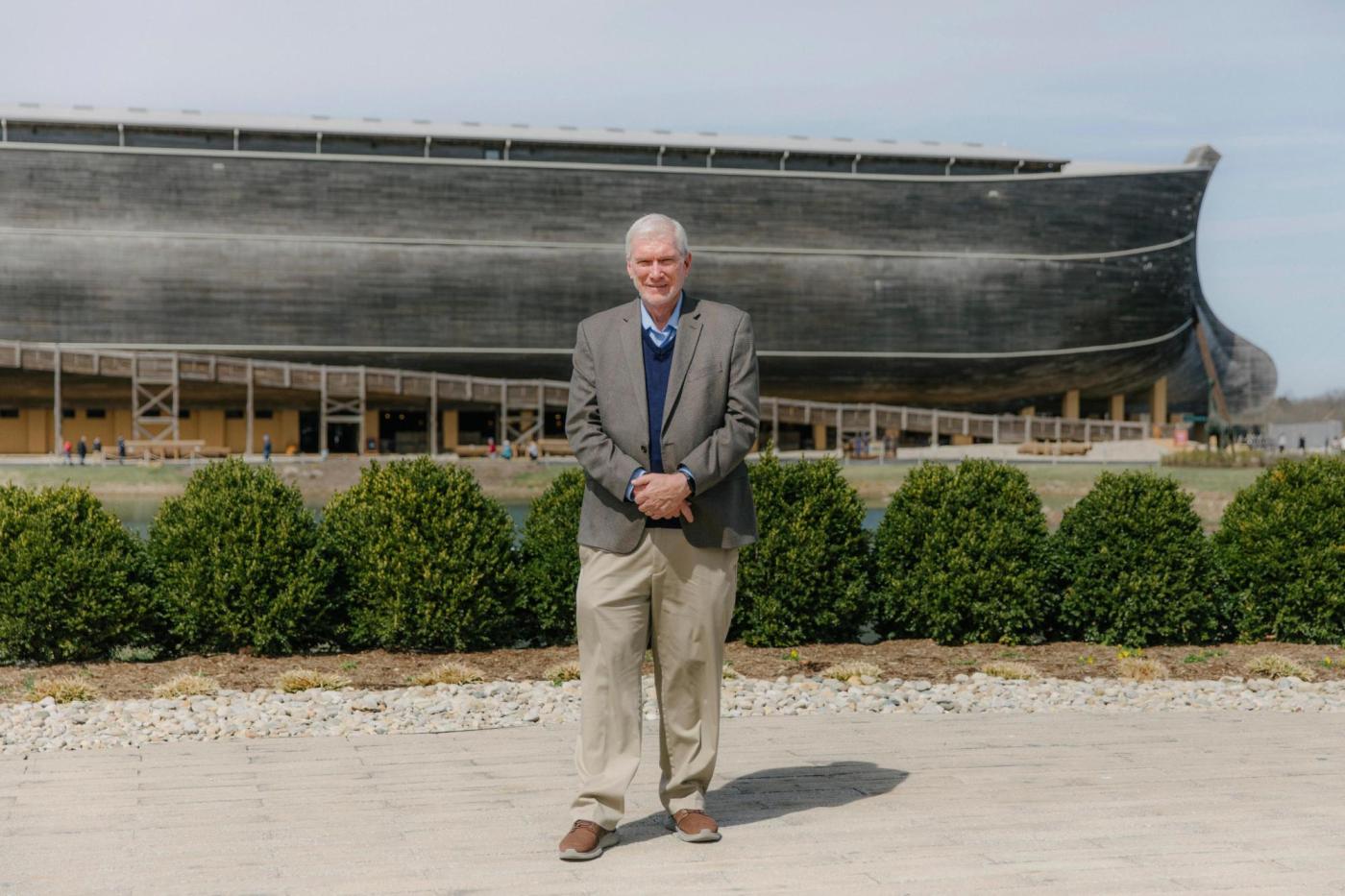
WILLIAMSTOWN, Ky. (AP) — As the colossal replica of the biblical Noah’s Ark rises incongruously from the countryside of northern Kentucky, Ken Ham gives the presentation he’s often repeated.
The ark stretches one and a half football fields long — “the biggest freestanding timber-frame structure in the world,” Ham says. It holds three massive decks with wooden cages, food-storage urns, life-size animal models and other exhibits.
The Ark Encounter is seen in Williamstown, Ky., Friday, March 21, 2025. (AP Photo/Madeleine Hordinski)
It’s all designed to argue that the biblical story was literally true — that an ancient Noah really could have built such a sophisticated ship. That Noah and a handful of family members really could have sustained thousands of animals for months, floating above a global flood that drowned everyone else in the wicked world.
“That’s what we wanted to do through many of the exhibits, to show the feasibility of the ark,” says Ham, the organizer behind the Ark Encounter theme park and related attractions.
And with that, he furthers his goal to assert the entire biblical Book of Genesis should be interpreted as written — that humans were created by God’s fiat on the sixth day of creation on an Earth that is only 6,000 years old.
All this defies the overwhelming consensus of modern scientists — that the Earth developed over billions of years in “deep time” and that humans and other living things evolved over millions of years from earlier species.
But Ham wants to succeed where he believes William Jennings Bryan failed.
Bryan, a populist politician and fundamentalist champion, helped the prosecution in the famous Scopes Monkey Trial, which took place 100 years ago this July in Dayton, Tennessee.
Bryan’s side won in court — gaining the conviction of public schoolteacher John Scopes for violating state law against teaching human evolution. But Bryan was widely seen as suffering a humiliating defeat in public opinion, with his sputtering attempts to explain the Bible’s spectacular miracles and enigmas.
The expert witness’ infamous missteps
For Ham, Bryan’s problem was not that he defended the Bible. It’s that he didn’t defend it well enough, interpreting parts of it metaphorically rather than literally.
“It showed people around the world that Christians don’t really believe the Bible — they can’t answer questions to defend the Christian faith,” Ham says.
“We want you to know that we’ve got answers,” Ham adds, speaking in the accent of his native Australia.
Ham is founder and CEO of Answers in Genesis, which opened the Ark Encounter in 2016. The Christian theme park includes a zoo, zip lines and other attractions surrounding the ark.
Nearly a decade earlier, Answers in Genesis opened a Creation Museum in nearby Petersburg, Kentucky, where exhibits similarly argue for a literal interpretation of the biblical creation narrative. Visitors are greeted with a diorama depicting children and dinosaurs interacting peacefully in the Garden of Eden.
The group also produces books, podcasts, videos and homeschooling curricula.
“The main message of both attractions is basically this: The history in the Bible is true,” Ham says. “That’s why the message of the Gospel based on that history is true.”
Creationist belief still common
If Ham is the most prominent torchbearer for creationism today, he’s hardly alone.
Polls generally show that somewhere between 1 in 6 and 1 in 3 Americans hold beliefs consistent with young-Earth creationism, depending on how the question is asked. A 2024 Gallup poll found that 37% of U.S. adults agreed “God created human beings pretty much in their present form at one time within the last 10,000 years or so.”
Visitors looks at a display at the Ark Encounter in Williamstown, Ky., Friday, March 21, 2025. (AP Photo/Madeleine Hordinski)
That percentage is down a little, but not dramatically, from its mid-40s level between the 1980s and 2012. Rates are higher among religious and politically conservative respondents.
“Scopes lost, but the public sense was that the fundamentalists lost” and were dwindling away, says William Vance Trollinger Jr., a professor of history and religious studies at the University of Dayton in Ohio.
But the reach of Answers in Genesis demonstrates that “a significant subset of Americans hold to young-Earth creationism,” says Trollinger, co-author with his wife, English professor Susan Trollinger, of the 2016 book “Righting America at the Creation Museum.”
Leading science organizations say it’s crucial to teach evolution and old-Earth geology. Evolution is “one of the most securely established of scientific facts,” says the National Academy of Sciences. The Geological Society of America similarly states: “Evolution and the directly related concept of deep time are essential parts of science curricula.”
The issue has been repeatedly legislated and litigated since the Scopes trial. Tennessee repealed its anti-evolution law in 1967. The U.S. Supreme Court ruled in 1968 that a similar Arkansas law was an unconstitutional promotion of religion, and in 1987 it overturned a Louisiana law requiring that creationism be taught alongside evolution. A 2005 federal court similarly forbade a Pennsylvania school district from presenting “intelligent design,” a different approach to creationism that argues life is too complex to have evolved by chance.
Science educators alarmed
Some lawmakers have recently revived the issue. North Dakota’s Senate this year defeated a bill that would have allowed public school teaching on intelligent design. A new West Virginia law vaguely allows teachers to answer student questions about “scientific theories of how the universe and/or life came to exist.”
The Creation Museum Welcome Center entrance is seen in Petersburg, Ky., Friday, March 21, 2025. (AP Photo/Madeleine Hordinski)
The Scopes trial set a template for today’s culture-war battles, with efforts to expand vouchers for attendees of private schools, including Christian ones teaching creationism, and to introduce Bible-infused lessons and Ten Commandments displays in public schools.
Such efforts alarm science educators like Bill Nye, the television “Science Guy,” whose 2014 debate with Ham was billed as “Scopes II” and has generated millions of video views online.
“What you get out of religion, as I understand it, is this wonderful sense of community,” Nye says. “Community is very much part of the human experience. But the Earth is not 4,000 years old. To teach that idea to children with any backing — be it religious or these remarkable ideas that humans are not related to, for example, chimpanzees or bonobos — is breathtaking. It’s silly. And so we fight this fight.”
Nye says evidence is overwhelming, ranging from fossils layers to the distribution of species. “There are trees older than Mr. Ham thinks the world is,” he adds.
Religious views on origins vary
One weekday in March, visitors milled about the Ark Encounter and Creation Museum, which draw an estimated 1.5 million visits per year (including duplicate visits).
“We are churchgoing, Bible-believing Christians,” says Louise van Niekerk of Ontario, Canada, who traveled with her family to the Creation Museum. She’s concerned that her four children are faced with a public-school curriculum permeated with evolution.
“The Sphenacodontid Kind,” Dimetrodon, is displayed at the Ark Encounter in Williamstown, Ky., Friday, March 21, 2025. (AP Photo/Madeleine Hordinski)
The Creation Museum, van Niekerk says, “is encouraging a robust alternate worldview from what they’re being taught,” she says.
Many religious groups accommodate evolution, though.
Gallup’s survey found that of Americans who believe in evolution, more say it happened with God’s guidance (34%) than without it (24%). Catholic popes have shown openness to evolution while insisting the human soul is a divine creation. Many liberal Protestants and even some evangelicals have accepted at least parts of evolutionary theory.
But among many evangelicals, creationist belief is strong.
The Southern Baptist Convention, the nation’s largest evangelical body, has promoted creationist beliefs in its publications. The Assemblies of God asserts that Adam and Eve were historical people. Some evangelical schools, such as Bryan’s namesake college in Tennessee, affirm creationist beliefs in their doctrinal statements.
There’s a larger issue here, critics say
Just as Ham says the creation story is important to defend a larger truth about the Christian Gospel, critics say more is at stake than just the human origin story.
An exhibit of Adam and Eve is seen at the Creation Museum in Petersburg, Ky., Friday, March 21, 2025. (AP Photo/Madeleine Hordinski)
The Trollingers wrote that the Answers in Genesis enterprise is an “arsenal in the culture war.” They say it aligns with Christian nationalism, promoting conservative views in theology, family and gender roles, and casting doubt on other areas of scientific consensus, such as human-made climate change.
Nye, too, says the message fits into a more general and ominous anti-science movement. “Nobody is talking about climate change right now,” he laments.
Exhibits promote a “vengeful and violent” God, says Susan Trollinger, noting the cross on the ark’s large door, which analogizes that just as the wicked perished in the flood, those without Christ face eternal hellfire.
And there are more parallels to 1925.
Bryan had declaimed, “How can teachers tell students that they came from monkeys and not expect them to act like monkeys?” The Creation Museum, which depicts violence, drugs and other social ills as resulting from belief in evolution, is “Bryan’s social message on steroids,” wrote Edward Larson in a 2020 afterword to “Summer for the Gods,” a Pulitzer Prize-winning account of the Scopes trial.
More attractions are planned
The protests that initially greeted the museum and ark projects, from secularist groups who considered them embarrassments to Kentucky, have ebbed.
When the state initially denied a tourism tax rebate for the Ark Encounter because of its religious nature, a federal court overturned that ruling. Representing Ham’s group was a Louisiana lawyer named Mike Johnson — now speaker of the U.S. House of Representatives.
Despite those blips, Ham’s massive ministry charges forward. Expansion is next, with AIG attractions planned for Pigeon Forge, Tennessee, and Branson, Missouri — both tourist hubs offering more opportunities to promote creationism to the masses.
Todd Bigelow, visiting the Ark Encounter from Mesa, Arizona, says the exhibit vividly evoked the safety that Noah and his family must have felt. It helped him appreciate “the opportunities God gives us to live the life we have, and hopefully make good choices and repent when we need to,” he says.
“I think,” Bigelow adds, “God and science can go hand in hand.”
Associated Press writer Dylan Lovan contributed.
Associated Press religion coverage receives support through the AP’s collaboration with The Conversation US, with funding from Lilly Endowment Inc. The AP is solely responsible for this content.