Markers in blood and urine may reveal how much ultraprocessed food we are eating

posted in: All news | 0

By JONEL ALECCIA, Associated Press

Molecules in blood and urine may reveal how much energy a person consumes from ultraprocessed foods, a key step to understanding the impact of the products that make up nearly 60% of the American diet, a new study finds.

It’s the first time that scientists have identified biological markers that can indicate higher or lower intake of the foods, which are linked to a host of health problems, said Erikka Loftfield, a National Cancer Institute researcher who led the study published Tuesday in the journal PLOS Medicine.

“It can potentially give us some clues as to what the underlying biology might be between an ultraprocessed food association and a health outcome,” Loftfield said.

Ultraprocessed foods – sugary cereals, sodas, chips, frozen pizzas and more – are products created through industrial processes with ingredients such as additives, colors and preservatives not found in home kitchens. They’re ubiquitous in the U.S. and elsewhere, but studying their health impacts is hard because it’s difficult to accurately track what people eat.

Related Articles


New Trump vaccine policy limits access to COVID shots


Medicaid payments barely keep hospital mental health units afloat. Federal cuts could sink them


Easily distracted? How to improve your attention span


Glioblastoma brain cancer research: Study provides glimmer of hope


Dum Dums lollipops stands by bright dyes, despite RFK Jr.’s push

Typical nutrition studies rely on recall: asking people what they ate during a certain period. But such reports are notoriously unreliable because people don’t remember everything they ate, or they record it inaccurately.

“There’s a need for both a more objective measure and potentially also a more accurate measure,” Loftfield explained.

To create the new scores, Loftfield and her colleagues examined data from an existing study of more than 1,000 older U.S. adults who were AARP members. More than 700 of them had provided blood and urine samples, as well as detailed dietary recall reports, collected over a year.

The scientists found that hundreds of metabolites – products of digestion and other processes – corresponded to the percentage of energy a person consumes from ultraprocessed foods. From those, they devised a score of 28 blood markers and up to 33 urine markers that reliably predicted ultraprocessed food intake in people consuming typical diets.

“We found this signature that was sort of predictive of this dietary pattern that’s high in ultraprocessed food and not just a specific food item here and there,” she said.

A few of the markers, notably two amino acids and a carbohydrate, showed up at least 60 times out of 100 testing iterations. One marker showed a potential link between a diet high in ultraprocessed foods and type 2 diabetes, the study found.

To confirm the findings, Loftfield measured the scoring tool with participants in a carefully controlled 2019 National Institutes of Health study of ultraprocessed foods.

In that study, 20 adults went to live for a month at an NIH center. They received diets of ultraprocessed and unprocessed foods matched for calories, sugar, fat, fiber and macronutrients for two weeks each and were told to eat as much as they liked.

Loftfield’s team found that they could use the metabolite scores to tell when the individual participants were eating a lot of ultraprocessed foods and when they weren’t eating those foods.

The results suggested the markers were “valid at the individual level,” Loftfield said.

It’s still early research, but identifying blood and urine markers to predict ultraprocessed foods consumption is “a major scientific advance,” said Dr. Dariush Mozaffarian, director of the Food Is Medicine Institute at Tufts University, who was not involved in the study.

“With more research, these metabolic signatures can begin to untangle the biologic pathways and harms of UPF and also differences in health effects of specific UPF food groups, processing methods and additives,” he said.

Loftfield said she hopes to apply the tool to existing studies where blood and urine samples are available to track, for instance, the effect of consuming ultraprocessed foods on cancer risk.

At a time when support for government research is being cut, funding remains uncertain.

“There’s a lot of interest across the board — scientifically, public interest, political interest — in the question of: Does ultraprocessed food impact health and, if so, how?” she said. “How can we fund the studies that need to be done to answer these questions in a timely way?”

The Associated Press Health and Science Department receives support from the Howard Hughes Medical Institute’s Science and Educational Media Group and the Robert Wood Johnson Foundation. The AP is solely responsible for all content.

Prosecutors charge congresswoman with pushing and grabbing agents while trying to stop mayor’s arrest

posted in: All news | 0

By MIKE CATALINI, ALANNA DURKIN RICHER and ERIC TUCKER, Associated Press

Federal prosecutors alleged Democratic Rep. LaMonica McIver of New Jersey pushed and grabbed officers while attempting to block the arrest of the Newark mayor outside an immigration detention facility, according to charges in court papers unsealed on Tuesday.

In an eight-page complaint, interim U.S. Attorney Alina Habba’s office said McIver was protesting the removal of Newark Mayor Ras Baraka from a congressional tour of the Delaney Hall detention center in Newark on May 9.

The complaint says she attempted to stop the arrest of the mayor and pushed into agents for Homeland Security Investigations and Immigration and Customs Enforcement. She faces two counts of assaulting, resisting and impeding an officer.

McIver has denied any wrongdoing and has accused federal agents of escalating the situation by arresting the mayor. She denounced the charge as “purely political” and said prosecutors are distorting her actions in an effort to deter legislative oversight.

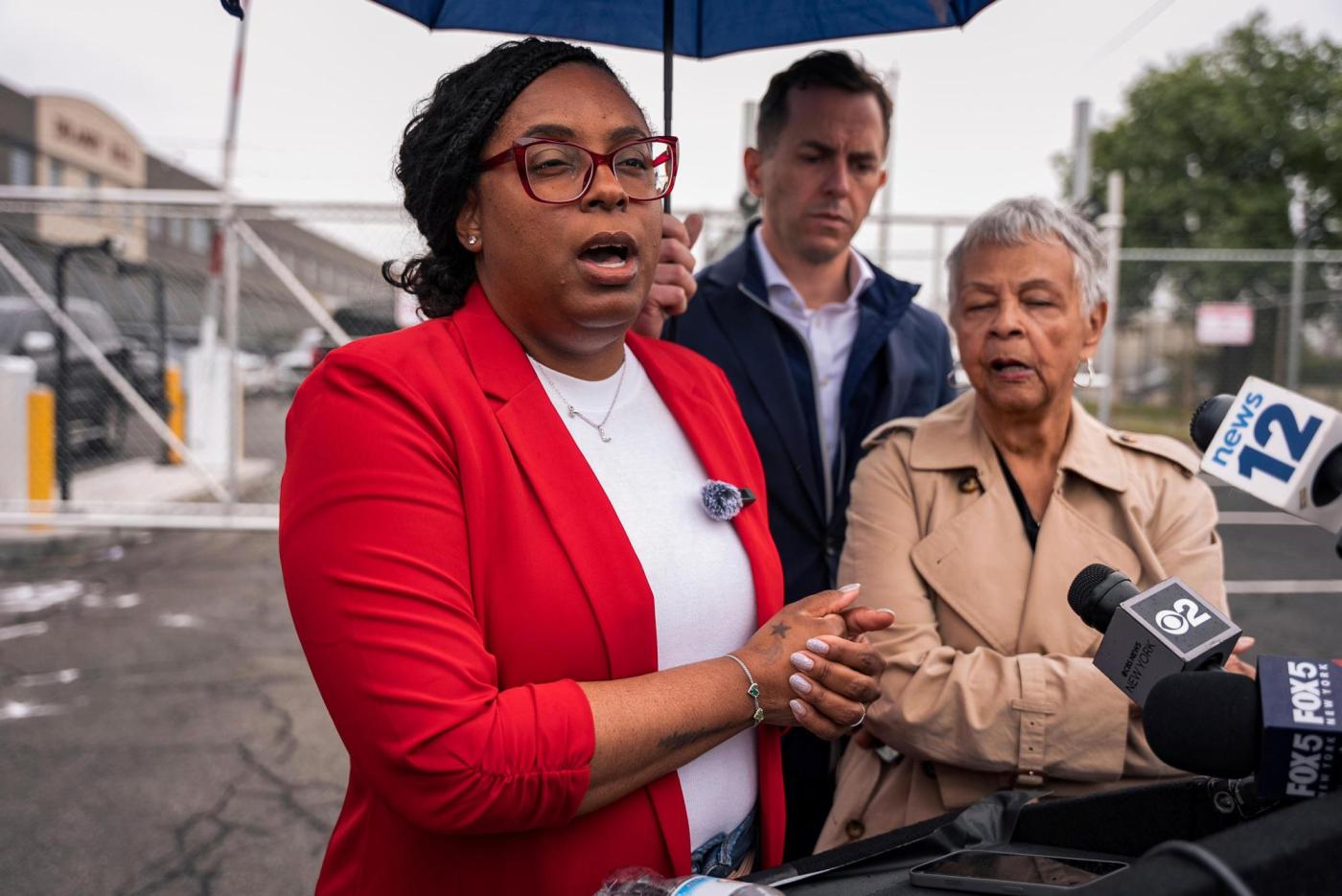
Rep. LaMonica McIver, center, demands the release of Newark Mayor Ras Baraka after his arrest while protesting outside an ICE detention prison, Friday, May 9, 2025, in Newark, N.J, (AP Photo/Angelina Katsanis)

Habba had charged Baraka with trespassing after his arrest but dismissed the allegation on Monday when she said in a social media post she instead was charging the congresswoman.

Prosecuting McIver is a rare federal criminal case against a sitting member of Congress for allegations other than fraud or corruption.

The case instantly taps into a broader and more consequential struggle between a Trump administration engaged in overhauling immigration policy and a Democratic party scrambling to respond.

Within minutes of Habba’s announcement, McIver’s Democratic colleagues cast the prosecution as an infringement on lawmakers’ official duties to serve their constituents and an effort to silence their opposition to an immigration policy that helped propel the president back into power but now has emerged as divisive fault line in American political discourse.

Members of Congress are authorized by law to go into federal immigration facilities as part of their oversight powers, even without advance notice. Congress passed a 2019 appropriations bill that spelled out the authority.

A nearly two-minute clip released by the Homeland Security Department shows McIver on the facility side of a chain-link fence just before the arrest of the mayor on the street side of the fence. She and uniformed officials go through the gate and she joins others shouting they should circle the mayor. The video shows McIver in a tightly packed group of people and officers. At one point her left elbow and then her right elbow push into an officer wearing a dark face covering and an olive green uniform emblazoned with the word “Police” on it.

It isn’t clear from bodycam video whether that contact was intentional, incidental or a result of jostling in the chaotic scene.

The complaint says she “slammed” her forearm into an agent and then tried to restrain the agent by grabbing him.

Tom Homan, President Donald Trump’s top border adviser, said during an interview on Fox News Tuesday “she broke the law and we’re going to hold her accountable”

“You can’t put hands on an ICE employee. we’re not going to tolerate it,” he said.

Related Articles


Video of the Nottoway Plantation fire sparks jubilation. It’s about anger and pain over slavery, too


Southwest Airlines will require chargers be kept out while in use because of battery fire concerns


Caitlin Clark says it was too loud to hear alleged racial comments but supports WNBA investigation


Cassie’s mother says Sean ‘Diddy’ Combs demanded $10K because her daughter was seeing someone else


Organizations and companies are partnering to introduce Black students in Detroit to golf

House Democratic leaders decried the criminal case against their colleague in a lengthy statement, calling the charge “extreme” and “morally bankrupt” and lacking “any basis in law or fact.

On Tuesday Democratic lawmakers pushed back against the charges.

New Jersey Democratic Rep. Frank Pallone called the arrest “outrageous” and said the lawmakers “were met by unidentified masked agents with loaded weapons, and now they face charges? The department of justice and ICE are weaponizing this place.”

Homeland Security Secretary Kristi Noem said Tuesday during a Congressional hearing that lawmakers can conduct oversight but accused those who visited the Newark detention facility of showing up with a “mob” intending to break in and attack law enforcement.

New Jersey Rep. Bonnie Watson Coleman, who along with Rep. Rob Menendez had joined McIver at the detention center, told reporters Tuesday that her and Menendez’s attorneys are scheduled to meet Wednesday with Habba’s office.

“That’s the first contact that we’ve actually had from her so we don’t know what she has intended, but we’re ready for whenever it might be,” she said.

Watson Coleman added that Habba’s office has indicated that charges are still on the table.

“It’s a possibility and it may be a probability. We shall see,” she said.

A message seeking comment Tuesday was left with Habba’s office.

McIver, 38, first came to Congress in September in a special election after the death of Rep. Donald Payne Jr. left a vacancy in the 10th District. She was then elected to a full term in November. A Newark native, she served as the president of the Newark City Council from 2022 to 2024 and worked in the city’s public schools before that.

Associated Press writers Matt Brown, Joey Cappelletti and Rebecca Santana in Washington contributed.

Texas Republicans Push to Define Biological Sex in Statute 

posted in: All news | 0

Representative Andy Hopper played biologist on the House floor, claiming with certainty that there are only two sexes during a debate in early April.

He made this point when presenting a budget amendment that would reduce government funding to the University of Texas at Austin in part because some programs “deny the unchangeable biological reality that there are only two sexes.” In the ensuing debate, State Representative Lauren Ashley Simmons, a Houston Democrat, asked him where intersex people fit into his statement. 

His argument quickly fell apart as he admitted he didn’t know what intersex meant, but doubled down anyway: “Those intersex individuals are still XX or XY, so you can’t change that.” 

It took his ally, Representative Valoree Swanson, who has authored bills focused on biological sex herself, to correct him, whispering “That’s not true.” 

Hopper, along with several other right-wing legislators, have leaned on the concept of biological reality to propose dozens of bills that seek to categorize people in the law or in public spaces through binary definitions of sex. Despite claiming to have science on their side, these legislators often eschew scientific facts, leaving intersex, transgender, and non-binary people in limbo when they do not fit into neatly legislated boxes. 

“If biological sex were as obvious as lawmakers keep insisting that biological sex is, we wouldn’t be here,” said Erika Slaymaker with the Texas Freedom Network, a progressive advocacy group. “You wouldn’t have to try so hard to legislate the gender binary into existence.”

One such bill, House Bill 229, was passed by the House last week on an 87-56 vote. Authored by Republican state Representative Ellen Troxclair, the bill would codify the terms “male” and “female” and require government agencies to abide by these definitions in sex-based data collection. Per the bill, a “female” is an individual whose biological reproductive system is developed to produce ova, and a “male” is an individual whose biological reproductive system is developed to fertilize the ova of a female. The bill notes that “Separate is not inherently unequal” and that males are “on average, bigger, stronger, and faster, than females.” Troxclair said the bill was “straightforward and necessary” to ensure bills are “grounded in biological reality.” 

During the floor debate on the bill, Dallas state Representative Jessica González criticized the bill for its attacks on trans Texans. “This bill is rooted in ignorance,” González said. “It’s abhorrent to abuse the power of this Legislature to target Texans who dare to defy your counterfeit standards of gender.” 

Other bills, like Senate Bill 406, filed by Senator Mayes Middleton, apply binary definitions of biological sex to legal documents. SB 406 would prevent people from changing the sex marker on their birth certificate except for instances of clerical errors and would require people to display sex markers on their birth certificates. Middleton said this will ensure birth certificates remain “reflective of biological reality,” as it states: “god-given sex, either XX or XY.” The Senate passed that bill in early April. 

Opponents of the bill raised concerns that SB 406 could pose challenges for people who don’t identify with their sex assigned at birth, as birth certificates are often used for identification. “When trans and gender expansive and intersex folks cannot make necessary and reasonable changes to their birth certificates while other demographics of people are still afforded the ability to do so through clerical changes, not only does the government violate equal protection under the law, but it sanctions transphobic violence,” said Landon Richie, policy coordinator of the Transgender Education Network of Texas. “It encourages a sick fixation on trans people’s bodies and lives and mandating cruelty through bureaucracy.” 

SB 406 follows directives from the Department of Public Safety and Department of State Health Services this summer that blocked trans people from updating gender markers on their driver’s licenses and birth certificates respectively. 

HB 229 defines biological sex based on reproductive systems, but other bills use different definitions. House Bill 980, defines males as individuals with a Y chromosome, while Senate Bill 240 says sex is defined by “an individual’s sex organs, chromosomes, and endogenous profiles.” 

These different biological elements—sex organs, chromosomes, and other characteristics—make defining one singular definition of biological sex impossible, said Anne Fausto-Sterling, a professor emerita of biology and gender studies at Brown University. “There is no simple, out of context, accurate way to define it,” Sterling said. “It’s a practical question, not an existential or permanent biological question.” 

Sterling said sex and gender are a “layered system” with different layers working independently of each other. Each layer doesn’t always align, allowing for natural variation. “The effort to try to make a single definition that accurately applies to everyone in an either/or way is a futile thing. You’ll never do it.” 

These scientific definitions—and some legislators, like Hopper— ignore the reality of intersex individuals. Koomah, a co-founder of The Houston Intersex Society, said intersex people are born with anatomical, hormonal, chromosomal or gonadal traits between what is considered typical for males or females. Though statistics vary, about 2 percent of the population is intersex, according to a study published in the American Journal of Human Biology. Over 50 conditions are classified as differences in sexual development, including Klinefelter Syndrome, in which a male has an additional X chromosome, according to the Cleveland Clinic, a nonprofit academic medical center. 

Koomah said stopping at binary understandings of biological sex is similar to having an elementary school understanding of math. “Just because you decide to stop learning after addition and subtraction doesn’t mean that negative numbers and calculus and algebra doesn’t exist,” Koomah said. 

The existence of intersex people is “inconvenient” to legislators, Koomah said. “The scapegoat of choice right now is transgender people. At the same time, we are also a target for erasure, because our existence really challenges a lot of things.” To contend with this inconvenience, legislation typically has exemptions for intersex people, which can ultimately cause more harm, Koomah said, as many intersex youth undergo non-medically necessary surgeries to assign them a sex. Intersex advocates like Koomah work to educate people against these unnecessary surgeries, something at odds with an increasing legislative insistence on a gender binary. 

In their education and advocacy work, Koomah said they are cautious to make space for the transgender community. “A lot of the targeting of the trans community targets us also. We get caught in the crossfire,” Koomah said. “We don’t want our liberation to come at the oppression of another group.” 

Sean Saifa Wall helped create the Strategy Lab for Intersex Movements in 2024 to try to understand the origins of increasing healthcare bans targeting trans and intersex youth. He attributed the prevalence of these bans to a coalescence of Christian nationalism in the United States. In the grand scheme of this political project, Wall said, trans and intersex people have become “collateral damage.” 

Upholding the gender binary through a rationale of biological sex is particularly effective, Wall said, because of people’s ignorance of biology and comfort with the gender binary. Legislators can capitalize on these misunderstandings and present their views as common sense. “They make people who are really opening the conversation around biological sex and gender as crazy,” Wall said. “It’s just like, ‘oh, those are the woke people. Those are those people who are pushing gender ideology. You can’t listen to them. They’re the ones who are coming for your kids.’”

At a hearing for HB 229, Jonathan Covey, policy director for the social conservative advocacy group Texas Values, said the bill would “inject a strong dose of common sense into an increasingly absurd social debate about who is considered a man and who is considered a woman.” 

Wall said these legislators also connect their science-based explanations to religion. “They have been able to say, ‘God created the science, and the science is male and female,” Wall said. “They know that they have to have a handle on the science, they have to look and sound competent in order to veil their religious bias.” 

Though legislators have taken a religion-infused scientific approach to biology, Bishop Sue Briner brought a different perspective to the HB 229 committee hearing. 

“The world God created doesn’t operate in such sharp categories,” Briner said. “Genesis tells us that God created day and night, yet we know that the beauty of creation lies not in light and darkness, but also in dusk and dawn. In the in-between places that are sacred in their own right.” 

The post Texas Republicans Push to Define Biological Sex in Statute  appeared first on The Texas Observer.

Video of the Nottoway Plantation fire sparks jubilation. It’s about anger and pain over slavery, too

posted in: All news | 0

By FERNANDA FIGUEROA and AARON MORRISON

After a fire engulfed a mansion at Louisiana’s Nottoway Plantation, one of the largest remaining pre-Civil War houses in the Deep South where scores of enslaved Africans labored, video footage of the combusted landmark lit the internet ablaze with mass jubilation and consternation over the weekend.

Related Articles


Southwest Airlines will require chargers be kept out while in use because of battery fire concerns


Caitlin Clark says it was too loud to hear alleged racial comments but supports WNBA investigation


Cassie’s mother says Sean ‘Diddy’ Combs demanded $10K because her daughter was seeing someone else


Organizations and companies are partnering to introduce Black students in Detroit to golf


Former FBI director James Comey calls controversy over Instagram post ‘a bit of a distraction’

For some, it was a moment to celebrate what they saw as centuries-deferred vengeance for enslaved ancestors. There was no shortage of memes and humorous social media posts to ignite the celebrations: from video of the plantation’s burning mansion set to the R&B hit song “Let It Burn” by Usher to other footage with the volume of burning wood cranked all the way up to trigger a cozy autonomous sensory meridian response.

“Went and watched (Nottoway Plantation) burn to the ground!” historian Mia Crawford-Johnson wrote in the Instagram caption of a grinning selfie taken Thursday across from the burned mansion near the banks the Mississippi River.

For others, it was a moment of sadness. Nottoway Plantation has for years been a venue for weddings and other events celebrating cherished milestones. Not to mention, proof of the ingenuity and skill of the enslaved people held on the plantation has been reduced to ashes.

Preservationists say the jubilant reactions to the charred mansion reflect the trauma and anger many people, especially Black Americans, still carry over the history and legacy of chattel slavery in the United States. Antebellum era plantations were built under grueling conditions on the backs of enslaved people, and many are now sites of honor on the National Register of Historic Places.

Fire crews mover a line around the now fully engulfed the Nottoway Plantation on Thursday, May 15, 2025 in White Castle, La. (Michael Johnson/The Advocate via AP)

Some plantations try to ignore their past

But some plantations also de-emphasize or overlook their full histories, foregoing mentions of slavery altogether. That is why the “good riddance” sentiment seemed to outweigh expressions of grief over Nottoway Plantation, which makes no mention of enslaved former inhabitants on its website.

Many sites of enslavement in the U.S. have been repurposed as places that actively participate in the erasure of their history, said Ashley Rogers, executive director of the Whitney Plantation Museum, located 40 miles west of New Orleans. She said the burning of Nottoway is not actually part of the movement for preservation, since nothing was truly being done on the property to tell its full history.

“It was a resort,” Rogers said. “I don’t know that it being there or not being there has anything to do with how we preserve the history of slavery. They already weren’t.”

Joseph McGill, executive director of the Slave Dwelling Project, a nonprofit focused on helping the U.S. acknowledge its history with slavery, said the reaction from the Black community about Nottoway burning represents years of complicated emotions related to plantations. But as a preservationist, McGill said it is unfortunate Nottoway burned down, even if it was failing at telling history.

Crews remain on scene after a fire on Thursday, engulfed the historic Nottoway Plantation, Friday, May 16, 2025, in White Castle, La. (Hilary Scheinuk/The Advocate via AP)

“I would like to see buildings preserved so that those buildings could tell the stories of all the people who inhabited those spaces,” McGill said. “We have been failing at that, but at least when the buildings are there the opportunity always exists to do the right thing.”

Nottoway Plantation became a resort and event venue

Before the fire, Nottoway was a resort and event venue, and its website described it as “the South’s largest remaining antebellum mansion.” Iberville Parish President Chris Daigle called the plantation “a cornerstone of our tourism economy and a site of national significance.”

The sprawling property exists on a former sugar plantation owned by sugar baron John Hampden Randolph. Located about 65 miles northwest of New Orleans, the 53,000-square-foot mansion had a three-story rotunda adorned with giant white columns and hand-carved Italian marble fireplaces, according to a description on its website. A brochure advertises 40 overnight rooms, a honeymoon suite, a lounge, fitness center, outdoor pool and cabana, among other resort features.

In 1860, 155 enslaved people were held at the property, National Park Service records show.

After the blaze, which drew an emergency response from nearly a dozen fire departments from surrounding towns, the property’s owner said the fire had led to a “total loss” and that he hoped to rebuild the mansion.

Rogers said it is unfortunate Nottoway’s mansion burned down, as it did serve as a testament to the “skill of enslaved craftspeople and free people of color who built it and who did a lot of the incredible design work that was inside of that building.”

Fire crews battle a fire on the South corner of the Nottoway Plantation on Thursday, May 15, 2025 in White Castle, La. (Michael Johnson /The Advocate via AP)

There are plenty of plantations, unlike Nottoway, that do not allow weddings or other celebratory events. For example, the Whitney, which documents slavery at a pre-Civil War plantation, draws tens of thousands of visitors annually and is known for centering the stories of enslaved people.

The Nottoway fire has also restarted a public discourse over plantations. Rogers, the Whitney museum director, said this is not new discourse, but can feel like such because there are not many places where productive conversations can be had about slavery and how to tell its history.

Racism and slavery dominate cultural debates

How, where and when to talk about the history of U.S. racism and slavery has dominated political and cultural debates in recent years. An executive order issued in March by the Trump White House seeks to root out “divisive, race-centered ideology” in the Smithsonian Institution, which operates a broad range of cultural centers in Washington. Among the order’s targets is the National Museum of African American History and Culture, a popular Smithsonian attraction that chronicles chattel slavery, Jim Crow segregation and its lingering effects.

Relatedly, plantations and other national historic sites with ties to civil rights have long been places where visitors and descendants of enslaved people go to learn about the past. But they are also places where visitors may encounter naysayers and deniers challenging the tour guide’s presentation about slavery.

Rogers said there are plenty of others sites besides Nottoway accurately telling Black history that need to be preserved.

“I don’t think one plantation burning down is going to change how we talk about slavery in this country,” she said. “All it does is exposes wounds that are already there.”