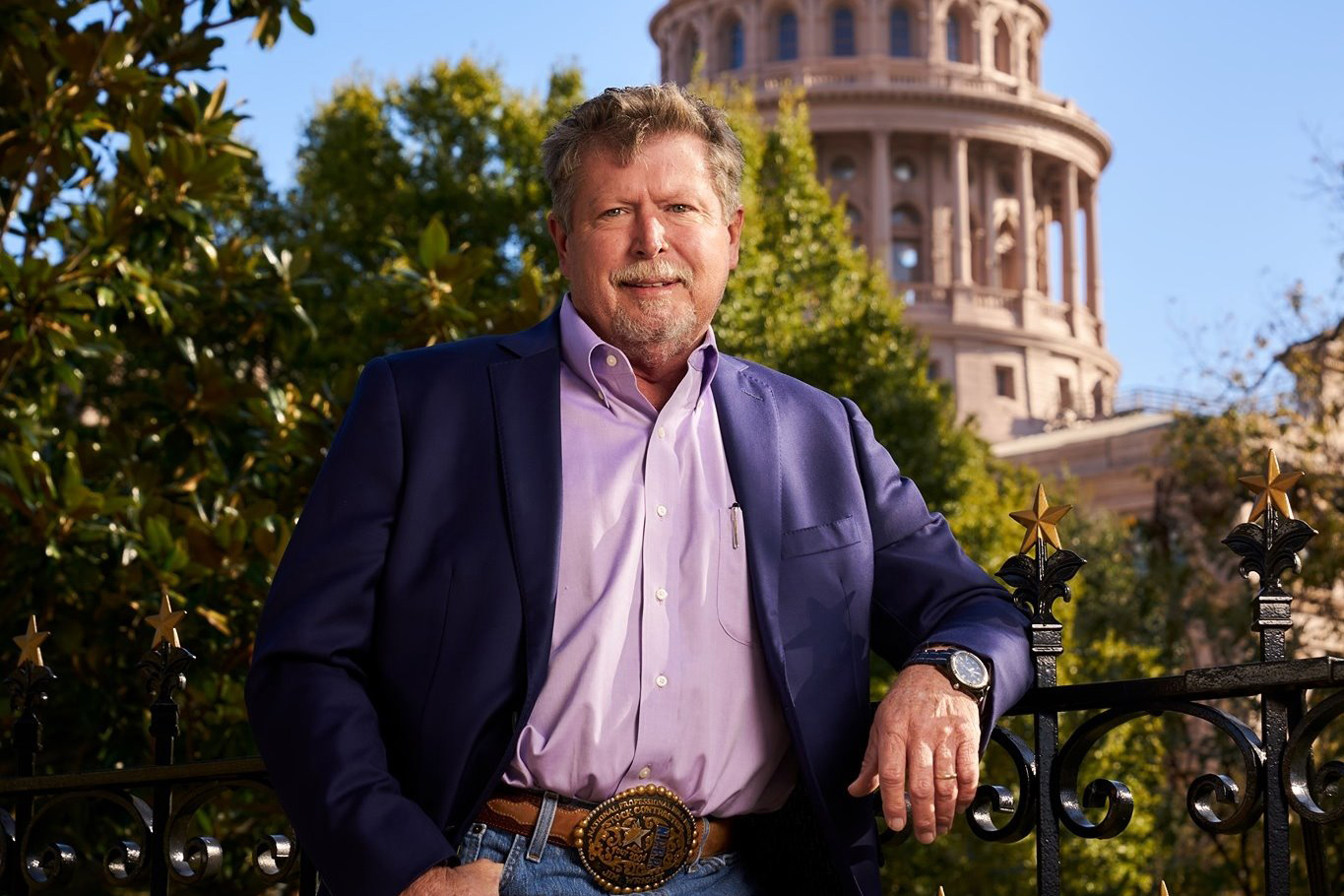
Former Tarrant County GOP Chairman Bo French is running what can fairly be called a fossil fascist campaign in his bid to unseat incumbent Railroad Commissioner Jim Wright in the May 26 runoffs. A victory for French would secure him the GOP nomination for a six-year term atop the agency that oversees, and is generally captured by, the state’s all-too-precious oil and gas industry.
Wright and French essentially tied at 32 percent in a five-way March primary, with French running strongest in the Houston and Dallas-Fort Worth areas. In Texas, incumbents forced into runoffs rarely survive.
The 56-year-old French spends much of his time commenting on things that seem far afield from oil and gas regulation. A silver-spoon scion of a Texas oil family, the well-coiffed French has called on X for the deportation of a Chinese-American state representative and a Muslim state representative—and indeed the denaturalization and deportation of all Muslims in America based on religious faith.
French has also repeatedly affirmed his belief in the far-right “Great Replacement” conspiracy theory, which holds that there’s a concerted effort by Democrats, Jews, or some other secretive “cabal” of evildoers to crowd out white people through mass immigration. “The Great Replacement is real,” he posted in November.
The idea as we know it today has its roots in French novelist Jean Raspail’s 1973 The Camp of the Saints, which depicted immigrants laying dystopian waste to the West. The novel’s racial paranoia animated the white nationalists who built the modern anti-immigration movement. The novel also inspired another French author, Renaud Camus, who pushed the idea closer to the mainstream some 15 years ago.
But “replacement”-style fears of white “extinction” stretch back much further: They spurred American eugenicists to introduce racist immigration quotas in the United States in 1924, as well as motivating völkisch ideologues to devise a political program to protect Germany’s “Aryan racial peasant core” that would ultimately fuel the Nazis’ imperial expansion and mass extermination project.
A hundred years later, French’s rhetoric has reappropriated the same fascist blood-and-soil rhetoric, pushing beyond the bounds even of Texas’ already far-right statewide Republican leaders. In October, French discussed “the ‘replacement’ of Europe’s sons & daughters in their blood-won lands,” writing that “We’re exiles in our own nations.” As a solution, he calls for the removal of all “third world savages,” including some Native Americans—“who we conquered, then bizarrely let have a nation inside our nation.”
Echoing fascists who’ve come before, French’s MAGA culture war seeks to “reclaim the natural order.” The order that he seeks, though, is decidedly anti-nature. Concerning the actual job of the Railroad Commission (RRC), French proposes to further deregulate an industry that already runs roughshod over the state’s ecologically interdependent web of life: He refers to modest oilfield waste rules spearheaded by Wright as “Green New Deal environmental regulations” that must be abolished.
In other words, French is running a blood-and-oil campaign that displaces blame for environmental and resource crises onto the far right’s favorite scapegoats: immigrants and Muslims.
Take his approach to the unfolding water crisis in Corpus Christi, for instance: French has run a major campaign ad laying the blame at the feet of the plastics company SABIC—not for its role as a major industrial petrochemical manufacturer and water user, but for the fact that it’s owned by Muslims (i.e. Saudi Aramco). In reality, the city’s water crisis is the result of a fossil-fuel driven feedback loop: Fossil extraction continues to drive planetary temperatures higher, propelling a drought that, in combination with operation of several major petrochemical outfits in the area, is sapping the city dry.
This type of deflection is likely to proliferate as the climate crisis accelerates in tandem with the rising racial resentment on display in French’s campaign. (This is all something I’ve spent the last several years researching for my forthcoming book, Blood, Soil, and Oil: Far Right Acceleration in the Age of Climate Crisis.)
Behind French are some familiar characters in Texas far-right politics: the same notorious archconservative oil magnates, Tim Dunn and Farris Wilks, whose money has been deployed against incumbent Republicans for more than a decade now. The Texas Freedom Fund for the Advancement of Justice, a PAC funded by Dunn and historically by Wilks, provided French with $375,000, more than half his campaign war chest in the run-up to the March 3 primary. (The PAC refunded $1 million to Wilks last summer, before it started giving to French’s RRC campaign, but Wilks did chip in a small personal contribution to French in February.)
These West Texas oilmen’s political giving fits the oil industry’s long history of funding and fueling fascist regimes. The Koch brothers’ father literally built a pivotal oil refinery for the Nazis. Spanish General Francisco Franco’s fascist revolt wouldn’t have been possible without Texaco. And BP fueled South Africa’s apartheid military (a system of rule that French openly defends).
In fact, French himself is an oil industry nepo baby: His father, Bob French, hoovered up over $100 million in Texas oil money as part of a generation of independent wildcatters that the RRC leveled the playing field for in the post-war years. According to one obituary, Bob was eventually “inducted into the All-American Wildcatters in 1982.” Bo French’s grandfather, Lloyd Robert French, also cofounded the Permian Basin Oil Show in 1940 and served as its first president from 1950 to 1952. Now known as the Permian Basin International Oil Show, the massive expo brings hundreds of oil and gas industry exhibitors to the Midland-Odessa area every year.
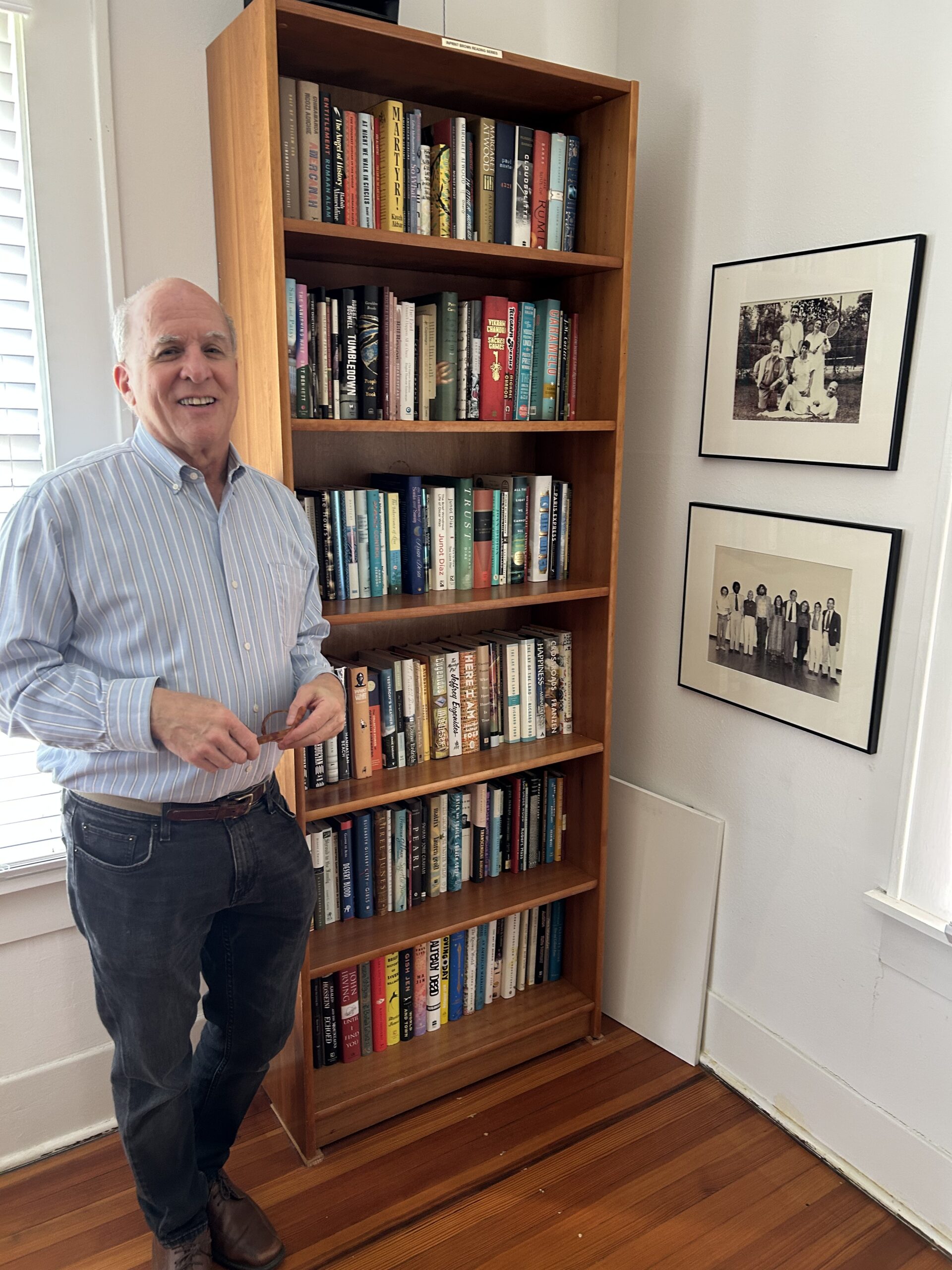
Wright, meanwhile, who secured his position through his own upset of an RRC incumbent in 2020, is backed by a broader swath of the oil and gas industry. ConocoPhillips, Valero Energy, Chevron, and Exxon have collectively funneled him at least $50,000 over this election cycle. Energy Transfer Partner’s Kelcy Warren (of Standing Rock and Dakota Access Pipeline infamy) has put up $10,000. In the typical railroad commissioner mold, Wright owns several gas patch waste companies and is invested in some of the very drillers he’s supposed to regulate.
Although French is backed by the insurgent wing of the party, including Senate candidate and Attorney General Ken Paxton, conservative stalwart and fellow Dunn beneficiary Lieutenant Governor Dan Patrick has endorsed Wright. Last summer, Patrick called for French’s resignation as Tarrant County GOP chair after French tweeted a poll asking his followers whether Jews or Muslims were the bigger “threat” to the nation. Governor Greg Abbott is backing Wright as well.
French’s fascism has nevertheless managed to push Wright to the, well, right. “Like every Texan, I am deeply concerned about the alarming Islamification of Texas. I fully expect the Texas Legislature to make this issue a priority in the upcoming session,” Wright posted on May 5. “But the Texas Railroad Commission, the agency charged with regulating the oil and gas industry,” he clarified, “has no authority to make any policy that would affect this issue.”
Neither French nor Wright responded to requests for comment for this article.
In an interesting global twist, French has made Islamophobia the heart of his campaign at a time when the very industry he’s seeking to oversee is reaping massive profits from the Trump administration’s war on Iran—and costing average Texans more at the pump as a result. Unlike some on the fringe right, French has stood with Trump on Iran. If history’s a guide, French’s cheerleading of hostilities abroad, paired with a hands-off regulatory approach, could portend economic disaster—and maybe a political shift down the road.
In his 1981 book, Petroleum Politics and the Texas Railroad Commission, University of Texas Emeritus Professor of Government David Prindle outlines how the RRC’s decision to allow the maximum rate of domestic extraction (crashing prices) handed embargo power to the Organization for Petroleum Exporting Countries, which rapidly curtailed extraction rates elsewhere. Then, the RRC’s failure to handle a Central Texas gas shortage amid the 1973 oil embargo crisis set up a pro-regulation and pro-consumer RRC candidate for victory during the 1976 election. Today’s global energy shock sets up a new opportunity for a historical echo, Prindle told the Observer.
Prindle also said he takes French’s Islamophobic attacks personally, since his wife is Turkish and culturally Muslim. French’s strategy, Prindle says, isn’t exactly new. “The original Ku Klux Klan in the 1860s was anti-Black, but the second Ku Klux Klan in the 1920s was at least as much anti-immigrant as it was anti-Black,” he said. “So the idea that white and incidentally, Christians, are under attack is by no means something [new].”
In a more immediate sense, the difference between a French term on the RRC and a second Wright term for day-to-day oil operations might be subtle. Since 2021, Wright has taken fairly standard positions on the agency’s biggest issues, paying bare-minimum lip service to issues of flaring, plugging abandoned wells, and injection blowouts and seismicity.
Drawing French’s ire, Wright did spearhead an effort to update the commission’s oilfield waste rules to require drillers to register their rainbow-hued toxic tailing ponds. The rules touched a nerve among the likes of Tim Dunn when the draft was released in 2024. His son’s oil and gas company later sued the RRC over the regulation.
Jim Wright (Courtesy/campaign)
Still, the difference between Wright and French on issues like flaring and waste pits isn’t much more than rhetorical window dressing, argued Virginia Palacios, executive director of Commission Shift Action, which promotes pro-regulatory reform at the RRC. While French has taken aim at the RRC’s wastefield rules as overly burdensome, Palacios said they ultimately amount to an ineffective patchwork with different requirements for different drillers.
“For Bo French to come in and talk about deregulating this industry … it really raises a lot of questions,” Palacios told the Observer. “What does he even want? Why even go through the process of deregulating when the rules are so weak, and they’re already not being enforced, and they don’t mean anything?”
Moreover, French has vowed to eliminate Diversity, Equity, and Inclusion (DEI) initiatives at the RRC—something that has already been effectively dismantled at state agencies after Abbott’s 2025 executive order banning such policies. While French has likewise made hay of the RRC’s Historically Underutilized Businesses program, the Texas Comptroller already restructured the program last year to the exclusive benefit of veterans. Nevertheless, Palacios argues his hostility toward DEI could hurt RRC recruitment and retention.
In any case, whoever emerges from this month’s GOP runoff will face Houston-area petroleum engineer and Democratic state Representative Jon Rosenthal in the November midterms. Rosenthal’s campaign has centered on the need for tighter weatherization standards for the industry after power losses during 2021’s Winter Storm Uri. He has also promised to more meaningfully restrain flaring and waste pits, bring down gas prices through better oversight, and protect the state’s dwindling water supply from oil contamination and leaks.
Another issue Rosenthal told the Observer he generally supports is re-empowering local municipalities. In 2014, the state legislature stripped municipalities of local regulatory control over oil and gas drilling sites following a novel fracking ban passed in Denton, and handed that power to the RRC. Rosenthal said he supports returning local control to cities and counties, an issue with implications for communities engaged in fights against artificial intelligence-related data centers and accompanying gas plants.
Stripping local authority, Rosenthal said, was an egregious overstep. “It was before I got in, but even during my time, this legislature has routinely preempted local control in all sorts of areas,” he said. “Local control used to be a cornerstone of Republican political ideology. I don’t know what happened.”
The post Bo French’s Blood-and-Oil Bid for Railroad Commissioner appeared first on The Texas Observer.