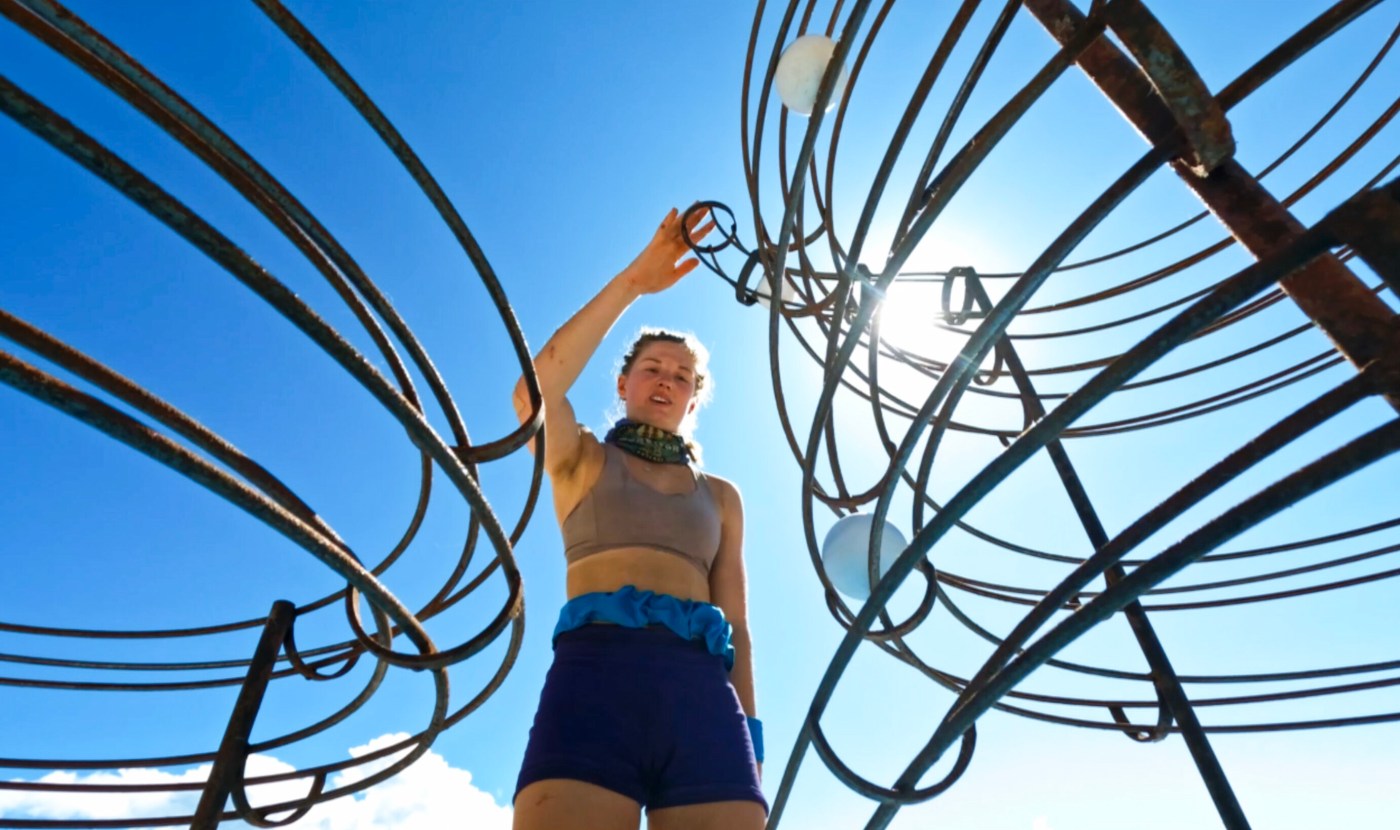
Viewers watched Eagan native Eva Erickson experience the highest of highs and lowest of lows on “Survivor 48.”
The first openly autistic player to appear on “Survivor,” Erickson immediately confided in fire captain Joe Hunter, knowing she’d have an ally who could help her in case she got overstimulated and fell into what she called an “episode,” losing control and sobbing uncontrollably.
And that’s what happened in the emotionally charged fifth episode, when she struggled at the immunity challenge and almost lost it for her team. She broke down into tears and moans and, after host Jeff Probst gave him permission, Hunter ran over and embraced Erickson, helping her to calm down and regain her focus. Erickson used the opportunity to tell the entire cast that she was autistic and that wasn’t a negative: “I’ve never viewed my autism as a roadblock to success. It’s not something to work around. It’s just part of who I am. There’s nothing bad about it.”
At a young age, doctors told Erickson’s parents she would never be able to hold a job or live independently as an adult. Erickson graduated from Georgia Institute of Technology in 2022 and was the first and only female player on the school’s hockey team. She’s currently pursuing a Ph.D. at Brown University School of Engineering, where she’s captain of the men’s club hockey team.
In the time since the show started airing, Erickson has used social media to discuss and demystify autism to an ever-growing number of followers. Thanks to a strong alliance she made with Hunter and lawyer Kyle Fraser, she made it all the way to the final three in the finale, which aired Wednesday on CBS and is now streaming on Paramount+.
Erickson ended up taking second place behind Fraser and above Hunter. But she had a huge smile when she discussed her time on “Survivor” during an afternoon Zoom call on Thursday. Here’s what she had to say.
Q: Tell me about your decision to come out as autistic on national television.
A: I mean, for me, it’s part of my life. It’s not something that I hide in real life. It’s just not something that comes up in conversation, right? Like, if anybody asked me, I wouldn’t hide from it, but it was something that going into the game I wasn’t going to advertise, because it’s really just part of who I am. It’s not the defining characteristic.
I knew I was going to need to tell somebody in case (I had an episode). So I told Joe. But then when I had this opportunity to tell everyone, I wanted to do it justice. When Jeff opened the floor for me, I was so proud to share my story and be able to tell what it is like to be someone on the autism spectrum. I was very happy. I was shown so much support by my castmates in that moment. It was really amazing.
Q: That’s one thing that really struck me. You were so open about being autistic and your fellow castaways all supported you, which isn’t always the case in real life.
A: Yeah, yeah. Because there’s been so many times in my life when I have had these episodes, and people have not been willing to learn and understand, to see what’s going on. They’ve looked at me like I was a freak, like something was wrong with me. Like I was crazy, because I’m screaming, I’m out of control, and once I come down from that, sometimes the judgment that I receive is so hard on me. But I was not judged out there. These people, they cared about me.
“Survivor” is a reflection of society, right? It really showed me that we are at a point in society where people are willing to learn and understand, and that is so important when there is so much misinformation about autism. Being able to share my story and tell people about this, and the response I received out there, has been amazing. I’m so grateful.
Q: What was it about Joe that made you decide, hey, this is the guy I’m going to confide in?
A: Like I said, my strategy was that I needed to tell someone I had autism. I was immediately looking for that. When we got to the beach that first day in Fiji, Joe jumped to the top of my list immediately. The second we get off those boats, everybody’s finally able to talk to each other and say where you’re from, what you do for a living, this and that, just the important things about you.
The first, most important thing about Joe is that he wanted to tell everybody how proud he was to be a father. I knew the names of his kids before I knew anything about what he does in his life. He showed such love for his family that I felt that I can really trust this man, that he would be there for me.
Joe Hunter, left, rushes to calm Eagan native Eva Erickson after she breaks down at the immunity challenge on “Survivor 48,” airing Wednesday, March 26, 2025 on CBS. (Robert Voets / CBS)
Q: In the fifth episode, you had a major breakdown and revealed your autism to everyone. I must admit, I’ve watched that scene several times, and I cried every time watching Joe embrace you.
A: Yeah, absolutely, it was a very big, impactful moment. It just shows both his compassion and my strength to get through that together. It was such an amazing moment for so many reasons.
Q: How do you feel about showing America yourself at your most vulnerable?
A: I knew that this might happen. This is something that I face in my real life, and it’s a challenge. I do get overstimulated. I get overwhelmed. I have these episodes and I normally have strategies I can use. But “Survivor” just puts you in these situations that are different than your real life, that are so much more intense.
Related Articles
Spoiler alert: How Eagan native Eva Erickson fared on ‘Survivor’ finale
‘Lilo & Stitch’ review: Disney puts another one through the de-animation machine
Movie Review: ‘Lilo & Stitch,’ a sweet but unnecessary live-action remake
Movie Review: Romance and writer’s block in bilingual rom-com ‘Jane Austen Wrecked My Life’
Movie Review: Tom Cruise goes for broke in ‘Mission: Impossible — The Final Reckoning’
I was, like, OK this will probably happen. I’ll be very depleted out there. How am I going to handle this? My family, my parents, were a little worried. They’re, like, are you going to be OK with the world seeing you like this? And I was, like, yes, because I know that it will mean a lot to a lot of people. I didn’t realize how many people until it was really out there. But, you know what? This is part of who I am. We all bring things into the game. We all bring our baggage of our life. I was just bringing this part of me, and I was so proud to show it, and just thankful for the reception that I received. Because it is hard to be that vulnerable. But when you open yourself up and you are vulnerable like that, it changes lives. It certainly changed my life.
Q: You’re a relative newcomer to “Survivor,” correct?
A: Yup, I started watching in college, so only, like, three years ago.
Q: What was it that appealed to you about the show?
A: I’m a competitor, right? I play hockey. I’m definitely an athlete type. I was playing the dumb jock out there, which was my cover, but it was also very strategic. I thought I can use my engineering brain that I don’t get to use playing hockey as much. And then I could also use my athletic side in these challenges. I love to compete and I brought this mesh of those two sides. The component that I discounted when I got onto “Survivor” was the relationship part. That is actually the most impactful part of the game for me, the relationships that I built out there. It’s very cool to see how all those things come together. The game is so unique, there’s nothing like it. So, of course, I was drawn into such a phenomenal competition.
Q: What prompted you to apply?
A: I’d been watching “Survivor” at Georgia Tech with my teammates, and we’d play our own “Survivor” game. We had drinking game challenges and we had alliances and you voted people out. I won the first time I played with them. And they were like, hey, maybe you should apply for the real thing. I was, like, ha, that’d be really funny. But I didn’t apply then. It wasn’t until I came to Brown, where I met my boyfriend. He loves “Survivor.” His entire family has watched every season. They’ve all applied for “Survivor” multiple times. I thought, I bet my new boyfriend would think I was pretty cool if I applied for “Survivor.” So I made my video, and now I’m here. I’m living his dream. He was the one who really got me to go and do it and I wanted to make him think I was cool. I hope he thinks I’m cool now that I actually went on the show.
Q: So you applied once and made it onto the show?
A: Yup.
Q: Wow. So what was the most surprising thing about the experience for you?
The relationships. I really discounted the social game. I did not think that I was going to make these friendships that would change my life. Joe, this amazing man, has shown me what true masculinity is in bringing both an emotional strength as well as physical strength and just being this amazing human. He’s what every man should strive to be, and women too. He’s amazing. And then Kyle, he is like my brother, in that we have a very different relationship than what Joe and I have. Kyle and I are closer in age and closer in our life experiences and the things that we have gone through. I went to his wedding, and that’s the first wedding I cried at. We are very close. These two relationships have shaped my life. I have become a better person because I know these amazing men.
Q: Yeah, I was going to ask you about your post-show relationships.
A: We have a big group message chat with most of the cast, and then I have a smaller, fantastic four group message between Kamilla (Karthigesu), Kyle, Joe and I. I’m very close with those three. Each of them are different relationships, and they have each shown me things about myself that have made me a better person. I strive to be like them in many ways. I’m so thankful for getting to spend so much time with them out there and now meeting their family, their significant others, and them meeting my family.
Eagan native Eva Erickson, left, and Bianca Roses tend to the rice on the second episode of “Survivor 48,” which aired March 5, 2025 on the CBS Television Network. (Robert Voets / CBS)
Q: What was it like to watch the show every week?
A: It was a lot of just stuff, you know? Your brain is packed full of all the stuff from “Survivor,” your own thoughts and personal experiences, your memories, combined with what the edit is showing, which is different than what you experienced. And then the fans, people saying great things about you, people saying horrible things about you, people saying horrible things about your friends. You want to be, like, hey don’t say that about my friend, but you can’t.
I call Kyle every day. We debrief the episode. We talk about our lives and having his support, especially that we are one and two in this game, we are each other’s number one and two, you know? We are here for each other. Joe is harder to get a hold of. I can’t call him every day because he’s saving lives. But the cast supports each other and that allows us to get through the watching experience, because it is a lot of stuff going on in your head.
Eagan native Eva Erickson is one of 18 castaways competing on “Survivor 48,” which premiered Feb. 26, 2025. (Robert Voets / CBS)
Q: Have you connected with “Survivor” contestants from other seasons? I’ve always got the sense it’s like one big family.
A: Yeah, it’s a very cool alumni community. One of my favorite interactions from the finale last night was getting to meet Austin (Li Coon) from “45.” He was the runner up and getting to meet another person who has been in the exact same spot that I am gave me so much relief. I’ve talked to Sam (Phalen, from “Survivor 47”), I’ve talked to Charlie (Davis, from “Survivor 46”). Meeting (others who made second place) has been pretty freaking cool. I’m very grateful that I’ve gotten to connect with them and we can share this experience and know that, hey, the runner-up club is great. Having that support across seasons is so important. And I hope that whoever’s the runner up of “49” can come to me for support, too.
Q: Tell me about using your platform to speak publicly about autism.
A: I didn’t go onto “Survivor” to try to create this platform to speak about autism. It’s just part of my life. But I’ve been given this opportunity from my large following because of “Survivor” and now I am able to speak my mind on this topic that is so important to me. So making videos to speak about how autism has affected me in my life, how it presents itself, what autism is, is helping to educate people and so that they understand. Because my representation of autism is just one version. It is a massive spectrum where everyone has different experiences.
If anyone can connect to part of my story, or can see themselves, see their child, it helps them learn and grow and understand autism better. It helps the community. The world has a lot of misconceptions about autism right now, and it is so important for people like me to share my story so that we can clear those up and help open this conversation and recognize that autism is not something wrong with you, but it is something that is special and unique, and it makes you who you are. It might give you challenges that are different than other people, but it also gives you strength. And I am so glad that I get to use my platform to spread this message.
Q: Would you play the game a second time?
A: In a heartbeat. I’m very proud that I got to the end with this team. I created this team. I told Kyle and Joe that I wanted to be in the final three with them many episodes ago. This is who I want to go to the end of the game with. And I made this team, and my team got to the end, and my team won, but I didn’t win. And I wanted to win. I am so competitive. I want to go back and I want to get a chance to do it again. But first I want to finish my Ph.D.
Related Articles
Spoiler alert: How Eagan native Eva Erickson fared on ‘Survivor’ finale
‘Sesame Street’ moves in with Netflix, but will stay on PBS
Curtain coming down after 30 years at ‘Inside Edition’ for Deborah Norville
A slow death? Broadcast TV news gets overhaul as viewers decline
Mary Tyler Moore’s personal collection, including Minneapolis statue renderings, up for auction
Q: How did growing up in Minnesota affect your game?
A: I mean, I grew up outside. I have a cabin in northern Minnesota, in Chippewa National Forest, so I’m used to the woods. Every day out there, I would go collect wood, because at my cabin, me and my dad are always cutting up trees and hauling wood around. So every day, I was gathering wood on the island and feeling close to my family and the stuff I go through back home. It’s a very different environment, but it reminded me of my cabin and reminded me a lot of a lot of home. I went straight to Minnesota after getting back from Fiji, and got to spend time with my family there. So it was nice to get to go home to Minnesota for that.