Trump campaign against law firms dealt another setback as judge blocks executive order

posted in: All news | 0

By ERIC TUCKER, Associated Press

WASHINGTON (AP) — President Donald Trump’s campaign against the legal profession hit another setback Tuesday as a federal judge struck down yet another executive order that sought to sanction one of the country’s most prestigious law firms.

The order in favor of WilmerHale marks the third time this month that a federal judge in Washington has deemed Trump’s series of law firm executive orders to be unconstitutional and has permanently barred their enforcement.

“The cornerstone of the American system of justice is an independent judiciary and an independent bar willing to tackle unpopular cases, however daunting. The Founding Fathers knew this!” wrote U.S. District Judge Richard Leon.

To permit the order to stand, Leon wrote, “would be unfaithful to the judgment and vision of the Founding Fathers.”

The firm applauded the ruling from Leon, an appointee of former Republican President George H.W. Bush.

“The Court’s decision to permanently block the unlawful executive order in its entirety strongly affirms our foundational constitutional rights and those of our clients. We remain proud to defend our firm, our people, and our clients,” a spokesperson for the firm said.

Related Articles


Trump set to pardon reality TV stars Todd and Julie Chrisley of fraud and tax evasion convictions


US Sen. Tommy Tuberville announces 2026 bid for Alabama governor


The US and EU are in a showdown over trade. What does Trump want and what can Europe offer?


Trump Media says investors will fund a company ‘bitcoin reserve’ through share purchases


COVID vaccines are no longer recommended for healthy children and pregnant women, Kennedy says

The ruling was similar to one from Friday by a different judge that rejected a Trump edict against the firm of Jenner & Block and another one from earlier in the month in favor of the firm Perkins Coie.

The firms had all been subjected to Trump executive orders that sought to impose the same set of consequences, including suspending security clearances of attorneys and barring employees from federal buildings. The orders have been part of a broader effort by the president to reshape American civil society by targeting perceived adversaries in hopes of extracting concessions from them and bending them to his will.

Several of the firms singled out for sanctions have either done legal work that Trump has opposed, or currently have or previously had associations with prosecutors who at one point investigated the president.

The order against WilmerHale, for instance, cited the fact that the firm previously employed former Justice Department special counsel Robert Mueller, who led an investigation during Trump’s first term into potential ties between Russia and Trump’s 2016 campaign.

Other major firms have sought to avert orders by preemptively reaching settlements that require them, among other things, to collectively dedicate hundreds of millions of dollars in free legal services in support of causes the Trump administration says it supports.
Maureen Dowd: Dance$ with emolument$

posted in: All news | 0

WASHINGTON — When Donald Trump was headed for the Republican nomination in the summer of 2016, I took Carl Hulse, our chief Washington correspondent, to Trump Tower to meet him.

Trump didn’t know anything about the inner workings of Washington. He proudly showed us his “Wall of Shame” with pictures of Republican candidates he had bested. His campaign office had few staffers, but it overflowed with cheesy portraits of him sent by fans: one of him playing poker with Ronald Reagan, Richard Nixon and Teddy Roosevelt, and a cardboard cutout of him giving a thumbs-up, flanked by Reagan and John Wayne.

As we were leaving, Hulse warned Trump dryly, “If you ever get a call from our colleague Eric Lipton, you’ll know you’re in trouble.”

“Eric Lipton?” Trump murmured.

The president probably knows who Lipton is now, because the Pulitzer Prize-winning New York Times investigative reporter is tracking Trump on issues of corruption as closely as the relentless lawman in the white straw hat tracked Butch Cassidy and the Sundance Kid.

Lipton and the Times’ David Yaffe-Bellany were on the scene at Trump’s Virginia golf club this month as the president held his gala dinner to promote sales of $TRUMP, the meme coin he launched on the cusp of his inauguration. (Melania Trump debuted hers two days later.)

Trump has been hawking himself in an absurdly grandiose way his whole life. But this time, he isn’t grandstanding as a flamboyant New York businessperson. He’s selling himself as the president of the United States, staining his office with a blithe display of turpitude.

Protesters at the golf club shouted, “Shame, shame, shame!” but there is no shame in Trumpworld. Trump asked guests, who were whooping with joy at the president who allowed them to purchase such primo access by essentially lining the pockets of Trump and his family, if they had seen his helicopter.

“Yeah, super cool!” gushed a guest.

Buyers flew in from China and around the world, scarfing up a fortune in $TRUMP — some had millions of dollars worth — to procure the 220 seats at the dinner.

“It was a spectacle that could only have happened in the era of Donald J. Trump,” Lipton and Yaffe-Bellany wrote. “Several of the dinner guests, in interviews with the Times, said that they attended the event with the explicit intent of influencing Trump and U.S. financial regulations.”

Pan-seared influence peddling with a citrus reduction. The prez is a pro at quid pro quo.

Trump’s press secretary, Karoline Leavitt, rebutted criticism Thursday, saying, “The president is attending it in his personal time. It is not a White House dinner.”

But he flew to Virginia on Marine One. He gave his remarks from a lectern with the presidential seal. And some of the crypto crowd Friday got a tour of the White House (Lipton took his post outside the fence).

With more than a dozen lucrative deals for his family and partners, the Times article said, “Mr. Trump is estimated to have added billions to his personal fortune, at least on paper, since the start of his new term, much of it through crypto.”

The corruption is seeping across the Potomac.

Donald Trump Jr. and investors are opening a pricey private club in Georgetown called “Executive Branch,” where business and tech moguls can cozy up to administration big shots.

The notorious $400 million gift for the president from the Qataris, a luxury jumbo jet, has arrived in San Antonio. This alluring “pre-bribe,” as “SNL” dubbed it, instantly wiped out Trump’s old concerns that “the nation of Qatar, unfortunately, has historically been a funder of terrorism at a very high level.” (Accepting the plane was sort of like a terrorist fist-bump, the same kind a Fox News host bizarrely accused the Obamas of making with each other.)

Other foreign leaders got the message that emoluments were welcome. In an Oval Office meeting where Trump continued to relish his role as protector of the white patriarchy, the South African president jokingly told the American president, “I’m sorry I don’t have a plane to give you.” (This might be the line that best sums up the Trump presidency in the history books.)

Trump replied breezily, “I wish you did. I’d take it.”

Trump Inc.’s money grabs were taking place against the background of the president pushing through his “big, beautiful bill” extending his obscene tax cut for the rich while slicing billions from programs that help poor people stay alive.

“The guy promised to make American families more prosperous,” David Axelrod said. “He just decided to start with his own.”

In a galaxy long ago and far away, there was shame attached to selling your office. Sherman Adams, President Dwight Eisenhower’s chief of staff, lost his job and ruined his reputation after he accepted a vicuña coat from a Boston textile manufacturer doing business with the federal government.

Trump has no reputable reputation to ruin. He’s a snatch-and-grab artist.

“I think social media and Donald Trump’s persona have numbed people to the idea that certain forms of behavior are off-limits,” said Tim O’Brien, a Trump biographer. “No institution has been able to rein in Donald Trump. He got impeached twice. Didn’t matter, so Congress couldn’t rein him in. He had all sorts of federal and state prosecutions that ended up going nowhere, so law enforcement couldn’t rein him in. The media has been covering him as close as anyone could ever be covered, and the media couldn’t rein him in. I think it makes people just sort of turn away and accept it as inevitable.”

Before he did his “YMCA” dance and scrammed early, the scamming Trump told the crypto enthusiasts at his golf club that he wasn’t pushing crypto and bitcoin for himself.

“I really do it because I think it’s the right thing to do,” he said.

In Trump’s moral universe, the right thing to do is always the thing that makes him richer.

Maureen Dowd writes a column for the New York Times.

What makes the Timberwolves’ 3-1 deficit feel even larger? That Oklahoma City crowd.

posted in: All news | 0

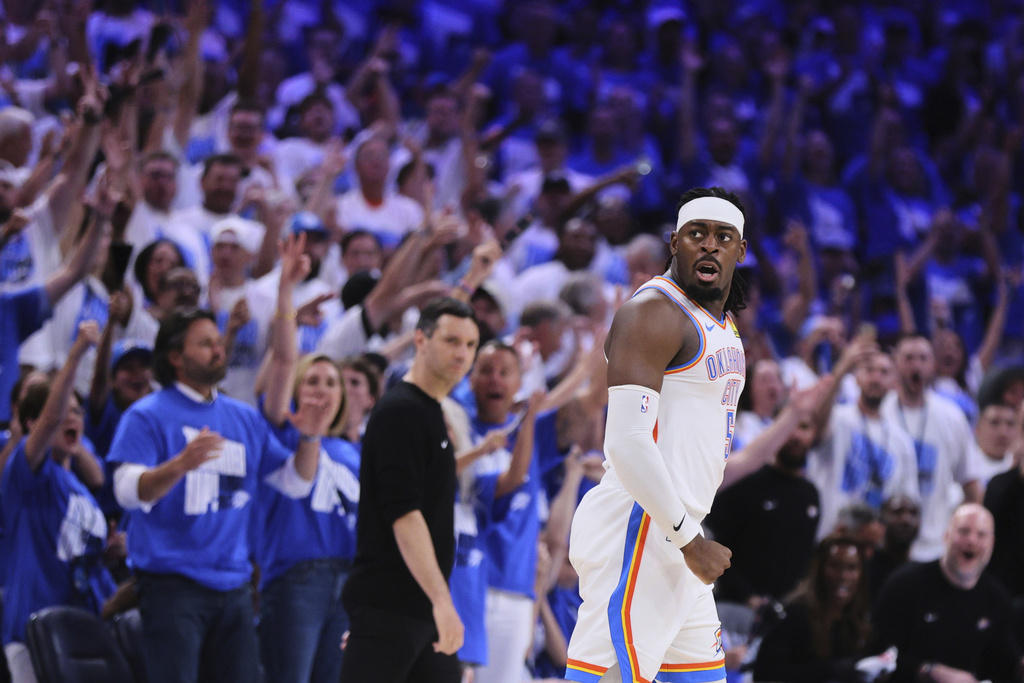
It’s difficult to explain the atmosphere at the Paycom Center in Oklahoma City to someone who hasn’t been there. But the sights on the television screen do it a sort of justice.

Ninety-nine percent of the patrons wear the complimentary t-shirt provided to create a monotone wall of fandom that surrounds the court. It’s a good visual representation of the crowd’s unity throughout the game.

Sure, it’s loud. The screams are deafening. The music blasts through the speakers. But it extends beyond that.

You’d swear the fans showed up hours prior to the contest to practice the rhythm of the chants, and in which situations they’d be used. Seemingly every person in the building knows exactly when to shout “De-fense!” Or, “O-K-C!” And does so without reservation.

Target Center has become a house of chaos for opponents in recent years as the Wolves have ascended the NBA ranks, but Oklahoma City is a different animal.

Fans waited outside the fence of a local airfield past 3 a.m. Tuesday in the pouring rain to greet the Thunder upon their return from not winning an NBA title or even securing a conference championship, just winning Game 4 of a best-of-seven series. It all gives off the vibes of high-level college sports, fitting given Oklahoma is a college sports state.

The Thunder are the state’s only top-tier men’s professional sports franchise, yet they’re treated with the same love and adoration as the Sooners. An invocation is delivered at center court just prior to the national anthem as part of the Oklahoma City pre-game festivities. It makes sense, because Thunder basketball feels like a religion of sorts in that part of the country.

“It’s a tough place. It really is a tough place to play,” Wolves guard Mike Conley said. “They’ve got a great fan base. Their home games are some of the loudest you’ll ever play in. They feed off of that. They’re already a team that plays hard and plays together and plays with momentum and confidence with that momentum, and they feed off of it. So, it makes it a tough environment.”

The Thunder went 32-8 at home during the regular season. They’re 7-1 in Oklahoma City in these playoffs, with six of the victories coming by 15 or more points. Minnesota was housed in Games 1 and 2 of this series.

The Thunder’s only home loss in these playoffs came in Game 1 of the conference semifinals to Denver. That felt like a miracle for the Nuggets, who trailed by 11 in the final five minutes, and were still down by nine with three minutes to play. Minnesota’s win in the Sooner State this season came via a 24-point fourth quarter comeback.

It feels like that’s what is required to beat the Thunder in their house. Now, in order to win this series, the Wolves will have to do so twice, starting with Game 5 on Wednesday. The odds are greatly stacked against them.

But Conley noted that Wolves players recognize how competitive this series has been, especially over the past two games played in Minneapolis. He said guys were already chatting in the locker room after a difficult Game 4 defeat about the next contest.

“I don’t think there’s a challenge of muscling up any kind of urgency now. It’s a one-game series for us. We’ve got to go in and win. We’ve got to figure it out,” Conley said. “So, we feel like when we play our best, hopefully our best can be better than their best.”

Wolves guard Nickeil Alexander-Walker said Minnesota cannot “concede to the situation.” They have no choice but to find a way. He cited the Timberwolves’ resilience — which has been exemplified all season as the group has responded well to being backed into a corner — as reason for optimism.

“Gotta play desperate. Gotta play like there’s no tomorrow because there isn’t,” Alexander-Walker said. “Right now, if we want to win, it’s not about how much we can score. It’s about can we get the stops? Can we rebound? Can we find a way to make winning plays relentlessly and consistently? For us, that’s the focus. For me, whatever that’s going to look like.

“… The only thing I care about is seeing another day. Donte (DiVincenzo) and I have a great relationship. We talk all the time about how we can help each other and the team. As long as that’s our focus, I have confidence that we can be OK.”

Winning two games in Oklahoma City is a monumental task. But DiVincenzo noted the only mission at the moment is to win there once and secure another opportunity to play on Minnesota’s home floor.

“Everybody has counted us out all year. We’ve been through a lot. We’re together as a locker room,” DiVincenzo said. “We don’t care what the media is going to say. We don’t care what TV is going to say. We’re focused on one game at a time and giving ourselves a chance on Wednesday.”

West Seventh Pharmacy to close after 110 years

posted in: All news | 0

Jeff Johnson raised seven kids in the West Seventh Street neighborhood, moving houses four times across 42 years, but never relocating much more than a mile from the century-old pharmacy he purchased with his wife and a business partner in 1999.

The business partner was bought out more than a decade ago, and with the Johnsons — husband-and-wife pharmacists — looking to retire this year, the couple put the West Seventh Pharmacy up for sale, including its inventory of greeting cards, angel-themed curios, toiletries and small household supplies. But facing industry headwinds that have shuttered some 44% of pharmacies in Minnesota since 2013, the Johnsons could not find a buyer.

When the doors close on the West Seventh Pharmacy on June 30, it will be for the final time. The pharmacy, in continuous operation since 1915, will cease to exist in a neighborhood that once was dotted by a number of street corner shops where a familiar face would fill a prescription while selling a customer a soda.

A sign in the West Seventh Pharmacy in St. Paul on Tuesday, May 27, 2025. Owner Jeff Johnson will retire at the end of June and shutter the 110-year-old neighborhood pharmacy. (John Autey / Pioneer Press)

“It’s been a good run,” said Johnson, who has welcomed 19 grandkids into the world. “It was like ‘Mr. Rogers Neighborhood.’ We knew the mailman. We knew the bar owners. We knew the people who worked in the gas station.”

While lacking the same street corner visibility, a clinic-based pharmacy opened last year two blocks away in the Riverland Community Clinic, the former United Family Medicine center, a federally-qualified health center off West Seventh Street and Osceola and Randolph avenues. Johnson spoke with them by phone and was assured they had capacity to absorb his customers.

“I talked to them yesterday and they said they can take anybody,” Johnson said Friday.

After that, options are limited.

Fewer drug stores

There’s Etel Pharmacy within Sibley Plaza, almost three miles to the southwest, or the pharmacy within United Hospital, nearly two miles in the opposite direction, toward the outskirts of downtown St. Paul. Within downtown, there’s a pharmacy at the two-level Walgreens on Wabasha Street, which has been plagued by shoplifting.

Since 2013, 61% of independently-owned and 39% of chain pharmacies have closed, according to the Minnesota Pharmacists Association.

Some point fingers at pharmacy benefit managers (PBMs) that work for managed care organizations (MCOs), who reimburse pharmacies well below their costs while instituting fees, contract terms and other market practices that leave small pharmacies at a disadvantage, according to the association.

Pharmacist Jeff Johnson, left, talks with a customer in his West Seventh Pharmacy in St. Paul on Tuesday, May 27, 2025. Johnson will retire at the end of June and shutter the 110-year-old neighborhood pharmacy. (John Autey / Pioneer Press)

A handful of companies such as United Health’s Optum Rx, Cigna, CVS Caremark, and Prime Therapeutics — which works with Express Scripts — have been able to effectively dictate prices for prescription drugs using take-it-or-leave-it policies that would lock shops out if they don’t accept their terms, according to independent pharmacists.

In the past, when PBMs dictated lower prices for prescription drugs, stores could make up the difference by selling greeting cards and other items.

“Pharmacies have very little control over the pricing of the drugs themselves. (PBMs) have ratcheted everything down, so it’s gotten to the point where there’s no place to make up the losses,” said Deborah Keaveny, a Winsted, Minn. pharmacist who founded Minnesota Independent Pharmacists. “We are all at the tipping point.”

Changing landscape

Johnson noted there are other industry players who aren’t exactly skipping meals, either. “Everyone talks about the PBMs,” he said. “It could be the manufacturers. It could be the wholesalers. Larger chains could be treated differently than smaller chains. It’s as competitive as the restaurant business. It’s as competitive as the grocery business.”

A labor shortage hasn’t helped. Connie Weber, one of the two pharmacists on staff at West Seventh Pharmacy, worked for an independent pharmacy for 22 years until that shop closed. She landed at West Seventh Pharmacy five years ago. Now, another pharmacy is closing around her, which is one of several reasons younger industry peers have opted to avoid the retail sector.

“You have to pay workers a fair share, but we’re paying our workers the bare minimum,” Johnson said. “It’s a nice place to work so they accept that, but they can make more money at bigger companies.”

At West Seventh Pharmacy, what was once a dozen retail workers has now dwindled to seven part-timers, several of whom have reached retirement age themselves. Johnson’s wife, who will retire this fall from Children’s Hospital in St. Paul, jokingly refers to the West Seventh Pharmacy as the “nonprofit pharmacy.”

A customer walks into the West Seventh Pharmacy in St. Paul on Tuesday, May 27, 2025. When owner Jeff Johnson retires on June 30, the pharmacy, in continuous operation since 1915, will close for the final time. (John Autey / Pioneer Press)

In addition to industry changes, customers have also changed. A younger clientele expects on-demand service akin to Amazon.com. “People treat us like McDonald’s,” Johnson said. “We have great customers, but there’s some who want things right away. That’s a hard one. There’s a difference in generations. The new customers need a little more attention.”

And to get that attention, they’ll soon have to look elsewhere.

“It’s been a good gig,” said Johnson, who is ending an era for himself and for his store. “We’ve been trying to sell it, but no one is interested in buying it.”

Related Articles


Twins ready for three-city “Minor League Road Trip”


Twins threaten but fall in series finale to Royals


Bethel students visit Thailand after immigrating to U.S.


Photo Gallery: George Floyd’s murder shook Twin Cities five years ago


What Minnesota laws and policies changed after George Floyd? Here are 9 topics