Opinion: NYC Needs Land and Housing for People, Not Profit

posted in: All news | 0

“As the city and state pour subsidies into for-profit development that fails to serve those most in need, Community Land Trusts (CLTs) offer a proven and powerful way to ensure lasting affordability, protect tenants, and begin to repair longstanding racial and economic injustices.”

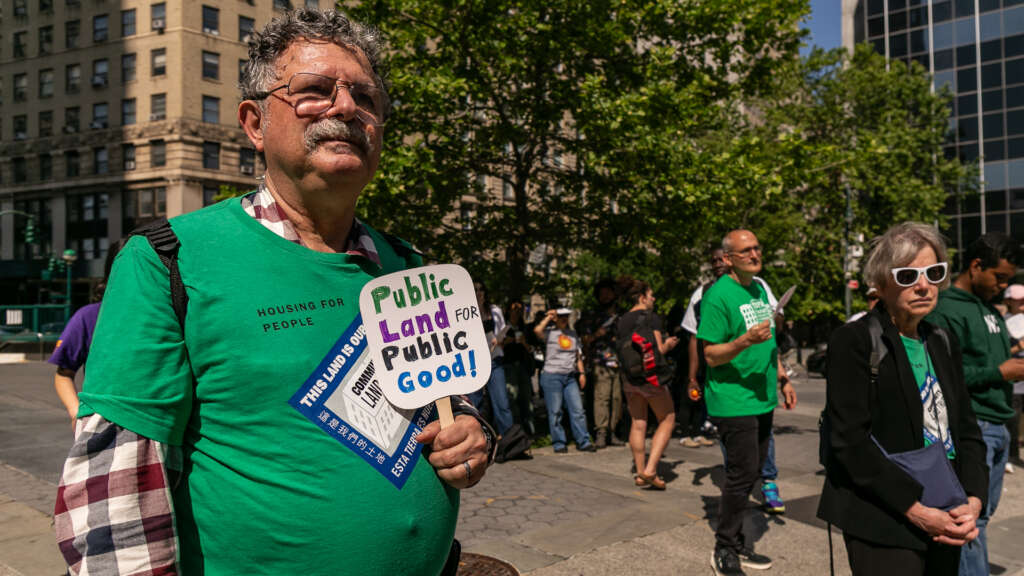
Housing advocates rallying Tuesday in lower Manhattan for passage of the Community Land Act in the City Council. (Photo by Adi Talwar)

From the South Bronx to East New York and beyond, communities are working to reclaim land for public good, take housing off the speculative market, and ensure permanent affordability—through community land trusts (CLTs) and neighborhood-led development. 

On Tuesday, the City Council held a historic hearing on the Community Land Act—a groundbreaking slate of bills backed by 150-plus groups that would enable CLTs and other nonprofits to dramatically expand the supply of deeply and permanently affordable housing in low-income and Black and brown neighborhoods. 

RELATED READING: Social Housing Supporters Revive Push to Boost Nonprofit & Community Ownership

More than 60 tenants and community groups testified in support of the bills, which include the Community Opportunity to Purchase Act (Intro 902), giving CLTs and other qualified nonprofits a first right to purchase multifamily buildings when landlords sell, as well as Public Land for Public Good (Intro 78), requiring the city to prioritize CLTs and other nonprofits in public land dispositions. The package also includes a resolution calling on New York State to enact the Tenant Opportunity to Purchase Act. 

Together, these bills represent a bold shift toward community stewardship, equity, and long-term housing stability.

The need for such a shift couldn’t be clearer—or more urgent. Today, more than half of Black and Latino New Yorkers face housing insecurity, the result of decades of disinvestment, displacement, and speculative development. As the city and state pour subsidies into for-profit development that fails to serve those most in need, CLTs offer a proven and powerful way to ensure lasting affordability, protect tenants, and begin to repair longstanding racial and economic injustices.

Community land trusts are nonprofit, community-governed organizations that own and steward land for the public good. Rooted in civil rights movements, CLTs represent a powerful approach to taking land and housing off the speculative market, preventing displacement, and advancing community self-determination.

In recent years, the CLT movement has grown by leaps and bounds—from just two CLTs a decade ago to more than 20 today, operating in every borough. New York City’s CLTs now steward more than 1,200 permanently affordable rentals and shared equity cooperatives, as well as green spaces, affordable retail storefronts, community and commercial hubs, and more. 

Among the movement’s recent wins:

Last year, the East New York CLT worked with organized tenants to purchase their 21-unit apartment building from a neglectful landlord—the first purchase of its kind by a CLT in New York City. The CLT is now coordinating with tenants to make long-overdue repairs and convert the building into a tenant-owned affordable cooperative. 

After a decade of sustained advocacy in the South Bronx, the Mott Haven Port Morris Community Land Stewards secured rights in 2023 to transform an abandoned city-owned property into a Health, Education, and Arts (HEArts) Center. The CLT is also waging a campaign to ensure an accessible waterfront, in an environmental justice community that lacks healthy green spaces and where one in five children suffers from asthma.

On a Queens peninsula devastated by Hurricane Sandy, the ReAL Edgemere CLT was selected to redevelop 119 vacant city lots for climate-resilient affordable homeownership and open space. The grassroots CLT is engaging community residents, many of whom live in public housing, through a robust and inclusive community planning process.

Cooper Square CLT, New York’s veteran CLT formed in 1994, has long stewarded more than 320 deeply affordable apartments on Manhattan’s Lower East Side. Now, the CLT is organizing tenants in two rent-stabilized buildings it rescued from tax foreclosure.

Northwest Bronx Community and Clergy Coalition launched the Bronx CLT in 2020 to build shared wealth and collective governance over Bronx land. In addition to other community ownership wins, NWBCCC has secured commitments for four sites in the Belmont neighborhood that the CLT will preserve as permanently affordable cooperative housing. 

Borne out of activist opposition to Amazon’s planned headquarters in Long Island City, Queens, the Western Queens CLT is currently focused on securing rights to the same site—a 600,000 square foot, publicly owned Dept. of Education building in Long Island City—to create manufacturing jobs, an immigrant street vendor commissary, and artist and community spaces. 

This Land Is Ours CLT, formed in 2019, contributed to a successful bid to the NY Archdiocese that will develop a decommissioned religious property into more than 500 newly constructed affordable apartments. The CLT also is working to acquire and convert two city-owned parking lots to permanently affordable low-income apartments for families and seniors. 

Even with these and other gains, the city’s CLTs face steep barriers to scaling up—chief among them, access to land and capital. 

The Community Land Act would begin to change that. By giving CLTs a first right to purchase buildings when landlords sell, COPA would enable communities to intervene before speculators swoop in. Meanwhile, Public Land for Public Good would empower CLTs to transform vacant public land-–a precious resource—into truly affordable housing, vibrant community and green spaces, and more.

The City Council has taken initial steps to foster the growth of New York’s CLT movement, including by funding CLT education, organizing, and technical assistance in the city budget, since 2019. Groups have leveraged modest funding awards to deliver outsized results—building deep bases of support in their communities, acquiring and rehabilitating their first properties, partnering with mission-aligned developers, and much more. 

We now need New York City to go all in on its support for CLTs, through robust funding and policy support that enables them to seize opportunities to bring land and housing into community control. The Community Land Act is an essential step forward.

The city’s deepening housing crisis demands bold, systemic solutions. CLTs are already showing what’s possible—ensuring real affordability, preventing displacement, and putting land in community hands. Beyond simply building more, communities are organizing through CLTs to ensure land and housing are developed—and stewarded, over generations—for the public good.

Deyanira Del Río is executive director of New Economy Project. Matthew Shore is senior organizer at South Bronx Unite and a member of the Mott Haven-Port Morris Community Land Stewards. Brianna Soleyn is a board member of the East New York Community Land Trust.

The post Opinion: NYC Needs Land and Housing for People, Not Profit appeared first on City Limits.
Trump’s Proposed Budget Would be ‘Disastrous’ for NYC Housing Agencies

posted in: All news | 0

An analysis of Trump’s proposed federal budget says it could cut housing programs in New York City by up to 42 percent, with the biggest impact on low income renters, including NYCHA tenants.

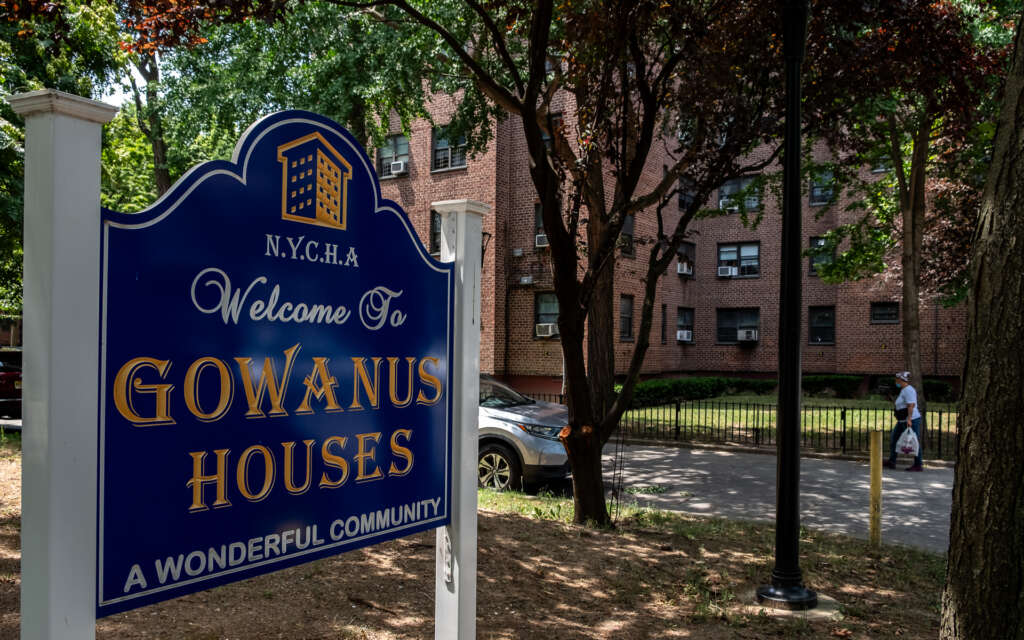
NYCHA’s Gowanus Houses in Brooklyn. (Photo by Adi Talwar)

President Donald Trump’s proposed federal budget would gut housing programs that low income New Yorkers rely on to keep them housed, according to a new report. The cuts could be particularly devastating for NYCHA, the largest public housing authority in the nation.

The federal government funds $6.3 billion in housing and homelessness programs that serve New Yorkers, according to the report from the NYU Furman Center* released Thursday morning. That includes funding for housing vouchers, operating public housing, home repair programs, and street outreach to the homeless. 

The proposed budget cuts $2.7 billion, or over 40 percent of the $6.3 billion total the city receives for these initiatives. 

“I can tell you that a 43 percent cut for any agency would be disastrous,” said New York City Housing Authority (NYCHA) CFO Annika Lescott-Martinez at a panel conversation on the proposal Thursday morning. 

Molly Waslow Park, commissioner of the NYC Department of Social Services, added, “I don’t see a world where we take a 43 percent cut and it doesn’t affect all of our services.”

The budget proposal would eliminate funding for some of the city’s largest housing programs. That includes Section 8 housing vouchers, public housing under Section 9, and project based rental assistance, programs that serve over 350,000 New York City households. It would replace them with a “State Rental Block Grant” program, where states distribute a smaller pool of money as they see fit.

“The devil of that is in the details,” said Furman Center Director Matthew Murphy. “So they’re proposing to move to that model, but also proposing to cut funding.”

With significantly less money to work with, the cuts would disproportionately affect very low income households and homeless individuals, the Furman Center analysis says. They are also more likely to affect neighborhoods with physically distressed properties that rely on federal programs for repairs.

The city’s Department of Housing Preservation and Development (HPD) gets 54 percent of its operating budget from federal funding, totaling nearly a billion dollars. It funds key services like housing vouchers, code enforcement, and emergency repair programs.

Those emergency repair funds flowed to neighborhoods like Bedford-Stuyvesant, East New York, and the Northwest Bronx—three hotspots for housing code violations, which jumped by 24 percent citywide in the most recent full fiscal year, as City Limits reported in October.

The budget is still a proposal, and the plan could change in the coming months as Congress negotiates its annual spending plan. “We are just a tweet away from changing our position,” said David Walsh, managing director of community development real estate and head of the east coast region at JPMorgan Chase.

But panelists at the Thursday morning breakfast at New York University Law School offered scant hope: “I hope that the worst of the worst doesn’t come about but I’m not optimistic at all,” said Andrew Scherer, professor of law and policy director of the Wilf Impact Center for Public Interest Law at New York Law School.

An apartment in a violation-riddled building in Washington Heights last year. (Gerardo Romo / NYC Council Media Unit)

Trepidation at NYCHA

The cuts could be felt most acutely in New York City’s public housing. NYCHA, the nation’s largest and oldest public housing authority, is home to over 300,000 people across 244 developments. Its budget is made up of over 75 percent federal funding, with most of the remaining revenue coming from tenants’ rental payments.

Public Housing Committee Chair and Councilmember Chris Banks called Trump’s cuts “a doomsday scenario for NYCHA, or for public housing, period,” in an interview with City Limits last month.

NYCHA officials, in a hearing before the City Council on May 14, also emphasized that only Congress has federal funding power, and while the president’s budget plan “acts as a guiding document of the administration’s priorities,” said Lescott-Martinez, it’s ultimately up to lawmakers to write and pass their own spending bills.

“NYCHA and New York City have weathered D.C.’s political storms before, and the present tempest won’t be an exception,” NYCHA CEO Lisa Bova-Hiatt said at the time. 

Still, Lescott-Martinez said the housing authority is “doing contingency planning across all of our programs.”

The City Council wants to provide an additional $2 billion in capital money for NYCHA over the next four years to help plug the gap. A city budget deal is due July 1. 

“We want to try to do as much as we can on the city budget to kind of undergird NYCHA,” Councilmember Banks said. “But the holes are pretty big when those types of cuts come through from the federal government.”

The brunt of the cuts could fall hardest on NYCHA residents. “It’s definitely a lot of uncertainty. Folks are scared,” said Banks.

NYCHA officials noted that the federal government has been disinvesting in public housing for decades. “The already significantly deteriorated public housing stock will continue to deteriorate,” said New York Law School’s Scherer.

A shift to incentives for development

While the budget cuts funding for housing programs, it expands tax incentives like the Low Income Housing Tax Credit program (LIHTC) and the Opportunity Zones program, which aims to spur development in underserved areas.

“These are different programs and targeted to different people, and while they intersect, it’s nowhere near going to offset [the other proposed cuts],” said Murphy.

In total, the Furman Center estimated that the city receives $7.2 billion from the federal government when including tax subsidies like LIHTC, according to the Furman Center report.

“An expansion of the LIHTC is great but it does not help us,” said NYCHA’s Lescott-Martinez.

Through the Opportunity Zone program, started in 2017 during Trump’s first term, New York State designated census tracts in 11 percent of the city’s land area, covering 16 percent of its population, as eligible for development incentives.

The Furman Center found that Opportunity Zones grew their housing stock faster, at a rate of over 2 percent in 2023 and 2024 compared to less than 1 percent in the rest of the city. But a greater proportion of the new development was market rate, rather than income-restricted, and new housing in opportunity zones was disproportionately built in high-income areas that overlapped with previous city upzonings.

“LIHTC serves low-income households, the Opportunity Zone program is not similarly targeted,” said Hayley Raetz, policy director at the Furman Center.

(Michael Appleton/Mayoral Photography Office)

Risks of eviction and homelessness

The proposed budget, which the Congressional Budget Office found would increase the deficit by $2.4 trillion, has alarmed local and state governments.

“It’s about redistributing the wealth upwards,” said Scherer.

At the Thursday morning panel, officials sounded the alarm about the compounding impacts of cuts to housing and social services. The Trump administration also wants to slash funding for Medicaid and SNAP benefits, which would leave local and state governments with many holes to plug, DSS’ Park detailed.

“Those are hitting the government budgets as well as low income household budgets,” she said.

The greatest strain would fall on low income renters, who would have to stretch their limited resources even further. The budget proposal also includes a two-year cap on rental assistance like Section 8 for “able bodied” adults (the cap would not apply to senior citizens or tenants with disabilities).

If these cuts come to pass, “evictions will come,” said Scherer.

Plugging those budget holes could put other programs at risk, Park elaborated, including CityFHEPS housing vouchers, DSS’ largest discretionary expenditure. 

 “There is absolutely the potential for a meaningfully increased homelessness rate,” said Park.

*Editor’s note: Reporter Patrick Spauster was previously a data fellow at the Furman Center.

To reach the reporter behind this story, contact Patrick@citylimits.org. The reach the editor, contact Jeanmarie@citylimits.org

Want to republish this story? Find City Limits’ reprint policy here.

The post Trump’s Proposed Budget Would be ‘Disastrous’ for NYC Housing Agencies appeared first on City Limits.

Jerome Johnson: A new era for Riverview mobility

posted in: All news | 0

The East Metro transit establishment is (finally) getting it right.

By pivoting to a more practical Bus Rapid Transit service model it is signaling that the concept of a Riverview Transit Corridor lives on, and by announcing plans to acquire additional off-street right-of-way it is hinting that there may yet be a role for rail-based transit in the corridor. But to ensure that both long- and short-run narratives play out, policymakers must act now, not 2032, to both jump-start short-run, bus-based, corridor mobility and then to secure sufficient throughput capacity to realize Riverview’s ultimate economic, logistical and recreational potential.

Metro Transit can start by implementing a “Highest Frequency” arterial Bus Rapid Transit (HF-BRT) service over a rebuilt West Seventh that improves current 12- to 15-minute express bus frequencies to five to six minutes and then extends the service north to Maplewood over the Purple Line BRT route. This will move Riverview and Purple Line riders to, from and through downtown more efficiently by reducing annoying curbside wait times and eliminating downtown transfers; it will move Gold Line and other transferring riders through downtown faster via shorter platform waits, and it will afford all riders unprecedented service reliability and broken trip recoverability.

There is nothing new or radical about five-minute bus service over extended city arterials. It is being done today in the suburbs of Toronto, where key components of the Brampton “ZUM” network operate at five-minute rush hour and 10-minute midday frequencies over arterials connecting suburban activity centers to Toronto’s rail transit network. Several of these 10-mile routes now handle over 20,000 weekday riders thanks to multiple double-digit year-over-year increases. Not surprisingly, the operator is planning to upgrade key parts of that network to either full, dedicated guideway, BRT status or as extensions to Toronto’s light rail network.

As such, it is a blueprint for what can happen here.

Five-minute service, however, is just the start.

City and Ramsey County authorities must also secure sufficient off-street right-of-way to cover longer-run, corridor-wide, traffic growth and usage contingencies. Acquiring the 4.5-mile CP Spur, an abandoned railroad pathway connecting the 100-acre mixed-use Highland Bridge development with the Randolph Avenue/West Seventh commercial district, makes that happen.

Through a bit of geographic luck, the spur comes sufficiently close to West Seventh at key transfer points to make it a viable trail and busway supplement to West Seventh itself. It will be just a short walk, for example, from the spur to Sibley Plaza, Lexington Parkway and Randolph Avenue station sites on West Seventh, as well as to the Mississippi River recreational corridor at Otto and Shepard Road.

Beyond these alignment attributes, the spur can safely support transit operations 10- to 15-mph faster than over a congested West Seventh, making it the only realistic right-of-way option for an eventual regional light rail presence in the corridor, should social and economic conditions warrant.

And, finally, the spur in transit deployment can accelerate conversion of 125 acres of industrial real estate along scenic Shepard Road to transit-oriented residential and commercial usage near potential Randolph (does St. Paul really want a garbage truck fueling station there?) and Homer Avenue station sites based on similarly successful Green and Blue Line station area conversions near the University of Minnesota and 46th Street, respectively.

The West End has waited for more than a decade for equitable transit service on its well-patronized Riverview Corridor as proponents tried without success to sell the public on a slow, rail-based, street-running alternative. Met Council can mitigate that by deploying best-in-class five-minute bus service now, while Ramsey County can nail the happy ending to the Riverview mobility saga by securing for the common good the right of way for what someday could be a faster, safer and far more effective version of … the Modern Streetcar.

Jerome Johnson is a retired transportation economist and cofounder of Citizen Advocates for Regional Transit (CART), a St. Paul based mobility advocacy organization.


Harvard files legal challenge over Trump’s ban on US entry for incoming foreign students

posted in: All news | 0

By ANNIE MA, AMANUEL BIRHANE and FU TING, Associated Press

Harvard University is challenging President Donald Trump’s move to block foreign students from coming to the United States to attend the Ivy League school, calling it illegal retaliation for Harvard’s rejection of White House demands.

In an amended complaint filed Thursday, Harvard called the president’s action an end-run around a previous court order. Last month, a federal judge blocked the Department of Homeland Security from revoking Harvard’s ability to host foreign students.

The filing attacks Trump’s legal justification for the action — a federal law allowing him to block a “class of aliens” deemed detrimental to the nation’s interests. Targeting only those who are coming to the U.S. to study at Harvard doesn’t qualify as a “class of aliens,” Harvard said in its filing.

“The President’s actions thus are not undertaken to protect the ‘interests of the United States,’ but instead to pursue a government vendetta against Harvard,” the university wrote.

The amended complaint came in a lawsuit filed last month challenging the previous action from Homeland Security. A federal judge in Boston blocked the move after Harvard said it violated the school’s First Amendment rights. The new filing asks the same judge to block Trump’s latest action too.

If Trump’s measure stands, it would block thousands of students who are scheduled to come to the campus in Cambridge, Massachusetts, for summer and fall terms.

“Harvard’s more than 7,000 F-1 and J-1 visa holders — and their dependents — have become pawns in the government’s escalating campaign of retaliation,” Harvard wrote.

THIS IS A BREAKING NEWS UPDATE. AP’s earlier story follows below.

Winning admission to Harvard University fulfilled a longtime goal for Yonas Nuguse, a student in Ethiopia who endured the Tigray conflict, internet and phone shutdowns, and the COVID-19 pandemic — all of which made it impossible to finish high school on time.

Now, it’s unclear if he will make it this fall to the Ivy League campus in Cambridge, Massachusetts. He and other admitted students around the world are anxiously tracking the school’s feud with the Trump administration, which is seeking to keep it from enrolling international students.

The war in the country’s Tigray region forced schools to close in many parts of the province. Nuguse, 21, took a gap year to study and save money to pay for his TOEFL English proficiency test in Addis Ababa, Ethiopia’s capital.

“The war affected me a great deal and when I found out the news that I was accepted to Harvard, I was ecstatic. I knew it was a proud moment for my family, teachers, mentors and friends, who were instrumental in my achievement,” he said.

Increasingly, the nation’s oldest and best-known university has attracted some of the brightest minds from around the world, with international students accounting for one-quarter of its enrollment. As Harvard’s fight with the administration plays out, foreign students are now navigating deep uncertainty and weighing other options.

On Wednesday, President Donald Trump signed a directive seeking to block U.S. entry for Harvard’s international students. It marked the administration’s latest effort to squeeze Harvard’s foreign enrollment after a federal judge in Boston blocked the withdrawal of its certification to host students from overseas.

“Harvard will continue to protect its international students,” the university said in a statement.

The standoff with Harvard comes as the administration has been tightening scrutiny of student visas nationwide. Thousands of students around the country abruptly lost permission to be in the U.S. this spring before the administration reversed itself, and Secretary of State Marco Rubio announced last week the U.S. would “aggressively revoke” visas for students from China.

“It is one blow after another,” said Mike Henniger, CEO of Illume Student Advisory Services, who works with colleges in the U.S., Canada and Europe to recruit international students. “At this point, international student interest in the U.S. has basically dropped to nil.”

The future of Harvard’s international students has been hanging in the balance since the Department of Homeland Security first moved to block its foreign enrollment on May 22.

For many, the twists and turns have been exhausting. Jing, a 23-year-old master’s student, is currently completing an internship in China this summer, and unsure if he can reenter the U.S. for the fall semester.

“It is tiring, we all feel numb now. Trump just makes big news headlines once every few days since he got back to the White House,” said Jing, who agreed to speak under his family name out of concern about retaliation from the Trump administration.

Jing said he is going to watch and see what happens for now, in case the move against international students is a negotiating tactic that does not stick.

The possibility that Trump could block foreign enrollment at other colleges only raises the uncertainty for students planning to pursue their education overseas, said Craig Riggs, who has been working in international education for about 30 years and is the editor of ICEF Monitor. He said he urges families to consult carefully with advisers and not to overreact to the day’s headlines.

“The rules under which students would make this huge decision to devote years of their lives and quite a bit of money to studying at Harvard have been shown to change quite quickly,” Riggs said.

An aspiring economist, Nuguse was the only student accepted to Harvard this year from Kalamino Special High School, which caters to gifted students from underprivileged backgrounds from across Tigray.

After receiving acceptances also to Columbia University and Amherst College, Nuguse chose Harvard, which he had long dreamed of attending. He said he hopes it will work out to attend Harvard.

Nuguse was granted a visa to study at Harvard, and he worries it might be too late to reverse his decision and attend another university anyway. He received an email from Harvard last week, telling him to proceed with his registration and highlighting a judge’s order in Harvard’s favor in the dispute over foreign enrollment.

“I hope the situation is temporary and I can enroll on time to go on and realize my dream far from reality in Ethiopia,” he said.

Associated Press writers Collin Binkley, Jocelyn Gecker and Cheyanne Mumphrey contributed to this report.

The Associated Press’ education coverage receives financial support from multiple private foundations. AP is solely responsible for all content. Find AP’s standards for working with philanthropies, a list of supporters and funded coverage areas at AP.org.