Iranian state television on Tuesday afternoon urged the country’s public to remove the messaging platform WhatsApp from their smartphones, alleging the app — without offering specific evidence — gathered user information to send to Israel.
In a statement, WhatsApp said it was “concerned these false reports will be an excuse for our services to be blocked at a time when people need them the most.” WhatsApp uses end-to-end encryption, meaning a service provider in the middle can’t read a message.
“We do not track your precise location, we don’t keep logs of who everyone is messaging and we do not track the personal messages people are sending one another,” it added. “We do not provide bulk information to any government.”
Related Articles
US spies said Iran wasn’t building a nuclear weapon. Trump dismisses that assessment
Overnight Russian attack on Ukraine kills 15 and injures 156
Alert raised to the highest level after Indonesia’s Mount Lewotobi Laki Laki volcano erupts
Trump says the US knows where Iran’s Khamenei is hiding and urges Iran’s unconditional surrender
G7 leaders try to salvage their summit after Trump’s early exit effectively makes it the ‘G6’
End-to-end encryption means that messages are scrambled so that only the sender and recipient can see them. If anyone else intercepts the message, all they will see is a garble that can’t be unscrambled without the key.
WhatsApp is owned by Meta Platforms, the parent company of Facebook and Instagram.
Iran has blocked access to various social media platforms over the years but many people in the country use proxies and virtual private networks, or VPNs, to access them. It banned WhatsApp and Google Play in 2022 during mass protests against the government over the death of a woman held by the country’s morality police. That ban was lifted late last year.
WhatsApp had been one of Iran’s most popular messaging apps besides Instagram and Telegram.
WASHINGTON (AP) — Tulsi Gabbard left no doubt when she testified to Congress about Iran’s nuclear program earlier this year.
The country was not building a nuclear weapon, the national intelligence director told lawmakers, and its supreme leader had not reauthorized the dormant program even though it had enriched uranium to higher levels.
“I don’t care what she said,” Trump told reporters. In his view, Iran was “very close” to having a nuclear bomb.
Trump’s statement aligned him with Israeli Prime Minister Benjamin Netanyahu, who has described a nuclear-armed Iran as an imminent threat, rather than with his own top intelligence adviser. Trump was expected to meet with national security officials in the Situation Room on Tuesday as he plans next steps.
Gabbard brushed off the inconsistency, blaming the media for misconstruing her earlier testimony and asserting that “President Trump was saying the same thing that I said.”
“We are on the same page,” she told CNN. Asked for comment, Gabbard’s office referred to those remarks.
U.S. Director of National Intelligence Tulsi Gabbard departs following a closed door meeting with Philippine President Ferdinand Marcos Jr. at Malacanang Palace in Manila, Philippines Monday, June 2, 2025. (Ezra Acayan/Pool Photo via AP)
Smoke rises from the building of Iran’s state-run television after an Israeli strike in Tehran, Iran, Monday, June 16, 2025. (AP Photo)
President Donald Trump speaks with reporters while flying aboard Air Force One en route from Calgary, Canada to Joint Base Andrews, Md., late Monday, June 16, 2025. (AP Photo/Mark Schiefelbein)
1 of 3
U.S. Director of National Intelligence Tulsi Gabbard departs following a closed door meeting with Philippine President Ferdinand Marcos Jr. at Malacanang Palace in Manila, Philippines Monday, June 2, 2025. (Ezra Acayan/Pool Photo via AP)
In her March testimony to lawmakers, Gabbard said the intelligence community “continues to assess that Iran is not building a nuclear weapon and Supreme Leader Khamenei has not authorized the nuclear weapons program he suspended in 2003.”
She also said the U.S. was closely monitoring Iran’s nuclear program, noting that the country’s “enriched uranium stockpile is at its highest levels and is unprecedented for a state without nuclear weapons.”
Trump’s contradiction of Gabbard echoed his feuds with U.S. spy leaders during his first term, when he viewed them as part of a “deep state” that was undermining his agenda. Most notably, he sided with Russian President Vladimir Putin in 2018 when asked if Moscow had interfered in the 2016 election, saying Putin was “extremely strong and powerful in his denial.”
The latest break over Iran was striking because Trump has staffed his second administration with loyalists rather than establishment figures. Gabbard, a military veteran and former Democratic congresswoman from Hawaii, was narrowly confirmed by the Republican-controlled Senate because of her scant experience with intelligence or managing sprawling organizations.
Gabbard, who left the Democratic Party in 2022 and endorsed Trump in last year’s election, is expected to testify Tuesday in a closed session on Capitol Hill, along with CIA Director John Ratcliffe, during a previously scheduled budget hearing.
Both officials likely would face questions about their views on Iran and Trump’s latest statements. A representative for the CIA did not immediately respond to requests for comment.
The head of the International Atomic Energy Agency has repeatedly warned that Iran has enough enriched uranium to make several nuclear bombs should it choose to do so. Iran maintains its nuclear program is peaceful.
An earlier intelligence report, compiled in November under then-President Joe Biden, a Democrat, also said Iran “is not building a nuclear weapon.”
However, it said the country has “undertaken activities that better position it to produce one, if it so chooses,” such as increasing stockpiles of enriched uranium and operating more advanced centrifuges. The report did not include any estimates for a timeline for how quickly a bomb could be built.
Related Articles
Newsom v. Trump: A defining moment for America or the California governor’s shot at presidency?
Trump says US knows where Iran’s Khamenei is hiding, urges Iran’s unconditional surrender
Abortion clinics are closing even in states where abortion is legal. More cuts could be coming
Senate is expected to pass a crypto bill without addressing Trump’s investments
Trump suggests he’ll extend deadline for TikTok’s Chinese owner to sell app
Trump’s immigration agenda is another place where he’s split with intelligence assessments. He cited the Alien Enemies Act, a 1798 wartime law, to deport Venezuelan migrants, which he justified by claiming that the Tren de Aragua gang was coordinating with the Venezuelan government. However, an intelligence assessment in April found no evidence of that.
In response to those reports, the White House released a statement from Gabbard supporting the president.
“President Trump took necessary and historic action to safeguard our nation when he deported these violent Tren de Aragua terrorists,” the statement said. “Now that America is safer without these terrorists in our cities, deep state actors have resorted to using their propaganda arm to attack the President’s successful policies.”
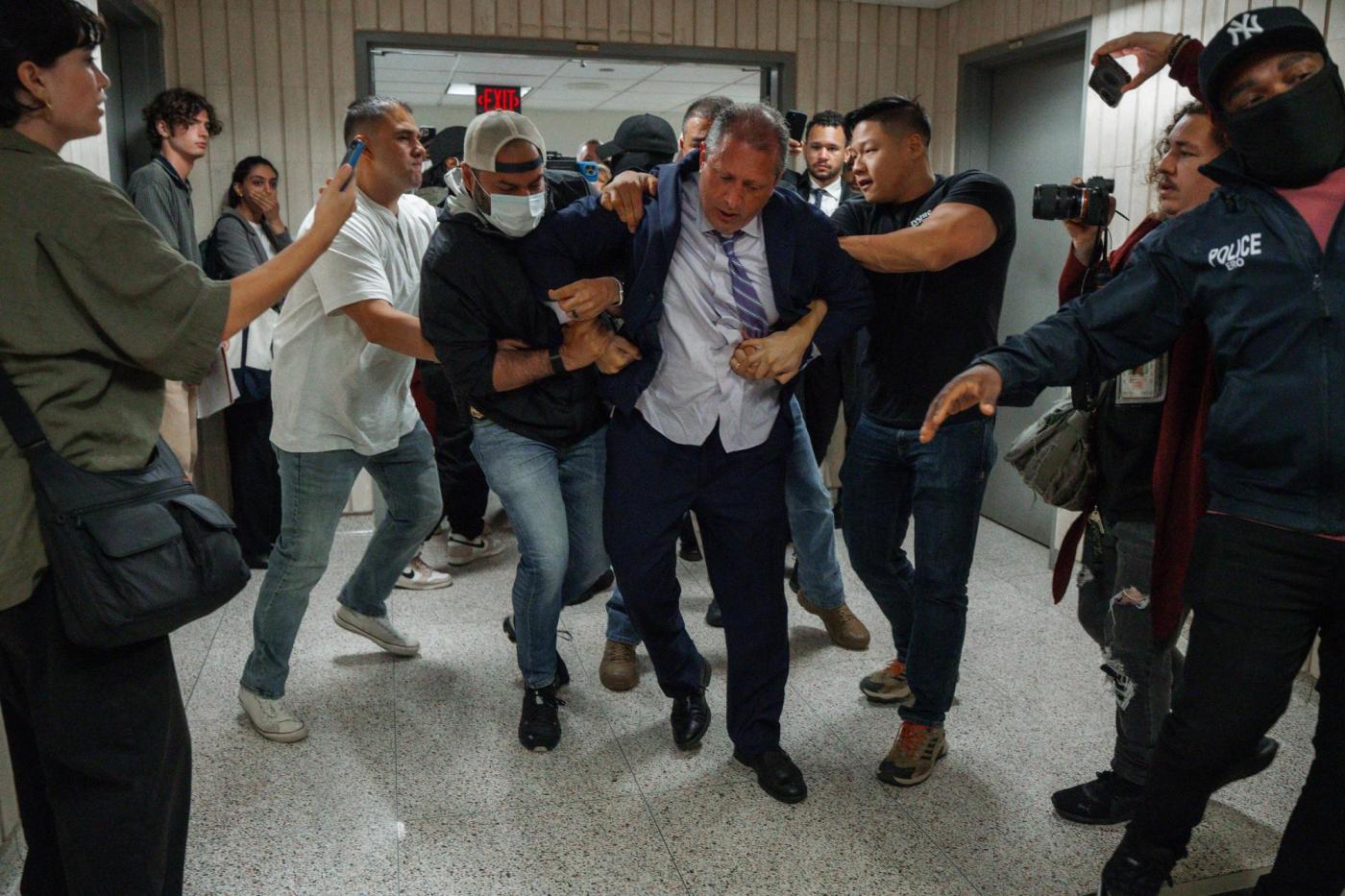
NEW YORK (AP) — New York City comptroller and Democratic mayoral candidate Brad Lander was arrested by federal agents at an immigration court Tuesday as he was trying to accompany a person out of a courtroom.
A reporter with The Associated Press witnessed Lander’s arrest at a federal building in Manhattan. The person Lander was walking out of the courtroom was also arrested.
Lander had spent the morning observing immigration court hearings and told an AP reporter that he was there to “accompany” some immigrants out of the building.
New York City Comptroller Brad Lander is placed under arrest by Immigration and Customs Enforcement (ICE) and FBI agents outside federal immigration court on Tuesday, June 17, 2025, in New York. (AP Photo/Olga Fedorova)
New York City Comptroller Brad Lander is placed under arrest by Immigration and Customs Enforcement (ICE) and FBI agents outside federal immigration court on Tuesday, June 17, 2025, in New York. (AP Photo/Olga Fedorova)
New York City Comptroller Brad Lander is placed under arrest by Immigration and Customs Enforcement (ICE) and FBI agents outside federal immigration court on Tuesday, June 17, 2025, in New York. (AP Photo/Olga Fedorova)
New York City Comptroller Brad Lander is placed under arrest by Immigration and Customs Enforcement (ICE) and FBI agents outside federal immigration court on Tuesday, June 17, 2025, in New York. (AP Photo/Olga Fedorova)
1 of 4
New York City Comptroller Brad Lander is placed under arrest by Immigration and Customs Enforcement (ICE) and FBI agents outside federal immigration court on Tuesday, June 17, 2025, in New York. (AP Photo/Olga Fedorova)
At a press conference following the arrest, Lander’s wife, Meg Barnette, said her husband had tried to link arms with a man following his immigration court hearing when “we were swarmed by a number of federal agents.”
“They said, ‘You’re obstructing,’” Barnette said. “I was shoved out of the way.”
“What I saw was shocking and unacceptable,” she added. “What I saw today was not the rule of law.”
A video of the arrest, captured by an AP reporter, shows an agent telling Lander, “You’re obstructing.”
In the moments before Lander was handcuffed, agents could be seen trying to physically separate Lander from the man they had come to detain. Lander briefly struggled to stay close to the detainee before he was pulled away.
“I’m not obstructing, I’m standing right here in the hallway,” Lander said as he was being handcuffed.
“You don’t have the authority to arrest U.S. citizens asking for a judicial warrant,” Lander said as he was led away down a hallway and into an elevator.
One of the officers who led Lander away wore a tactical vest labeled “federal agent.” Others were in plainclothes, with surgical masks over their faces.
The episode occurred as federal immigration officials are conducting large-scale arrests outside immigration courtrooms across the country.
Lander’s detainment comes a little more than a month after Newark, New Jersey, Mayor Ras Baraka was arrested on a trespassing charge outside a federal immigration detention center in his city.
Related Articles
Sean ‘Diddy’ Combs probably won’t testify as defense says its case could be less than 2 days
US stocks drift lower as oil prices return to rising
Disgraced former Sen. Bob Menendez arrives at prison to begin serving his 11-year bribery sentence
Kraft Heinz pulling certain artificial dyes from its US products in 2027
Americans turn cautious and retail sales slide after a spring rush to beat tariffs
The charge was later dropped by interim U.S. Attorney for New Jersey Alina Habba, and Baraka’s fellow Democrat, Rep. LaMonica McIver, was charged with assaulting and impeding federal agents stemming from her role at the same visit as the mayor. A federal indictment charges she grabbed, pushed and blocked officers from arresting the mayor. She’s denied the charges and said she plans to fight them. Baraka filed a federal lawsuit against Habba alleging false arrest and malicious prosecution.
Emailed inquiries to the FBI and U.S. Immigration and Customs Enforcement were not immediately returned.
Lander is a candidate in the city’s Democratic mayoral primary. Early voting in the contest is underway.
In a statement, Lander’s campaign said, “While escorting a defendant out of immigration court at 26 Federal Plaza, Brad was taken by masked agents and detained by ICE.”
With players required to return to Minnesota in a little more than a month, on Tuesday the the Vikings announced 12 of their training camp practices at TCO Performance will be open to the public.
The annual summer spectacle will give fans a chance to see presumed starting quarterback J.J. McCarthy live in action for the first time since he suffered a torn meniscus roughly 10 months ago.
Here’s more information about training camp next month.
Is there a set schedule?
Yes. The following dates will feature practices open to the public: July 26, July 28, July 29, July 30, August 1, August 2, August 3, August 4, August 6, August 7, August 11, August 13, and August 14.
Some notable dates on that list include the annual night practice at TCO Stadium on August 4, as well as joint practices with the New England Patriots on August 13 and August 14.
Yes. Those wanting to attend any of the practices open to the public will need to reserve a digital ticket online at www.vikings.com/camp. The digital tickets will be available to the public starting Wednesday at 10 a.m.
How much are tickets?
It depends. The cost for regular practices will be $10 for adults, $5 for children 17 years old and younger, and free for children 36 inches and under. The cost of the annual night practice at TCO Stadium will be $15 for adults, $10 for children 17 years old and younger, and free for children 36 inches and under.
There is no cost for season ticket members with the exception of the annual night practice at TCO Stadium. A season ticket member can reserve up to four free digital tickets for a maximum of two days. There is no limit on paid digital tickets.
A portion of all ticket sale proceeds will go to the Minnesota Vikings Foundation.
Will there be parking?
Yes. A digital parking pass can be purchased for $10 when purchasing digital tickets. Those who do not pay for parking in advance can pay $20 upon arrival at TCO Performance Center. There will be ADA parking available in the ramp connected to the Vikings Locker Room Store and Training Haus.
Related Articles
J.J. McCarthy’s arm strength could be a weapon for the Vikings
Is safety Josh Metellus close to a contract extension with the Vikings?
After interviewing elsewhere, Brian Flores is happy to be back with Vikings
Vikings sign tight end Josh Oliver to contract extension
What does Vikings depth chart look like ahead of mandatory minicamp?