Judge says he will order Columbia University protester Mahmoud Khalil freed from detention

posted in: All news | 0

By PHILIP MARCELO, Associated Press

NEW YORK (AP) — A federal judge on Friday ordered the U.S. government to free former Columbia University graduate student Mahmoud Khalil from the immigration detention center where he has been held since early March while the Trump administration sought to deport him over his role in pro-Palestinian protests.

Related Articles


Man with Taser and rope charged in attempted kidnapping of mayor, Memphis police say


An ex-college basketball player testifies that Sean ‘Diddy’ Combs got ‘extremely creative’ on drugs


Billions of login credentials have been leaked online, Cybernews researchers say


Aflac finds suspicious activity on US network that may impact Social Security numbers, other data


Investigator and jurors speak out about Karen Read murder trial in aftermath of not guilty verdict

U.S. District Judge Michael Farbiarz announced the decision from the bench in New Jersey, responding to a request from Khalil’s lawyers to free him on bail or, at the very least, move him from a Louisiana jail to New Jersey so he can be closer to his wife and newborn son.

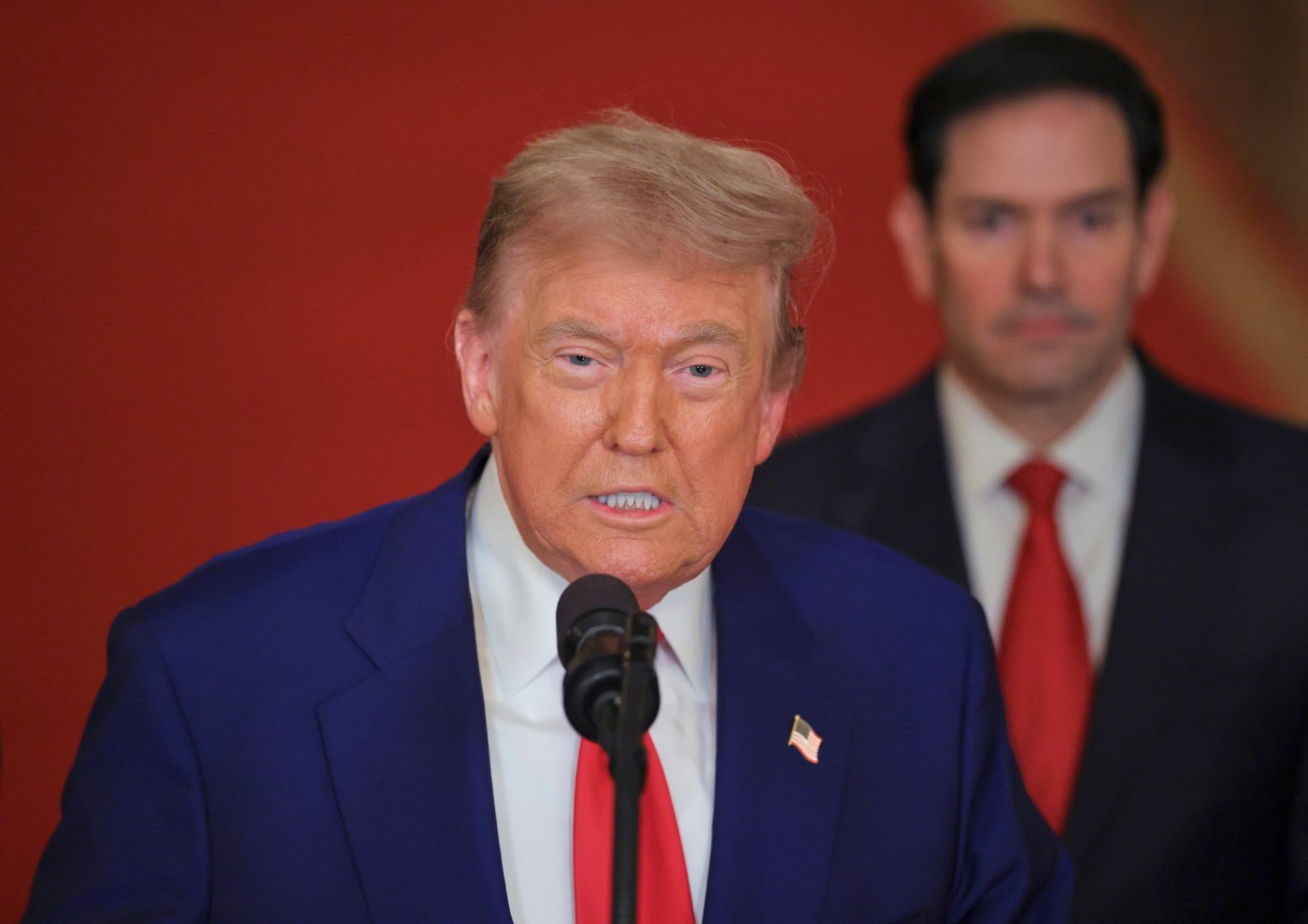
Khalil was the first arrest under President Donald Trump ’s crackdown on students who joined campus protests against Israel’s devastating war in Gaza. U.S. Secretary of State Marco Rubio has said Khalil must be expelled from the country because his continued presence could harm American foreign policy.

Farbiarz had ruled earlier that the government can’t continue to hold Khalil on those grounds, but the government argued the legal U.S. resident was instead being held based on allegations that he lied on his green card application. Khalil disputes the accusations that he wasn’t forthcoming on the application.

Khalil, a legal U.S. resident, was detained on March 8 at his apartment building in Manhattan over his participation in pro-Palestinian demonstrations. His lawyers say the Trump administration is simply trying to crack down on free speech.

Khalil isn’t accused of breaking any laws during the protests at Columbia. The international affairs graduate student served as a negotiator and spokesperson for student activists. He wasn’t among the demonstrators arrested, but his prominence in news coverage and willingness to speak publicly made him a target of critics.

The Trump administration has argued that noncitizens who participate in such demonstrations should be expelled from the country as it considers their views antisemitic.

How to stay cool in the heat wave hitting parts of the US — even without air conditioning

posted in: All news | 0

By CALEIGH WELLS and MELINA WALLING

The first big heat wave of 2025 has arrived, coinciding with the official start of summer.

More than 40 million people in the U.S. were under heat alerts Friday, according to the National Weather Service. Temperatures in the Midwest are expected to crest well into the 90s Fahrenheit (30s Celsius) this weekend. Triple-digit highs could pop up in New York, Philadelphia, Washington and Denver. The peak will likely hit the East Coast early next week.

Meanwhile, British health officials are also issuing heat warnings for the U.K.

Climate change has been exacerbating heat waves, and the problem isn’t going away any time soon. An increasingly hot planet — due largely to burning fossil fuels such as coal, oil and natural gas — means already hot regions are getting worse.

Heat doesn’t just mean canceled events. It also poses a health risk, especially for children, older people and those with certain health conditions.

So here are some tips to stay safe.

When does heat become dangerous?

The answer depends on more than the temperature. The most detailed measurement is called the wet bulb globe temperature (WBGT), which includes temperature, humidity, cloud cover and wind. The heat index, which measures temperature and humidity, is less descriptive but easier to find on weather apps. Both explain why a shaded soccer field on a 90 degree F day (32 degree C) in arid Phoenix may be less risky than an exposed park on an 80 degree F (27 degree C) day in soupy Little Rock.

Just based on heat index, NOAA has a chart that calculates how dangerous prolonged exposure can be. For example, a day where temperatures reach 96 degree F (36 degrees C) and 45% humidity would fall into the “danger” category for prolonged exposure or strenuous activity.

The WBGT threshold isn’t exact, but recent research suggests that even some young, healthy people can’t endure hours of exposure to high heat and humidity.

How to cool down

Overnight lows can be a particularly dangerous part of a heat wave, said Ashley Ward, director of the Heat Policy Innovation Hub at Duke University.

“Your body needs a reprieve,” she said. “You don’t get that overnight, we start the next day at a deficit.” Heat can worsen labor productivity and lead to more visits to the emergency room.

“When we have overnight temperatures that don’t drop below 75 degrees” F (24 degrees C), she said, “You start to see some pretty extraordinary outcomes with respect to heat illness and heat stroke, and even mortality.”

Related Articles


More employers adopting ICHRAs, giving workers money to buy their own health insurance


NFL widows struggled to care for ex-players with CTE. They say a new study minimizes their pain


Natural disasters may be shaping babies’ brains


New CDC advisers will skip some expected topics and explore a target of antivaccine activists


The world’s only twice-a-year shot to prevent HIV could stop transmission — if people can get it

Ward’s answer: Find air conditioning. That might be at home, but she said census data overcounts how many people have access.

If you can’t afford to cool the whole house, Ward said, create a “cool corner” and sleep there, so your body is prepared to tackle the next day.

Evaporative or “swamp” coolers can help in dry heat, but they increase humidity and can make it more difficult to cool down. In humid places, just use a fan.

If you don’t have air conditioning, find public places that do, including movie theaters, malls and libraries. Some communities set up cooling centers.

Depending on where you live, the Low-Income Home Energy Assistance Program can help you buy a window air conditioning unit, according to the National Council on Aging. Some local nonprofits and civic organizations can also help you access one if cost is a burden.

Know your rights if you work outside

Knowing what workplace protections you have is important. But there are no federal heat rules to protect workers in the United States.

Some states have them, including Washington, Oregon, California, Nevada, Colorado, Minnesota and Maryland, according to the National Resources Defense Council. Other states don’t have any.

If your state has work rules, try to learn them — though there are still challenges to ensuring regulations are actually enforced, said Bharat Venkat, director of the University of California, Los Angeles Heat Lab.

He notes that sometimes shaded areas are too far for workers to take breaks without losing wages, or that management can make it impossible for workers to advocate for themselves. “Most workers don’t actually have control over their time or control over where they work,” he said.

Within those constraints, finding ways to stay hydrated and lower your body temperature are paramount. You can do this by drinking lots of fluids, wetting clothing or putting cold water or a cold rag on your hands, feet, armpits and neck. A portable handheld fan or a cooling vest can also help.

If you’re exercising, avoid the hottest times of day and bring more water than you think you need.

Knowing heat illness symptoms

Heat illness symptoms can vary by person, Venkat said. Medications or underlying conditions can also make it harder to regulate body temperature or notice you’re getting too hot.

Early trouble signs include heavy sweating, muscle cramps and headache. That’s when you stop what you’re doing and cool yourself off — for example, by splashing yourself with cold water or finding an air conditioned space.

As heat exhaustion sets in, new symptoms arrive, including faster heart rate and dizziness. Next comes heat stroke, which can include confusion, slurred words and fainting. Ward said that’s when to call 911.

“Don’t be embarrassed to call 911 or go to urgent care when you think you might have overdone it in the heat,” he said.

Walling reported from Chicago. Wells reported from Cleveland.

Related Articles


More employers adopting ICHRAs, giving workers money to buy their own health insurance


NFL widows struggled to care for ex-players with CTE. They say a new study minimizes their pain


Natural disasters may be shaping babies’ brains


New CDC advisers will skip some expected topics and explore a target of antivaccine activists


The world’s only twice-a-year shot to prevent HIV could stop transmission — if people can get it

Opinion: A Safer, More Affordable NYC Starts With Investing in Afterschool Care

posted in: All news | 0

“Investing in quality afterschool services now is not only fundamental to supporting the next generation of New Yorkers. It is critical to building a stronger economy, enabling more parents—particularly mothers—to participate fully in the workforce.”

Students at an afterschool program on Staten Island in 2023. (Michael Appleton/Mayoral Photography Office)

New York City is at a critical juncture. As we look toward a pivotal mayoral election, city leaders have a profound opportunity to build better, safer and more affordable communities across the five boroughs. 

One of our best tools to shape the future of our city is investing in accessible, affordable high-quality afterschool services. These programs are critical to both supporting the healthy development of young people and ensuring families can participate in the job market. In New York City, however, many afterschool programs are out of reach for families, operating with limited capacity, long waitlists, and inconsistent quality. Today, 80 percent of families can’t afford afterschool services, according to an analysis by the Citizens’ Committee for Children of New York.

Programs like New York City’s Comprehensive Afterschool System (COMPASS) for students through fifth grade and School’s Out New York City (SONYC) for sixth-through-eighth grade students are particularly scarce and unevenly distributed. This has led to countless school-aged children being unsupervised and at risk after school from 3 p.m. to 6 p.m.

Thankfully, Mayor Eric Adams recently announced a $331 million commitment to create a total of 20,000 new afterschool slots by Fiscal Year 2028 as part of his vision to build an afterschool system that is accessible to all.

The investment is a critical step in the right direction and presents a once-in-a-generation opportunity to build a truly universal afterschool system—one that will help prevent learning loss, reduce community violence and crime and enable families to continue to work and put food on the table. We commend the administration for having such a forward-looking policy that can help make a universal afterschool system finally a reality. 

Unfortunately, the proposed investments overlook one key piece of the puzzle. Afterschool programs are experiencing a staffing crisis. At a time when demand for afterschool programs from families is high, there is not enough capacity to care for children because of a lack of funding from the city. Across the city, providers are forced to operate in the red just to meet the needs of their communities. As a result, children and youth suffer.

Advocates have called for higher reimbursement rates for years, but the mayor’s proposal unfortunately does not address the issue of insufficient rates until 2027. That is too late. Children, youth and families are in desperate need of quality services now. To cover the true costs of operating the critical afterschool programs New York’s families rely on, New York City must increase rates for COMPASS and SONYC in the Fiscal Year 2026 budget.

In this moment when the mayor has rightly focused on making New York City more affordable, it’s critical that the administration focus on the urgent investments needed to sustain one of the basic supports the city provides working families. Increasing the base rates of afterschool programs would help ensure that we are building and expanding capacity upon a stable foundation. 

Investing in quality afterschool services now is not only fundamental to supporting the next generation of New Yorkers. It is critical to building a stronger economy, enabling more parents—particularly mothers—to participate fully in the workforce. 

Regardless of the outcome of the mayoral election, a clear vision for how to move the city toward a universal afterschool system requires investments now to ensure stable and sustainable growth. Let’s not miss this opportunity to build a quality system that meets the needs of children, youth and working families.

Our city’s future depends on it.

Raysa S. Rodriguez is the executive director of Citizens’ Committee for Children of New York.* Ben Thomases is the executive director of Queens Community House.

*Citizens’ Committee for Children is among City Limits’ funders.

The post Opinion: A Safer, More Affordable NYC Starts With Investing in Afterschool Care appeared first on City Limits.

Billions of login credentials have been leaked online, Cybernews researchers say

posted in: All news | 0

NEW YORK (AP) — Researchers at cybersecurity outlet Cybernews say that billions of login credentials have been leaked and compiled into datasets online, giving criminals “unprecedented access” to accounts consumers use each day.

According to a report published this week, Cybernews researchers have recently discovered 30 exposed datasets that each contain a vast amount of login information — amounting to a total of 16 billion compromised credentials. That includes user passwords for a range of popular platforms including Google, Facebook and Apple.

Related Articles


Minnesota adds a net 6,600 jobs in May, unemployment rate at 3.3%


Aflac finds suspicious activity on US network that may impact Social Security numbers, other data


More employers adopting ICHRAs, giving workers money to buy their own health insurance


What is a HENRY and are you one?


US stocks drift in a quiet return from the Juneteenth holiday

Sixteen billion is roughly double the amount of people on Earth today, signaling that impacted consumers may have had credentials for more than one account leaked. Cybernews notes that there are most certainly duplicates in the data and so “it’s impossible to tell how many people or accounts were actually exposed.”

It’s also important to note that the leaked login information doesn’t span from a single source, such as one breach targeting a company. Instead, it appears that the data was stolen through multiple events over time, and then compiled and briefly exposed publicly, which is when Cybernews reports that its researchers discovered it.

Various infostealers are most likely the culprit, Cybernews noted. Infostealers are a form of malicious software that breaches a victim’s device or systems to take sensitive information.

Many questions remain about these leaked credentials, including whose hands the login credentials are in now. But, as data breaches become more and more common in today’s world, experts continue to stress the importance of maintaining key “cyber hygiene.”

If you’re worried about your account data potentially being exposed in a recent breach, the first thing you can do is change your password — and avoid using the same or similar login credentials on multiple sites. If you find it too hard to memorize all your different passwords, consider a password manager or passkey. And also add multifactor authentication, which can serve as a second layer of verification through your phone, email or USB authenticator key.