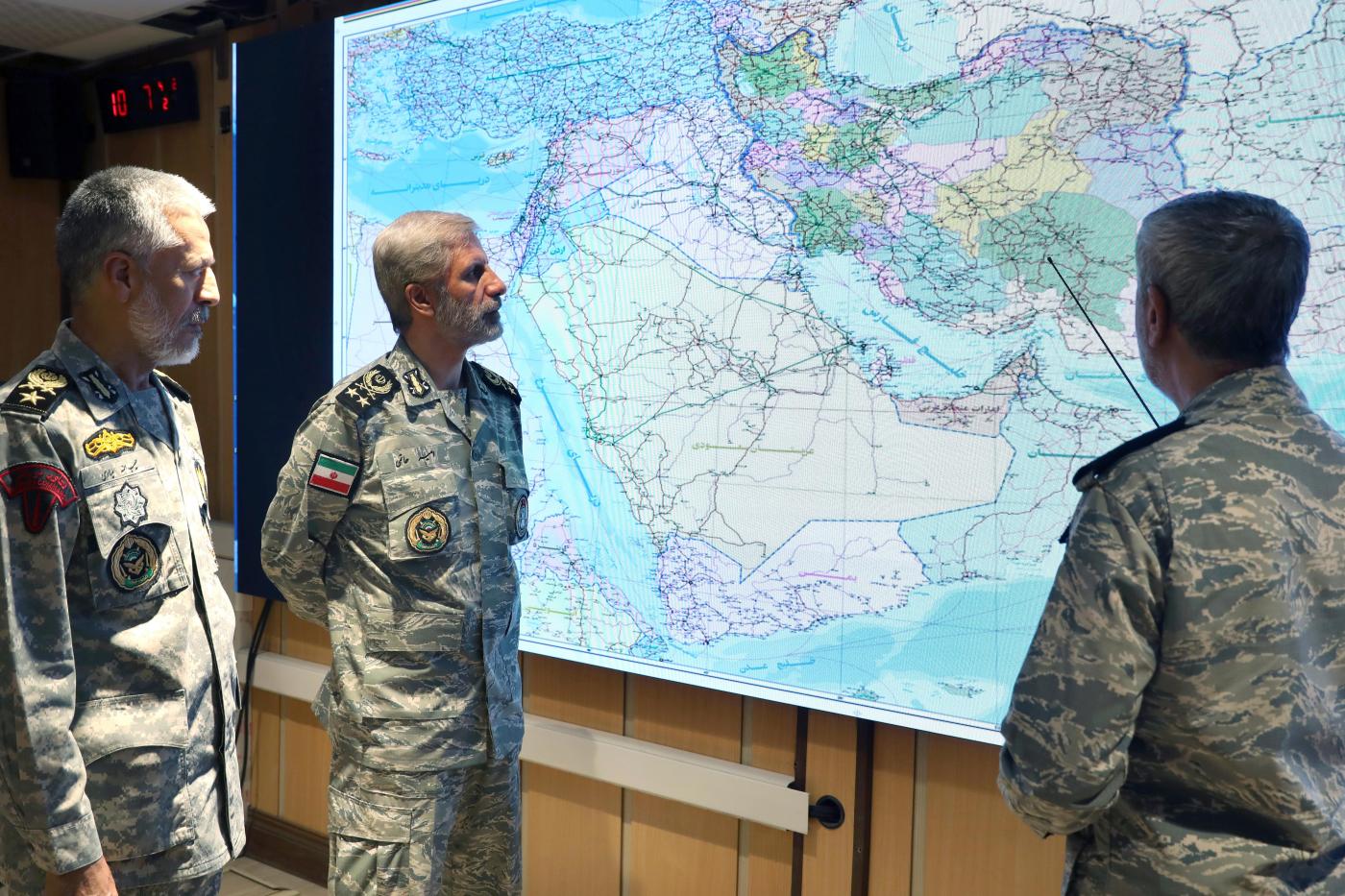
There are so many things to say in the wake of the U.S. bombing of three key Iranian nuclear facilities that it is easy to get lost in the gripping details. So for now, let me try to step back and explore the global, regional and local forces shaping this story. What’s really going on here?
It is a very, very big drama, and it is not confined to the Middle East.
To my mind, Vladimir Putin’s invasion of Ukraine in 2022, with the sole aim of wiping its democracy off the map and absorbing it into Russia, and the attacks on Israel in 2023 by Hamas and Iran’s proxies in Lebanon, Yemen and Iraq were manifestations of a global struggle between the forces of inclusion and the forces of resistance.
That is a struggle between countries and leaders who see the world and their nations benefiting from more trade, more cooperation against global threats and more decent, if not democratic, governance — versus regimes whose leaders thrive on resisting those trends because conflict enables them to keep their people down, their armies strong and their thieving of their treasuries easy.
The forces of inclusion had steadily been growing stronger. Ukraine in 2022 was getting closer to joining the European Union. This would have been the biggest expansion of a whole and free Europe since the fall of the Berlin Wall in 1989, because it would have added to the West a huge agricultural, technological and military power and left Russia more isolated — and looking more out of step to its own people — than ever.
At the very same time, the Biden administration was making rapid headway on a deal for the United States to forge a security alliance with Saudi Arabia. In return, Saudi Arabia would normalize relations with Israel, and Israel would begin talks with the Palestinians on possible statehood. This would have been the biggest expansion of an integrated Middle East since the Camp David peace treaty between Egypt and Israel in 1979.
In short, Ukraine looked poised to join the West, and Israel looked poised to join the East.
So what happened? Putin invaded Ukraine to stop the first movement, and Hamas and Iran’s other proxies attacked Israel to stop the second.
As such, my first question in the aftermath of Sunday morning’s strike on Iran is: Does President Donald Trump understand whose side of this global struggle Putin is on? Iran and Russia are close allies for a reason. Iran has been providing Russia with the drones it has used to more effectively kill Ukrainian soldiers and civilians. I do not ask Trump to drop a bomb on Russia, but I do ask him to provide Ukraine with the military, economic and diplomatic support it needs to resist Russia — every bit as much as the United States is doing for Israel to defeat Hamas and Iran.
It is all the same war. Putin and the ayatollahs want the exact same kind of world. That is a world safe for autocracy, safe for theocracy, safe for their corruption; a world free from the winds of personal freedoms, the rule of law, a free press; and a world safe for both Russian and Iranian imperialism against independent-minded neighbors.
China has always had a foot in each camp. Its economy depends on a healthy and growing world of inclusion, but its political leadership has also maintained strong ties to the world of resistance. So Beijing plays in both leagues — buying oil from Iran but always worried that if Iran got a nuclear bomb, it might one day give a copy to Muslim separatists from Xinjiang.
That said, China’s oil purchases from Iran are a crucial part of this story. Those purchases are Tehran’s biggest source of external income, which has enabled it to finance Hamas, Hezbollah and (until recently) Syria. As my colleague Keith Bradsher reported from Shanghai, oil sales to China are today 6% of Iran’s economy and equal to about half of government spending.
Now let’s look at this struggle from a purely Middle East angle.
Here I happen to have a very personal perspective. By pure coincidence, I began my career as a cub foreign correspondent for UPI in Beirut in 1979.
Here are the four big stories that I covered that first year, on my manual typewriter:
— The Islamic Revolution in Iran toppling the shah.
— The takeover of the Grand Mosque in Mecca by puritanical jihadis trying to overthrow the Saudi ruling family.
— The signing of the Camp David peace treaty between Israel and Egypt.
— And, less well known but no less important, the opening of Jebel Ali Port in Dubai in the United Arab Emirates, which would become one of the largest in the world. It would emerge as the global hub that would connect the Arab East — through trade, tourism, services, shipping, investments and world-class airlines — with almost every corner of the planet. It opened a hugely significant door through which the globalization of the Arab world just took off.
And thus began a titanic regional struggle between the forces of inclusion and resistance in the Middle East. On one side were those states that were ready to accept Israel, provided that it made progress with the Palestinians, and that also sought to integrate the region more intimately with the West and the East. On the other side stood the forces of resistance led by Iran, the Muslim Brotherhood and various puritanical, jihadi Sunni movements that originally incubated in post-1979 Saudi Arabia and later spread their influence to mosques across the region.
They all sought to drive Western influences out of the area, Israel out of existence and the pro-American governments — like those of Jordan, Egypt and the Saudi ruling family — out of power.
The United States and Israel fought this war with their armies, while groups like al-Qaida and Islamic State did so with terrorist cells and Iran did so by slowly creating a network of proxy armies in Lebanon, Syria, Yemen and Iraq that enabled Iran to indirectly control all four countries — and to even gain a toehold in the West Bank and the Gaza Strip. Tehran never had to risk a single soldier; it let Syrians, Lebanese, Iraqis, Yemenis and Palestinians die for its interests. Yes, the problems in the Middle East were the product of not just Israeli occupation but also Iranian imperialism — among other things.
A couple of years ago, I quoted Nadim Koteich, a Lebanese Emirati political analyst and the general manager of Sky News Arabia, who said that Iran’s resistance network sought “to bridge militias, rejectionists, religious sects and sectarian leaders.” The goal was to create an anti-Israel, anti-American, anti-Western axis that could simultaneously pressure Israel in Gaza, in the West Bank and on the Lebanon border — as well as the United States in the Red Sea, in Syria and in Iraq and Saudi Arabia from all directions.
In contrast, Koteich added, the United States, its Arab allies and Israel sought to weave together and integrate global and regional markets — instead of battle fronts — that featured business conferences, news organizations, elites, investment funds, tech incubators and major trade routes. This inclusion network transcended traditional boundaries, “creating a web of economic and technological interdependence that has the potential to redefine power structures and create new paradigms of regional stability,” Koteich said.
Those who caution against regime change in Tehran often point to Iraq as a cautionary tale. But that analogy is flawed. America’s nation-building effort in Iraq failed for years largely (but not exclusively) because of Iran, not in spite of it. Tehran, with the help of its proxy in Syria, did everything it could to sabotage regime change in Iraq, knowing that if the United States was successful in creating a multisectarian, reasonably democratic, secular government in Baghdad, it would be a huge threat to Iran’s theocracy, just as a successful pro-Western Ukrainian democracy would be a huge threat to Putin’s kleptocracy.
By the way, no one knows that better than the new, frail, democratic government in Syria, which has been reluctant to condemn Israel’s bombing of Iran. That is a sign the Syrians know who kept their tyrant, Bashar Assad in power, all those years: Iran.
It’s a good bet that a lot of Sunnis and Shiites in Lebanon and Iraq are quietly rooting for Trump and Prime Minister Benjamin Netanyahu. Majorities in these countries, I believe, do not want to be part of the resistance. For the first time in decades, a Syrian state and a Lebanese state are being rebuilt by decent leaders — imperfectly, yes, but with far less foreign ideological manipulation. The absence of Iran’s malign influence is not a coincidence. It’s a prerequisite for that.
The other prerequisite was the emergence of Crown Prince Mohammed bin Salman of Saudi Arabia over the past eight years. His mission, though never stated in so many words, has been to reverse the puritanical trends that gripped Saudi Arabia and were exported, after the failed takeover by the jihadis there, as the Saudi ruling family sought to protect itself from a rerun by making Saudi Arabia, and the region, more religious.
Crown Prince Mohammed’s recasting of Saudi Arabia as the biggest engine for regional trade, investment and reform of Islam has been a vital addition to the integrationists in the Arab world. He is a flawed leader who has made some serious mistakes, not the least his government’s murder of journalist Jamal Khashoggi, but he is also reversing the Saudi fundamentalist turn of 1979 — which is huge.
I make no predictions of what would happen in Iran if the regime there fell. It could be chaos on top of chaos. It could also help free Iran’s people and its neighbors from Iranian-manufactured instability.
But that is not the only prerequisite for any kind of decent ending to this current drama. Now let’s go down one level deeper and focus just on Israel.
I am a big believer that two (and sometimes three) contradictory things can be true at the same time. And one of those dualities today is that Israel is a democracy with many people who want to be part of the world of inclusion. But it has a messianic government that is the most extreme in its history and openly aspires to annex the West Bank and possibly Gaza as well. That aspiration is a fundamental threat to American interests, Israel’s interests and the interests of Jews everywhere.
To paraphrase something my friend Nahum Barnea, an Israeli Yedioth Ahronoth columnist, said to me the other day: I will unapologetically resist Netanyahu’s annexationist agenda, his refusal to even consider a Palestinian state under secure conditions and his attempt to overthrow Israel’s Supreme Court, as if Israel were not at war with Iran. And I will unapologetically praise Netanyahu for taking on this terrible Iranian regime, as if Israel were not in the grip of its own Bibi-led Jewish supremacists who threaten a more inclusive Middle East in their own way. I will unapologetically praise Trump for efforts to shrink Iran’s nuclear-bomb-making capabilities, as if he were not engaged in a dangerous autocratic project at home. And I will resist with all my might Trump’s autocratic moves at home as if he were not taking on Iran’s autocracy abroad. All are true and need to be said.
If we want to see the forces of integration triumph in this region, what Trump has done militarily today is necessary, but it is not sufficient.
The real knockout blow to Iran and all the resisters — and the keystone that would make it easy as pie for Saudi Arabia, Lebanon, Syria and Iraq to normalize relations with Israel and consolidate the victory for the forces of inclusion — is for Trump to tell Netanyahu: “Get out of Gaza in return for a ceasefire from Hamas and the return of all Israeli hostages. Let an Arab peacekeeping force move in there, blessed by a reformed Palestinian Authority, and then begin what will have to be a long process of Palestinians building a credible governing structure in return for a halt to all Israeli settlement building in the West Bank. That would create the best conditions to birth a Palestinian state there.”
If Trump can combine shrinking Iran’s power with building toward a two-state solution — and aiding Ukraine to resist Russia as unabashedly as he is aiding Israel to resist Iran — he will make a real contribution to peace, security and inclusion in both Europe and the Middle East that would be historic.
Thomas Friedman writes a column for the New York Times.