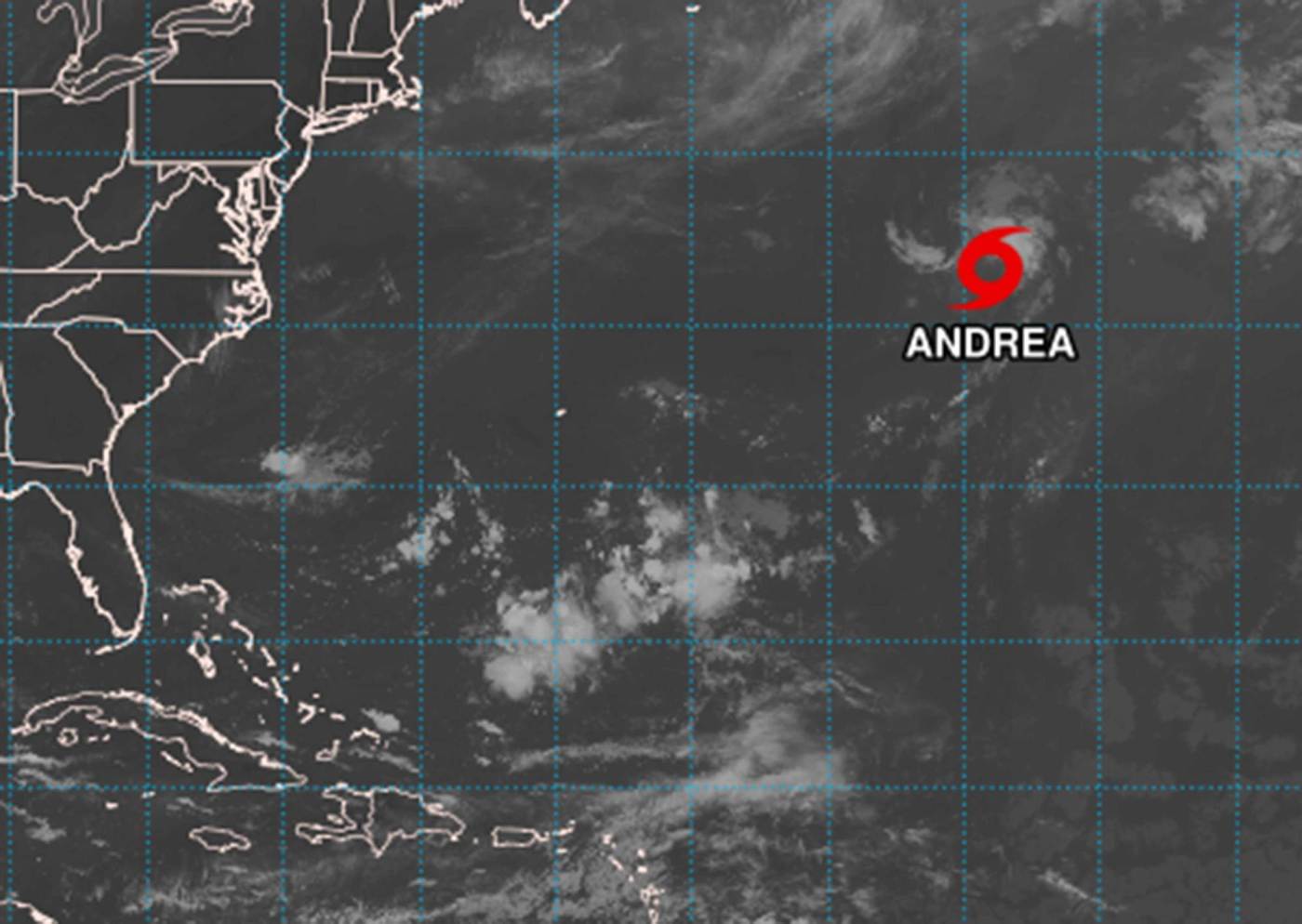
The 2025 Atlantic hurricane season got its first named storm of the year, even though the National Hurricane Center says it will be short-lived.
The NHC began advisories on Tropical Storm Andrea after 10 a.m. located about 1,205 miles west of the Azores moving east-northeast at 17 mph with sustained winds of 40 mph. Tropical-storm-force winds extend out 45 miles.
“Little change in strength is expected today. Weakening is expected to begin tonight, with Andrea dissipating by Wednesday night,” forecasters said.
The next advisory won’t be until 5 p.m. ET.
The system had looked like it would die out without formation as it moved east in the central subtropical Atlantic 900 miles east-northeast of Bermuda, but then the NHC said in a special 8:30 a.m. tropical outlook that the small gale-force low-pressure system was becoming more organized.
In most years, the Atlantic hurricane season has generated at least one storm by this time, more than three weeks into hurricane season. It’s the latest since 2014 that tropical activity hasn’t bred a tracked system. That year, the first tropical depression didn’t form until June 30.
Related Articles
Early-season heat dome brings highest temperatures in years to parts of Eastern US
Thousands still without power, cleanup continues after severe storms in northern Minnesota
Dangerous heat lingers, with highest temps moving from Midwest to East
Tornado sweeps through North Dakota town leaving at least 3 dead
How to stay cool in the heat wave hitting parts of the US — even without air conditioning
Between 2015 to 2024, though, the first tracked system had already formed by June 1, the first official day of hurricane season.
Despite the late start, the 2025 Atlantic hurricane season is predicted to be above-normal by the National Oceanic and Atmospheric Administration.
The agency predicts 13 to 19 named storms, of which 6-10 will become hurricanes. Three to five of those would grow into major hurricanes of Category 3 strength or higher.
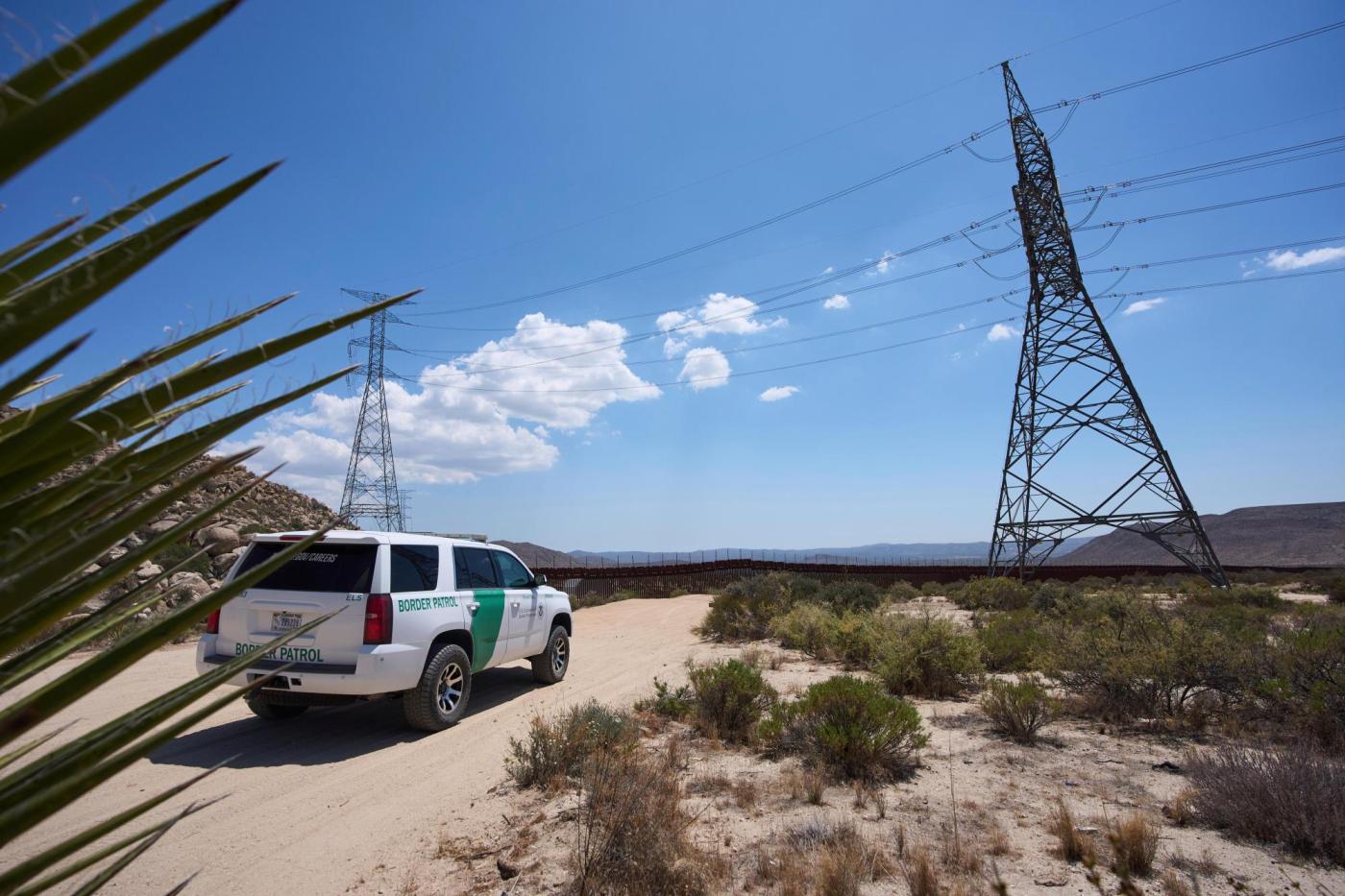
McALLEN, Texas (AP) — Immigration arrests seen on video are showing an emerging trend: More Border Patrol agents are doing their jobs far from the borders with Mexico or Canada.
A Border Patrol agent was seen hitting a Southern California landscaper on the head and neck as he was pinned to the ground during an arrest Saturday. The Department of Homeland Security said the man swung his weed trimmer at agents. The man’s son, Alejandro Barranco, a Marine veteran, said his father was scared but did not attack anyone.
With border arrests at the lowest levels in about 60 years, the roughly 20,000 Border Patrol agents are showing up elsewhere.
Here are things to know about the trend:
Why is the Border Patrol working away from the border?
President Donald Trump’s House-approved “big, beautiful bill” proposes $8 billion to increase U.S. Immigration and Customs Enforcement staff by 10,000 people. Until then, the agency primarily responsible for interior enforcement is relying on other federal agencies as it struggles to meet a daily arrest target of at least 3,000 set by Stephen Miller, White House deputy chief of staff and chief architect of immigration policy.
ICE, with only about 6,000 deportation officers, has found a ready partner in the Border Patrol, which is also part of the U.S. Department of Homeland Security. It comes at a time when border arrests plunged to an average of 282 a day in May after peaking at more than 8,000 a day in December 2023.
Related Articles
NTSB Chair says systemic failures led to door plug flying off Boeing 737 Max plane midflight
Justice Department official suggested ignoring court orders on deportations, whistleblower claims
What to know about Kilmar Abrego Garcia’s release and risk of deportation
As US cities heighten security, Iran’s history of reprisal points to murder-for-hire plots
Today in History: June 24, Sally Ride completes historic space shuttle mission
Agents in the Border Patrol’s Yuma, Arizona, sector assisted ICE officers last week in Philadelphia, Justin De La Torre, the sector chief, said in a social media post. His sector averaged only four arrests a day on the Arizona border last month after peaking at more than 1,100 a day in May 2023.
Greg Bovino, chief of the Border Patrol’s El Centro, California, sector, appeared alongside U.S. Homeland Security Secretary Kristi Noem at a news conference this month in Los Angeles during which U.S. Sen. Alex Padilla was forcefully removed, pushed to the ground and handcuffed.
“We’re here and not going away,” Bovino said, introducing himself to reporters as his agency’s top representative during ICE-led operations in Los Angeles.
Few see any reason to doubt the Border Patrol will remain.
“So long as the border remains relatively quiet, we will continue to see the Border Patrol deployed to act almost as if they are ICE agents,” said Aaron Reichlin-Melnick, senior fellow at the American Immigration Council, an advocacy group.
What is the 100-mile border zone?
Agents are granted by federal law the ability to stop and question people within 100 miles (161 kilometers) of the border, including the coasts. They have heightened authority to board and search buses, trains and vessels without a warrant within the zone.
That encompasses vast swaths of the country that include about two-thirds of the U.S. population, according to the American Civil Liberties Union. Los Angeles is well within 100 miles of the Pacific Ocean.
Beyond that zone, agents are still authorized to work within the United States.
“The Border Patrol can still operate fully in the interior. It’s just that they have less authority to stop and question people,” said Reichlin-Melnick.
What can the Border Patrol do beyond the 100 miles?
Past the 100-mile enforcement zone, Border Patrol agents, like officers working for ICE or the U.S. Customs and Border Protection Office of Field Operations, are classified as immigration officers who are authorized to carry out arrests and detain people on suspicion of violating immigration law. There are some limits.
“They could only search somebody’s car on probable cause that the person has violated the law,” Reichlin-Melnick said. “And so people have somewhat heightened rights against search and seizure outside of the 100-mile zone than they do inside of the 100-mile zone. But each individual case will vary depending on the specific circumstances.”
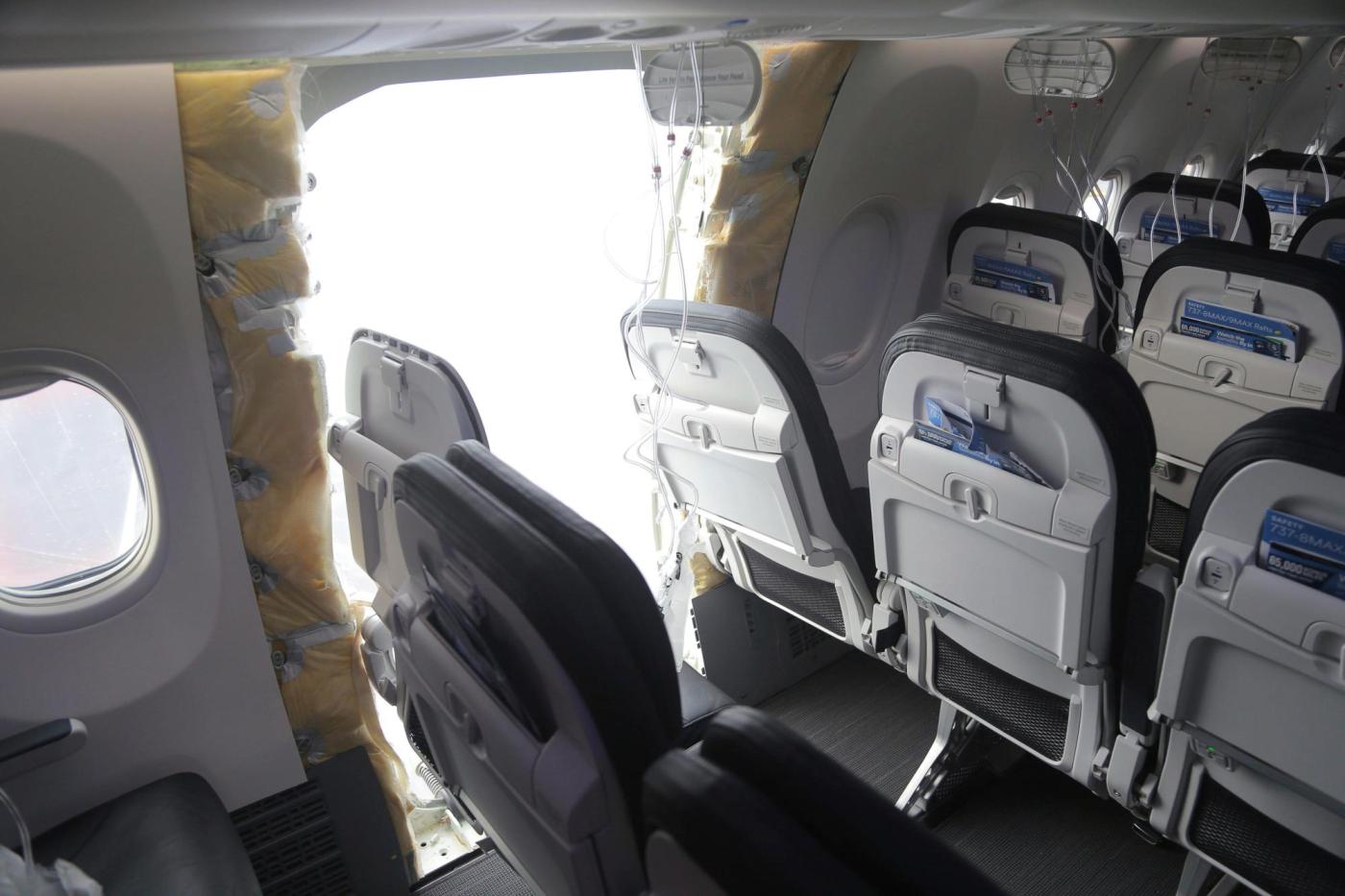
National Transportation Safety Board Chair Jennifer Homendy said Tuesday that the heroic actions of the crew aboard Alaska Airlines flight 1282 ensured everyone survived the terrifying incident last year when the door plug panel flew off the plane shortly after takeoff in January of 2024.
But Homendy said “the crew shouldn’t have had to be heroes, because this accident never should have happened” if Boeing and the Federal Aviation Administration had done enough to ensure the safety of the Boeing 737 Max plane.
She said the investigation over the past 17 months found bigger problems than just the revelation that bolts securing what is known as the door plug panel were removed and never replaced during a repair because “an accident like this only happens when there are multiple system failures.”
Homendy said Boeing’s new CEO, Kelly Ortberg, has made many improvements in safety since he took the job last summer but more needs to be done. The board is expected to approve several recommendations at Tuesday’s meeting to keep something similar from happening again.
The blow out aboard Alaska Airlines flight 1282 occurred minutes after it took off from Portland, Oregon, and created a roaring air vacuum that sucked objects out of the cabin and scattered them on the ground below along with debris from the fuselage. Seven passengers and one flight attended received minor injuries, but no one was killed. Pilots were able to land the plane safely back at the airport.
Oxygen masks dropped and phones went flying
The accident occurred as the plane flew at 16,000 feet (4,800 meters). Oxygen masks dropped during the rapid decompression and a few cellphones and other objects were swept through the hole in the plane as 171 passengers contended with wind and roaring noise.
The first six minutes of the flight to Southern California’s Ontario International Airport were routine. The Boeing 737 Max 9 was about halfway to its cruising altitude and traveling at more than 400 mph (640 kph) when passengers described a loud “boom” and wind so strong it ripped the shirt off someone’s back.
“We knew something was wrong,” Kelly Bartlett told The Associated Press in the days following the flight. “We didn’t know what. We didn’t know how serious. We didn’t know if it meant we were going to crash.”
The 2-foot-by-4-foot (61-centimeter-by-122-centimeter) piece of fuselage covering an unoperational emergency exit behind the left wing had blown out. Only seven seats on the flight were unoccupied, including the two seats closest to the opening.
Missing bolts put the focus on Boeing’s manufacturing
The panel that blew off was made and installed by a supplier, Spirit AeroSystems. It was removed at a Boeing factory so workers could repair damaged rivets, but bolts that help secure the door plug were not replaced. It’s not clear who removed the panel.
The NTSB said in a preliminary report that four bolts were not replaced after a repair job in a Boeing factory, but the company has said the work was not documented.
Related Articles
U.S. Border Patrol is increasingly seen far from the border as Trump ramps up deportation arrests
Justice Department official suggested ignoring court orders on deportations, whistleblower claims
What to know about Kilmar Abrego Garcia’s release and risk of deportation
As US cities heighten security, Iran’s history of reprisal points to murder-for-hire plots
Today in History: June 24, Sally Ride completes historic space shuttle mission
Investigators determined the door plug was gradually moving upward over the 154 flights prior to this incident before it ultimately flew off.
Boeing factory workers told NTSB investigators they felt pressured to work too fast and were asked to perform jobs they weren’t qualified for, including opening and closing the door plug on the particular plane involved. Only one of the 24 people on the door team had ever removed one of these plugs before and that person was on vacation when it was done on the plane.
A Boeing door installer said he was never told to take any shortcuts, but everyone faced pressure to keep the assembly line moving.
“That’s how mistakes are made. People try to work too fast,” he told investigators. The installer and other workers were not named in documents about the probe.
Investigators said Boeing did not do enough to train newer workers who didn’t have a background in manufacturing. Many of its workers who were hired after the pandemic and after two crashes involving the 737 Max planes lacked that experience.
But the NTSB staff also told the board Boeing didn’t have strong enough safety practices in place to ensure the door plug was properly reinstalled, and the FAA inspection system did not do a good job of catching systemic failures in manufacturing.
Investigators determined those crashes were caused by a system that relied on a sensor providing faulty readings to push the nose down, leaving pilots unable to regain control. After the second crash, Max jets were grounded worldwide until the company redesigned the system.
Last month, the Justice Department reached a deal allowing Boeing to avoid criminal prosecution for allegedly misleading U.S. regulators about the Max before the two crashes.
Boeing hired Ortberg last year and created a new position for a senior vice president of quality to help improve its manufacturing.
The company was back in the news earlier this month when a 787 flown by Air India crashed shortly after takeoff and killed at least 270 people. Investigators have not determined what caused that crash, but so far they have not found any flaws with the model, which has a strong safety record.
Associated Press writer Claire Rush in Portland, Oregon, contributed to this report.
WASHINGTON (AP) — President Donald Trump on Tuesday injected some uncertainty over whether the U.S. would abide by the mutual defense guarantees outlined in the NATO treaty as he headed to its summit — comments that could revive longstanding concern from European allies about his commitment to the military alliance.
“Depends on your definition,” Trump told reporters on Tuesday as he was headed to The Hague, where this year’s summit is being held. “There’s numerous definitions of Article Five, you know that, right? But I’m committed to being their friends.” Asked later to clarify, Trump said he is “committed to saving lives” and “committed to life and safety” but did not expand further, saying he didn’t want to elaborate while flying on an airplane.
The remarks, which came to reporters on Air Force One as Trump traveled to the Netherlands, previewed what could be another volatile appearance by Trump at a summit celebrating an alliance that the Republican president has often derided.
And it comes amid a backdrop of tumult in the Middle East, after Trump moved to strike three nuclear enrichment facilities in Iran as well as the president’s sudden announcement that Israel and Iran had reached a “complete and total ceasefire.” The sharp U-turn in hostilities — followed hours later by Trump’s declaration that both parties violated the agreement — had already started to shape the summit, with NATO Secretary-General Mark Rutte publicly dancing around the issue even as hundreds of people showed up in The Hague on Sunday to denounce the conflict in a protest that was initially focused on defense spending.
Still, other NATO countries have become accustomed to the unpredictable when it comes to Trump, who has made no secret of his disdain for the alliance, which was created as a bulwark against threats from the former Soviet Union.
Trump’s debut on the NATO stage at the 2017 summit was perhaps most remembered by his shove of Dusko Markovic, the prime minister of Montenegro, as the U.S. president jostled toward the front of the pack of world leaders during a NATO headquarters tour.
And he began the 2018 summit by questioning the value of the decades-old military alliance and accusing its members of not contributing enough money for their defense — themes he has echoed since. In Brussels, Trump floated a 4% target of defense spending as a percentage of a country’s gross domestic product, a figure that seemed unthinkably high at the time.
“NATO was broke, and I said, ‘You’re going to have to pay,’” Trump said Tuesday, recounting his initial encounters with the alliance. “And we did a whole thing, and now they’re paying a lot. Then I said, ‘You’re going to have to lift it to 4% or 5%, and 5% is better.’”
That 5% figure is “good,” Trump said, adding: “It gives them much more power.”
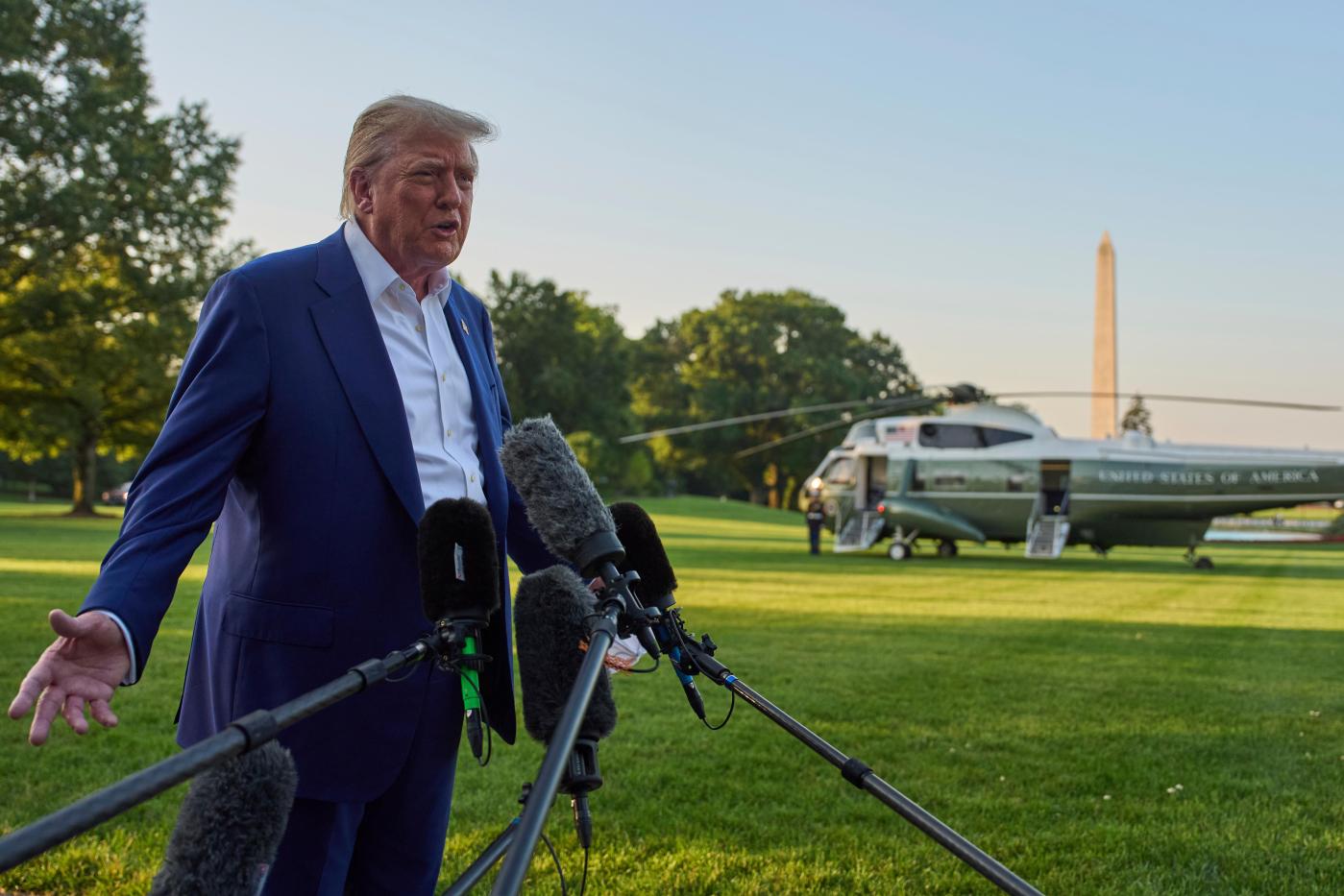
President Donald Trump speaks with reporters before boarding Marine One on the South Lawn of the White House, Tuesday, June 24, 2025, in Washington. (AP Photo/Evan Vucci)
President Donald Trump boards Marine One on the South Lawn of the White House, Tuesday, June 24, 2025, on his way to The Hague, to join world leaders gathering in the Netherlands for a two-day NATO summit. (AP Photo/Evan Vucci)
Marine One, with President Donald Trump aboard, lifts off the South Lawn of the White House, Tuesday, June 24, 2025. Trump is on his way to The Hague, to join world leaders gathering in the Netherlands for a two-day NATO summit. The Washington Monument stands right. (AP Photo/Evan Vucci)
President Donald Trump boards Air Force One, Tuesday, June 24, 2025, at Joint Base Andrews, Md., on his way to The Hague, to join world leaders gathering in the Netherlands for a two-day NATO summit. (AP Photo/Manuel Balce Ceneta)
1 of 4
President Donald Trump speaks with reporters before boarding Marine One on the South Lawn of the White House, Tuesday, June 24, 2025, in Washington. (AP Photo/Evan Vucci)
Sen. Jeanne Shaheen of New Hampshire, the top Democrat on the Senate Foreign Relations Committee, will also attend the NATO summit this week. She said if Trump does anything to sow division within the alliance, it would benefit Xi Jinping of China, which NATO countries have accused of enabling Russia as it invades Ukraine.
“That does not help America, does not help our national security,” Shaheen said in an interview. “What it does is hand a victory to our adversaries, and for an administration that claims to be so concerned about the threat from (China), to behave in that way is hard to understand.”
Trump heavily telegraphed his attitude toward global alliances during his presidential campaigns.
As a candidate in 2016, Trump suggested that he as president would not necessarily heed the alliance’s mutual defense guarantees outlined in Article 5 of the NATO treaty. And during a campaign rally in 2024, Trump recounted a conversation with another NATO leader during which Trump said he would “encourage” Russia “to do whatever the hell they want” to members who weren’t meeting the alliance’s military spending targets.
In The Hague, Trump will tout the pledge to hike military spending, which requires other NATO countries to invest in their defense at an unprecedented scale. In a private message from Rutte that Trump posted on his Truth Social account on Tuesday, the secretary-general praised him for driving NATO “to a really, really important moment for America and Europe, and the world.”
“You will achieve something NO American president in decades could get done,” Rutte wrote in the message that Trump published, which NATO confirmed he sent. “Europe is going to pay in a BIG way, as they should, and it will be your win.”
Last week, the president went as far as to argue that the U.S. should not have to abide by the 5% spending pledge he wants imposed on the other NATO countries, although he appeared to soften those comments on Tuesday.
Related Articles
Justice Department official suggested ignoring court orders on deportations, whistleblower claims
Presidents vs. Congress: Trump is only the latest to test the War Powers Act
Truckers fear job loss as new English language rules take effect
Powell says Fed can wait to reduce interest rates as Trump demands cuts
Trump says Israel-Iran ceasefire ‘is in effect’ and Israeli planes won’t attack anymore
That 5% is effectively divided into two parts. The first, 3.5%, is meant to be made up of traditional military spending such as tanks, warplanes and air defense. What can comprise the remaining 1.5% is a bit fuzzier, but it can include things like roads and bridges that troops could use to travel. According to NATO, the U.S. was spending about 3.4% of its gross domestic product on defense as of 2024.
Most NATO countries — with Spain as the key holdout — are preparing to endorse the pledge, motivated not just by Russian President Vladimir Putin’s invasion of Ukraine to bolster their own defenses but also perhaps appease the United States and its tempestuous leader.
“He hasn’t said this in a while, but there are still a lot of worries in Europe that maybe the United States will pull out of NATO, maybe the United States won’t honor Article 5,” said Matthew Kroenig, vice president and senior director of the Atlantic Council’s Scowcroft Center for Strategy and Security and a former Pentagon official. “I think there is a real fear among Europeans that we need to deliver for Trump in order to keep the United States engaged in NATO.”
Kroenig added: “Like it or not, I do think Trump’s tougher style does get more results.”
European allies have taken note of potential signs of a broader U.S. retreat. France and other NATO countries have been concerned that the Trump administration is considering reducing troop levels in Europe and shift them over to the Indo-Pacific, which Cabinet officials have signaled is a higher priority.
Still, Secretary of State Marco Rubio and U.S. Ambassador to NATO Matt Whitaker have underscored the U.S.’ commitment and have said the Trump administration is only seeking a stronger alliance.
The White House has not said which world leaders Trump will meet with at the World Forum in The Hague. Trump said Tuesday that he’ll “probably” see Ukrainian President Volodymyr Zelenskyy. The two leaders were scheduled to meet at the Group of 7 summit in Kananaskis, Alberta, earlier this month before Trump abruptly cut his trip short and returned to Washington as the Israel-Iran conflict was intensifying.
But Trump does get quite the royal treatment this week: He plans to stay Tuesday night at Huis Ten Bosch palace, home to Dutch King Willem-Alexander.
Associated Press writers Mike Corder and Lorne Cook in The Hague, Netherlands, and Darlene Superville in Washington contributed to this report.