By WILL GRAVES, AP National Writer
CORTINA D’AMPEZZO, Italy (AP) — Soaring arias. Wrenching tragedy. Joyful triumphs. Exotic backdrops. Climaxes often designed to produce tears, sad or otherwise.
Perhaps more than anything, the operas that Italians began creating 400 years ago are designed to make you feel. To have the rest of the world melt away as you get lost in a story sung in a language you might not understand, but whose stakes are unmistakable.
No wonder the country that invented the art form where music and poetry merge, and these Winter Olympics seem to be such a perfect fit.
The quadrennial spectacle that began its stay in Northern Italy with a gala hosted by the International Olympic Committee at the iconic La Scala opera house in Milan spent its first full week reflecting the host country’s signature art form onto itself.
The magic the Games so often provide, no matter where they may go, seemingly a little bolder, a little louder, a little more deeply felt.
United States’ Lindsey Vonn is airlifted away after a crash during an alpine ski women’s downhill race, at the 2026 Winter Olympics, in Cortina d’Ampezzo, Italy, Sunday, Feb. 8, 2026. (AP Photo/Jacquelyn Martin)
Tearful exits
The initial gasp that gave way to eerie silence after American skiing star Lindsey Vonn’s right arm clipped a gate just 13 seconds into the women’s downhill on Sunday, leading to a spectacular and brutal crash that broke her left leg and ended her unlikely Olympic return at 41.
Crashes happen. It’s a part of the sport. The “only at the Games” flourish came afterward, when Vonn’s long, slow helicopter ride down the mountain to safety veered gently to the left, flying over the grandstand where the throngs who came out to watch her bid for history waved a tearful goodbye instead.
The tears for Vonn were borne out of concern and what might have been. The tears from IOC president Kirsty Coventry after telling Ukrainian skeleton racer Vladyslav Heraskevych he was disqualified for refusing to replace a helmet adorned with images of over 20 coaches and athletes who have died since Russia’s invasion began were of anguish and regret.
“No one, no one — especially me — is disagreeing with the messaging,” Coventry said. “The messaging is a powerful message.”
Ukrainian skeleton athlete Vladyslav Heraskevych holds his crash helmet as he stands outside the sliding center at the 2026 Winter Olympics, in Cortina d’Ampezzo, Italy, Thursday, Feb. 12, 2026. (AP Photo/Alessandra Tarantino)
One so compelling and so important to Heraskevych that the 27-year-old sacrificed his dreams of Olympic glory to make it. Even if the attention he received for his stand caught him off guard.
“I never expected it to be such a big scandal,” he said on Friday after an appeal hearing.
Four years into a war that drags on with an end still not quite in sight, Heraskevych’s stand dragged a conflict that in some areas of the world has retreated to the shadows and thrust it back into the international spotlight unique to the Games. His selfless decision elevated the discussion about his homeland to the public writ large in a way that no gold-medal-winning run ever could.
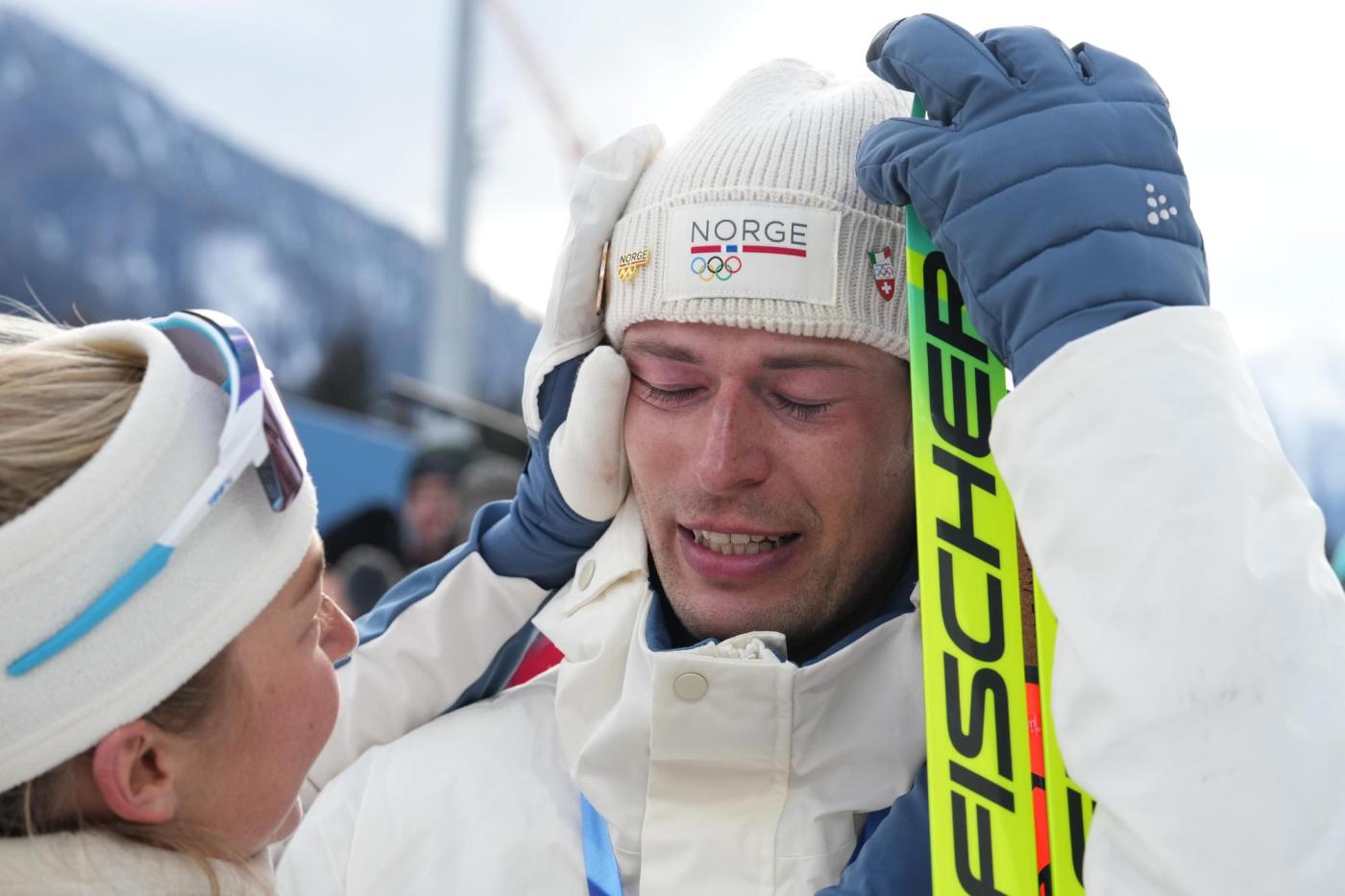
Heraskevych’s act was intended for a global audience. Norway’s Sturla Holm Laegreid was speaking to an audience of one after earning bronze in the men’s 20-kilometer race. His startling confession of infidelity to a former partner after what was supposed to serve as one of the highlights of his career upstaging the gold won in the same race by countryman Johan-Olav Botn.
Love both lost and won
Being lovesick in Italy is hardly new. There’s a reason seemingly every high school literature class makes “Romeo and Juliet” required reading. The Shakespearean tragedy is set in Verona, about 3 hours southwest of where Laegreid made his stunning plea, sounding very much like a teenager in the throes of heartache. His vow of contrition created a viral moment that passes for social currency, the fallout be damned.
“I can understand what he wants to have happen with his girlfriend,” retired German athlete Erik Lesser told The Associated Press. “But I just want to think about sport, want to see sport, want to talk about sport.”
Yet the Olympics have never really been just about sport. How can they be when the lines between sports, politics and culture seem to be growing more blurry by the day? The only thing perfect about the Games may be the five intertwined rings that have long served as its logo.
That’s what makes it so enthralling. A few days after Laegreid achieved a small piece of infamy, Olympic downhill champion Breezy Johnson retreated into the arms of boyfriend Connor Watkins after crashing in the Super-G.
While Johnson’s dreams of leaving Cortina with multiple golds were gone, another was realized anyway when Watkins dropped to a knee and recited Taylor Swift lyrics while producing a blue and white sapphire ring.
United States’ Breezy Johnson, right, and fiancee Connor Watkins smile at each other as they are interviewed after he proposed to her at the end of an alpine ski, women’s super-G race, at the 2026 Winter Olympics, in Cortina d’Ampezzo, Italy, Thursday, Feb. 12, 2026. (AP Photo/Jacquelyn Martin)
Johnson giddily accepted before jumping into his arms, the physical pain and emotional disappointment of what happened up on the mountain only minutes earlier replaced by a memory and a promise that will stick with her forever.
“I think most people want to peak at the Olympics,” Johnson said. “I just extra peaked.”
Ilia Malinin of the United States does a back flip while competing during the figure skating men’s team event at the 2026 Winter Olympics, in Milan, Italy, Sunday, Feb. 8, 2026. (AP Photo/Natacha Pisarenko)
Favorites upstaged
Not everyone does at a festival where unpredictability often outduels inevitability for top billing.
For every breakthrough like the one American figure skater Ilia Malinin is providing one electrifying backflip and quadruple jump at a time, there are bold-faced champions somewhat surprisingly ceding the stage they’ve so often commanded.
A fugitive on the run for years is arrested when he turns up at the Olympics to watch hockey
Norwegian biathlete wins another Olympic bronze medal, 3 days after confessing his infidelity
ISU defends Olympic ice dance scoring after French judge’s margin swings gold to French team over US
Norway’s Klaebo makes history on skis, ties all-time Winter Olympics gold record
Chloe Kim falls short of Olympic three-peat, but passes the torch to a protege from South Korea
Mikaela Shiffrin arrived in Cortina as the winningest ski racer in the history of the sport. Eager to put an 0 for 6 run four years ago in Beijing behind her, she instead began her fourth Olympics with her worst showing in a slalom that she started and finished since 2012, costing Shiffrin and Johnson a gold in women’s combined and opening the door for teammates Jackie Wiles and Paula Moltzan to claim the first Olympic medals of their long careers.
American snowboarding icon Chloe Kim’s bid for an unprecedented third gold in the halfpipe ended late Thursday when a teenager who grew up idolizing her — Gaon Choi of South Korea — pulled off an upset in snowy Livigno.
“I’m a winner because I was able to persevere and fight through,” said Kim, who competed just a month removed from a dislocated shoulder.
And perhaps more than anything at the Olympics, it’s the fight that matters.
For the thousands of athletes scattered across northern Italy, the road to this moment in their lives is rooted in a passion found long ago. The flames may have flickered for many along the way. How could they not? The drudgery of practice. The financial burden. The inevitable physical toll. The hidden mental strain has only recently graduated from hushed whispers to a full-fledged conversation.
It’s a lot to carry. No wonder it’s such fertile ground for drama.
Italy’s moment
And no one has leaned into it more than the hosts who have surged to the top of the medal table.
Yet a country known for big gestures and even bigger emotions is also one that can revel in the quiet and before the catharsis.
Ten months ago, Italian skier Federica Brignone shredded her left leg in a crash that required multiple surgeries, a handful of screws to keep things in place and months of rehab. The 35-year-old never stopped pointing toward Cortina. On Thursday, in front of a crowd that included Italian President Sergio Mattarella, Brignone ignored the lingering pain to throw down a sublime Super-G run in tricky conditions to earn her first Olympic gold.
After the medal ceremony, the Italian Air Force’s acrobatic unit thundered overhead, leaving a trail of the country’s familiar combination of green, white and red in its wake.
The slopes in Cortina shook. The flags waved. Brignone wept, thinking not so much of glory, but the winding path she took to get here.
“One of those films that you don’t believe in because it’s not possible for it to end that well,” Brignone said.
Maybe that’s the best part.
It’s not the end. We’re only halfway there. Who knows?
Milan Cortina’s second act could be even better than the first.
AP Sports Writers Andrew Dampf, Graham Dunbar, Dave Skretta, Tim Reynolds and AP National Writer Eddie Pells contributed to this report.
AP Winter Olympics: https://apnews.com/hub/milan-cortina-2026-winter-olympics