
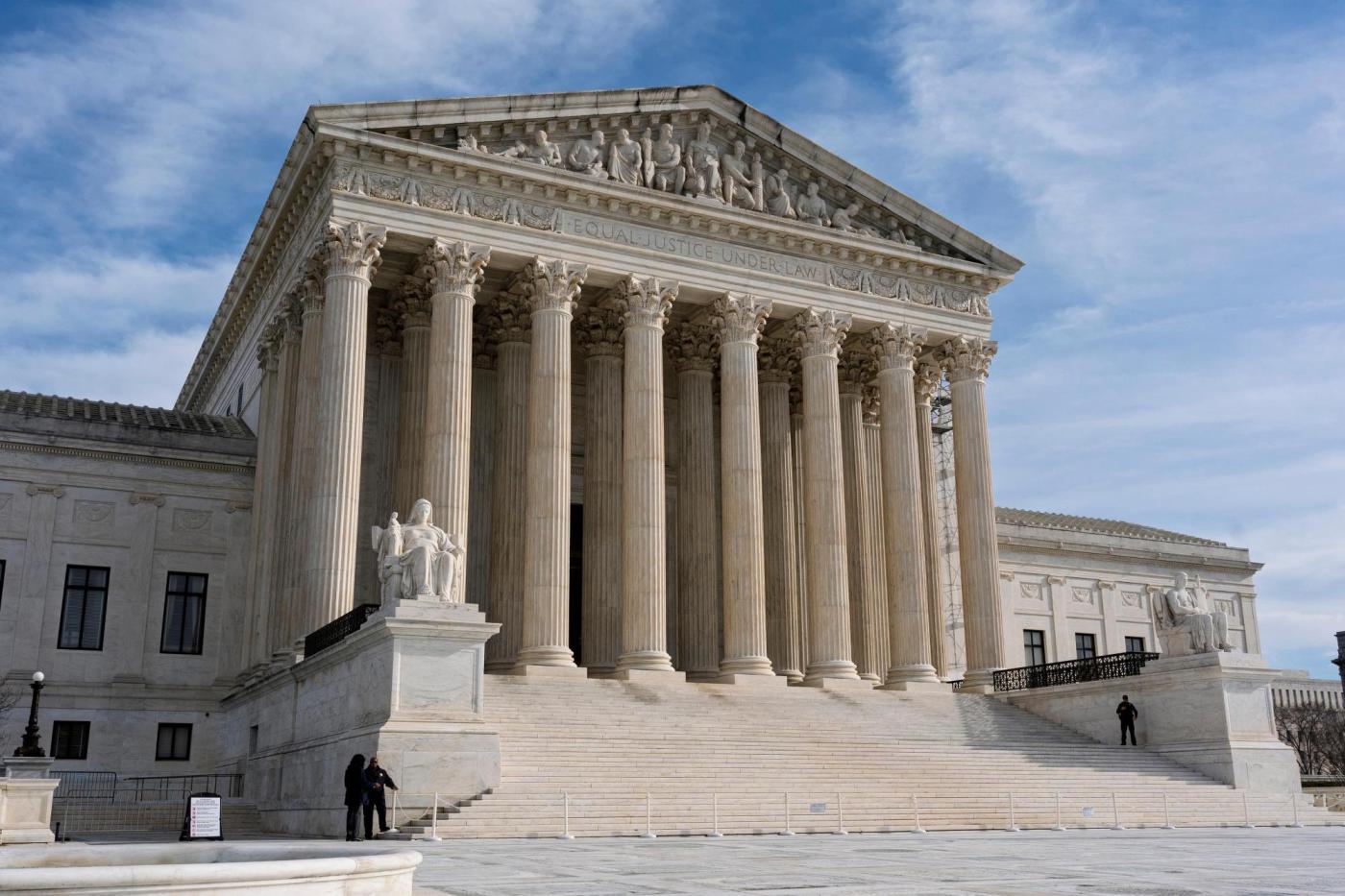
Supreme Court has 6 cases to decide, including birthright citizenship

posted in: All news | 0

By MARK SHERMAN and LINDSAY WHITEHURST

WASHINGTON (AP) — The Supreme Court is in the final days of a term that has lately been dominated by the Trump administration’s emergency appeals of lower court orders seeking to slow President Donald Trump’s efforts to remake the federal government.

But the justices also have six cases to resolve that were argued between January and mid-May. One of the argued cases was an emergency appeal, the administration’s bid to be allowed to enforce Trump’s executive order denying birthright citizenship to U.S.-born children of parents who are in the country illegally.

The remaining opinions will be delivered Friday, Chief Justice John Roberts said. On Thursday, a divided court allowed states to cut off Medicaid money to Planned Parenthood amid a wider Republican-backed push to defund the country’s biggest abortion provider.

Here are some of the biggest remaining cases:

Trump’s birthright citizenship order has been blocked by lower courts

The court rarely hears arguments over emergency appeals, but it took up the administration’s plea to narrow orders that have prevented the citizenship changes from taking effect anywhere in the U.S.

The issue before the justices is whether to limit the authority of judges to issue nationwide injunctions, which have plagued both Republican and Democratic administrations in the past 10 years.

These nationwide court orders have emerged as an important check on Trump’s efforts and a source of mounting frustration to the Republican president and his allies.

At arguments last month, the court seemed intent on keeping a block on the citizenship restrictions while still looking for a way to scale back nationwide court orders. It was not clear what such a decision might look like, but a majority of the court expressed concerns about what would happen if the administration were allowed, even temporarily, to deny citizenship to children born to parents who are in the country illegally.

Democratic-led states, immigrants and rights groups who sued over Trump’s executive order argued that it would upset the settled understanding of birthright citizenship that has existed for more than 125 years.

The court seems likely to side with Maryland parents in a religious rights case over LGBTQ storybooks in public schools

Parents in the Montgomery County school system, in suburban Washington, want to be able to pull their children out of lessons that use the storybooks, which the county added to the curriculum to better reflect the district’s diversity.

The school system at one point allowed parents to remove their children from those lessons, but then reversed course because it found the opt-out policy to be disruptive. Sex education is the only area of instruction with an opt-out provision in the county’s schools.

The school district introduced the storybooks in 2022, with such titles as “Prince and Knight” and “Uncle Bobby’s Wedding.”

The case is one of several religious rights cases at the court this term. The justices have repeatedly endorsed claims of religious discrimination in recent years. The decision also comes amid increases in recent years in books being banned from public school and public libraries.

A three-year battle over congressional districts in Louisiana is making its second trip to the Supreme Court

Lower courts have struck down two Louisiana congressional maps since 2022 and the justices are weighing whether to send state lawmakers back to the map-drawing board for a third time.

The case involves the interplay between race and politics in drawing political boundaries in front of a conservative-led court that has been skeptical of considerations of race in public life.

Related Articles


Families and businesses are concerned about the effect of tariffs on youth sports


States can cut off Medicaid funding to Planned Parenthood, the Supreme Court rules


Key Medicaid provision in Trump’s big tax cut and spending bill is found to violate Senate rules


US pulls funding from global vaccines group, saying it has ‘ignored the science’


Pentagon leaders double down on the destruction from US attacks on Iran

At arguments in March, several of the court’s conservative justices suggested they could vote to throw out the map and make it harder, if not impossible, to bring redistricting lawsuits under the Voting Rights Act.

Before the court now is a map that created a second Black majority congressional district among Louisiana’s six seats in the House of Representatives. The district elected a Black Democrat in 2024.

A three-judge court found that the state relied too heavily on race in drawing the district, rejecting Louisiana’s arguments that politics predominated, specifically the preservation of the seats of influential members of Congress, including Speaker Mike Johnson. The Supreme Court ordered the challenged map to be used last year while the case went on.

Lawmakers only drew that map after civil rights advocates won a court ruling that a map with one Black majority district likely violated the landmark voting rights law.

The justices are weighing a Texas law aimed at blocking kids from seeing online pornography

Texas is among more than a dozen states with age verification laws. The states argue the laws are necessary as smartphones have made access to online porn, including hardcore obscene material, almost instantaneous.

The question for the court is whether the measure infringes on the constitutional rights of adults as well. The Free Speech Coalition, an adult-entertainment industry trade group, agrees that children shouldn’t be seeing pornography. But it says the Texas law is written too broadly and wrongly affects adults by requiring them to submit personal identifying information online that is vulnerable to hacking or tracking.

The justices appeared open to upholding the law, though they also could return it to a lower court for additional work. Some justices worried the lower court hadn’t applied a strict enough legal standard in determining whether the Texas law and others like that could run afoul of the First Amendment.

Why Bringing Back Dr. Garry Conille as Haiti’s Transitional Leader Would Be a Mistake

posted in: All news | 0

By Emmanuel Roy, Founder of HDPAC

As Haiti teeters on the edge of collapse—gripped by gang violence, institutional breakdown,
and a desperate cry for bold, principled leadership—there is growing speculation in
Washington, D.C., about reinstating Dr. Garry Conille as head of a new transitional
government. That would be a monumental mistake.

Dr. Conille, who briefly served as Prime Minister from 2011 to 2012 under President Michel
Martelly, was again appointed interim Prime Minister in June 2024 with support from the
Haitian Diaspora. I was, in fact, the first person to urge Dr. Conille, back in 2022, to consider
returning to serve as Prime Minister—a decision I now deeply regret.

While his resume is polished and marked by global affiliations—including with the United
Nations and the Clinton Foundation—Dr. Conille is emblematic of the top-down, externally-
driven leadership that has repeatedly failed the Haitian people. Choosing him to head the
transitional government would not only reinforce that failed pattern but also alienate the
very grassroots support required for national renewal.

Dr. Conille’s first term lasted a mere four months, cut short by internal power struggles and
his inability to navigate or unify a fragmented political environment. That brief and
ineffective tenure mirrored the very dysfunction Haiti is desperate to move beyond. His
recent return in June 2024 has offered little reason for renewed confidence. Instead of
fostering consensus or asserting clear leadership, he spent the majority of his time in
combative standoffs with the Presidential Transitional Council (CPT). He surrounded
himself with advisors more interested in personal gain than national recovery, undermining
security and institutional reform efforts at a critical time.

Moreover, Dr. Conille lacks organic ties to the Haitian population. He is widely viewed as a
technocrat parachuted into leadership at the behest of international actors—out of touch
with the suffering, resilience, and hopes of the people. Haiti is in urgent need of leadership
born from struggle, not resume credentials; from lived experience, not elite conference
rooms.

This disconnect is particularly dangerous in a climate where foreign intervention is met
with suspicion, and transitional leaders are often viewed as pawns of international powers.
Conille’s deep and visible associations with global institutions only exacerbate public
mistrust and the perception of a government driven by external interests rather than
national sovereignty.

Haiti’s next transitional leader must be someone who can do more than issue statements.
They must forge broad alliances, confront entrenched criminal networks, bring political and
civil society factions to the table, and inspire a grassroots movement toward healing and
institutional legitimacy. Dr. Conille has never demonstrated the capacity to galvanize this
kind of movement or manage such complexity. He lacks the political base and moral
gravitas required to pull Haiti from the brink.

This is Haiti’s opportunity to start fresh—not by recycling ineffective leaders, but by
elevating a new generation rooted in credibility, justice, and national unity. The future
leader must be a bridge-builder—able to mobilize youth, engage the Diaspora, and stand
courageously against corruption and foreign manipulation. That is not Dr. Garry Conille.

Bringing him back as transitional president would signal a return to elite capture,
international dependence, and political inertia. Haiti needs more than administrative
experience—it needs moral authority, deep public trust, and transformative leadership.
The Haitian people deserve better. And this moment demands better.

More refunds are being sent to Fortnite players ‘tricked’ into unwanted purchases. How you can apply

posted in: All news | 0

By WYATTE GRANTHAM-PHILIPS, AP Business Writer

PHILADELPHIA (AP) — The U.S. Federal Trade Commission is sending out the latest round of refunds to consumers it says were “tricked” into purchases they didn’t want from Fortnite maker Epic Games — and eligible players who haven’t been compensated yet still have time to apply.

In an announcement this week, the FTC said it was distributing more than 969,000 refunds totaling over $126 million to consumers on Wednesday and Thursday. That follows the regulator’s first round of payments amounting to more than $72 million, which went out in December 2024.

The refunds are part of a $520 million settlement that Epic agreed to pay back in 2022 — to address complaints revolving around children’s privacy and payment methods on its popular Fortnite video game. At the time, the FTC had alleged that the gaming giant used deceptive online design tactics to trick Fortnite players, including children, into making unintended purchases “based on the press of a single button.”

Consumers could be charged while doing something as simple as attempting the wake the game from sleep mode, for example, or by pressing a nearby button when trying to preview an item, the agency said. The FTC also accused Epic of blocking some users who disputed the charges from accessing the content they purchased.

Beyond a $275 million fine related to collecting personal information for players under the age of 13, the settlement, which was finalized in 2023, included $245 million in customer refunds. Between December’s payments and the refunds sent out this week, about $198 million of that has been sent out — leaving roughly $47 million left to be distributed.

The latest refunds are being doled out to consumers who filed a valid claim before Feb. 14 — meaning that any claims filed after that date are still under review, according to the FTC.

And the FTC also says it’s reopening the claims process. Eligible consumers who have not been compensated yet now have until July 9 to file a claim.

Related Articles


US stocks drift toward their record after erasing almost all their 20% springtime drop


US economy shrank 0.5% between January and March, worse than 2 earlier estimates had revealed


Trump gets ‘golden share’ power in US Steel buyout. US agencies will get it under future presidents


Judge dismisses authors’ copyright lawsuit against Meta over AI training


Nestle says it will remove artificial dyes from US foods by 2026

If accepted, the refunds come in the form of checks or PayPal payments. To apply and learn more about the settlement, users should visit the FTC’s website. People who are eligible for these payouts include Fortnite players who were charged in-game currency for items they didn’t want or saw their account locked after complaining to a credit card company about wrongful charges between January 2017 and September 2022 — as well as parents whose kids made charges on their credit cards without their knowledge from January 2018 through November 2018.

The Associated Press reached out to Epic for comment on Thursday. At the time the settlement was announced in December 2022, Epic said it accepted the agreement because it wanted “to be at the forefront of consumer protection and provide the best experience for our players.” The Cary, North Carolina-based company added that it was already rolling out changes “to ensure our ecosystem meets the expectations of our players and regulators, which we hope will be a helpful guide for others in our industry.”

College graduates face toughest job market in more than a decade as hiring slows

posted in: All news | 0

By CHRISTOPHER RUGABER, AP Economics Writer

WASHINGTON (AP) — While completing a master’s degree in data analysis, Palwasha Zahid moved from Dallas to a town near Silicon Valley. The location made it easy to visit the campuses of tech stalwarts such as Google, Apple, and Nvidia.

Zahid, 25, completed her studies in December, but so far she hasn’t found a job in the industry that surrounds her.

“It stings a little bit,” she said. “I never imagined it would be this difficult just to get a foot in the door.”

Young people graduating from college this spring and summer are facing one of the toughest job markets in more than a decade. The unemployment rate for degree holders ages 22 to 27 has reached its highest level in a dozen years, excluding the coronavirus pandemic. Joblessness among that group is now higher than the overall unemployment rate, and the gap is larger than it has been in more than three decades.

The rise in unemployment has worried many economists as well as officials at the Federal Reserve because it could be an early sign of trouble for the economy. It suggests businesses are holding off on hiring new workers because of rampant uncertainty stemming from the Trump administration’s tariff increases, which could slow growth.

“Young people are bearing the brunt of a lot of economic uncertainty,” Brad Hersbein, senior economist at the Upjohn Institute, a labor-focused think tank, said. “The people that you often are most hesitant in hiring when economic conditions are uncertain are entry-level positions.”

The growth of artifical intelligence may be playing an additional role by eating away at positions for beginners in white-collar professions such as information technology, finance, and law.

Higher unemployment for younger graduates has also renewed concerns about the value of a college degree. More workers than ever have a four-year degree, which makes it less of a distinguishing factor in job applications. Murat Tasci, an economist at JPMorgan, calculates that 45% of workers have a four-year degree, up from 26% in 1992.

While the difficulty of finding work has demoralized young people like Zahid, most economists argue that holding a college degree still offers clear lifetime benefits. Graduates earn higher pay and experience much less unemployment over their lifetimes.

The overall U.S. unemployment rate is a still-low 4.2%, and the government’s monthly jobs reports show the economy is generating modest job gains. But the additional jobs are concentrated in health care, government, and restaurants and hotels. Job gains in professions with more college grads, such as information technology, legal services, and accounting have languished in the past 12 months.

The unemployment rate has stayed low mostly because layoffs are still relatively rare. The actual hiring rate — new hires as a percentage of all jobs — has fallen to 2014 levels, when the unemployment rate was much higher, at 6.2%. Economists call it a no-hire, no-fire economy.

For college graduates 22 to 27 years old, the unemployment rate was 5.8% in March — the highest, excluding the pandemic, since 2012, and far above the nationwide rate.

Lexie Lindo, 23, saw how reluctant companies were to hire while applying for more than 100 jobs last summer and fall after graduating from Clark Atlanta University with a business degree and 3.8 GPA. She had several summer internships in fields such as logistics and real estate while getting her degree, but no offer came.

“Nobody was taking interviews or responding back to any applications that I filled out,” Lindo, who is from Auburn, Georgia, said. “My resume is full, there’s no gaps or anything. Every summer I’m doing something. It’s just, ‘OK, so what else are you looking for?’”

She has returned to Clark for a master’s program in supply chain studies and has an internship this summer at a Fortune 500 company in Austin, Texas. She’s hopeful it will lead to a job next year.

Related Articles


US stocks drift toward their record after erasing almost all their 20% springtime drop


US economy shrank 0.5% between January and March, worse than 2 earlier estimates had revealed


Trump gets ‘golden share’ power in US Steel buyout. US agencies will get it under future presidents


Judge dismisses authors’ copyright lawsuit against Meta over AI training


Nestle says it will remove artificial dyes from US foods by 2026

Artificial intelligence could be a culprit, particularly in IT. Matthew Martin, senior U.S. economist at Oxford Economics, has calculated that employment for college graduates 28 and above in computer science and mathematical occupations has increased a slight 0.8% since 2022. For those ages 22 to 27, it has fallen 8%, according to Martin.

Company announcements have further fueled concerns. Tobi Lutke, CEO of online commerce software company Shopify, said in an April memo that before requesting new hires, “teams must demonstrate why they cannot get what they want done using AI.”

Last week, Amazon CEO Andy Jassy said AI would likely reduce the company’s corporate work force over the next few years.

“We will need fewer people doing some of the jobs that are being done today, and more people doing other types of jobs,” Jassy said in a message to employees. “We expect that this will reduce our total corporate workforce as we get efficiency gains from using AI extensively across the company.”

Zahid worries that AI is hurting her chances. She remembers seeing big billboard ads for AI at the San Francisco airport that asked, “Why hire a human when you could use AI?”

Still, many economists argue that blaming AI is premature. Most companies are in the early stages of adopting the technology.

Professional networking platform LinkedIn categorized occupations based on their exposure to AI and did not see big hiring differences between professions where AI was more prevalent and where it wasn’t, said Kory Kantenga, the firm’s head of economics for the Americas.

“We don’t see any broad-based evidence that AI is having a disproportionate impact in the labor market or even a disproportionate impact on younger workers versus older workers,” Kantenga said.

He added that the Federal Reserve’s interest rate hikes have also slowed hiring in tech. Many IT firms expanded when the Fed pinned its short-term rate at nearly zero after the pandemic. In 2022, the Fed began cranking up rates to combat inflation, which made it harder to borrow and grow.

In fact, IT’s hiring spree when rates were low — fueled by millions of Americans ramping up their online shopping and video conferencing — left many firms with too many workers, economists say.

Cory Stahle, an economist at the job-listings website Indeed, says postings for software development jobs, for example, have fallen 40% compared with four years ago. It’s a sharp shift for students who began studying computer science when hiring was near its peak.

Zahid, who lives in Dublin, California, has experienced this whiplash firsthand. When she entered college in 2019, her father, who is a network engineer, encouraged her to study IT and said it would be easy for her to get a job in the field.

She initially studied psychology but decided she wanted something more hands-on and gravitated to data analysis. Her husband, 33, has a software development job, and friends of hers in IT received immediate job offers upon graduation a few years ago. Such rapid hiring seems to have disappeared now, she said.

She has her college diploma, but hasn’t hung it up yet.

“I will put it up when I actually get a job, confirming that it was worth it all,” she said.

AP Writer Matt Sedensky in New York contributed to this report.