What’s the biggest difference between fantasy football and the National Football League? Other than the fact that fantasy owners are generally more upstanding citizens than real NFL owners?
That’s easy: You cannot win a Super Bowl championship without an A-plus performance at the QB position. But countless armchair experts have won fantasy titles with less-than sterling quarterback play.
The consensus of the “experts” says there are five top-tier QBs: Baltimore’s Lamar Jackson, Buffalo’s Josh Allen, Washington’s Jayden Daniels, Philly’s Jalen Hurts and Cincinnati’s Joe Burrow.
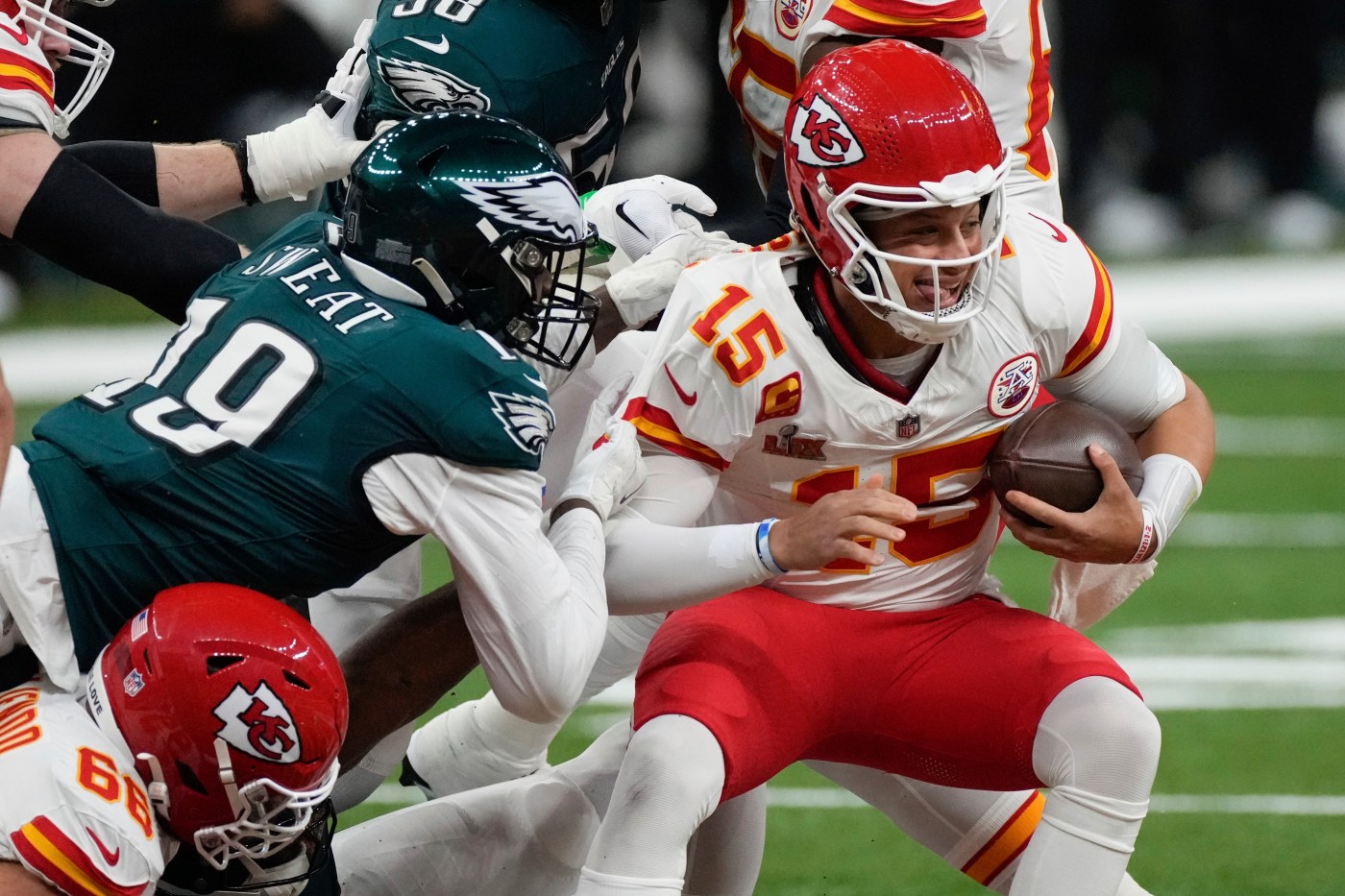
Notice a name missing there? How about three-time Super Bowl winner Patrick Mahomes. Fantasy mavens can grab him with a middle-round draft pick and laugh all the way to the bank.
How about Denver’s Bo Nix, Arizona’s Kyler Murray or Dallas’ Dak Prescott? You can grab them even later in your drafts and concentrate your early picks on running backs and pass catchers.
Here’s our list of other players that we’re pretty enthusiastic about, at least more than the “experts” are. We’ll start off with QBs you can get even later on draft day.
Our fave quarterbacks
Justin Fields (Jets) — If you haven’t noticed, Fields’ running ability has made him a consistent fantasy performer when he’s starting, like he was early last season in Pittsburgh. He’s got the job to himself with the J-E-T-S, and he could run for double-digit touchdowns. Really.
New York Jets quarterback Justin Fields (7) participates during an NFL football practice in Florham Park, N.J., Thursday, May 29, 2025. (AP Photo/Seth Wenig)
Justin Herbert (Chargers) — How can one be underrated after averaging 4,200 yards and 27 TDs over his first five seasons? Sure, Herbert has been throwing less since Jim Harbaugh came to SoFi. But he’s getting better, throwing only 10 interceptions over the past two seasons.
Los Angeles Chargers quarterback Justin Herbert (10) during the second half of an NFL football game against the New England Patriots, Saturday, Dec. 28, 2024, in Foxborough, Mass. (AP Photo/Michael Dwyer)
Jared Goff (Lions) — Were it not for a number of Detroit blowouts where he rested on the bench late, Goff would have topped 5,000 yards last season. He doesn’t have coordinator whiz Ben Johnson around, but Goff still has the most talented set of offensive weapons in the NFL.
FILE – Detroit Lions quarterback Jared Goff (16) passes against the Washington Commanders during an NFL football divisional playoff game, Saturday, Jan. 18, 2025, in Detroit. (AP Photo/Rick Osentoski, File)
Others — Tua Tagovailoa (Dolphins), Bryce Young (Panthers)
Our fave running backs
Derrick Henry (Ravens) — Over the past seven seasons, The King has averaged nearly 1,500 yards and 14 TDs. And he was just 79 yards short last season of becoming the first-ever two-time 2,000-yard rusher. Yet there’s a half-dozen RBs ranked higher? Now THAT is fake news.
Baltimore Ravens running back Derrick Henry (22) breaks away from Houston Texans safety Calen Bullock during an NFL football game Wednesday, Dec. 25, 2024, in Houston. (AP Photo/David J. Phillip)
Kyren Williams (Rams) — Another dependable scorer who has somehow slipped below more trendy RBs. More than 3,000 total yards and 31 touchdowns over the past two seasons. Sean McVay’s meal ticket is an absolute steal at the end of the second round where you’ll find him.
Los Angeles Rams running back Kyren Williams runs against the New York Jets during the second half of an NFL football game in East Rutherford, N.J., Sunday, Dec. 22, 2024. (AP Photo/Julia Demaree Nikhinson)
D’Andre Swift (Bears) — No RB has been more consistent, yet more TD deprived, than Swift, going back to his days in Philly when he lost countless goal-line opportunities to the Tush Pushers. Good chance things improve being reunited with new coach Ben Johnson.
Minnesota Vikings linebackers Blake Cashman (51) and Andrew Van Ginkel (43) contain Chicago Bears running back D’Andre Swift (4) in the third quarter of a NFL football game at U.S. Bank Stadium in Minneapolis on Monday, Dec. 16, 2024. (John Autey / Pioneer Press)
Jordan Mason (Vikings) — Kevin O’Connell has already made it clear he considers Mason and veteran Aaron Jones to be a tandem. So even if this former 49er is the 1B option, he will post career-best numbers. Don’t be surprised when Mason becomes goal-line option No. 1.
Minnesota Vikings running back Jordan Mason (27) grips the ball tight he rushes for a first down in the first quarter of a NFL preseason football game against the Houston Texans at U.S. Bank Stadium in Minneapolis on Saturday, Aug. 9, 2025. (John Autey / Pioneer Press)
Javonte Williams (Cowboys) — Want to throw a dart at somebody outside the top 30? Can’t do better than the presumed No. 1 back in Dallas. A perennial disappointment in Denver, he has almost no competition in the Boys’ backfield. Another guy who will have a career-best season.
Denver Broncos’ Javonte Williams runs during the second half of an NFL football game against the Indianapolis Colts Sunday, Dec. 15, 2024, in Denver. (AP Photo/Jack Dempsey)
Others — Kenneth Walker III (Seahawks), Tony Pollard (Titans), Jaylen Warren (Steelers)
Our fave receivers
Tyreek Hill (Dolphins) — The most jaw-dropping stat of 2024 is that, after the opener, Hill did not catch a single pass of more than 30 yards. Now he’s out of the top 10 WRs. No chance that drought continues, especially since a chastened Cheetah says he’s in best shape of his career.
Tyreek Hill #10 of the Miami Dolphins in action against the Jacksonville Jaguars at Hard Rock Stadium on Sept. 08, 2024 in Miami Gardens, Florida. (Photo by Carmen Mandato/Getty Images)
Ladd McConkey (Chargers) — No rookie improved more during last season, and McConkey looked all-world with his 197-yard playoff debut. He’s Herbert’s No. 1 option by a mile and will likely finish in NFL top 10 in targets. And, we’re guessing, in yards and TDs, too.
New England Patriots cornerback Jonathan Jones (31) battles with Los Angeles Chargers wide receiver Ladd McConkey (15) during the second half an NFL football game, Saturday, Dec. 28, 2024, in Foxborough, Mass. (AP Photo/Greg M. Cooper)
D.K. Metcalf (Steelers) — How is this guy not ranked in the top 20 now that he’s destined to be Aaron Rodgers’ new favorite? Metcalf’s stats were always held back some in Seattle because there were many mouths to feed. He might double the seven TDs he posted last season.
DK Metcalf #14 of the Seattle Seahawks reacts against the New York Jets at MetLife Stadium on Dec. 01, 2024 in East Rutherford, New Jersey. (Photo by Luke Hales/Getty Images)
George Pickens (Cowboys) — Meanwhile, the occasional malcontent Metcalf replaced in the Steel City has landed on his feet in Dallas, playing opposite the incomparable CeeDee Lamb. Pickens will see only single coverage this season, making him a middle-round steal.
FILE – Pittsburgh Steelers wide receiver George Pickens (14) runs after a catch during an NFL football game, Sunday, Oct. 6, 2024, in Pittsburgh. (AP Photo/Matt Durisko)
Cooper Kupp (Seahawks) — He’s not a Super Bowl MVP anymore, but come on. He’s being rated barely in the top 40, now that he has downgraded from Matthew Stafford to Sam Darnold. If he can stay healthy, Kupp could be a top candidate for comeback player of the year.
Seattle Seahawks wide receiver Cooper Kupp (10) talks with quarterback Sam Darnold (14) during an NFL football minicamp Monday, June 2, 2025, at the training facility in Renton, Wash. (AP Photo/John Froschauer)
Others — Davante Adams (Rams), Rome Odunze (Bears), Marvin Harrison Jr. (Cardinals)
Our fave tight ends
Travis Kelce (Chiefs) — Another old dude claiming to be in the best shape of his career, Kelce has dropped out of the top five after a decade as the No. 1 tight end. Mr. Swift will be one of the Chiefs who will strongly bounce back after absorbing their Super Bowl humiliation.
Travis Kelce #87 of the Kansas City Chiefs kisses Taylor Swift after defeating the San Francisco 49ers 25-22 in overtime during Super Bowl LVIII at Allegiant Stadium on Feb. 11, 2024 in Las Vegas, Nevada. (Photo by Ezra Shaw/Getty Images)
Kyle Pitts (Falcons) — Remember when he was one of the top rookie prospects? Just four years ago. And few have been as underwhelming, with only 10 career TD catches. But with a full season with Michael Penix at QB, you could do worse than taking a last-round flyer on Pitts.
Atlanta Falcons tight end Kyle Pitts (8) catches the ball before an NFL football game against the Washington Commanders, Sunday, Dec. 29, 2024 in Landover, Md. (AP Photo/Daniel Kucin Jr.)
Isaiah Likely (Ravens) — Another TE you can get very late, in part, because of his injured foot. But he caught a TD pass in three of the Ravens’ last five games in ‘24, and it’s only a matter of time until he supplants Mark Andrews as the Baltimore starter.
Baltimore Ravens tight end Isaiah Likely warms up before an NFL football game against the Houston Texans Wednesday, Dec. 25, 2024, in Houston. (AP Photo/David J. Phillip)
Others — T.J. Hockenson (Vikings), Evan Engram (Broncos)
Coming next Sunday
The spirit of Nipsey Russell will be with us all when we present the “Match Game” legend-inspired NFL preview.
NEW YORK – DECEMBER 14: Actor Nipsey Russell (1924 – 2005) and his guest attend “The Aviator” film premiere on December 14, 2004 at the Zeigfeld Theatre in New York City. (Photo by Evan Agostini/Getty Images)
You can hear Kevin Cusick on Wednesdays on Bob Sansevere’s “BS Show” podcast on iTunes. You can follow Kevin on X — @theloopnow. He can be reached at kcusick@pioneerpress.com.
The Loop 2025 Fantasy Football Preview: Our Non-favorites
The Loop 2025 Fantasy Football Preview: The Rookies