Lisa Jarvis: RFK Jr.’s vaccine panel is turning misinformation into policy

posted in: All news | 0

Health and Human Services Secretary Robert F. Kennedy’s dismantling of Americans’ trust in — and ultimately, access to — vaccines isn’t happening with one sweeping policy that grabs the public’s attention. It’s unfolding quickly and quietly, in bland conference rooms where hand-picked appointees make decisions that will have far-reaching consequences for our health.

Inside one of those nondescript rooms last week, the Advisory Committee on Immunization Practices (ACIP), an independent panel that makes vaccine recommendations to the Centers for Disease Control and Prevention, offered a glimpse of what’s to come. The group, few of whom have any expertise in vaccines, infectious diseases or epidemiology, at times cast aside evidence-based science and sowed doubt in some of our most valuable public health tools.

This panel of seven replaced the 17 ACIP members Kennedy fired last month in order to stack the committee with members who share his anti-vaccine agenda.

Their lack of expertise and, for some, even basic knowledge of epidemiology, were evident throughout the two-day meeting. Some were unfamiliar with the Vaccines for Children Program, which provides free shots to those eligible. (The program has provided some 71.5 billion doses to kids since 1994.)

At least one member appeared to struggle to understand the distinction between a vaccine’s efficacy and its effectiveness. It’s a wonky, but important distinction referring to how well a vaccine works in a trial versus the real world. Some seemed not to take seriously the risk that infections like RSV and the flu can pose to even healthy children. One member suggested that the 250 children who died from the flu last season — a recent high — was a “modest” number.

But this group isn’t just unqualified — it’s dangerous. Its decisions directly influence insurance coverage and access to vaccines, affecting health outcomes for all Americans. The stakes are particularly high when it comes to protecting children against preventable diseases. Yet the tone of the panel’s first formal meeting suggested many members are more intent on sowing doubt about routine immunizations. Even worse, their actions could impede access to these important medicines.

“That whole meeting was a travesty,” says Fiona Havers, a physician and epidemiologist. After the ACIP firings, Havers resigned from the CDC, where she was considered one of its leading experts on vaccine policy.

Kennedy’s oft-repeated claim is that the COVID-19 response caused vaccine hesitancy in the U.S. and that his drastic changes at the CDC are a necessary step in rebuilding the public’s trust. Martin Kulldorff, a former Harvard epidemiologist and chair of the panel, echoed that sentiment during the meeting’s opening, emphasizing the importance of “rebuilding trust in sound science,” and again at the end, when he commended participants for discussing vaccines in an “unbiased, open and transparent way.”

It’s a convenient — and inaccurate — framing. It elides the role Kennedy’s Make America Healthy Again movement played in spreading vaccine misinformation during the pandemic. It provides cover for their “just asking questions” approach to evaluating vaccine policy.

The problem, of course, is when people given the CDC’s imprimatur are asking questions that are purposely crafted to sow doubt. That became clear from the outset when Kuldorff announced that the committee would evaluate the cumulative effects of the childhood vaccine schedule, as well as any immunizations that had not been considered in the last seven years, including the hepatitis B shot given to newborns. The implication is that the CDC has been ignoring some unknown dangers of shots that have been safely used for years. Kuldorff, who was fired from Harvard, was a vocal critic of COVID vaccine mandates during the pandemic and refused the shot.

“The claims that were framed as efforts to increase vaccine confidence actually do the opposite — they undermine vaccine confidence,” says Sean O’Leary, the American Academy of Pediatrics’ liaison to ACIP. He called the meeting “a really long couple of days for science.”

A discussion of flu vaccines was a disturbing preview of what “rebuilding trust” might look like under Kennedy’s CDC — and how that mantra could be used to disrupt access to vaccines. After a thankfully routine vote to recommend that Americans get their fall flu shots, the panel stated that those vaccines should not contain thimerosal, a mercury-containing preservative that decades ago came under scrutiny for a now-disproven link to autism.

It was a disturbing development that upended the panel’s normally measured process for evaluating vaccines. The discussion was added to ACIP’s agenda at the last minute, but more alarming was that thimerosal was being discussed at all. The preservative’s safety has been thoroughly studied, but was removed from all childhood vaccines in 2001 to try to address parents’ hesitancy. Today, it is used sparingly — the single-dose flu vaccines that the majority of Americans receive don’t contain it, but it’s still used as a preservative in multi-dose vials, which just 4-5% of patients in the US receive.

Most troubling was that the “evidence” against thimerosal was presented by Lyn Redwood, a nurse and former head of the Children’s Health Defense, the anti-vaccine group founded by Kennedy. She used her time to make a series of false claims about the preservative’s risks. Her original presentation cited a fake study on the risks of thimerosal — a reference removed after the media raised concerns.

Pediatrician Cody Meissner, one of two rational members, questioned the purpose of her presentation and its contents. (Meissner was often the lone voice of reason and expertise on the panel during the two-day meeting.) Ultimately, when it came time to vote on recommending the preservative be removed from flu shots, Meissner was also the only member to vote against it.

The vote has real consequences. It means some Americans will lose out on their shots. The vaccine is more commonly used outside the U.S., and there’s concern about how ACIP’s decisions could ripple into global health. And vaccine hesitancy experts worry that re-litigating a settled topic could undermine broader confidence in immunizations.

And perhaps most alarming is the precedent set by the committee bypassing the CDC’s normal review process to push through what seemed like a preordained decision.

Typically, a CDC working group comprised of internal staff and subject matter experts would spend months developing recommendations that are presented to ACIP in a public forum. They would examine hard data on a vaccine within the broader context of its real-world use, considering, for example, the magnitude of the public health problem it addresses, challenges to implementing a rollout, and its impact on health equity, Havers explains. Before considering removing a shot like the thimerosal-containing flu vaccine, the working group would first study the public health consequences of the decision.

“None of that happened, which is why this was a complete farce,” Havers says.

That’s the antithesis of transparency. And it’s a sign for what we can expect from this group. After watching the panel railroad a vote on settled science, it’s fair to worry about their future plans. The next effort to “rebuild trust” could have far-reaching health consequences — and, without a doubt, will cost lives.

Lisa Jarvis is a Bloomberg Opinion columnist covering biotech, health care and the pharmaceutical industry. Previously, she was executive editor of Chemical & Engineering News.
Confederacy group sues Georgia park for planning an exhibit on slavery and segregation

posted in: All news | 0

By CHARLOTTE KRAMON

STONE MOUNTAIN, Ga. (AP) — The Georgia chapter of a Confederacy group filed lawsuits this week against a state park with the largest Confederate monument in the country, arguing officials broke state law by planning an exhibit on ties to slavery, segregation and white supremacy.

Related Articles


Dealers’ advice on cheap used cars: Buy them while you still can


How people are celebrating, protesting and traveling for July Fourth


Search continues for 7 missing after huge explosion at California fireworks warehouse


Mexican boxer Julio César Chávez Jr. was arrested and will be deported, federal officials say


What’s in Trump’s big bill that passed Congress and will soon become law

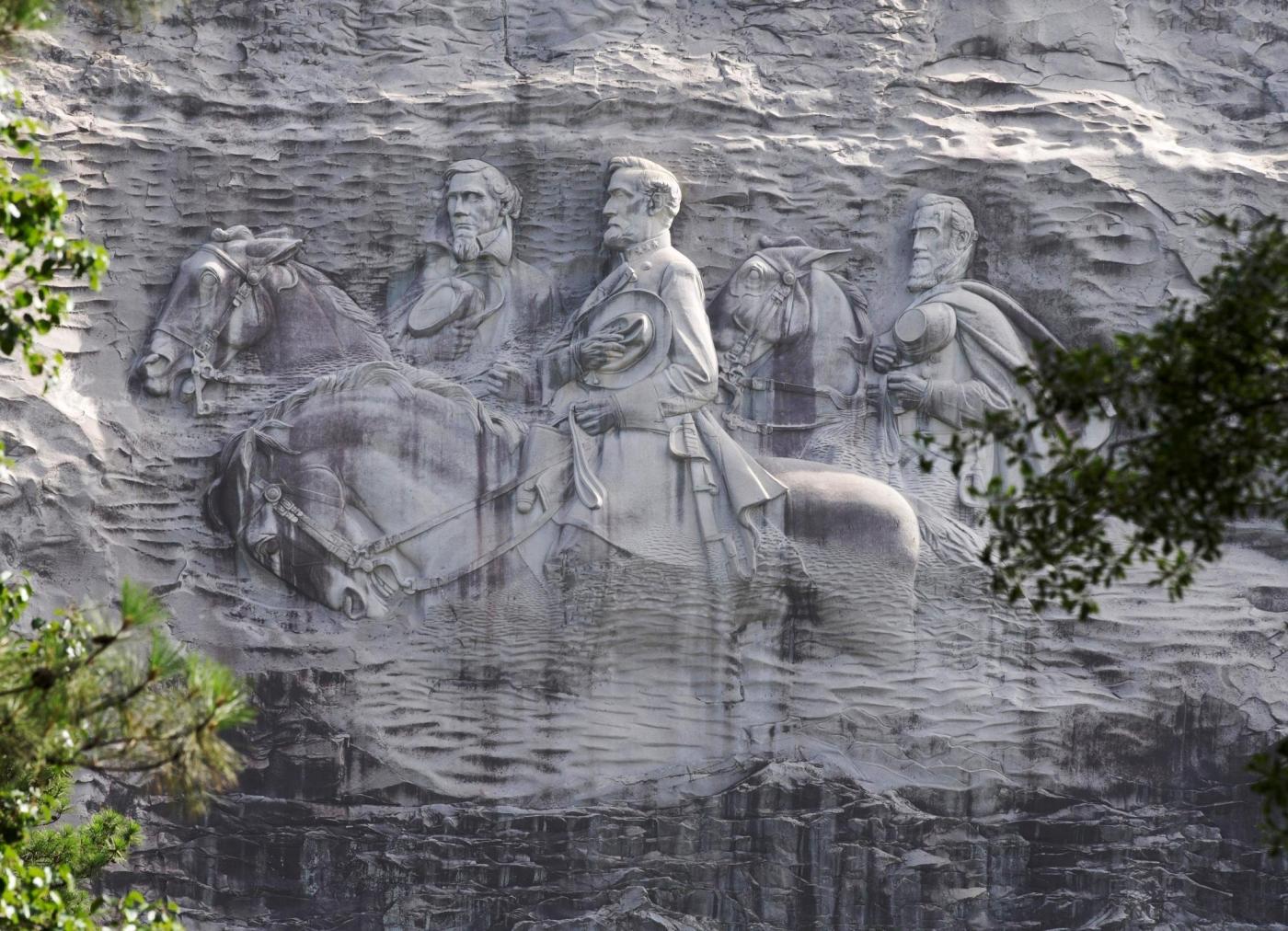
Stone Mountain’s massive carving depicts Confederate President Jefferson Davis, Gen. Robert E. Lee and Thomas “Stonewall” Jackson on horseback. Critics who have long pushed for changes say the monument enshrines the “Lost Cause” mythology that romanticizes the Confederate cause as a state’s rights struggle, but state law protects the carving from any changes.

After police brutality spurred nationwide reckonings on racial inequality and the removal of dozens of Confederate monuments in 2020, the Stone Mountain Memorial Association, which oversees Stone Mountain Park, voted in 2021 to relocate Confederate flags and build a “truth-telling” exhibit to reflect the site’s role in the rebirth of the Klu Klux Klan, along with the carving’s segregationist roots.

The Georgia Division of the Sons of Confederate Veterans also alleges in court documents filed Tuesday that the board’s decision to relocate Confederate flags from a walking trail violates Georgia law.

“When they come after the history and attempt to change everything to the present political structure, that’s against the law,” said Martin O’Toole, the chapter’s spokesperson.

Stone Mountain Park markets itself as a family theme park and is a popular hiking spot east of Atlanta. Completed in 1972, the monument on the mountain’s northern space is 190 feet across and 90 feet tall. The United Daughters of the Confederacy hired sculptor Gutzon Borglum, who later carved Mount Rushmore, to craft the carving in 1915.

That same year, the film “Birth of a Nation” celebrated the Reconstruction-era Ku Klux Klan, which marked its comeback with a cross burning on top of Stone Mountain on Thanksgiving night in 1915. One of the 10 parts of the planned exhibit would expound on the Ku Klux’s Klan reemergence and the movie’s influence on the mountain’s monument.

The Stone Mountain Memorial Association hired Birmingham-based Warner Museums, which specializes in civil rights installations, to design the exhibit in 2022.

“The interpretive themes developed for Stone Mountain will explore how the collective memory created by Southerners in response to the real and imagined threats to the very foundation of Southern society, the institution of slavery, by westward expansion, a destructive war, and eventual military defeat, was fertile ground for the development of the Lost Cause movement amidst the social and economic disruptions that followed,” the exhibit proposal says.

Other parts of the exhibit would address how the United Daughters of the Confederacy and the Sons of Confederate Veterans perpetuated the “Lost Cause” ideology through support for monuments, education programs and racial segregation laws across the South. It would also tell stories of a small Black community that lived near the mountain after the war.

Georgia’s General Assembly allocated $11 million in 2023 to pay for the exhibit and renovate the park’s Memorial Hall. The exhibit is not open yet. A spokesperson for the park did not immediately respond to a request for comment.

The park’s board in 2021 also voted to change its logo from an image of the Confederate carveout to a lake inside the park.

Sons of the Confederate Veterans members have defended the carvings as honoring Confederate soldiers.

Changes to the park would “radically revise” the park’s setup, “completely changing the emphasis of the Park and its purpose as defined by the law of the State of Georgia,” the organization said in court documents.

Kramon is a corps member for The Associated Press/Report for America Statehouse News Initiative. Report for America is a nonprofit national service program that places journalists in local newsrooms to report on undercovered issues. Follow Kramon on X: @charlottekramon.

Now an NBA champion, Chet Holmgren returns to his roots in St. Paul

posted in: All news | 0

Chet Holmgren grew up hooping at random parks throughout the Twin Cities. If there was a pickup game to be played, no matter the location, the lanky teenager and his friends were always up for the challenge.

“We would go all over the place,” Holmgren said. “Wherever people were playing.”

In a perfect world for Holmgren, his return to the Jimmy Lee Recreation Center in St. Paul on Thursday afternoon would have been much less conspicuous.

“There’s a bunch of media here,” he said. “I don’t even know how this happened.”

Such is life for an NBA champion.

Less than weeks after the Oklahoma City Thunder defeated the Indiana Pacers in Game 7 to win the NBA championship, Holmgren returned to the Twin Cities and brought the coveted Larry O’Brien Trophy with him to share with the community that helped raise him.

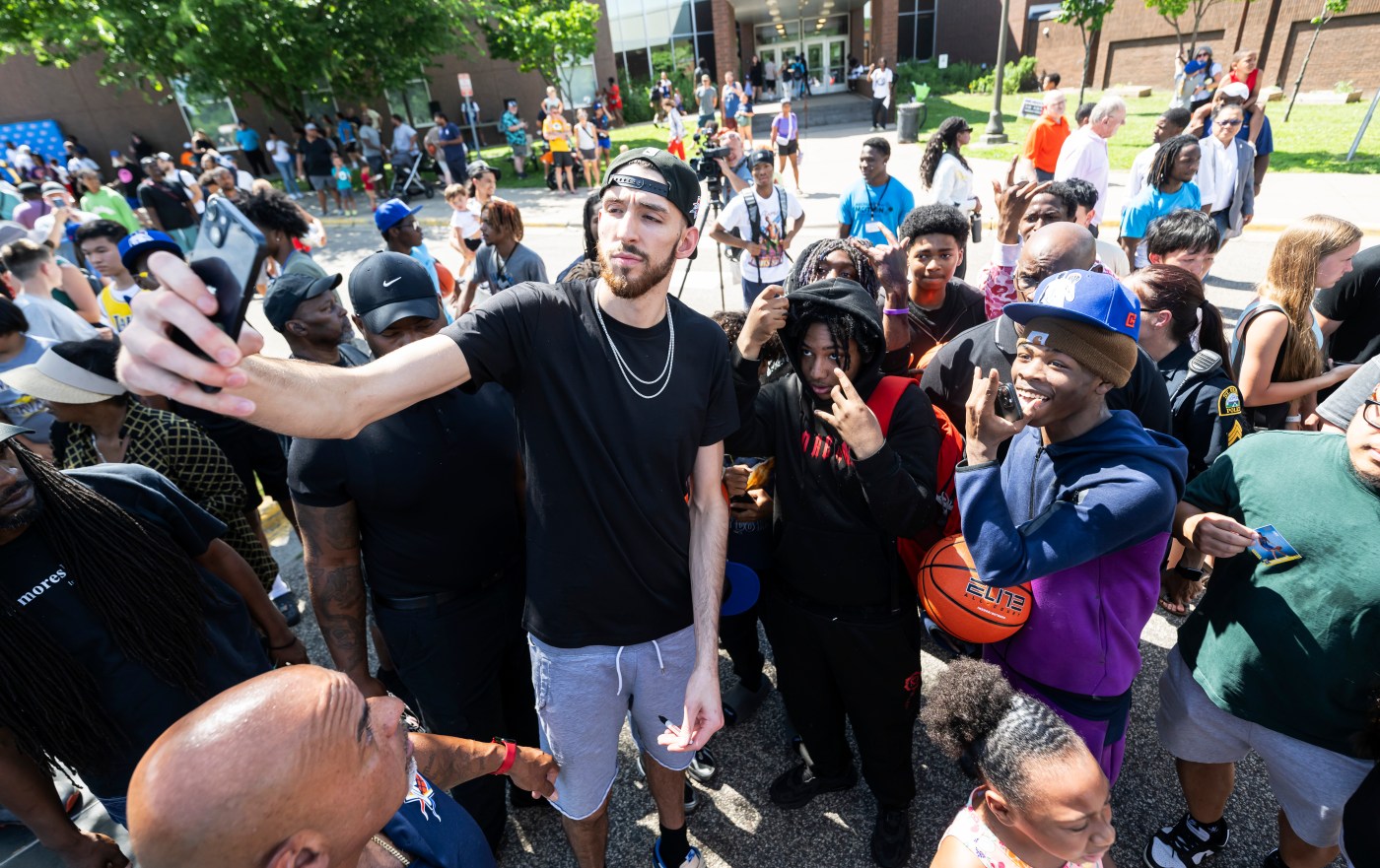
In the hour leading up to Holmgren’s arrival at the Jimmy Lee Recreation Center, hundreds lined up in the parking lot to take pictures with the hardware. They did so while wearing hats and bouncing basketballs that were being handed out for the occasion. There were also a number of food trucks set up in the parking lot, as as well as makeshift basketball court in the distance.

“This is for this kids,” Holmgren said. “Just to kind of show them that anything is possible.”

After talking to reporters inside the recreation center for roughly 15 minutes, Holmgren made his way outside where everybody was anxiously waiting for him.

“This might be a little overwhelming,” he said. “It’s a great problem to have.”

That perspective was on display in Holmgren, who handled himself with grace despite being bombarded as soon as he walked out the door.

Never mind that there were items being shoved in his face as he slowly made his way around the parking lot. He signed autographs for roughly 45 minutes with the sun beating down and temperatures sitting in the mid-90s.

As soon as that crowd started to die down, Holmgren went back inside to cool off, then returned outside and played 1 on 1 with anybody who was up for the challenge.

As the sweat dripped form his forehead it was almost as if Holmgren had been transported back in time. He wasn’t an NBA player for the 30 minutes he was playing on the blacktop, just a hooper sharing the game he loves with those that love it as much as he does.

“It’s all about the kids,” Holmgren said. “Just trying to inspire them and give them something that they’ll remember for a long time to come.”

Why is that part so important to him?

“To show them what they can dream of,” Holmgren said. “The hardest thing for a lot of kids is that they can’t work to accomplish something if they don’t think it’s possible. It’s big for them to be able to see something like this, just so they understand that if they want to do something, they can strive for that.”

Related Articles


Timberwolves agree to one-year deal to bring back Joe Ingles as Nickeil Alexander-Walker and Luka Garza depart


Timberwolves decline options on Josh Minott, Luka Garza


Timberwolves reach three-year deal with Julius Randle


Why the Timberwolves fell in love with first-round pick Joan Beringer


Timberwolves, Naz Reid agree to five-year, $125 million extension

Honduran family freed from detention after lawsuit against ICE courthouse arrests

posted in: All news | 0

By JIM VERTUNO

AUSTIN, Texas (AP) — A mother and her two young children from Honduras who had filed what was believed to be the first lawsuit involving children challenging the Trump administration’s policy on immigrant arrests at courthouses have been released from detention, civil rights groups and attorneys for the family said Thursday.

Related Articles


Supreme Court clears way for deportation to South Sudan of several immigrants with no ties there


Here’s what to know about clean energy in Republican megabill headed to Trump


Takeaways as Congress sends tax and spending cuts bill to Trump’s desk


EPA puts on leave 139 employees who spoke out against policies under Trump


Medicaid, food aid recipients worry about safety net cuts in bill sent to Trump

The lawsuit filed on behalf of the mother identified as “Ms. Z,” her 6-year-old son and her 9-year-old daughter, said they were arrested outside the courtroom after an immigration court hearing in Los Angeles. They had been held for weeks in the Dilley Immigration Processing Center in Texas. Their identities have not been released because of concerns for their safety.

The lawsuit said that the family entered the U.S. legally using a Biden-era appointment app and that their arrest violated their Fourth Amendment right to be free from unreasonable searches and seizure and their Fifth Amendment right to due process.

The family’s lawyers said the boy had also recently undergone chemotherapy treatment for leukemia and his mother feared his health was declining while in detention.

The family was released late Wednesday while their lawsuit was still pending, and they went to a shelter in South Texas before they plan to return to their lives in the Los Angeles area, said Columbia Law School professor Elora Mukherjee, one of the lawyers representing the family.

“They will go back to their lives, to church, and school, and the family will continue to pursue their asylum case. And hopefully the little boy will get the medical attention he needs,” Mukherjee said. “They never should have been arrested and detained in the first place. We are grateful they have been released.”

Department of Homeland Security officials did not immediately respond to an email request for comment. Last week, the agency posted on social media that the boy “has been seen regularly by medical personnel since arriving at the Dilley facility.”

Starting in May, the country has seen large-scale arrests in which asylum-seekers appearing at routine hearings have been arrested outside courtrooms as part of the White House’s mass deportation effort. In many cases, a judge will grant a government lawyer’s request to dismiss deportation proceedings and then U.S. Immigration and Customs Enforcement officers will arrest the person and place them on “expedited removal,” a fast track to deportation.

Lawyers for the “Z” family said their lawsuit was the first one filed on behalf of children to challenge the ICE courthouse arrest policy.

There have been other similar lawsuits, including in New York, where a federal judge ruled last month that federal immigration authorities can’t make civil arrests at the state’s courthouses or arrest anyone going there for a proceeding.

“The Z family’s release demonstrates the power we have when we fight back against harmful, un-American policies,” said Kate Gibson Kumar, staff attorney for the Beyond Borders Program of the Texas Civil Rights Project.

The family’s lawyers have said that during their hearing before a judge, the mother said they wished to continue their cases for asylum. Homeland Security moved to dismiss their cases, and the judge immediately granted that motion.

When they stepped out of the courtroom, they found men in civilian clothing believed to be ICE agents who arrested the family, Mukherjee said. They spent about 11 hours at an immigrant processing center in Los Angeles and were each only given an apple, a small packet of cookies, a juice box and water.

At one point, an officer near the boy lifted his shirt, revealing his gun. The boy urinated on himself and was left in wet clothing until the next morning, Mukherjee said.