‘That dream definitely did come true’: Quinceañera through generations

posted in: All news | 0

Sitting in the chair at Accolades Salon Spa in St. Paul, Nabella Grijalva held out her phone to show the hairstylist some of the ideas she had for her big day on June 27.

On the other side of the room, Nabella’s grandmother Blanca Grijalva closed her eyes while a woman applied her makeup.

When she was Nabella’s age, Blanca did her own hair and makeup for her own quinceañera celebration — a traditional commemoration of a girl’s 15th birthday held by many Latino families.

“I had seen this girl have one, and it was really pretty. I wanted one, but I didn’t know if I could have one,” Blanca told the Pioneer Press when the paper covered her quinceañera celebration in 1985.

Now 40 years later, some parts of the day are a little more extravagant for Nabella’s celebration, held the day after her birthday. Blanca has been preparing for the last two years.

“When Bella came along, I just always, I’m like, ‘Well, we’re gonna have a quinceañera for you one day,’ because I didn’t have girls of my own,” Blanca said. “And that was what I grew up with traditionally, the whole concept of it, I guess. The religious aspect of it, the food, the dance, just the whole tradition, just the way it’s celebrated, was just really important. And to get your family members together. And to celebrate her, because it’s about her.”

Over the years, Nabella’s dad often asked her if she wanted a quinceañera celebration or the money for it. Nabella knew she wanted the celebration.

“I’ve known exactly what theme and what dress I wanted since I was like 8 years old, so I guess that dream definitely did come true,” she said.

Blanca’s quinceañera celebration

With a little help from Linda Velasques, left, and Lillian Velasques, Blanca Grijalva, née Blanca Estela Santana, is ready to receive congratulations at her quinceañera in St. Paul on May 10, 1985. (Liz Hafalia / Pioneer Press)

Forty years ago, when Blanca celebrated turning 15 years old, her friends – 14 girls and 15 boys – marched ahead of her down the aisle of Our Lady of Guadalupe Church on St. Paul’s West Side. The teenage Blanca followed in a white dress and veil, a bouquet of flowers in her hand and her parents on each side. Her father, Victorio Santana, made a special trip to Mexico to buy the dress.

For the family, the celebration was an important Mexican custom and a symbol that Blanca had stayed loyal to her religious faith.

“Everybody thought she deserved this party,” Santana told the Pioneer Press in 1985. “She is like the perfect child in everybody’s eyes. This is something we could give her.”

For Nabella’s family, the celebration is also a symbol of moving into a new phase in life, one with more responsibility and freedom.

“This party, this quinceañera signifies, for me personally, the next step in life,” said Jesús Grijalva, Nabella’s uncle.

Related Articles


Oklahoma man’s swim from Twin Cities to New Orleans grabbed headlines in 1930


Two Harbor lighthouse regains its ‘iconic beam’


Nine pet stories featured in our Morning Report newsletter in June


Stillwater approves first — and only — adult-use recreational cannabis retail business


City asks: Why are St. Paul’s Green Line stations going offline during Yacht Club music festival?

At Blanca’s celebration, more than a dozen sets of godparents paid for much of the party, including the clothes, reception room rentals, cake, music, photographs and flowers. The food was a homemade meal of mole, rice and beans made by Blanca’s mom and friends.

Now, more of the financial responsibility falls on immediate family members, Blanca said. It can be significant – while Blanca’s quinceañera dress cost her father $100, Nabella’s was $1,900. It’s just one of the changes in the 40 years since Blanca had her celebration.

“But back then, we didn’t do the surprise dances or anything. We just did, like, the presentation of the godparents and then the waltz. And there was a lot of godparents back then, but now that’s kind of gone away,” Blanca said. “So most people, I think, that have them now just kind of take care of the whole thing themselves.”

Her father had a lot of friends to help him with the preparations, she said.

The tradition and religious aspect of the celebration was an important part of that day for her father, she added.

“I knew it was important, especially to my dad,” Blanca said.

Nabella’s day

Gracyella Rivera makes sure Nabella “Bella” Grijalva’s hair will stay in place as she applies hairspray before Bella’s quinceañera party at the Intercontinental Hotel in St. Paul on Friday, June 27, 2025. (John Autey / Pioneer Press)

The day of a quinceañera is spent preparing for the evening’s celebrations.

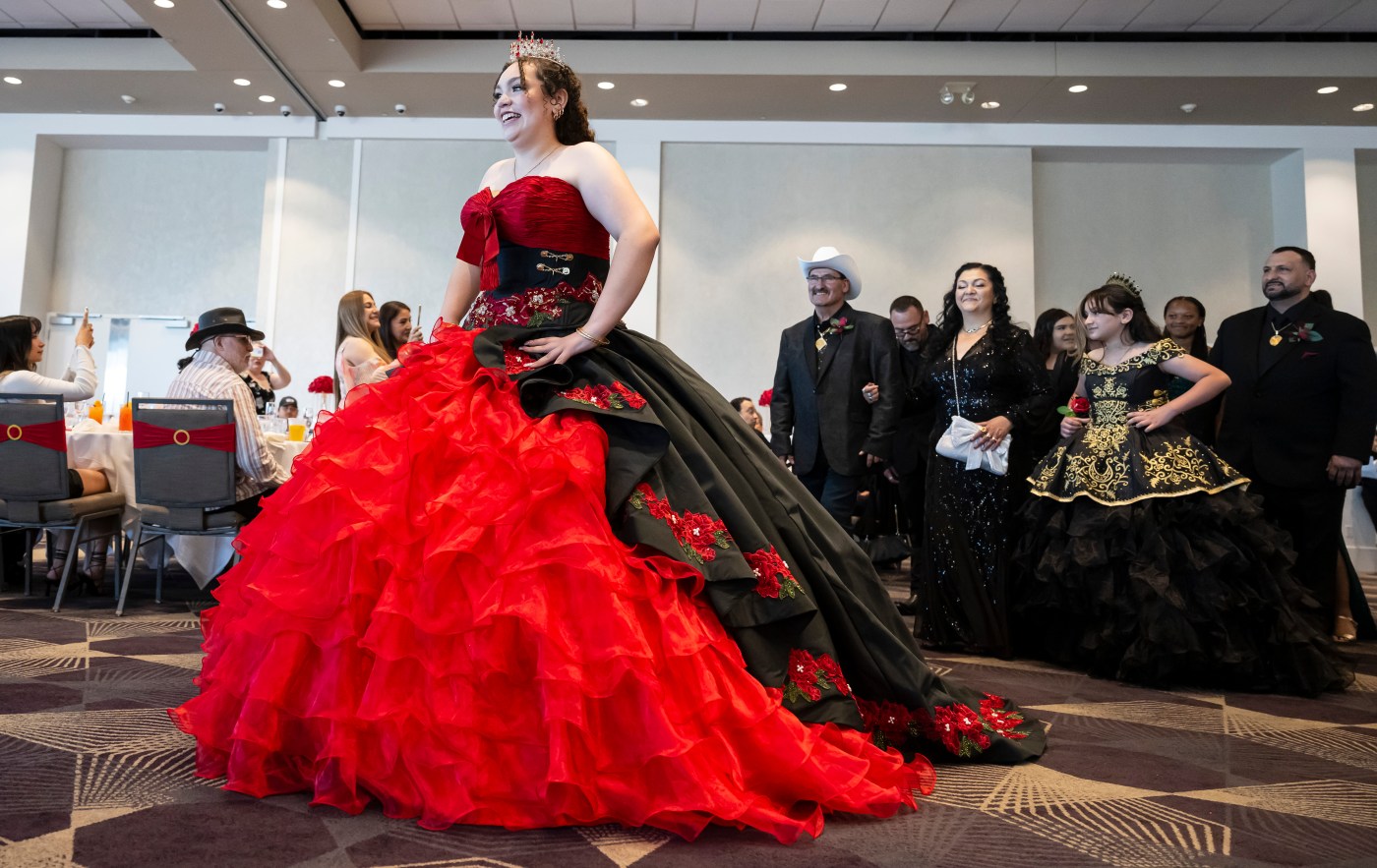
With her hair and makeup done, Nabella dons her red and black quinceañera dress and takes a limo to the Cathedral of St. Paul for pictures with her damas – the five girls who make up her court. Nabella chose not to have any boys on her court – the girls’ green dresses go better with the green accents in Nabella’s dress.

More of the day is spent visiting different parts of the city for photos before heading to the Intercontinental St. Paul Riverfront hotel downtown. There, Nabella and her friends do last-minute touch-ups on their hair and talk about anything from the popular video game Roblox to their families’ homemade tortillas.

The girls are nervous, but prepared. They joke about ordering food delivery if they don’t have enough time to eat during the festivities. They’ve spent weeks preparing their dances for the evening. Being a part of Nabella’s court is an honor, they said.

Nabella asked her friend Gracyella Rivera to be a part of her court when they were just 8 years old.

“We were childhood best friends,” Rivera said. “And we still are, and we were playing in our living room, and we would always talk about having a quince and her having one, and how she would want it ranchero-style — she did have it like that — and she asked me that time, and then it just stuck. Someone actually had it. It was just like living a childhood dream.”

Outside the room, the guests socialize and eat food from the buffet while a mariachi group plays. Men wear big hats and belt buckles as part of that ranchero-style theme, which Nabella described as a cowboy, Hispanic-Western style.

The girls get ready for their grand entrance with Nabella’s family. The mariachi band plays them in to applause and cheers.

Blanca had tried to secure a church for a blessing of Nabella, but many don’t host quinceañeras on Fridays. So a chaplain offers a blessing at the hotel venue, that Nabella may grow in wisdom, knowledge and grace, with love and faithfulness for her family and friends. She is gifted a Bible and rosary. Other gifts include jewelry, as well as high heels and a teddy bear to symbolize her transition from childhood into young womanhood.

Nabella and her friends sit at a long table at the front of the room, with Nabella’s name largely displayed in lights. They mingle with guests. It’ll be sad when the celebration is over, but it’s happy, too, they said.

Related Articles


Oklahoma man’s swim from Twin Cities to New Orleans grabbed headlines in 1930


Joe Soucheray: Grate, more pointless, dangerous vandalism in St. Paul


Three men shot overnight in St. Paul, prompting hospital lockdown


Nine pet stories featured in our Morning Report newsletter in June


As family mourns 14-year-old killed in St. Paul scooter crash, they call for more traffic safety

Near the end of the evening, Nabella and her 9-year-old sister Amaia switch from dresses to jeans, crowns still on their heads, for a coordinated dance they’ve been practicing for weeks. When Nabella’s dad asked her if she wanted a quinceañera celebration or the money, she knew she wanted the celebration — but she thinks Amaia will pick the money to travel. Either way, they have this dance together.

“It’s been very fun. I mean, definitely kind of stressful. But I love every night just practicing our dances in the living room, making sure to get it down and having good laughs throughout this very stressful time,” Nabella said. “It’s just fun. I love getting more time with my family than just us being cooped in our rooms. So I love that. I also feel like I built a better connection with my sister throughout this whole process.”

Literary calendar for week of July 6

posted in: All news | 0

(Courtesy of HarperCollins Publishers)

SALLY FRANSON: Minnesota author discusses her novels “Big In Sweden” and “A Lady’s Guide to Selling Out” in the Union Depot’s Stories at the Station reading series presented by Story Line Books. Free. 6 p.m. Thursday, Union Depot, 214 E. Fourth St., St. Paul.

JONATHAN HIGGINS: Presents “Fat, Black, Femme” in conversation with Chris Stedman. 7 p.m. Tuesday, Magers & Quinn, 3038 Hennepin Ave. S., Mpls.

MARIS KRETZMAN: Cultural critic discusses her debut essay collection, “I Want to Burn This Place Down,” in conversation with Steph Opitz. 7 p.m. Thursday, Magers & Quinn, 3038 Hennepin Ave. S., Mpls.

TODD OTIS: Former member of the Minnesota House of Representatives discusses his novel “Sparks of the Revolution: James Otis and the Birth of American Democracy,” inspired by his distant ancestor’s participation in actions that led to the American Revolution. In conversation with David Unowsky. 7 p.m. Tuesday, SubText Books, 6 W. Fifth St., St. Paul.

MIDSTREAM READING SERIES: Readings of original works by Donna Isaac, Jim Johnson, Paula Cisewski and Diego Vasques Jr., hosted by Diane Jarvenpa. Free. 7:30 p.m. Thursday, Unity Church-Unitarian, 732 Holly Ave., St. Paul.

What else is going on?

Community of Literary Magazines and Presses awarded the 2025 Firecracker award to “Obligations to the Wounded” by Minnesota writer Mubanga Kalimamukwento (University of Pittsburgh Press). Judges for the awards, which celebrate the best of independently published literature, wrote of the novel: “Seldom does fiction so expertly capture the complications of queerness, family, dislocation, and culture… a stunning work of compassionate art worthy of our attention and emotions.” Kalimamukwento founded Ubwali Literary Magazine, co-founded the virtual Idembeka Creative Writing Workshop and is a mentor at the Minnesota Prison Writing Workshop.

Related Articles


8 graphic nonfiction books that use comics to unlock memoir, history and more


Literary calendar for week of June 29


Readers and writers: Twin Cities baker/writer in midst of marathon contemplation of MIA painting


33 new books you’ll want to read this summer from independent publishers


Q&A: Pulitzer Prize winner Robin Givhan chronicles Virgil Abloh’s rise to fashion fame

Skywatch: Shooting the moon

posted in: All news | 0

This Thursday we’ll have our first full moon of astronomical summer but for all practical purposes the moon will be pretty much full all week long. As much as full moons louse up the skies for real stargazing and astrophotography, two things near and dear to me, I just love, love, love full moons! I’ve been known to stay up way too late relaxing on my deck, bathing under the light of the full moon. I call it my magic moon time.

As with all full moons, I love the names given to them by cultures all over the world. Some of the old-time American and Native American names for the July full moon include the full buck moon because this time of year buck deer begin sprouting out new antlers. It’s also called the thunder moon because of more frequent thunderstorms this time of year. My favorite name for the July full moon comes from ancient Chinese Buddhist tradition. They called it the Hungry Ghost moon.

Whatever you call the July full moon you can’t help but notice that it’s a low rider. July full moons don’t rise very high in the sky. They take the same low arc across the southern sky as the sun does as winter begins. This makes sense because this time of year the sun takes a very high arc across the southern sky during the day, and since the full moon is on the opposite side of the sky from the sun it just makes sense that it would be a low rider in the southern heavens in the good old summertime. That’s one of the reasons I like full moon gazing this time of year. You can enjoy it for an extended time without craning your neck nearly as much

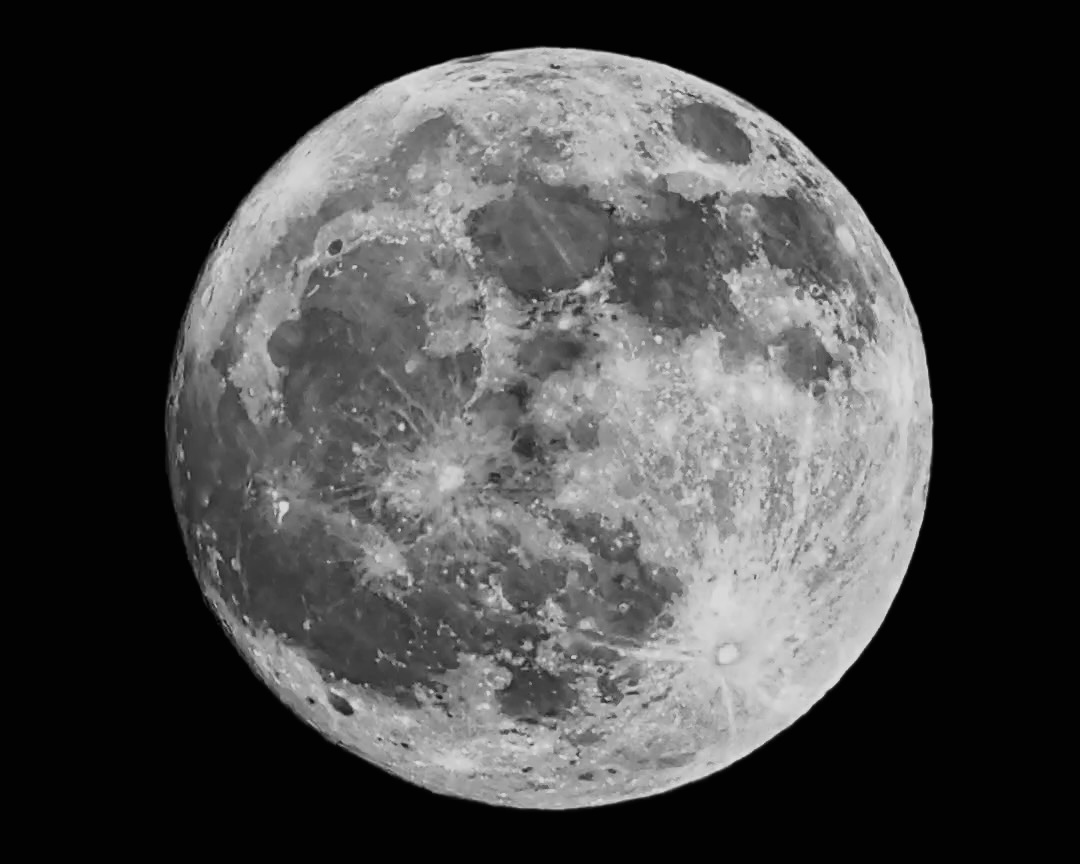
Not only is it nice to gaze upon the moon in July, but you can also have a lot of fun taking pictures of it. You don’t even need that fancy of a camera. Even your smartphone can do a pretty good job if you do it right. Apps like ProShop and NightCap can really help with light and exposure control so the image isn’t just a washout of white.

Crescent moon (Mike Lynch)

If you really want to do it right, I suggest investing in either the new ZWO Seestar S30 or S50 All-in-One Smart Telescopes. Not only can you get amazing moon shots, but you can also capture star clusters, galaxies, nebulae, the sun, and even great terrestrial images. As I wrote about a few weeks ago, there’s a telescope revolution going on right now. These lower-cost photographic telescopes are becoming at least as popular as conventional visual scopes. For generally less than $600, you can purchase a photographic telescope controlled remotely with your smartphone or iPad. You can’t look through these scopes but instead you take celestial images with them. They have a real advantage over visual scopes because you see so much more in the way of color and detail in the photos you take than what you can see looking through the eyepiece of a traditional scope. And again, you don’t have to spend an arm and a leg. For example, the ZWO SeeStar S30 is only $349, and a great place to order one is Starizona in Tucson at www.starizona.com

You can also take some amazing pictures of the moon through the eyepiece of even a small to moderate visual telescope. Just hold your camera or your smartphone over the eyepiece as steady as you can. That can be a bit of a challenge. My suggestion is just keep hitting the shutter button or icon and hopefully you’ll get some decent shots. If possible, rig up a tripod or something else to help steady your camera or smartphone over the eyepiece.

Along with keeping the telescope steady, another thing that’s important is to start taking your shots through a low-magnification eyepiece with your telescope. That’ll have a much wider aperture than a high-magnification eyepiece. Once you get some low-magnification shots, see what you do with higher-magnification eyepieces.

To be honest full moons are not my favorite to photograph through a telescope. I actually prefer pictures of the moon at other various phases in its cycle. Crescent moons, half moons and even gibbous (football-shaped) moons are all fun to photograph. You can see more detail especially along what’s known as the terminator. That’s the line that divides the sunlit part of the moon from the darkened portion.

Once you get the photos, you can work with them with the editing functions on your phone or even software like Photoshop to make your captures look even better, but not fake. You can really see details in the dark maria or plains on the moon as well as the mountains and craters. You’ll want to share them, use them as screensavers, or even hang them on your wall! One more thing that makes gazing at the moon or photographing it so special this month is what happened in July, 56 years ago, when Neil Armstrong and Buzz Aldrin took the first human steps on the moon. I hope we go back there someday!

Mike Lynch is an amateur astronomer and retired broadcast meteorologist for WCCO Radio in Minneapolis/St. Paul. He is the author of “Stars: a Month by Month Tour of the Constellations,” published by Adventure Publications and available at bookstores and adventurepublications.net. Mike is available for private star parties. You can contact him at mikewlynch@comcast.net.

Related Articles


Skywatch: Full-blown July summer skies


Skywatch: The “Z” stars, tongue twisters of the night sky


Skywatch: A telescope revolution is here


Skywatch: Constant Capella


Skywatch: June stargazing — the great late show

Oklahoma man’s swim from Twin Cities to New Orleans grabbed headlines in 1930

posted in: All news | 0

Oklahoman Fred Newton swims down the Mississippi River near Inver Grove Heights on his way to New Orleans from the Ford Dam in this July 1930 clipping from the St. Paul Dispatch. (Pioneer Press files)

The Mississippi River runs 1,826 miles between the Ford Dam in the Twin Cities and New Orleans.

In 1930, Fred Newton swam every single one of them.

A 27-year-old sign painter from Clinton, Okla., Newton guessed the endeavor would take him about three months. And —  maybe — bring him fame and fortune.

“I just picked myself a nice cool job for the summer,” Newton told the St. Paul Dispatch on July 7, the day after he began his swim. “I’m in the water from six to eight hours a day and I’ve put on a tan most folks would envy.”

He made it to New Orleans nearly six months later, on Dec. 29, having endured cold and current — even floating rafts of manure and offal as he passed the South St. Paul stockyards.

He did set a distance record for open-water swimming, but fame and fortune proved elusive.

“Not much came out of it,” said Worth Sparkman, a Clinton native who first learned about Newton’s swim during the COVID-19 pandemic from a brief article in Smithsonian Magazine.

“I thought, ‘I didn’t know anything about that, and I lived there most of my life,’ ” he said. “I Googled (Newton) and there really wasn’t a lot out there.”

Now a reporter for Axios Northwest Arkansas based in Fayetteville, Sparkman is working on a book about Newton and his under-appreciated exploits.

A cross-country swim

It wasn’t unreasonable for Newton to imagine that swimming the length of the Mississippi might make him rich and famous in 1930, Sparkman said. The previous decade had seen America’s ascendant mass media fuel a flurry of headline-grabbing stunts.

Daredevils seeking an early version of viral fame tested their mettle by sitting atop flagpoles for days at a time, going over Niagara Falls in a barrel or walking on the wings of airplanes in flight.

Promoters of the nation’s new interstate highway system sought to capitalize on this trend in the late 1920s, organizing a cross-country foot race along Route 66 dubbed the “Bunion Derby,” which boasted a $25,000 prize — nearly $470,000 in today’s dollars.

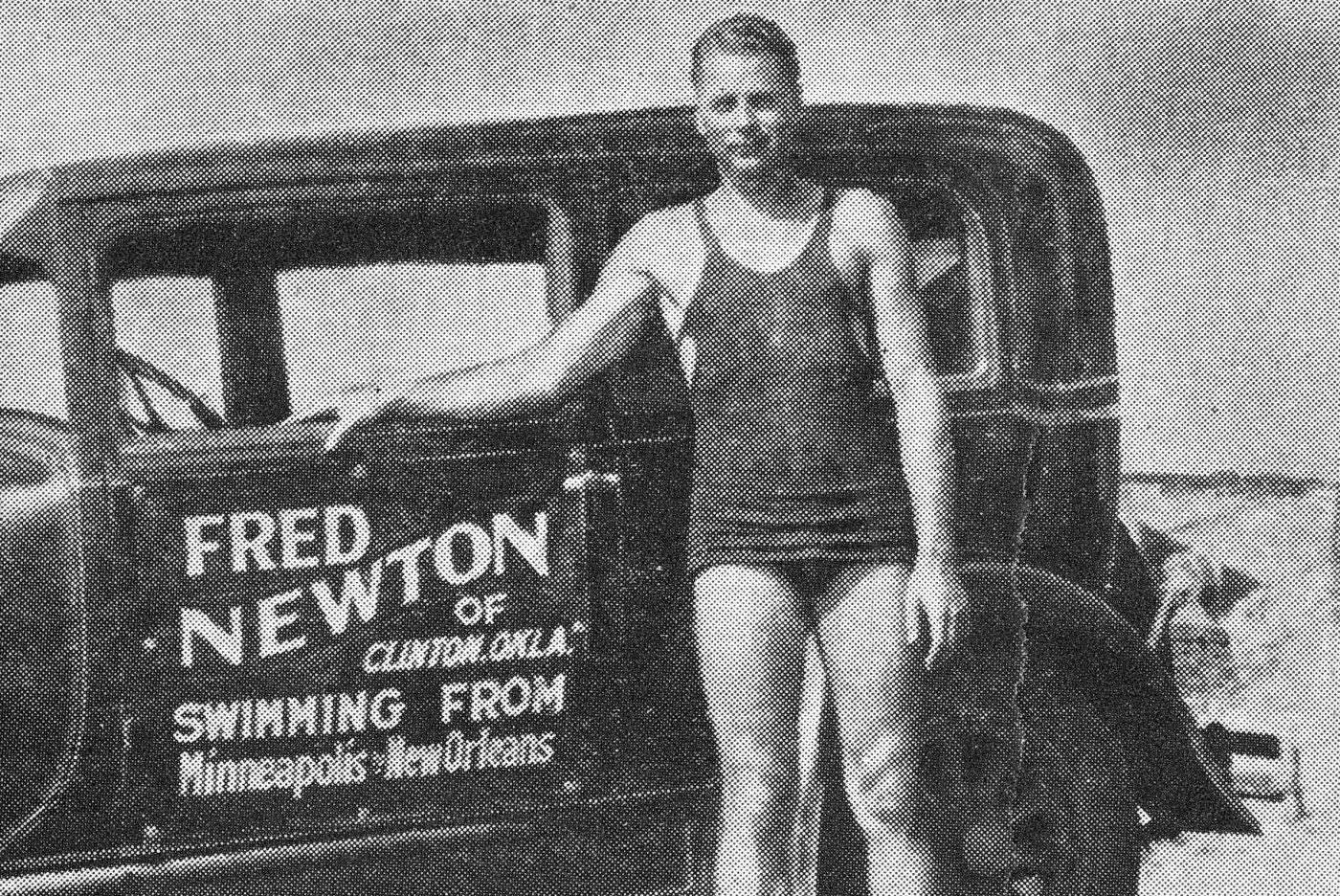
Seen in a postcard image, Oklahoman Fred Newton stands next to an automobile with his ambitious goal painted on the door — swimming the Mississippi River from the Twin Cities to New Orleans — in the summer of 1930. (Courtesy of Worth Sparkman)

The race passed right through Clinton, where Newton earned a living painting signs for local businesses.

“He was an artist,” his son Phil said. “He could stand on the inside of a window and paint a sign on it that you could read from the outside.”

While Newton was tempted by the Bunion Derby’s $25,000 purse, his knees had been damaged by an amateur football career, said Sparkman, who has read Newton’s unpublished memoir in the course of his research.

So he devised an alternative: Newton would swim across the country — albeit north-to-south — via the Mississippi River.

“He says in his manuscript that he hoped to earn fame and fortune,” Sparkman said.

Newton enlisted the help of his younger brother and a friend, who agreed to follow along behind him in a rowboat with food and other supplies.

The trio spent three weeks camped on Lake Minnetonka, where Newton trained with two long swims each day in June 1930, according to a report in the Clinton Daily News. They hoped to be in New Orleans by the beginning of October.

‘The timing was unfortunate’

Newton’s epic swim started small on July 6. Entering the water on the Minneapolis side of the Ford Dam, he swam only as far as Union Depot in St. Paul, where local reporters caught wind of this aquatic curiosity.

The Dispatch reported that Newton ate just two meals a day, supplementing his diet with candy handed to him by his companions in the rowboat.

Newton told the newspaper that although he had been vaccinated against all manner of river-borne diseases, he still had one fear as he headed south.

“I’ve had all these serums, but there’s nothing a man can do for an alligator bite that I know of,” Newton told the newspaper.

As he departed the Twin Cities on his second day in the water, Newton encountered a very different obstacle. Refuse from South St. Paul’s stockyards and slaughterhouses flowed directly into the Mississippi, creating rafts of manure and animal remains.

“There were enough islands of this that birds were actually alighting on them and eating the refuse,” Sparkman said.

Newton made it all the way to Hastings that day, but that pace was difficult to maintain. It took him more than 170 days to reach New Orleans, where the water temperature of the Mississippi dips into the low 50s by late December, according to the National Weather Service.

Newton was greeted by a supportive crowd and newsreel cameras as he emerged from the water covered in a thick layer of grease to insulate him from the cold.

Related Articles


How a St. Paul newspaper wiretapped the city’s police force 90 years ago


‘Jaws’ sank its teeth into Twin Cities moviegoers 50 years ago


Hortman began legal career with win in landmark housing discrimination case


Marine of Minnesota’s ‘Twins Platoon’ details legacy of Vietnam in new book


Downtown St. Paul has been declared ‘dead’ before

The publicity generated by his success resulted in a series of exhibition swims and speaking engagements, but the Great Depression kept potential financial backers on the sidelines.

“The timing was unfortunate for him,” Sparkman said. “If he had been able to do it in ’29, he might have been better funded.”

It was at one of his exhibition swims in Arkansas that Newton met his future wife. The couple eventually settled with their family in Gainesville, Texas, where Newton went into the insurance business. He died in 1992 at age 89.

“We moved to a little lake outside of town,” Phil Newton said. “He would still swim into his 70s and 80s. Not too much.”