Private school for Native Hawaiians vows to defend admissions policy from conservative strategist

posted in: All news | 0

By JENNIFER SINCO KELLEHER, Associated Press

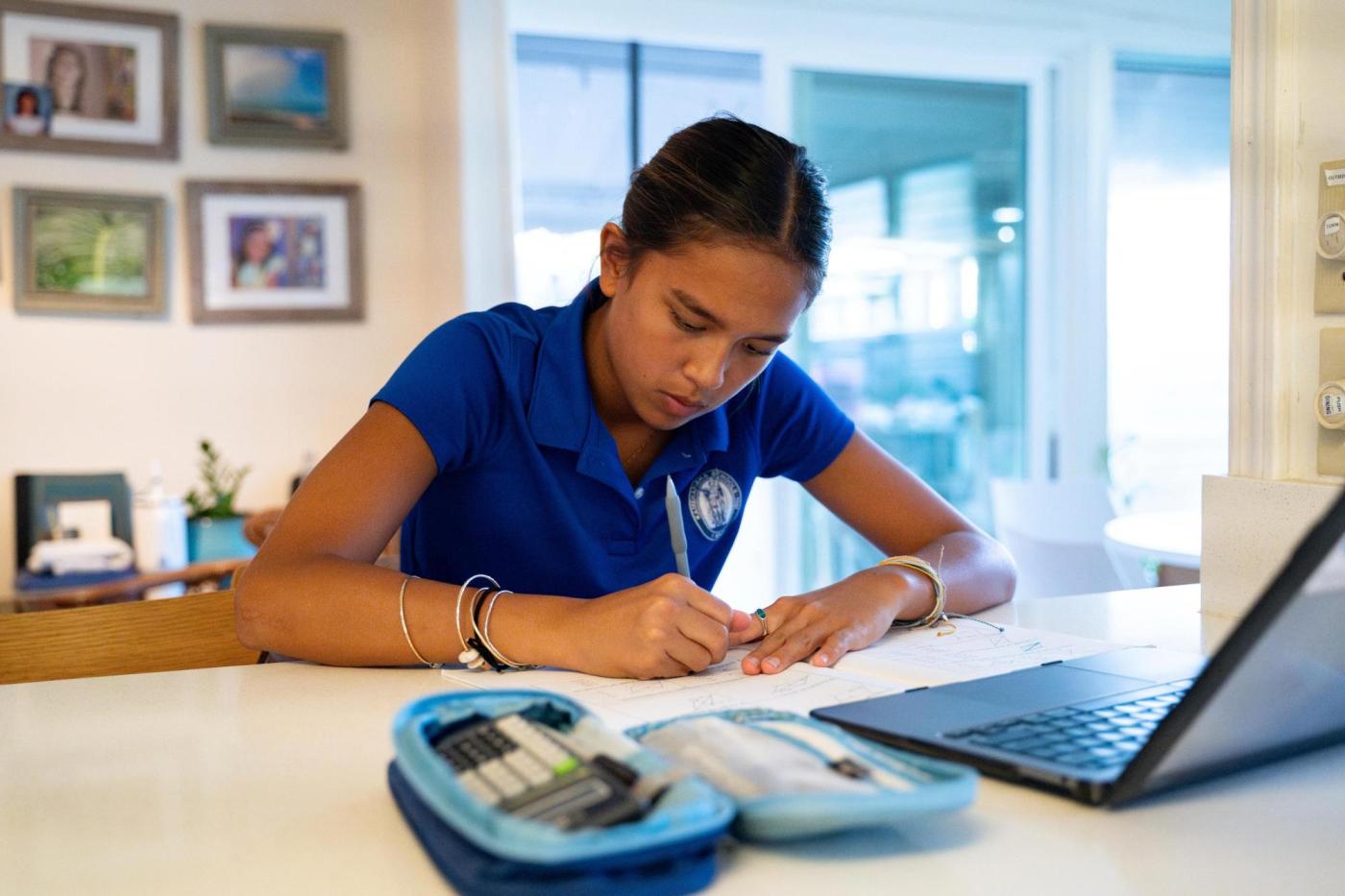
HONOLULU (AP) — After water polo practice at her school atop a hill overlooking Honolulu Harbor, Kapua Ong marvels at the sunset.

“I do feel proud of myself for getting in because not everyone gets accepted,” said Kapua, 14, a freshman at Kamehameha Schools, a competitive private school with affordable tuition that gives preference to Native Hawaiians. “I’m just, like, grateful for being able to have those opportunities.”

Kapua was just a baby when her parents set the stage for her acceptance at the school by adding details of her Native Hawaiian ancestry to a genealogy database. As an incoming seventh grader, she also took an admissions test and highlighted her kung fu skills and fluency in Hawaiian language.

Kamehameha Schools gives admissions preference to the Indigenous people of Hawaii, with a caveat: “to the extent permitted by law.”

A campaign is underway to test the policy’s legality and stop Kamehameha from favoring Hawaiians, part of a movement to expand the legal definition of racial discrimination in education. Conservative activists have been emboldened by a Supreme Court ruling against affirmative action in college admissions and by the Trump administration’s war against diversity, equity and inclusion. Now, they’re targeting scholarships, academic programs and admissions policies tied directly or indirectly to race.

Students for Fair Admissions, led by Edward Blum, a leading opponent of affirmative action, set up a website this month vowing to challenge Kamehameha’s admissions policy in court. “It is essentially impossible for a non-Native Hawaiian student to be admitted to Kamehameha,” the site says.

Alumni, parents and local leaders are urging the private school system with an endowment valued at more than $15 billion — larger than most universities — to fight to defend the policy.

“I’m hoping they hire a good lawyer, build a good case,” said Andria Tupola, a 1998 graduate and a member of the Honolulu City Council. She says the school helped her build a stronger connection to Hawaiian culture.

Attending Kamehameha can also be life-changing. The Native Hawaiian community struggles with higher rates of poverty and incarceration, so Hawaiian children may have educational disadvantages. Admission to Kamehameha offers a chance for quality private school education — with boundless opportunities, first-class facilities and Hawaiian cultural values.

Along with a breathtaking ocean view, the sprawling Honolulu campus boasts top amenities — an Olympic-sized pool, buffet lunches, athlete laundry service and grounds adorned with native plants. An annual, elaborate Hawaiian song contest between high school classes is broadcast on local TV.

A Hawaiian princess’s will

Kamehameha Schools was founded by the will of Bernice Pauahi Bishop, the great-granddaughter of King Kamehameha I. When she died in 1884, her will directed the establishment of schools that give preference to Native Hawaiians. The endowment also supports scholarships to other private schools, plus community activities.

Last year, more than 5,400 students enrolled across three Kamehameha campuses on Oahu, Maui and the Big Island.

Each year, the number of applications exceeds the number of spaces by as much as 17 to 1, depending on the campus and grade, the Kamehameha website says.

There’s an understanding among Hawaii residents that only students with Hawaiian blood will be admitted. Many see the policy as a way to remedy disparities stemming from U.S. colonization and the 1893 overthrow of the Hawaiian Kingdom by a group of American businessmen.

Sterling Wong, a Kamehameha spokesperson, declined to say how many non-Hawaiian students have been admitted.

Related Articles


MN Attorney General reaches $220,000 settlement in Hmong College Prep funds suit


Trump administration boosts HBCU funding after cutting grants for Hispanic-serving colleges


Youth mental health challenges keep mounting 2 years after Maui wildfires


Annunciation Catholic School programming to resume


Belwin opens $3.6M accessible outdoor-education facility with ‘first-class experience’ — for all

Kalani Rosell was the first non-Hawaiian to graduate from Kamehameha Schools Maui in 2007. His acceptance drew sharp criticism from Hawaiians. The school said he had been selected after a list of qualified Hawaiian students had been exhausted.

More than 15,000 people protested after a 2005 ruling by a panel of the 9th U.S. Circuit Court of Appeals struck down the policy of restricting admission to Hawaiians, ruling it violated federal civil rights law. Kamehameha sought a rehearing.

The following year, the court upheld the policy. Kamehameha later settled with the family of the white student who brought the case when he was denied admission.

“We anticipated that our nearly 140-year-old admissions policy, providing preference to Native Hawaiian children, would again be challenged,” Kamehameha trustees said in a statement. “We are confident that our policy aligns with established law.”

‘Heavy hitter’ takes on the Hawaiian schools

When Kekoa Kealoha, who graduated in 2003, heard about the campaign against the school, he was shocked to hear it was led by “somebody who was, like, a real heavy hitter.”

Students for Fair Admissions sued Harvard and the University of North Carolina in cases that led to the landmark 2023 Supreme Court decision barring colleges from considering race in admissions decisions.

Blum, a former stockbroker, has since expanded his opposition to racial preferences throughout education, fueled by President Donald Trump’s fight against DEI.

Reached by The Associated Press, Blum said he was traveling and asked for written questions. Then, he didn’t respond.

Blum’s group probably will argue the Kamehameha policy is unlikely to survive the strongest form of constitutional review because it has an absolute race-based requirement for admissions, said John Tehranian, a professor at Southwestern Law School in Los Angeles.

Kamehameha could counter that its policy is not race-based, but a classification based on political status, drawing on cases that allow government programs for Native Americans, he said.

Blum’s group is going after anything related to race and “seeing what sticks,” said Natasha Warikoo, a professor at Tufts University, who wrote a book about affirmative action.

Though the Supreme Court decision focused on university admissions, conservatives have increasingly targeted K-12 schools, along with admissions factors they consider “proxies” for race, including family income and neighborhood.

For instance, in July, the conservative Pacific Legal Foundation filed a lawsuit challenging an admissions policy at Boston Public Schools’ elite exam schools that gives students additional points if they’re from lower-income areas.

Hawaiian Republican calls campaign ‘racist’

When Blum launched his campaign against Kamehameha, people started calling Brenton Awa, a Hawaiian Republican state senator.

Awa didn’t get into Kamehameha and graduated from a public school, but he called Blum anyway. When Blum didn’t call back, Awa and another Republican flew to the East Coast to find him.

“If anybody had a chance at discussion, it would be us,” Awa said.

The Arlington, Virginia, address on the website led the duo to just a mailbox. They went to an office for Blum’s attorneys but had no luck. So they met with Republicans in Washington to educate them about Kamehameha’s mission.

“Anybody going after Kamehameha Schools with this kind of initiative and intention, to us that’s racist,” Awa said.

Moving to Hawaii for ‘life-changing’ school

Kona Purdy and his family moved back to Hawaii in 2021, partly because his daughter was accepted to Kamehameha. The family had moved to Las Vegas, joining many Hawaiians who could no longer afford to live in the islands.

They were forced to move back to Vegas in 2023 when they lost their housing. “We had considered leaving her … so that she could stay in the school,” Purdy said. “It was life-changing.”

Kamehameha only charged the family about $100 in tuition.

The family returned to Hawaii in June. Purdy’s daughter is now a seventh grader at a public school.

She will apply to Kamehameha next year, hoping to rejoin for high school.

“Hopefully, the admissions policy is still in place so she has the best shot,” Purdy said.

Associated Press education writer Collin Binkley contributed.

DNR: Zebra mussel larvae reported in Phalen chain of lakes in Ramsey County

posted in: All news | 0

Zebra mussel larvae has been found in Lake Gervais and Spoon Lake, according to the Minnesota Department of Natural Resources. The lakes are part of the Phalen chain of Lakes in Ramsey County, between Little Canada and Maplewood.

State officials had taken water samples from Lake Gervais, Kohlman Lake, Keller Lake and Spoon Lake to check for zebra mussel larvae. While larvae were found in Lake Gervais and Spoon Lake, adult zebra mussels have not been detected. Nevertheless, the larvae indicates zebra mussel presence. The two lakes — as well as the connecting lakes Kohlman and Keller — will be listed as infested.

To prevent the spread of invasive species, the DNR asks people to:

• Clean watercraft, trailers and equipment to remove aquatic plants and prohibited invasive species.

• Drain all water and leave drain plugs out when moving watercraft and get rid of unwanted bait in the trash.

• Never release bait, plants or aquarium pets into state waters.

• Use dry docks, lifts and rafts for 21 days before moving watercraft from one waterbody to another. Also, spray down watercraft and equipment with high-pressure hoses or rinse them off with water.

There are free stations to decontaminate watercraft around the state — for more information go to the DNR website.

Anyone thinking they have found zebra mussels or other invasive species can contact the DNR at dnr.state.mn.us/invasives/ais/contacts.html.

More information can be found at mndnr.gov/ais.

Related Articles


How much will your taxes go up? St. Paul, Ramsey County, SPPS asking for hikes


New federal charges against 3 men for 3 Roseville and Little Canada robberies in 3 hours


Man fatally shot over drug debt at St. Paul homeless encampment, charge says


Forest Lake man sentenced for friend’s fatal overdose at White Bear Lake hotel


St. Paul homeowners face bigger tax burden as other property values fall

Longtime St. Paul coffee shop Kopplin’s to close next month

posted in: All news | 0

After nearly 20 years in St. Paul, Kopplin’s coffee shop will pour its last cup next month.

Related Articles


Rio 1854, from family behind Taco Libre, coming to former Dock spot in Stillwater


Minneapolis restaurant named Food & Wine’s Restaurant of the Year


St. Croix Chocolate Co. in Marine on St. Croix has been sold


As The Lexington turns 90, a public celebration and a new chef


Dining Diary: Trying classic and new-to-me foods at the Minnesota State Fair

While owners Andrew and Amanda Kopplin plan to continue roasting coffee and selling beans online and via wholesale, they’re shutting down the Marshall Avenue cafe and walk-up window when their lease ends, they announced on social media. An exact closing date has not been announced but is expected to be in October.

“For many reasons, (this) is the best move for us at this time,” the pair wrote online. “Wherever you stopped along your journey, thanks for sharing a cup with us! We hope you’ll stop by the window if you’re around, and we’ll see your names on our shipping and subscription lists into the future.”

The Kopplins did not respond to a request for comment.

Andrew Kopplin opened his namesake coffee shop in April 2006 in Highland Park and moved to the current Marshall Avenue spot in 2011. During those early years, Kopplin’s was one of the first and only places in the Twin Cities to find specialty or “third-wave” coffee roasted in small batches.

That style of coffee is popular now but, outside of a few places like Spyhouse and Peace Coffee in Minneapolis and JS Bean Factory and to some extent Dunn Brothers in St. Paul, was not well-known or understood in the early 2000s. So there was just as much education going on in the snug Highland Park shop as coffee-brewing, Andrew Kopplin told the Pioneer Press in 2007.

“If you can get people through it and they like what you’re doing, they’re a very devoted customer because there’s no one else that does it. But you have to get them here,” he said at the time.

Kopplin’s: 2038 Marshall Ave.; 651-808-0958; kopplinscoffee.com

FDA takes aim at Hims and other telehealth services in drug advertising blitz

posted in: All news | 0

By MATTHEW PERRONE, AP Health Writer

WASHINGTON (AP) — For the first time, federal health officials are taking aim at telehealth companies promoting unofficial versions of prescription drugs — including popular weight loss medications — as part of the Trump administration’s crackdown on pharmaceutical advertising.

The Food and Drug Administration on Tuesday posted more than 100 letters to various drug and online prescribing companies, including Hims & Hers, which has built a multibillion-dollar business centered around lower-cost versions of blockbuster obesity injections.

The FDA warned the company to remove “false and misleading” promotional statements from its website, including language claiming that its customized products contain “the same active ingredient” as FDA-approved drugs Wegovy and Ozempic. The formulations cited by regulators are produced by specialty compounding pharmacies and aren’t reviewed by the FDA.

“Your claims imply that your products are the same as an FDA-approved product when they are not,” states the warning letter, dated Sept. 9.

San Francisco-based Hims said Tuesday that it “looks forward to engaging with the FDA.”

“Our website and our customer-facing materials note that compounded treatments are not approved or evaluated by the FDA,” the company said in a statement.

It’s the first FDA attempt to directly police online platforms like Hims, which have long argued they’re not subject to traditional drug advertising rules.

A memo signed by President Donald Trump last week directed Health Secretary Robert F. Kennedy Jr. and the FDA to ensure that pharmaceutical ads on TV, social media and other websites are “truthful and non-misleading.” As part of the initiative, the FDA promised to send 100 letters to companies with deceptive ads.

The new FDA letters each contain “cease and desist” language. That’s a different approach for the agency, which typically drafts its letters in highly bureaucratic language citing specific FDA regulations.

Related Articles


Here’s what dermatologists are saying about your skin care routine: Keep it simple


Kennedy’s vaccine committee plans to vote on COVID-19, hepatitis B and chickenpox shots


Youth mental health challenges keep mounting 2 years after Maui wildfires


The nest is empty: Parents grapple with mixed emotions after children move out


Unproven Lyme disease tests and treatments are proliferating

Hims has been under scrutiny from Washington for months.

Earlier this year, a Super Bowl ad from the company touted the benefits of its weight-loss medications but didn’t list any of their side effects or potential harms. FDA rules require advertisements to present a balanced picture of drug risks and benefits.

Makary singled out the ad in last week’s Journal of the American Medical Association, calling it a “brazen” example of how advertising is “contributing to America’s culture of overreliance on pharmaceuticals for health.”

Hims and similar companies initially sold cheap generic versions of drugs for hair loss, erectile dysfunction and other health issues. But booming demand for obesity medications opened the door to selling cheaper copies.

The FDA permits so-called compounding, or customized production, when there is a shortage of the official versions of FDA-approved medications.

FDA recently determined that the GLP-1 drugs no longer met the criteria for a shortage. That should have ended the compounding, but there is an exception: The practice is still permitted when a prescription is customized for the patient.

Hims and other companies have taken to offering “personalized” dosages and formulations for certain patients, arguing they offer extra benefits.

The letters posted Tuesday come from FDA’s drug center.

A letter posted last week from FDA’s vaccine division took issue with a TV ad for AstraZeneca’s FluMist vaccine, saying the spot’s “background music and visual distractions” detract from information about side effects. The letter was signed by FDA vaccine chief Dr. Vinay Prasad, an ally of Kennedy who recently returned to his job at the agency after briefly being forced to step aside.

Researchers and consumer advocates have long complained that the upbeat TV images of patients enjoying life with family and friends often overshadow discussions of side effects.

Additionally, studies have shown that patients exposed to drug ads are more likely to ask their doctors about the medication, even if they don’t fit the prescribing criteria. The American Medical Association, the nation’s largest physician group, came out in support of a ban in 2015, citing TV advertising’s role in “inflating demand for new and more expensive drugs.”

The Associated Press Health and Science Department receives support from the Howard Hughes Medical Institute’s Science and Educational Media Group and the Robert Wood Johnson Foundation. The AP is solely responsible for all content.