The 15th annual St. George Middle Eastern Festival will return to West St. Paul this weekend for a cultural celebration featuring food, dancing, live Arabic music and camel rides.
The event will be from noon to 10 p.m. Saturday and noon to 6 p.m. Sunday at the St. George Antiochian Orthodox Church.
“It’s more of all the same fun we’ve had at the last 14 festivals,” founding chair Anthony Rezcallah said.
The St. George Dance Troupe and Lebanese singer John Khoury will perform at the event. Middle Eastern cuisine, such as falafel and kebab wraps, will be served. There will be a bake sale, a silent auction and a children’s tent with games and activities.
The event is free. Visitors can park in front of the church at 1250 Oakdale Ave. in West St. Paul.
WASHINGTON (AP) — Senate Republicans were exploring changes Tuesday to President Donald Trump’s request to cancel $9.4 billion in previously approved spending targeted by his Department of Government Efficiency, signaling potential difficulties ahead of an important test vote.
Related Articles
World’s premier cancer institute faces crippling cuts and chaos
Immigration agents demand tenant information from landlords, stirring questions and confusion
Capital One, Walmart: A look at some of the consumer cases dropped by the CFPB under Trump
Mike Waltz pledges to make UN ‘great again’ at Senate confirmation hearing
With Epstein conspiracy theories, Trump faces a crisis of his own making
The president is looking to claw back $1.1 billion of funding authority from the Corporation for Public Broadcasting and about $8.3 billion from foreign aid programs that aim to fight famine and disease and promote global stability. Congress has until Friday to get a bill to the president’s desk for his signature or the spending stands.
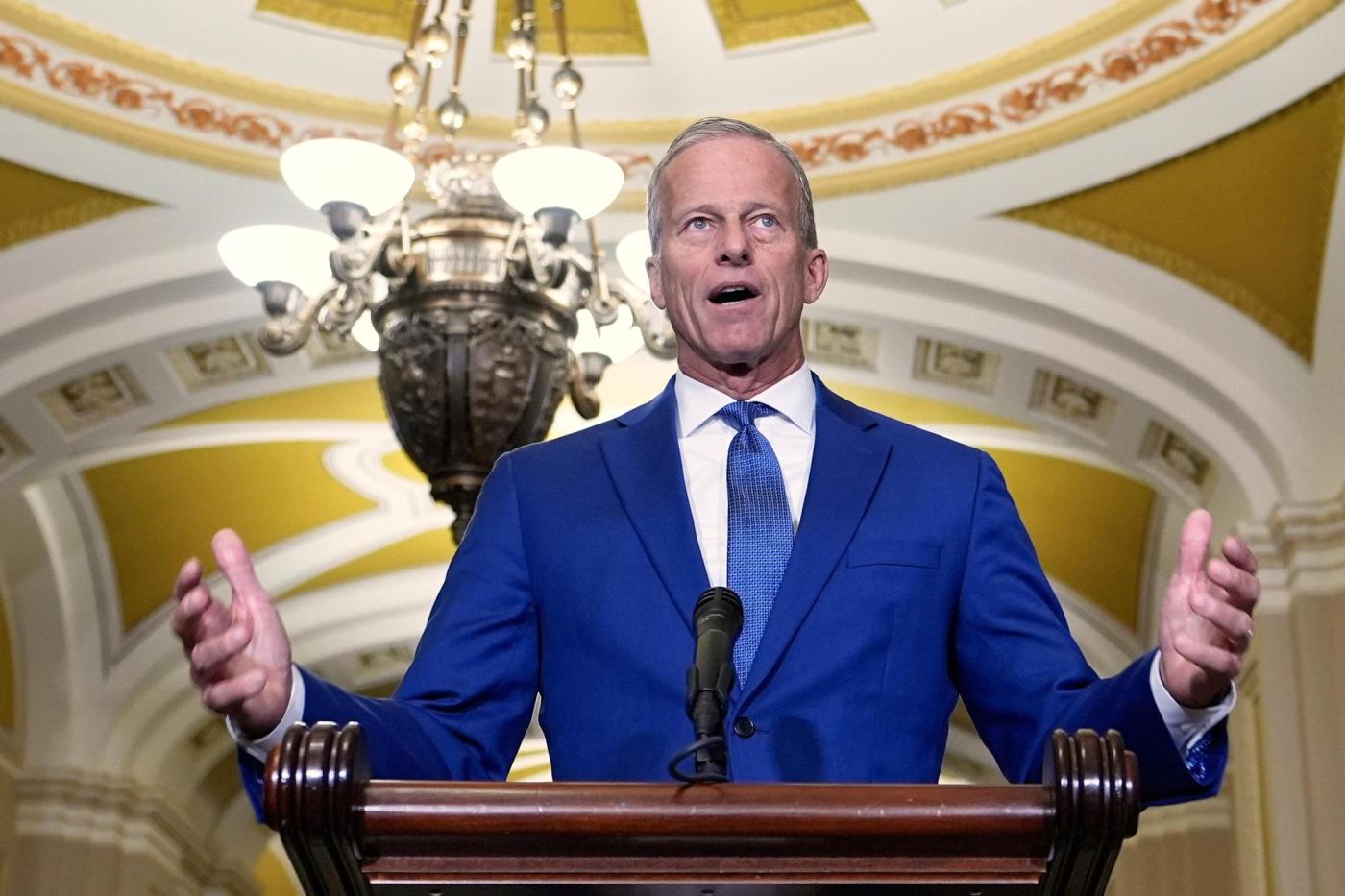
Senate Majority Leader John Thune, R-S.D., said some GOP senators would like to see “modest changes” to the bill. He’ll need nearly every Republican senator on board to get the package approved, but some are questioning the severity of the cuts to public media and to a global health program known as PEPFAR that has saved millions of lives since it was established under then-President George W. Bush.
“We’re trying to find out if there’s a path forward that gets us 51 (votes) and stays consistent with what the White House proposed in terms of a rescissions package,” Thune told reporters.
Republicans were expected to hear directly from Russ Vought, the director of the White House Office of Management and Budget, during their weekly conference luncheon on Tuesday as the White House worked to address their concerns.
The White House campaign to win over potential holdouts was already having some success. Sen. Mike Rounds, R-S.D., tweeted that he would vote to support the measure after working with the administration to “find Green New Deal money that could be reallocated to continue grants to tribal radio stations without interruption.”
Sen. Susan Collins of Maine, the Republican chairman of the Senate Appropriations Committee, said she still had questions about what the administration was seeking to cut from global health programs.
Other senators are worried that the cuts to public media could decimate many of the 1,500 local radio and television stations around the country that rely on some federal funding to operate. The Corporation for Public Broadcasting distributes more than 70% of its funding to those stations.
Democrats are expected to unanimously oppose the package. They see the president’s request as an effort to erode the Senate filibuster. They also warn it’s absurd to expect them to work with Republicans on bipartisan spending measures if Republicans turn around a few months later and use their majority to cut the parts they don’t like.
“It shreds the appropriations process,” said Sen. Angus King, an independent from Maine who caucuses with Democrats. “The Appropriations Committee, and indeed this body becomes a rubber stamp for whatever the administration wants.”
If senators vote to take up the bill, it sets up the potential for 10 hours of debate plus votes on scores of potentially thorny amendments in what is known as a vote-a-rama. The House has already shown its support for the president’s request with a mostly party line 214-212 vote, but if the Senate amends the bill, it will have to go back to the House for another vote.
“We’re encouraging our Senate partners over there to get the job done and to pass it as it is,” House Speaker Mike Johnson said Tuesday. “That’s what we did.”
Republicans who vote against the measure also face the prospect of incurring Trump’s wrath. He has issued a warning on his social media site directly aimed at individual Senate Republicans who may be considering voting against the rescissions package. He said it was important that all Republicans adhere to the bill and in particular defund the Corporation for Public Broadcasting.
“Any Republican that votes to allow this monstrosity to continue broadcasting will not have my support or Endorsement,” he said.
Congressional correspondent Lisa Mascaro and staff writer Stephen Groves contributed to this report.
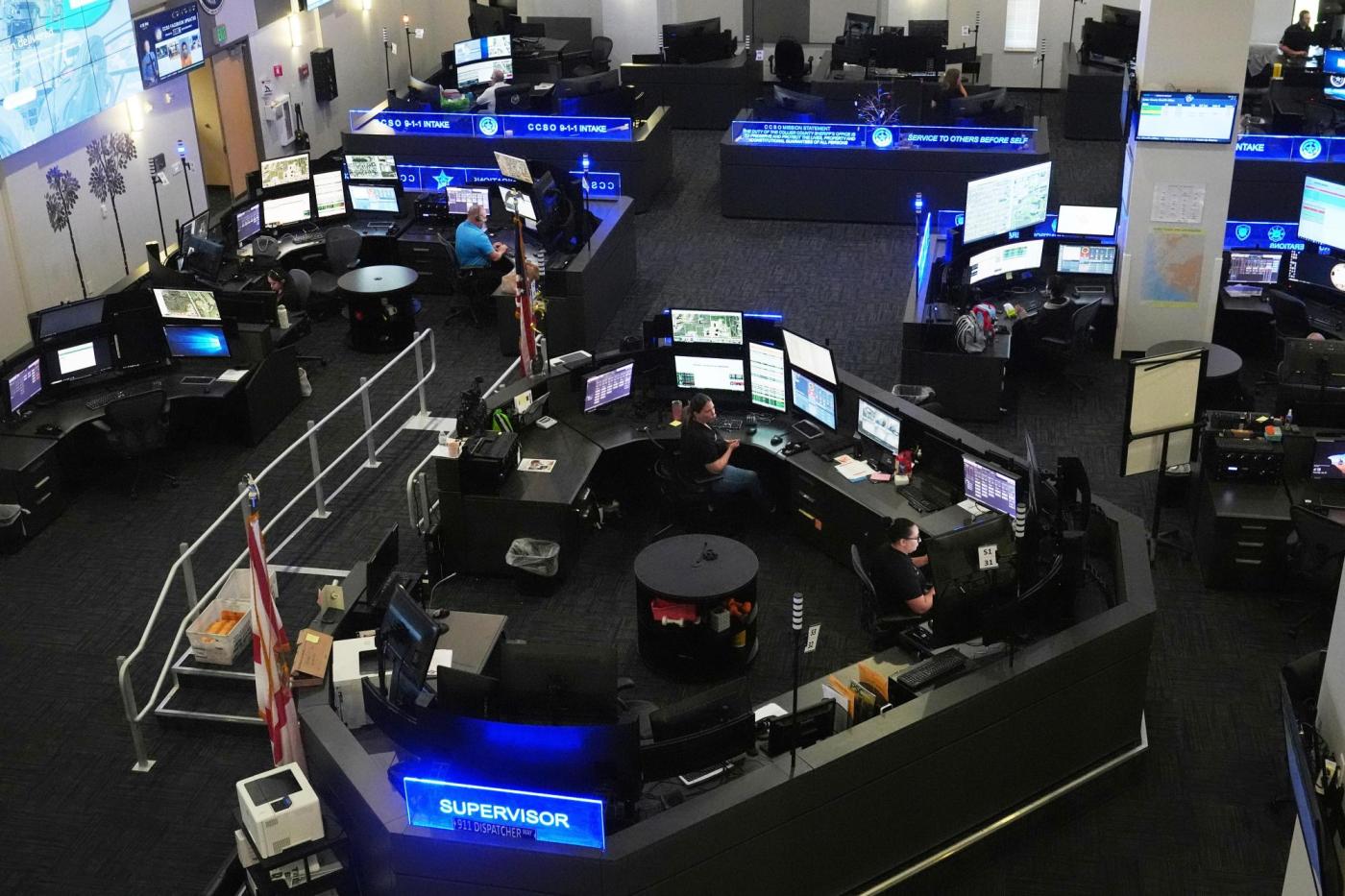
NAPLES, Fla. (AP) — When an emergency happens in Collier County, Florida, the 911 calls go to one of the most high-tech communications centers in the U.S., where callers can send text and video from the scene to dispatchers.
Related Articles
Murder trial begins for Colorado dentist accused of poisoning wife’s protein shakes
Most US stocks fall, but Nvidia keeps Wall Street near records
2 dead in New Jersey after flood waters carry away vehicle during heavy rains that hit Northeast
JPMorgan posts strong second quarter numbers, though Dimon warns of tariff, geopolitical risk
The tariff-driven inflation that economists feared begins to emerge
Moving to what’s known as an NG911 — or Next Generation 911 — system is a journey Sheriff Kevin Rambosk and Bob Finney, the county’s director of communication, have been on for much of the past decade.
It’s a long way from Feb. 16, 1968, when Alabama’s then-House Speaker Rankin Fite made the nation’s very first 911 call in Haleyville, Alabama, on a bright red, rotary-style landline telephone. That ceremonial call came just 35 days after AT&T announced plans to use 911 as a nationwide emergency number.
Today, most calls to 911 originate with cellphones, with dispatchers in upgraded centers using geo tracking to get accurate geographic locations from callers.
But the response time in an emergency depends on the type of technology being used at any of the 6,000 emergency communications centers in the U.S. that receive 911 calls. There is no uniform emergency system in the U.S., so individual cities, counties, states or geographic regions are responsible for operating their own 911 call centers.
While some states have fully updated to NG911 systems, others are still using legacy 911 systems that rely on antiquated equipment.
“We’re just reminded in these last two weeks, with the flooding in Texas, just how important the work of 911 is,” said Michael Martin, CEO of RapidSOS, which provides infrastructure that passes critical data to emergency centers across the United States.
The future is now for 911
The Collier County Sheriff’s Office covers 911 calls from an area of about 2,030 square miles that stretches from sandy beaches at the southernmost tip of the Gulf Coast on Florida’s peninsula inland to the Everglades.
It’s a region that has been ravaged by hurricanes this century, including Hurricane Irma in 2017 and Hurricanes Ian and Milton most recently.
That’s why Sheriff Rambosk wanted a high-tech emergency operations center.
“We just believe that when we can reduce the response time using technology, it will improve safety and survivability of those calling in,” said Rambosk, who has been sheriff since 2009. “And that’s really what we’re all about, keeping people safe and rescuing them when they need it.”
Today 61 full-time employees and three part-timers staff two emergency operations centers around the clock.
Dispatchers work emergency calls at the Collier County Emergency Services Center, Friday, July 11, 2025, in Naples, Fla. (AP Photo/Marta Lavandier)
Collier County Sheriff Kevin Rambosk explains the upgrades to the technology used by emergency responders, Friday, July 11, 2025, in Naples, Fla., at the Collier County Emergency Services Center. (AP Photo/Marta Lavandier)
Dispatcher Donna Bocik responds to a 911 call at the Collier County Emergency Services Center, Friday, July 11, 2025, in Naples, Fla. (AP Photo/Marta Lavandier)
Senior dispatcher Jude Sannicandreo responds to an emergency call at the Collier County Emergency Services Center, Friday, July 11, 2025, in Naples, Fla. (AP Photo/Marta Lavandier)
1 of 4
Dispatchers work emergency calls at the Collier County Emergency Services Center, Friday, July 11, 2025, in Naples, Fla. (AP Photo/Marta Lavandier)
They rely on data that RapidSOS collects from connected buildings, devices, vehicles and even smart watches to send first responders to emergency scenes. The baseline data is provide free of charge to all 911 centers, Martin said.
Mixing technology with emergency response
As Hurricane Helene was tracking toward north Florida last September, forecasters were predicting it could hit Tallahassee as a major Category 3 storm. Officials in Leon County, which serves the state’s Capitol and nearby counties on legacy 911 equipment, reached out to Collier County, some 430 miles to the southeast, to see if they could take over emergency calls if the storm knocked their center out.
Helene moved to the east of Tallahassee, but Collier County was prepared to help if needed.
“Because of the partnership with Rapid SOS, they were able to create a map to where not only did we see our own calls, but we could see exactly where the calls were coming in Tallahassee,” Finney said.
Collier County has also partnered with Charleston, South Carolina, as a backup 911 center. Each region is fully prepared to take on 911 calls for the other in case their emergency system goes down for any reason.
It’s a similar story in North Carolina, where legislation in 2017 helped establish funding for a next generation 911 system, said Pokey Harris, who serves as president of the National Association of State 911 Administrators and executive director of the North Carolina 911 Board.
Harris said Hurricane Helene provided validation for the upgraded system by being able to direct 911 calls from areas that were devastated by the storm to other parts of North Carolina that were not affected.
“During Helene, if a citizen could reach a dial tone, even though their local 911 center may have been impacted because of infrastructure devastation, another center somewhere in the state could answer their call,” Harris said.
No federal funding for next-generation systems
Next Generation 911 systems aren’t cheap.
“There has been no federal funding for 911,” Martin, of RapidSOS said. “It has been in various draft formats as long as I’ve been doing this and it’s never gotten through Congress.”
There is also no federal oversight of 911, he said.
“It’s really quite remarkable how well 911 works despite those challenges,” Martin said. “I think it’s a testament to the people of 911, not the technology.”
In a downtown St. Paul switcheroo of sorts, Afro Deli has moved across the street to the Treasure Island Center building. And Pino’s Pizzeria, a longtime skyway staple popular with downtown workers, will move into Afro Deli’s former space on West Seventh Place.
Afro Deli’s new space “offers an enhanced dining experience with improved facilities and extended operating hours,” according to a news release.
The restaurant will be open until 8 p.m., which means dinner is an option for residents and event-goers.
Pino Lipari, center, owner of Pino’s Pizzeria, located in the Alliance Bank Center in downtown St. Paul, serves up pizza to his lunchtime crowd on Tuesday, March 11, 2025. Commercial tenants in the building were notified late Monday by owner Madison Equities that they should vacate the premises as the building will lose all heating, cooling and electricity on Wednesday. (John Autey / Pioneer Press)
There are signs up at Afro Deli’s former space announcing the imminent opening of Pino’s Pizzeria, but a peek inside shows there’s a bit of work to be done. A July 4 social media post from the restaurant says it will open very soon.
Pino’s, which operated in St. Paul’s skyway for 30 years, has been closed since March, when tenants of the beleaguered Alliance Bank Building were told to vacate the premises, as heating, cooling and electricity would be turned off.
Afro Deli is celebrating its 10th year in St. Paul. Its website has been updated with the following:
“As we settle into our new space, we’re dreaming about all the possibilities ahead. More community events, new menu items we’ve been excited to try, and countless more years of serving the St. Paul family that’s embraced us so completely.
“Thank you for 10 amazing years. Thank you for growing with us, supporting us, and making us feel like we truly belong in this incredible city. Here’s to many more years of great food, warm community, and the flavors that bring us all together.”
Afro Deli: 400 N. Wabasha St. #200, St. Paul; 651-888-2168; afrodeli.com
Pino’s Pizzeria: 1 W. Seventh Place, St. Paul; orderpinos.com
Related Articles
Dining Diary: Pre- and post-event dining in St. Paul and Duluth yields delicious results
French restaurant Aubergine to move into former Revival space on Selby Ave.
Suburban restaurant group hires former Revival, Corner Table chef Thomas Boemer
A first taste of the Palace Pub, now open next to St. Paul’s Palace Theatre
Former Coffee Cup space reopens as The Perfect Coffee, serving diner staples and more