Northern Minn. man shot, killed in exchange with deputies after allegedly starting fires

posted in: All news | 0

NORMANNA TOWNSHIP — Law enforcement shot and killed a man suspected of starting several fires at his neighbors’ homes and shooting a gun at responding officers.

St. Louis County Sheriff Gordon Ramsay said in a video posted to Facebook on Tuesday afternoon that a call for a report of a structure fire on Heritage Road in Normanna Township came in at around 9:20 a.m.

The first caller said their neighbor had “sprayed” gasoline on a family member and lit their home on fire. Then another neighbor called to report that the suspect was armed with a rifle. The suspect, who lived next door to the reporting party, attempted to light the second neighbor’s house on fire, Ramsay said. Meanwhile, the suspect’s own home was “engulfed” in fire.

Ramsay said a lone volunteer firefighter from Normanna Township arrived to put out both fires at each neighbor’s house. At 9:27, the firefighter and a neighbor reported hearing shots fired.

The firefighter “believed he was shot at” but not hit, Ramsay said, and the firefighter sheltered in place. At 9:36 a.m., an officer from the Duluth Township Police Department arrived, and the suspect shot at that officer, Ramsay said. The officer was not hit and did not return fire, Ramsay said.

At 9:52 a.m., the suspect “engaged” five deputies from the St. Louis County Sheriff’s Office, causing “all five deputies to discharge their weapons, striking the suspect,” Ramsay said.

Deputies unsuccessfully attempted lifesaving measures on the suspect, Ramsay said. No one else was injured.

The officers, whose names were not released, are on administrative leave, as is standard procedure. “I could not be more proud of our deputies,” Ramsay said. “They used their training, their experience, and teamwork to protect the community and to safely end this very dangerous and chaotic situation.”

Ramsay said he requested the Minnesota Bureau of Criminal Apprehension investigate the deputies’ use of force and turned the scene over to them.

The Minnesota Bureau of Criminal Apprehension posted the following statement: “BCA agents and crime scene personnel are on scene of a use-of-force incident in St. Louis County.”

That same initial report included the promise of further details “after the preliminary investigation is complete.”

Ramsay said “homemade devices” were found on the scene and are believed to have been “designed to shoot projectiles at first responders as they approached on the road.”

While Ramsay did not identify the suspect, authorities were initially dispatched to 6258 Heritage Road, home to Adam Clinton Wolf, shortly after 9 a.m. Tuesday.

Three neighbors had a restraining order against Wolf, 57, and he was awaiting a hearing for allegedly violating that order for a second time, court documents show.

The most recent incident to prompt charges occurred Oct. 13, when Wolf reportedly banged pieces of metal and shouted homophobic insults at the occupants of a neighboring residence.

He was found guilty of violating a restraining order July 1, 2023. If convicted again, the newest charge would have been considered a gross misdemeanor. The case had been scheduled for a July 8 hearing, but it was postponed last week.

Judge Leslie Beiers wrote that, if successfully prosecuted, the charge could be considered a “qualified domestic-violence related offense.”

A neighbor had also sought reimbursement totaling over $5,000 for the cost of installing a 6-foot-tall, 80-foot-long fence “to keep Mr. Wolf on his own property and to deafen the sound of his rages and insulting slurs toward my family and me.”

Related Articles


Family of man in St. Paul shooting spree apologizes to ‘innocent victims’


Mike Waltz pledges to make UN ‘great again’ at Senate confirmation hearing


Murder trial begins for Colorado dentist accused of poisoning wife’s protein shakes


Weeklong burglary trial for Minnesota Sen. Nicole Mitchell begins


Hulu series names new person of interest in Jodi Huisentruit case

Nonprofit Legal Service Employees Strike, As NYC Politics Take a Pro-Worker Turn

posted in: All news | 0

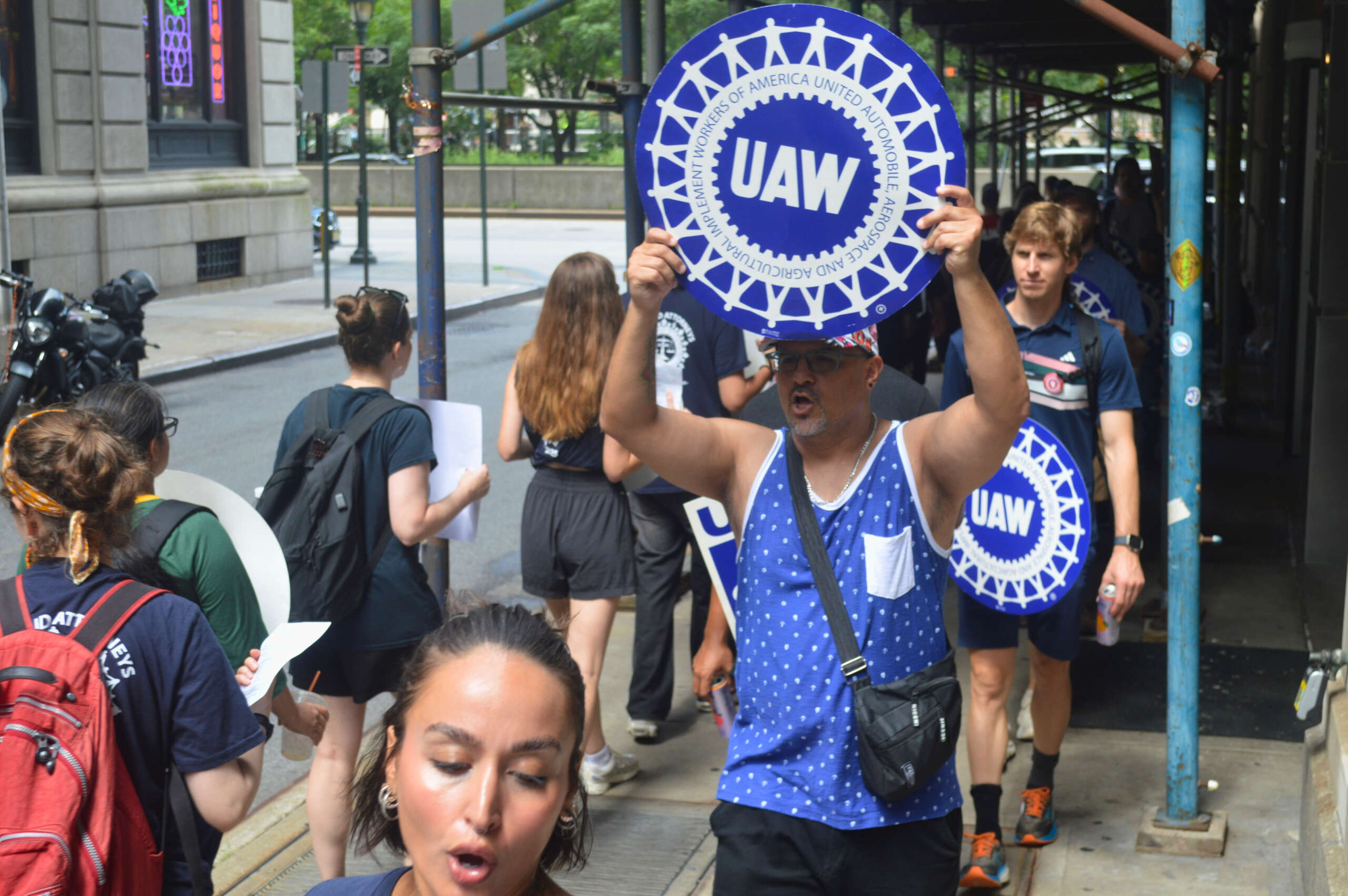
Hundreds rallied in Foley Square Tuesday, including over a dozen local politicians—Zohran Mamdani, the Democratic nominee for mayor among them—in a strong show of support for the striking workers, who include attorneys representing low-income tenants in housing court.

Legal services workers picketing outside Urban Justice Center’s offices in Manhattan on Tuesday, July 15. (Tareq Saghie for City Limits)

In July of 2023, the Association of Legal Advocates and Attorneys, UAW Local 2325 (ALAA) passed a resolution to engage in sectoral bargaining for the workers they represent at legal aid organizations across the city.

As part of this strategy, they aligned the workers’ contract expiration dates to June 30 of this year, believing they could achieve more ambitious demands with collective power. 

On Tuesday, the plan came to fruition, as workers at the Urban Justice Center and New York Legal Assistance Group (NYLAG) launched a strike in Manhattan’s Foley Square alongside fellow ALAA members at the Goddard Riverside Law Project, who began a strike last Wednesday. Three other shops who might go out Friday joined the rally, as well as workers from several other organizations who authorized a strike but haven’t yet announced a deadline.

The crowd of hundreds, which included over a dozen local politicians—Assemblymember Zohran Mamdani, the Democratic nominee for mayor among them—was a strong show of support for the workers’ demands, and a display of the disruption a strike could cause the courts. 

This includes attorneys representing low-income New Yorkers in housing court, where tenants are facing eviction or pursuing building repairs.

“It’s not just about how much our members make. It’s not just about their caseloads. It’s about justice for all New Yorkers who deserve high quality representation,” said Brandon Mancilla, director of UAW Region 9A, which includes New York City. “The shorter the strike, the sooner our members can get back to do the work, but it’s on the organization to ensure that that continues while we have our fight.”

If the legal staff are unable to reach contract agreements with their respective publicly-funded employers, New York City’s courts could be hit by the most disruptive labor conflict since 1994, when over 1,100 ALAA attorneys at the Legal Aid Society went on strike for higher wages, which former Mayor Rudy Giuliani promptly responded to by cutting off the contract that funded their work.

The workers quickly folded then, but Giuliani retaliated by offering the Legal Aid Society’s contracts to new, ununionized organizations, reducing the ALAA’s hold over the sector. Since then, the ALAA has slowly brought these groups into their union, such as the Bronx Defenders, whose workers have a strike deadline this Friday.

This year’s strike is in a completely different political environment, though, defined by Mamdani’s recent landslide win in the Democratic mayoral primary. Before Attorney General Letitia James recounted her experience working at the Legal Aid Society during the 1994 strike, Mamdani took the stage in front of a roaring audience of UAW members.

Assemblymember and Democratic mayoral nominee Zohran Mamdani addressing striking workers at Tuesday’s rally. (Tareq Saghie/City Limits)

“We are facing a president who is seeking to attack the very fabric of this city. In a moment like that, we have to use every single tool at our disposal to protect this city, to protect its people,” he said. 

“I look at all of you as the people on the front lines of that protection. You are the people who keep New Yorkers in their homes,” Mamdani added. “You are the people who keep families together. So it is incumbent upon every single one of us to stand with you so that you can continue to afford to do this work.”

Workers across the local legal groups share some demands, such as higher wages, reduced workloads, and transparent disciplinary processes, but units also have unique demands to their individual organizations.

The Urban Justice Center, for example, is structured around specific projects with individual pay scales, meaning workers doing the same role are paid differently in different projects. At times, these projects have split off from the organization into separate affiliates without worker input. ALAA members want consistent compensation across projects and a voice in whether their project splits off.

Workers at the Urban Justice Center are also particularly frustrated with their salaries, which start for some at around $48,000 per year, far below what an MIT study found to be a living wage in New York City. At the same time, their executive director, Doug Lasdon, earned close to $300,000 in the 2024 fiscal year. The union has lowered their wage floor proposal to just above $62,000, but management won’t go much above $50,000.

In a phone call with union members, Lasdon said only a couple people made below $55,000 anyway, and that he was “pretty sure that’s a living wage,” according to a recording of the call reviewed by City Limits.

Kristin Jamberdino, a spokesperson for the Urban Justice Center, said those salaries don’t account for bonuses and benefits, and that they offered annual pay increases over 10 percent to many workers. “We continue to work diligently towards finding a solution that will meet the needs of our staff, our obligations to our grantors, and, most importantly, the needs of our clients,” she added.

Progress toward a contract has been slow, workers say, because there haven’t been many opportunities to bargain. ALAA members say they did not receive counterproposals to their economic demands until June 6.

“With the strike, [clients] know that I will be able to show up for them better after, because they also see the effects of understaffing, they see the effects of not being able to just take their calls whenever they call me,” said Amanda Katapang, staff attorney at the Urban Justice Center. “They also know that if I have to make a decision in my career to change a pathway to take care of myself that they then wouldn’t have an attorney at all.” 

At NYLAG, workers have made progress towards their demands, with management agreeing to spend an additional $3.1 million in wages to bring everyone up to a base salary of $70,000 per year by the end of the contract. 

The union is pushing for higher immediate wage increases and cost-of-living adjustments, though, arguing that NYLAG’s proposal would erode the spending power of their wages over the course of the contract (the exact length of which is under negotiation).

Caseloads remain an issue, with the ALAA demanding management reduce their workloads to a clear standard established across the organization, and put a grievance process in place if staff are overworked.

Bargaining has also hit a wall on free speech, which became a demand after workers started speaking out against Israel’s siege of Gaza. NYLAG refuses to include free speech protections in the contract, which workers say they never needed before NYLAG began disciplining workers for hanging pro-Palestine posters. 

Many of NYLAG’s funders are supporters of Israel’s actions, including the David Berg Foundation, which funds international legal advocacy on Israel’s behalf, and BNY Mellon, which invests in Elbit Systems, an Israeli defense contractor. NYLAG says its rules around political displays are intended  to maintain a safe workplace for all employees. 

Workers at the Urban Justice Center and New York Legal Assistance Group (NYLAG) launched a strike in Manhattan’s Foley Square Tuesday. More than a dozen local politicians showed out to support the employees. (Tareq Saghie/City Limits)

NYLAG employees say these working conditions are unsustainable, but that their clients—who face issues ranging from evictions to deportations—remain their top priorities. To prepare for the strike, attorneys have been speaking with clients about what to expect and how to proceed, as well as handing off detailed memos to management about their cases.

Maya Leggatt, an attorney in NYLAG’s Tenants’ Rights division, is one of them.

“I’m so attached to my clients. I know their cases so well. And I want the best outcome for them. I have to trust in my supervisors to make sure that my clients are taken care of, but it’s very hard to let go and let that happen,” she said. 

“It’s probably going to be a shit show,” she added.

But NYLAG says the workers’ decision to strike is a decision to abandon their clients.

“No one knows the urgency of our clients’ needs better than our staff, and instead of walking away from New Yorkers in nearly every community whose basic rights are routinely under siege, we hope the Union will remain at the table and continue to bargain with us,” wrote Sara Rodriguez, a spokesperson for NYLAG.

With federal funding cuts, mass immigration crackdowns, and hundreds of evictions filed across the city per day, the work will quickly mount at the legal aid service providers. 

But with the attorneys united, supporters showing up to their rallies, and solidarity coming in from elected officials, the ALAA feels optimistic about their leverage to resolve this efficiently.

“[Elected officials] know the work we do is important, and that we’re doing it for our clients. And they haven’t always known that that’s why we’re doing this, so it’s really important to have those folks here, and it’s really important to have everyone here,” said Leah Duncan, treasurer at the ALAA and former grant writer at NYLAG. 

“Morale is very high, and members are pretty fired up. They see management making movement, but they see that that means management is scared. Management knows the power is with us.”

To reach the reporter behind this story, contact Tareq@citylimits.org. To reach the editor, contact Jeanmarie@citylimits.org

Want to republish this story? Find City Limits’ reprint policy here.

The post Nonprofit Legal Service Employees Strike, As NYC Politics Take a Pro-Worker Turn appeared first on City Limits.


Map: Scenic sites in Hawaii that are now off-limits, and why

posted in: All news | 0

A boy’s injury at a popular scenic overlook is the latest incident leading to a closure of an Oahu tourist site.

Related Articles


4 hours kayak fishing at a California lake with a fly rod … and a rattlesnake in the boat


Travel: How a swanky Bahamas resort was brought back to life


Long after the fuss over Pope Leo XIV, the village of Dolton will still be here


USS Midway Museum debuts ‘top secret’ exhibit on Navy intelligence


Best campground in the US, according to camping app

The Koko Crater trail (blue No. 1 on the map) was closed after an 8-year-old fell 20 feet down a shaft on July 5. It reopened five days later with some areas of the summit off limits.

Other Oahu trails, however, have been permanently closed or switched to permit-only status because of hazards or overuse.

The map above shows these sites:

Closed (red)

1. Haiku Stairs (Stairway to Heaven). This route has been officially closed since 1987, but it continued to draw crowds — especially after it began getting attention on social media. Neighbors complained of trespassing, noise and littering, and in April 2024 the demolition of the stairs began.

2. Sacred Falls. It has been closed to the public since 1999, when a rockslide killed eight people. In February of this year, a California couple in their 60s had to be airlifted out after falling from the trail. They had been hiking for about 15 minutes, they told the rescuers.  Several days later, while her husband was still in the hospital, the woman was fined $1,000 for violating the restriction, the state’s parks agency said.

Permit or reservation required (orange)

1. Diamond Head. Since 2022, non-residents have been required to make a reservation ($5 per person) and pay for parking ($10 per car) to hike to the summit that looms over Honolulu.

2. Lulumahu Falls. A day-use permit is required to hike this short out-and-back trail off the Pali Highway.

3. Poamoho Trail. Hikers need a permit (and a high-clearance 4-wheel-drive vehicle) to get to the trailhead for the spectacular and challenging ridge hike.

4. Kuaokala Trail. A day-use permit is required for hiking, biking or four-wheeling in the area accessed through the Ka’ena Point Air Force property.

In addition to the Oahu trails, reservations are required for the Kalalau Trail on Kauai’s famed Na Pali Coast. The out-and-back covers 22 rugged miles, so most people doing the full trip will be spending a night at one of the two camping areas, but day hikers also need a permit.

Proposed Transmission Line Threatens Texas’ Largest Reservoir 

posted in: All news | 0

Houstonian Mike Peppercorn bought property along Lake Livingston in 2008, choosing timberland where his family would have privacy and pasture where they could raise cattle for Future Farmers of America projects. He and his neighbors with acreage along Barrett’s Landing Road all figured that surely this lake—which serves as a reservoir for the City of Houston 80 miles south—was an invaluable public resource that would forever be protected.

That seemed like a safe bet. Lake Livingston, an enormous impoundment of the Trinity River created in 1971, is surrounded by retirement homes, ranchettes, and sprawling RV parks. Part of its shoreline is a popular 635-acre state park, and its waters, stocked with bass, crappie, and catfish, are favored by Texas anglers’ for fishing tournaments.

The reservoir, the largest located entirely in Texas, is owned by the Trinity River Authority and is a major source of Houstonians’ drinking water.

So it shocked Peppercorn‚ and his neighbors Karl Van Brocklin, a retired engineer, and Randy and Ginny Lammers, when energy giant Entergy Texas Inc. (ETI) proposed building a high-powered electrical transmission line, up to 160 miles long, that would run right through their properties and the lake itself. 

One of Entergy’s favored pathways for the project, dubbed the SETEX Area Reliability Route would cut across about a mile of the reservoir. And yet Entergy, records show, 

didn’t ever bother to inform the City of Houston—which gets about 70 percent of the water produced by the reservoir—about its proposed lake routes.

Lammers, Peppercorn and Van Brocklin, all former Houstonians who regularly gather to share research in a barn-like workshop on Lammers’ property, worry about much more than the impact of unsightly poles and power lines on birds and on the people who live, boat, and fish here. They fear that its construction could unleash toxic threats buried in the lake’s sediment that could poison the fish and impair water quality for Houston residents—and for everyone downstream.

“All of these routes are 100 miles long. Going across the lake is one mile. For the safety of everybody’s drinking water, why go across the water?” Peppercorn said in an interview with the Texas Observer.

Until this small group reached out to Randy Macchi, director of Houston Public Works, city officials knew nothing about it. Entergy’s plans call for erecting a variety of steel structures that, if one of the lake routes are chosen, would be anchored to pilings and stand at least 75 to as much as 195 feet tall above the water and could create a mile-long path of obstacles between 125 and 250 feet wide.

After being informed by the Barrett’s Landing bunch, Macchi dispatched a letter of opposition expressing concerns that any route across the lake could adversely impact the city’s water supply. “The construction of powerlines across Lake Livingston could create many undesirable scenarios; none of which are in the best interest of HPW’s customers or the customers of other entities” that receive treated lakewater,” he wrote.

But the city’s letter of opposition arrived too late to be considered. Macchi, who did not respond to the Texas Observer’s request for comment, told KPRC he’s outraged that the utility’s failure to inform city officials shut them out. “There’s a regulatory process, and Entergy notified a lot of entities… The City of Houston was not one of them. And that’s troubling—because this isn’t just a lake; it’s our most critical water source.”

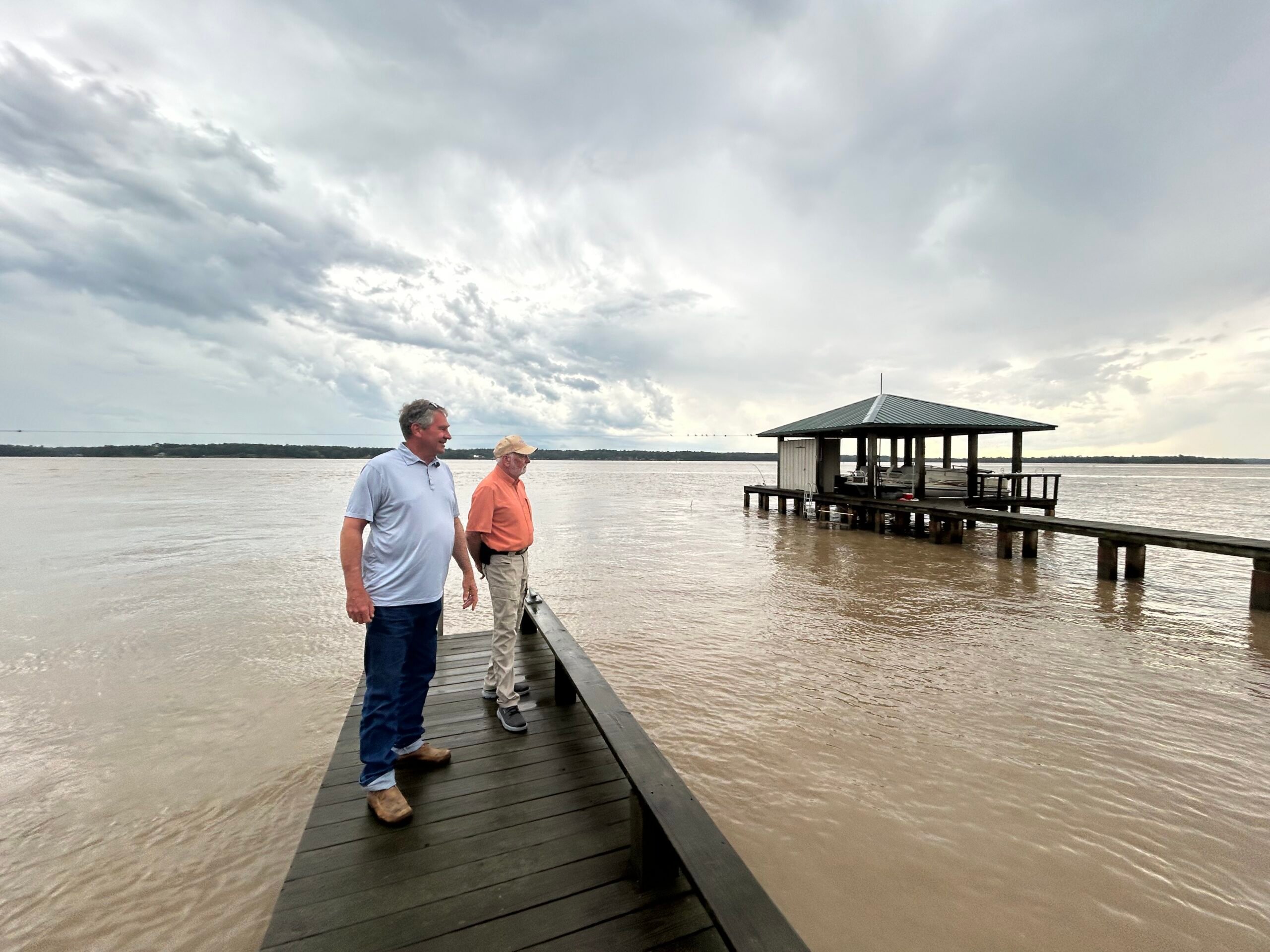
Neighbors Mike Peppercorn (left) and Randy Lammers (right) fear that a proposed electrical line project that may cross Lake Livingston—and their neighborhood—could stir up contaminated sediment. (Photo by Lise Olsen)

The contested project, part of Entergy’s plans to improve the grid that connects Entergy’s power plant in Willis with several counties in East Texas, is now under review by an administrative law judge at the State Office of Administrative Hearings. By August, the judge is expected to make a recommendation on the project to the Texas Public Utility Commission. But a look at the growing number of opponents to Entergy’s proposed Lake Livingston routes shows that Entergy thus far has done little testing to determine how the lake’s ecosystem might be affected by the construction or by the power line itself. 

In the Texas Parks and Wildlife Department’s comment, the agency’s wildlife division director Alan Cain remarked that the company had done insufficient work to determine the impact on “important rare or protected species and their associated habitats”—including alligator snapping turtles and other creatures that live in or near the reservoir—along the more than 100-mile route proposal. The letter doesn’t specifically mention the Livingston reservoir.

Lake Livingston may look pristine. Indeed, park officials boast that its shoreline is home to multiple nesting pairs of Bald Eagles. Trinity Water Authority officials like to brag that big strides have been made to improve the quality of the river’s sometimes turbid water since the passage of the Clean Water Act in 1972.

But this huge reservoir’s waters are still troubled. Since 2017, it has been listed by the Texas Commission on Environmental Quality (TCEQ) as an impaired body of water—contaminated by cancer-causing dioxins and PCBs. In other words, it’s one of the lakes and rivers that the state has designated as needing more protection and clean-up to fully comply with the lofty aims of the Clean Water Act. In 2017, the TCEQ did a limited amount of testing of sediment in the lakebed, probing four sites for toxics, but those samples are miles away from the proposed route, according to a report posted online.

For even longer, an underfunded Texas fish-testing program has documented that some of this lake’s gar and even its prized species of catfish and bass are essentially too dangerous to be regularly eaten by anyone because of those same carcinogenic contaminants. 

Though Lake Livingston and other East Texas lakes along the Trinity River continue to be popular for anglers, the state health department has issued periodic advisories warning children and women of child-bearing age not to eat gar and bass or catfish–and for all others to limit consumption. Surprisingly, Cain, the Texas Parks and Wildlife official who reviewed the proposed pipeline routes, doesn’t mention Lake Livingston or the fish studies that the park service has conducted there over the years.

The source of the poisons found in those fish issues is believed to be contaminated sediment in the bed of the lake—sediment that’s already frequently disturbed by floods and hurricanes but would be stirred up by the process of excavation and construction of those enormous metal towers and high-powered lines.

Entergy has also failed to consider that Lake Livingston is used for “recreational purposes”–despite the ubiquitous presence of fishermen, boaters and campers, according to documents filed by the Trinity River Authority (TRA) Attorneys representing the TRA, which opposes the route through the lake and favors alternatives, have objected that there was “no discussion of recreational uses of Lake Livingston itself and no discussion of boating or potential public safety hazards that would be created.” (The TRA did not immediately respond to the Observer’s request for comment).

For its part, Entergy insisted in a statement released to KPRC that “we are committed to transparency and continue to fully participate in the regulatory review process, which includes opportunities for public input and review of all routes under consideration.”

The utility company’s statement adds it was “also committed to complying with all federal and state environmental regulations, including any permitting requirements under the Clean Water Act. While route evaluation is ongoing and no final decision has been made, each proposed route—including lake and land crossings—is being thoroughly assessed based on a number of factors, including environmental impact, community input, engineering feasibility, and long-term reliability for our customers.” 

Peppercorn argues that Texans who fish, live, and ultimately drink this water deserve more answers before the PUC approves construction through this large reservoir and popular recreation area. He and his neighbors argue that any other route would be better.

“We want a study on the water,” he told Observer. “There’s a lot of people who pull water on the Trinity River and on Lake Livingston–and not all of them have the sophistication of the City of Houston…Why not do the right things?”

The post Proposed Transmission Line Threatens Texas’ Largest Reservoir  appeared first on The Texas Observer.