‘Fear is the tool of a tyrant,’ fired federal prosecutor Maurene Comey tells colleagues

posted in: All news | 0

By ERIC TUCKER and ALANNA DURKIN RICHER

WASHINGTON (AP) — Maurene Comey, the daughter of former FBI director James Comey who as a federal prosecutor in Manhattan worked on cases against Sean “Diddy” Combs and Jeffrey Epstein, said in a note to colleagues that “fear is the tool of a tyrant” and that her firing without reason should fuel “a fire of righteous indignation at abuses of power.”

Related Articles


The House is poised to OK Trump’s $9 billion cut to public broadcasting and foreign aid


State Department layoffs affect key Trump priorities like intelligence, energy and China


Consultant, claiming White House backing, called Colorado clerks to gain access to voting machines


Trump administration hands over Medicaid recipients’ personal data, including addresses, to ICE


Border Patrol hiring spree offers lessons as another immigration agency embarks on massive growth

“If a career prosecutor can be fired without reason, fear may seep into the decisions of those who remain,” Comey said in the note, which was obtained by The Associated Press on Thursday. “Do not let that happen. Fear is the tool of a tyrant, wielded to suppress independent thought.”

“Instead of fear,” she added, “let this moment fuel the fire that already burns at the heart of this place. A fire of righteous indignation at abuses of power. Of commitment to seek justice for victims. Of dedication to truth above all else.”

Until her firing Wednesday, Comey had been a veteran lawyer in the Southern District of New York, long considered the most elite of the Justice Department’s prosecution offices. Her cases included the sex trafficking prosecution of Epstein, who killed himself behind bars in 2019 as he was awaiting trial, and the recent case against Combs, which ended earlier this month with a mixed verdict.

Her termination represented the latest Justice Department effort to fire lawyers without explanation, a trend that has raised alarm over a disregard for civil service protections designed to prevent terminations for political reasons. The department has also fired a number of prosecutors who worked on cases that have provoked Donald Trump’s ire, including some who handled U.S. Capitol riot cases and lawyers and support staff who worked on special counsel Jack Smith’s prosecutions of the Republican president.

She was long seen as a potential target given her father’s fraught relationship over the last decade with Trump. The Justice Department recently appeared to acknowledge the existence of an investigation into James Comey, though the basis for that inquiry is unclear.

Maurene Comey had most recently been among the prosecutors in the sex trafficking and racketeering case against Combs. The failure to convict the hip-hop mogul of the main charges, while gaining a conviction on prostitution-related charges that will likely result in a prison sentence of just a few years, was viewed by some fellow lawyers as a rare defeat for prosecutors.

But she was successful in numerous other prosecutions, most notably the conviction of Ghislaine Maxwell on sex trafficking charges for helping financier Epstein sexually abuse underage girls. In that case, she delivered a rebuttal argument during closings, as she did in the Combs case.

Her firing comes as Attorney General Pam Bondi faces intense criticism from some members of Trump’s base for the Justice Department’s decision not to release any more evidence in the government’s possession from Epstein’s sex trafficking investigation. Some right-wing internet personalities, like Laura Loomer, who have been critical of Bondi’s handling of the Epstein files, had been calling for Maurene Comey’s firing.

James Comey was the FBI director when Trump took office in 2017, having been appointed by then-President Barack Obama, a Democrat, and serving before that as a senior Justice Department official in Republican President George W. Bush’s administration.

But his relationship with Trump was strained from the start. The FBI director resisted a request by Trump at a private dinner to pledge personal loyalty to the president — an overture that so unnerved the FBI director that he documented it in a contemporaneous memorandum.

Trump soon after fired Comey amid an investigation into potential ties between Russia and Trump’s presidential campaign. That inquiry, later taken over by special counsel Robert Mueller, would ultimately find that while Russia interfered with the 2016 election and the Trump team welcomed the help, there was insufficient evidence to prove a criminal collaboration.

Trump’s fury at the older Comey continued long after firing him from the bureau, blaming him for a “hoax” and “witch hunt” that shadowed much of his first term.

Comey disclosed contemporaneous memos of his conversations with Trump to a friend so that their content could be revealed to the media. The following year, Comey published a book calling Trump “ego driven” and likening him to a mafia don. Trump, for his part, has accused Comey and other officials of treason.

Associated Press writer Larry Neumeister in New York contributed.

Ground squirrels are taking over a North Dakota city and officials are not amused

posted in: All news | 0

By JACK DURA

MINOT, N.D. (AP) — The Richardson’s ground squirrel weighs less than a pound, is about a foot long and is native to the northern Plains.

Related Articles


‘Fear is the tool of a tyrant,’ fired federal prosecutor Maurene Comey tells colleagues


Can artificial reefs in Lake Michigan slow erosion and boost fish population? Researchers aim to find out.


An Idaho judge has lifted a sweeping gag order in Bryan Kohberger’s quadruple murder case


Why is the Los Angeles Innocence Project trying to free Scott Peterson?


Trump administration hands over Medicaid recipients’ personal data, including addresses, to ICE

The little creature also is a ferocious tunneler, and it’s exasperating the people of Minot, North Dakota, where it’s burrowing everywhere from vacant lots to the middle of town, and growing more plentiful over the past two decades.

Now North Dakota’s fourth-largest city is fighting back, but even the pest control guy leading the charge acknowledges that it will be difficult to turn the tide against the rodent.

An uphill battle

Joshua Herman said fighting the squirrels is akin to “one guy standing against a massive storm.”

“If I’m trapping but my neighbor isn’t, well then, we’re really not going to get anywhere with it, long-term,” Herman said.

Ground squirrels have been an issue in Minot, a city of nearly 50,000 people, for at least 20 years, but the problem has dramatically worsened in the last few years, said Minot Street Department Superintendent Kevin Braaten.

It’s unclear how many of the squirrels live in Minot but it likely nears or even exceeds the city’s population.

“Gosh, there’s got to be tens of thousands of them in the area,” Herman said.

Officials in the city, a green spot along the winding Souris River surrounded by farmland and grassy prairie, know they can’t get rid of the squirrels, but hope to simply get the rodent numbers down.

“I don’t see the population ever going to zero,” Braaten said. “I mean, it’s almost impossible by the numbers that we have.”

Three Richardson’s ground squirrels appear Monday, July 14, 2025, in a vacant lot near apartment homes in Minot, N.D. (AP Photo/Jack Dura)

Put another way, Minot won’t be able to rid itself of the squirrels because the animals have lived on the prairie for centuries. Outside of town, predators like coyotes, badgers, owls and even snakes love to dine on the squirrels. But in residential neighborhoods and even downtown, where few of their predators live, the rodents can roam pretty freely.

Greg Gullickson, an outreach biologist with the North Dakota Game and Fish Department, adds that the squirrels now have fewer grassland areas available to them and like the mowed spots they find in town.

No land is safe

Female squirrels typically give birth to litters of about six babies a year, so it’s easy to see how their numbers can quickly soar.

Herman said he kills 3,500 to 5,000 of them a year, primarily by putting snares and carbon monoxide into the holes, and using an air rifle.

“I’ve had calls downtown, calls in the mall, along the highways, here at the airport — really every part of the city I’ve done trapping for ground squirrels here in Minot,” Herman said as he checked his traps along an apartment building and shoveled dirt over holes.

Herman says they damage driveways, sidewalks and lawns; create tripping hazards with their holes and can harbor disease from fleas.

Along an apartment building, the squirrels had dug under a concrete slab and against the foundation. Nearby in a vacant lot, the rodents popped in and out of holes.

Ground squirrels near Pashone Grandson’s ground-level apartment dig holes near her door and eat her plants. One squirrel even got around her baby gate at the door and into her daughter’s clothes in her bedroom.

“It was a little scary. You don’t know what disease they carry. They’re dirty. I have a young daughter … I didn’t know if it was going to bite her,” Grandson said.

North of town, Minot Air Force Base, which houses bombers and intercontinental ballistic missiles, has fought the ground squirrels for years. Earlier this month, the base said it had trapped more than 800 “dak-rats,” a base name for the rodents.

Base officials declined to comment on the squirrels.

Jared Edwards, facilities director for Minot Public Schools, which has three schools on the base, said residential areas of the base and runways are overrun by ground squirrels. He called it “a continuous battle for them for the last 75 years since the base has been there.”

“I’m not going to exaggerate: They’re by the millions out there,” Edwards said.

In town, three school properties have large populations of ground squirrels, he said. Last year, the school system began using snares, and for years before that had used poison.

“It’s something you have to keep up with. It is Mother Nature,” Edwards said, adding that they’ve probably been in the area since homesteaders came through.

A cute nuisance

Still, not everyone sees the squirrels as a pest. Some find the critters cute and fuzzy.

Herman said people have sabotaged, stolen or thrown out his traps. They occasionally confront him when he shoots at ground squirrels with an air rifle, scolding him for hurting the wildlife, he said.

“They get that cute association, and they are, you know, adorable, but they’re a vermin and a pest and dangerous when they are allowed to proliferate,” Herman said.

Can artificial reefs in Lake Michigan slow erosion and boost fish population? Researchers aim to find out.

posted in: All news | 0

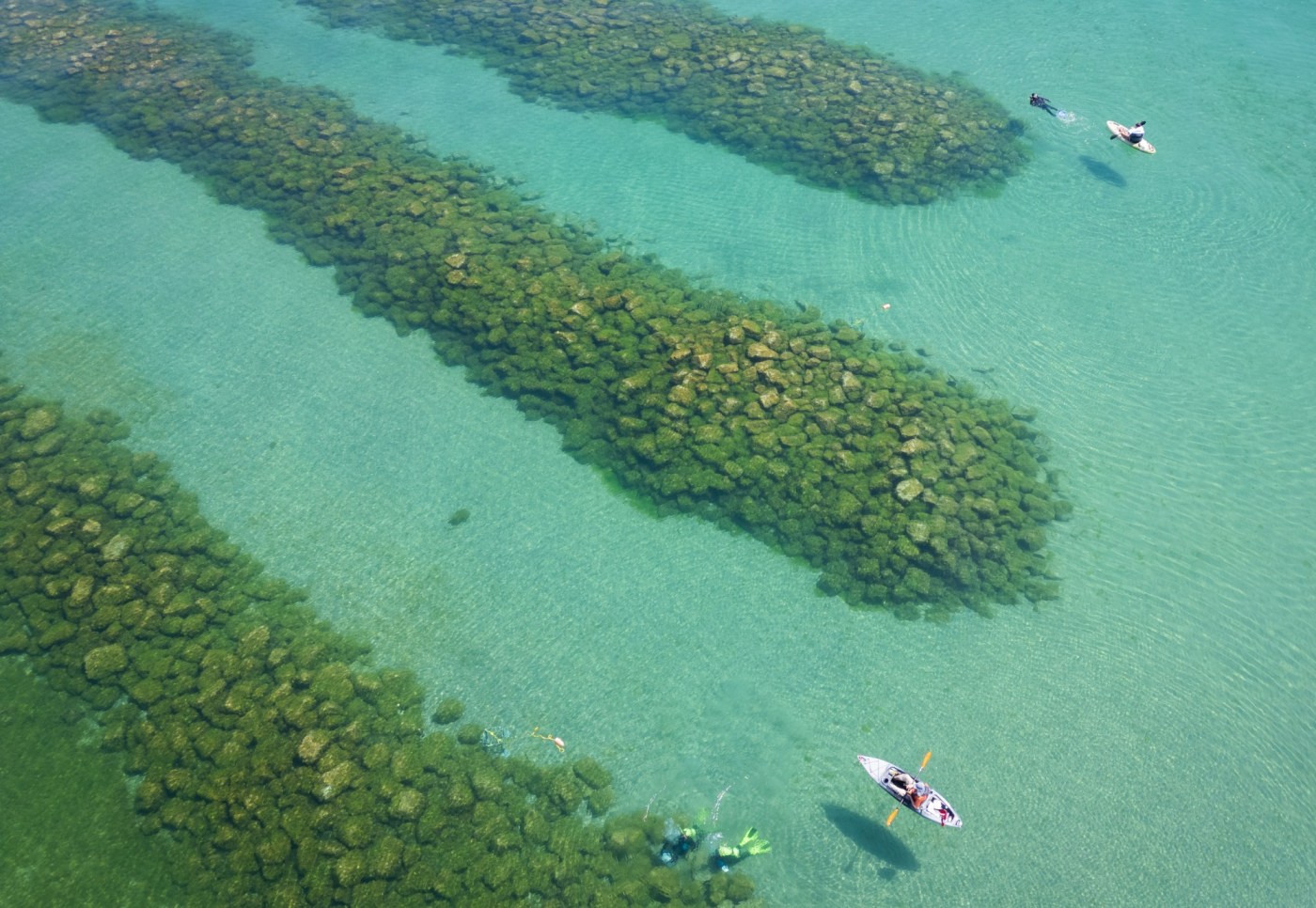
Floating about 500 feet offshore of Illinois Beach State Park, Hillary Glandon tightened her scuba goggles, grabbed a small masonite plate from a nearby kayak and dove beneath the Lake Michigan surface.

The masonite plate, called a Hester-Dendy sampler, helps biologists like Glandon scrape algae off underwater rocks. Just a few feet below the surface, she reached a huge underwater ridge made of limestone and other rocks piled into 750-foot rows parallel to the coast.

On this dive in late June, a crew of four scuba divers ferried equipment back and forth between the kayaks and the underwater ridges, collecting sediment samples near the boulders and dropping off underwater cameras on the bottom of the lake. As the divers continued their work, a thick morning fog began to fade, giving way to clear blue waters. From the surface, schools of juvenile fish could be spotted drifting between patches of sunlight at the bottom of the ridges.

These structures, called “rubble ridges,” aren’t just typical rocky reefs found on the bottom of the Great Lakes — they’re entirely man-made.

“We just want to see, are these reefs impacting aquatic biodiversity as well as sediment retention?” Glandon said. “We’re trying to get the whole picture of the aquatic community, and in order to do that, we need to sample in a lot of different ways. It allows us to not only look at the sediment … but also the critters that are living in there.”

Man-made reefs have become a popular way to provide a habitat for fish in coastal communities. The rubble ridges, however, are also designed as a cost-effective tool to prevent erosion. Each ridge sits about 3 to 5 feet beneath the lake’s surface, which allows them to block some of the energy and sediments carried by waves during intense winter storms. When these waves reach the coast, they don’t hit the shoreline as hard, which slows the process of erosion. And the gaps between each ridge help to retain some sediment without fully stopping the natural flow of sand.

“The designers call it passive sand management, just to slow erosion down when it’s the worst,” said Steve Brown, the Illinois state geologist. “That was part of the idea — a lower-cost offshore breakwater system. And we’re trying to see, does it work like the designers thought it would work?”

Glandon and her team of biologists and geologists at the Lake Michigan Biological Station, a research station in Zion run by the University of Illinois, are studying the rubble ridges as part of a federally funded pilot project through the Great Lakes Restoration Initiative. The initiative is a collaborative effort that provides funding to over a dozen federal agencies to protect the Great Lakes through infrastructure and lake monitoring projects.

Installed at Illinois Beach State Park in 2021 by the U.S. Army Corps of Engineers, the ridges are being monitored along with another artificial reef at Fort Sheridan in Highland Park, as well as two control sites, about 2 miles south of each respective reef.

In this part of Lake Michigan, just 3 miles south of the Illinois-Wisconsin state line, the lake bottom consists of a flat layer of sand, which doesn’t usually attract invertebrates and smaller fish.

But as Glandon descended onto the rocky ridge, she saw hundreds of fish, from species that tend to stay near the reef year-round like the round goby, to schools of younger migratory species like alewife that were using the ridge as a nursery habitat.

By analyzing both biodiversity and shoreline changes at the reef, researchers are hoping to see whether this new kind of infrastructure could be scaled up as a tool for cities across the Great Lakes.

“Lake Michigan is a very dynamic place. It is always changing, and it always wants to change, and it always will change,” said Philip Willink, a biologist with the Illinois Natural History Survey and an expert on natural reefs in Chicago. “People don’t like that change and are trying to hold the shoreline in stasis, when, in reality, nature wants to erode some shoreline … But how do we put that into city planning?”

Tracking shoreline changes

As Glandon and a crew of three other scuba divers and two kayakers ventured out to sample algae and sediments at the ridges, a few other researchers remained onshore to help handle equipment. It was the research team’s first dive of the year, and biologist Scot Peterson could already spot the traces of erosion from the winter’s storms.

Where a wooden boardwalk had once extended out over the beach, only a small chunk of wood remained, poking out from under a sand dune on a nearby roadbed. Strong waves had gradually weakened the structure over the past few years, and last year, the state park decided to remove it altogether.

“Every time I come back, it feels like something has changed,” Peterson said.

Sights like these are common across the Great Lakes, and Lake Michigan in particular can be especially “unpredictable,” said Liz Spitzer, a coastal geologist with the Illinois State Geological Survey. The lake’s levels tend to fluctuate from low to high in 10- to 30-year cycles, with levels usually reaching their annual peak during the summer.

However, climate change is speeding up these fluctuations, experts say. In January 2013, Lake Michigan was at a record low. Just 3 ½ years later, the lake had risen 4 feet and by July 2020, it nearly broke the record high. Lake levels have always fluctuated, but that has been over a period of decades. Now these shifts are happening within a few years. That variability is attributed to multiple factors, but increased precipitation from climate change is the driving force.

Today, lake levels are hovering at about 579 feet, close to the lake’s average.

At Illinois Beach State Park, these fluctuations have taken a toll, causing extreme erosion along the coastline. Kellogg Creek, located just south of the rubble ridges, has flooded several times over the past few years, damaging one of the buildings that researchers at the Lake Michigan Biological Station used to store samples. The lake bed at the northern part of the beach has eroded away, leaving grass roots exposed as windswept dunes pile up behind the shore.

In response, the Illinois Department of Natural Resources approved a massive breakwater installation project in 2019 for the state park. The state spent $73 million to install 22 breakwaters along a 2.2-mile stretch of the state park’s shoreline, making it the largest capital project in IDNR history.

According to a 2023 release about the breakwaters, the state intended the structures to “guide and direct the movement of the sand instead of simply trying to prevent its movement.” The breakwaters, made of stone, are angled slightly to the northwest to block storms that typically come from that direction. IDNR officials did not respond to requests for comment.

The breakwaters, along with 430,000 cubic feet of sand that was added to bolster the beach, have helped rehabilitate the beach since construction finished in August 2024. The first chain of breakwaters ends just a few hundred feet north of the rubble ridges.

With extreme erosion and other construction projects unfolding at the state park, Glandon said her team has had to deal with several “confounding factors” at this reef site.

“The rubble was actually supposed to be built a little bit north of where it currently is, and that’s because the large breakwater project was in the process of being designed when the rubble was being implemented,” Glandon said. “They moved (the rubble) further south to accommodate those breakwaters.”

The monitoring project at Illinois Beach State Park began in 2021 and is set to wrap up next year. The other artificial reef site at Fort Sheridan has been monitored since 2023 under a different project funded by the Illinois-Indiana Sea Grant. Researchers are comparing the results between the two sites, hoping to explain how reef systems function along different types of shorelines. The shoreline at Fort Sheridan consists mostly of rocky bluffs, and the lake bottom in that area is dotted with small boulders.

Each spring, geologists have used drones to map the elevation of the bottom of the lake, allowing them to compare any changes in the lake’s topography that happened during the winter storm season and see if the reefs are helping retain sediment.

According to the research team’s preliminary results, the Fort Sheridan reef has successfully helped to build up some sand. At Illinois Beach State Park, though, erosion has overall increased. Most of this erosion occurred between 2022 and 2024, with very little change happening at the site during the 2025 winter season.

“The sediment dynamics, that part of it is going to be very hard to make any conclusions without a huge asterisk, since they built these big breakwaters,” Glandon said. “But what we’re hoping to do is kind of zoom out with the geology story, and tell it from the perspective of before they built these big breakwaters and after. We’re just trying to be nimble with the way we’re sampling.”

Starved of sand

Illinois Beach State Park, which boasts the state’s longest continuous stretch of natural shoreline, is somewhat of an anomaly. The park takes up 6.5 of Illinois’ 63 miles of coastline along Lake Michigan, and the majority of this coastline consists of man-made structures, such as breakwaters or seawalls.

This infrastructure is meant to help protect the urban coastline from eroding. However, it’s not how the shoreline naturally functions, according to Spitzer.

“Along this stretch of the coast, the dominant current is generally coming from the north, going southward,” she said. “Over the past couple thousand years, with the direction of the dominant current, we’ve been seeing the sand moving southward over time. And then human activity adds an extra layer of complexity to that, because that compartmentalizes where the sand can go.”

The goal of most coastal protection structures, like seawalls, is to retain sand that’s flowing through the lake. This helps build up extra sand along lakefront beaches and harbors, and lessens the impacts of erosion. Sand was already a scarce resource in southern Lake Michigan before humans began to build coastal infrastructure, according to a 2020 study conducted by Brown and other geological survey researchers, making sand retention in the area particularly vital.

But man-made structures, which often run perpendicular to the shore, can also block the natural southward flow of sand. So while seawalls can build up sand in one location, a beach directly downstream of that seawall might face worse erosion as a result.

“Every time we create a structure, it stops the sand movement, and you get erosion downstream,” said Brown. “And so the real question is that we haven’t sorted out how to live along the lake.”

The rubble ridges were designed to be an “actively moving system,” Glandon said — as waves crash against the ridges over several years, researchers expect that some of the boulders will tumble to the bottom, flattening out over time.

Since reef structures like the rubble ridges run parallel to the coast, they serve as somewhat of a middle ground — they retain some sand near the coastline but still allow most of it to pass through. So as the sand moves downstream, it leaves more for lakefront properties to the south to use as they build up their own shorelines, helping distribute sediments more evenly across the lake.

That’s part of the reasoning behind government investments in this project, Glandon said. Currently, most municipalities along the North Shore run their own coastal management programs and tend to build shoreline infrastructure like seawalls without consulting their neighbors. When one town builds a seawall, it creates a so-called domino effect — that can starve neighbors of sand directly to the south, and usually the only solution is to build their own seawalls.

“When we have private land ownership, it can be tricky to manage sediment movement that occurs outside of those human-created bounds,” Glandon said.

Using infrastructure like artificial reefs, or other more natural designs, could help alleviate the need to build seawall after seawall. It also presents a relatively low-cost option — installing the rubble ridges cost just over $1.4 million.

“One of the hopes of our program is to try to provide this quantitative data on the effects of these structures … to give towns and local managers options for ways that they could potentially retain some sand in their areas without impacting their neighbors as much,” Glandon said.

Building biodiversity

From the shores of Fort Sheridan and Illinois Beach State Park, the artificial reefs are invisible, hovering just beneath the surface. For aquatic creatures, though, these rocky reefs are a landmark, rising distinctly above the lake bottom.

“Most of the bottom of Lake Michigan is pretty flat. It’s either sand or mud, with no real features,” Willink said. “But every once in a while, there are natural reefs out there, and these can be in shallow water, in deeper water, they can be from a variety of sources as well.”

Willink, the biologist who now works with the Illinois Natural History Survey at the University of Illinois, worked for many years at Chicago’s Field Museum and Shedd Aquarium. There, he studied one of Chicago’s most iconic underwater landmarks.

Morgan Shoal, located just off the coast of Promontory Point by 53rd Street, is one of a handful of naturally occurring rocky reefs in Lake Michigan. This reef is actually a remnant of Chicago’s ancient past, Willink said — about 425 million years ago, the modern-day Great Lakes region was located south of the equator, submerged in a tropical sea that was home to several coral reefs.

Though the region’s latitude has shifted, traces like the rocky reefs remain on the bottom of the lake, providing an ideal habitat for fish. Morgan Shoal features a wide variety of “nooks and crannies,” Willink said, which provide habitats for a range of animals from large migratory fish to small invertebrates and worms.

“In the smaller spaces, that’s where we found a lot of the aquatic insects and worms — things which may not sound super exciting, but that is the bottom of the food chain,” Willink said. “This is the key, to have a variety of different habitats. When you do that, you create more of a larger variety of living spaces for a larger variety of species. And then ultimately, you end up with a higher biodiversity on the site.”

While natural reefs often provide more appealing habitats for fish, artificial reefs are also widely used for the same purpose, and have been shown to boost biodiversity.

This has been shown at the rubble ridges, too. Both the Illinois Beach State Park and Fort Sheridan reefs showed a significant increase in fish populations and biodiversity when compared against the control site for each reef, according to preliminary data from the Lake Michigan Biological Station research team.

The team tracks fish diversity with a number of different measures. During the June dive at Illinois Beach State Park, kayakers carried large aluminum frames, each with an underwater camera mounted in the middle, out to the reefs. Scuba divers carried these frames down to the reefs, where they’ll remain for the rest of the summer season.

The cameras are programmed to take a picture every five minutes, which helps scientists track the density and mass of the fish living on the reef.

“We see at the control sites, biomass is high, but abundance is low, versus at the reef sites, we have much smaller fish,” Glandon said. “We think it’s because this is showing that the reefs are nursery habitats for these fish.”

They also take samples of algae living on the underwater boulders that make up the reef, and collect sediments to see what types of invertebrates are living at the site. These invertebrates are the core of the food chain, attracting smaller fish in search of food sources.

While fish and invertebrates do sometimes seek shelter around man-made breakwaters, Willink said they’re most attracted to natural structures that don’t totally stop the flow of sand.

“Part of the key is that it isn’t a dam to the sand, it doesn’t hold the sand there,” Willink said. “If there’s too much sediment, that would smother all these small places.”

As the reef monitoring project continues, so does the constant movement of sand. Despite humans’ best efforts to counter this, the currents of the lake are ever-changing and ever-powerful, scientists say. As lakefront communities have built containment structures along their waterfronts, this trend has remained the same — even at established places like Illinois Beach State Park, waves surge above boardwalks, benches sink beneath sand, roadways are left to crumble in the face of encroaching shorelines.

“A lot of what we’re facing right now in the 21st century is, how do we deal with nature in urban areas? How do we live with nature next to us and allow nature to do its thing, and yet still maintain the infrastructure of a city?” Willink said. “And I think that’s sort of an emerging field, trying to figure out how to deal with this sort of struggle between the two. It’s not just restricted to Lake Michigan — it’s everywhere.”

Lily Carey is a freelancer.

NYC Head Start Providers Assessing Impact of Plan to Exclude Undocumented Children

posted in: All news | 0

Head Start supports school readiness for children from birth to age 5, including free childcare, nutrition assistance, health screenings, and resources for pregnant women. It’s serving 42,997 people across New York State this year, including thousands of homeless families.

(Michael Appleton/Mayoral Photography Office)

On July 10, the U.S. Department of Health and Human Services (HHS) announced a policy change to the federal Head Start program that would exclude undocumented immigrant children from enrollment. 

The proposal would rescind a 1998 Clinton-era interpretation of the Personal Responsibility and Work Opportunity Reconciliation Act (PRWORA). It allowed certain children without legal immigration status to access services that were not considered “federal public benefits,” but rather part of the government’s school readiness education program.

The rules are expected to take effect after publication in the Federal Register on Aug. 13, following a 30-day public comment period.

They’re part of a set of changes by President Donald Trump to make it harder for immigrants to access government services, and comes as his administration adds stricter requirements for public assistance

HHS also listed other federally funded programs that would now be considered “public benefits” to exclude immigrants without legal status, which HHS Secretary Robert F. Kennedy, Jr. said had previously “diverted hardworking Americans’ tax dollars to incentivize illegal immigration.” 

Soon after the announcement, the American Civil Liberties Union sued the administration, while advocates condemned the plan.

Should the new rule take effect, it would require verification of a child’s citizenship or immigration status before they could be enrolled in a Head Start program, excluding undocumented children nationwide. 

Head Start offers a variety of services to support school readiness for children from birth to age 5, including free childcare, nutrition assistance, health screenings, and resources for pregnant women. 

It primarily serves children from low-income families, but also children who don’t have a home, are in foster care, or receiving public assistance. In the past, the program was also available to legal permanent residents, children who’ve been granted asylum, humanitarian parole or refugee status. 

According to HHS’s final regulatory impact analysis, Congress provided $12.27 billion for the Head Start Preschool and Early Head Start programs in fiscal year 2024, to serve 718,947 children and pregnant women throughout the country.

While HHS oversees the program, it’s mostly run by local municipalities. New York City Public Schools (NYCPS, formerly known as the Department of Education) runs Head Start programs in the city, as well as a network of providers that receive funding directly from the federal government. City Limits reached out to providers receiving federal funds, but they declined to speak publicly about the matter, worried it would jeopardize their funding.

HHS Secretary Robert F. Kennedy, Jr. announced the policy change on July 10. (Official White House Photo by Joyce N. Boghosian)

The National Head Start Association (NHSA), a nonprofit that represents Head Start staff and families, says Head Start funded 42,997 program seats in New York State in fiscal year 2024. The program served 3,807 local homeless families, but neither officials nor advocates know how many might be excluded from the program if undocumented children are made ineligible. 

Both NYCPS  and the Office of Children and Family Services for New York State (OCFS) don’t know exactly how many children may lose coverage, the agencies told City Limits.

“New York City Public Schools does not track or ask for our students’ immigration status or country of origin,” a City Hall spokesperson said. “We are reviewing this change and will continue to monitor the situation.”

An OCFS spokesperson said via email that the agency is “currently assessing the impact of the guidance issued by the U.S. Department of Health and Human Services (HHS).” 

HSS’s final regulatory impact analysis acknowledges that estimating the share of beneficiaries it would exclude “is inherently uncertain since this demographic information is not currently collected under the 1998 Notice.”

According to their estimates, however, “approximately 115,000 Head Start children and families could be impacted, or about 16 percent” of Head Start enrollees nationwide during the last fiscal year. 

NHSA Deputy Director Tommy Sheridan raised concerns about the policy’s potential to create barriers for children and families, especially those experiencing homelessness. “Producing documentation is a challenge, and we need to be mindful of that as we’re thinking about the verification of this,” he said. 

“We’re also really worry that requiring Head Start programs to verify [immigration] status changes both the relationship that we have with families as well as with the community, and is something that will pull us away from our primary job, which is to ensure that children are prepared for school and that families are ready to succeed in life as well,” he added.

Nora Moran, the director of policy & advocacy at United Neighborhood Houses, which provides Head Start services, said that the program’s providers and city administrators have never had to ask children or their families about their immigration status as a condition for enrollment.

“We know that there are families with varying immigration statuses who enroll their children in Head Start programs, but we cannot offer a precise number,” Moran said.

She said the announcement has confused community-based organizations that run Head Start programs. Previously, providers said their main responsibility was to identify people in the city who met the program’s income, housing, and other eligibility criteria, adding that the U.S. government had for decades viewed Head Start as an early education program, rather than a public benefit that would exclude noncitizens.

“United Neighborhood Houses condemns the federal administration’s latest attempt to undermine our communities,” said the organization’s Executive Director Susan Stamler. “To be clear: throwing immigrant children out of Head Start programs or adults out of education and training programs is as senseless as it is cruel.”

To reach the reporter behind this story, contact Daniel@citylimits.org. To reach the editor, contact Jeanmarie@citylimits.org

Want to republish this story? Find City Limits’ reprint policy here.

The post NYC Head Start Providers Assessing Impact of Plan to Exclude Undocumented Children appeared first on City Limits.