Seven cameras that scan and record the license plates of every passing vehicle have been installed this year at intersections in Stillwater, and more are coming.
Stillwater Police Chief Brian Mueller said another 11 Flock Safety automatic license-plate readers are expected to be installed throughout the city by the end of the year.
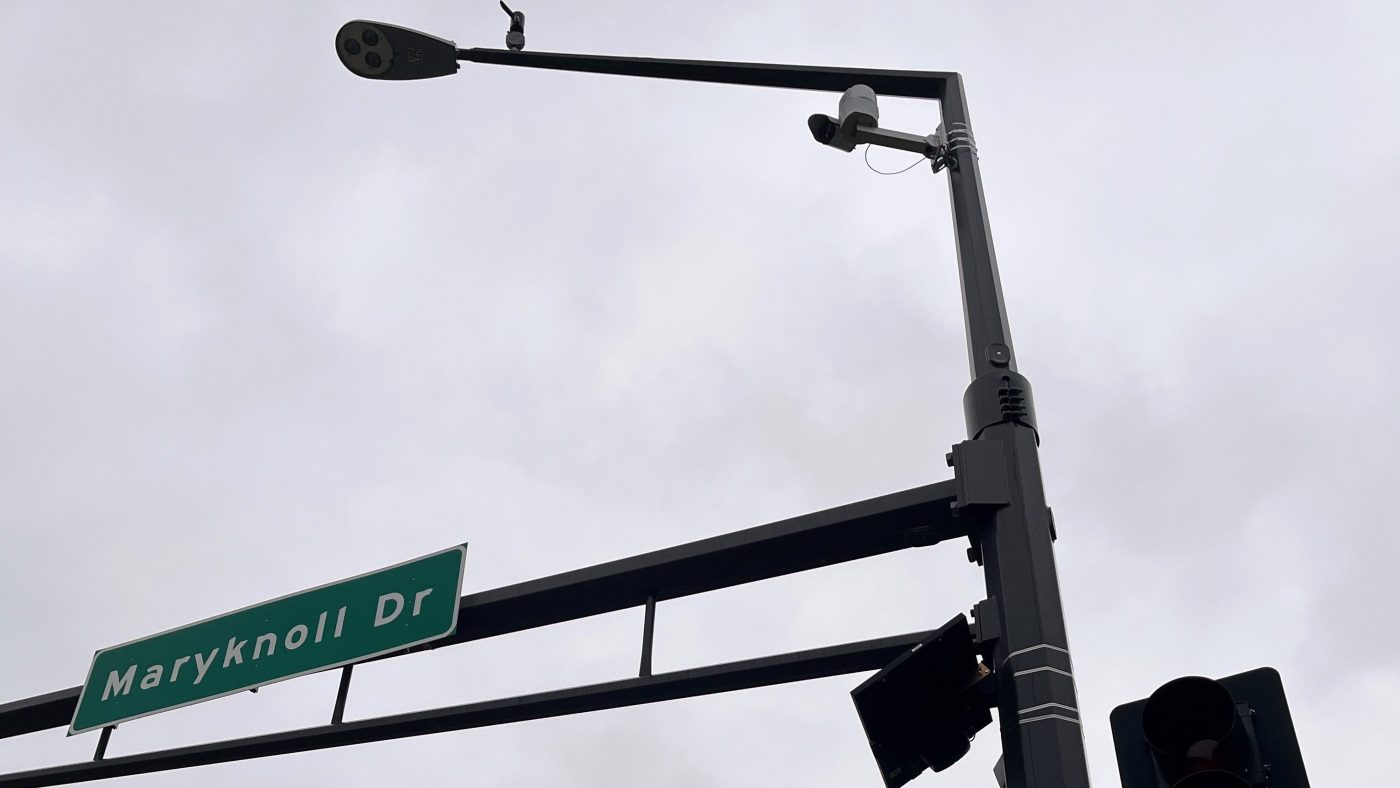
A Flock Safety license-plate reader, which helps police track vehicles involved in crimes, mounted on a light pole at the intersection of Maryknoll Drive and 75th Street North in Stillwater. (Courtesy of Stillwater Police Department)
The solar-powered license-plate readers are meant to act as a deterrent to anyone considering committing a crime in the city, Mueller said; the readers will not be used for speed-limit enforcement.
In addition, 24 fixed surveillance cameras – 20 downtown and four in other parts of the city – will be installed soon. Four of those cameras and two Flock license-plate readers will be placed in the city-owned parking ramp downtown, he said.
In all, 24 cameras and 18 license-plate readers are expected to be deployed around the city, Mueller said.
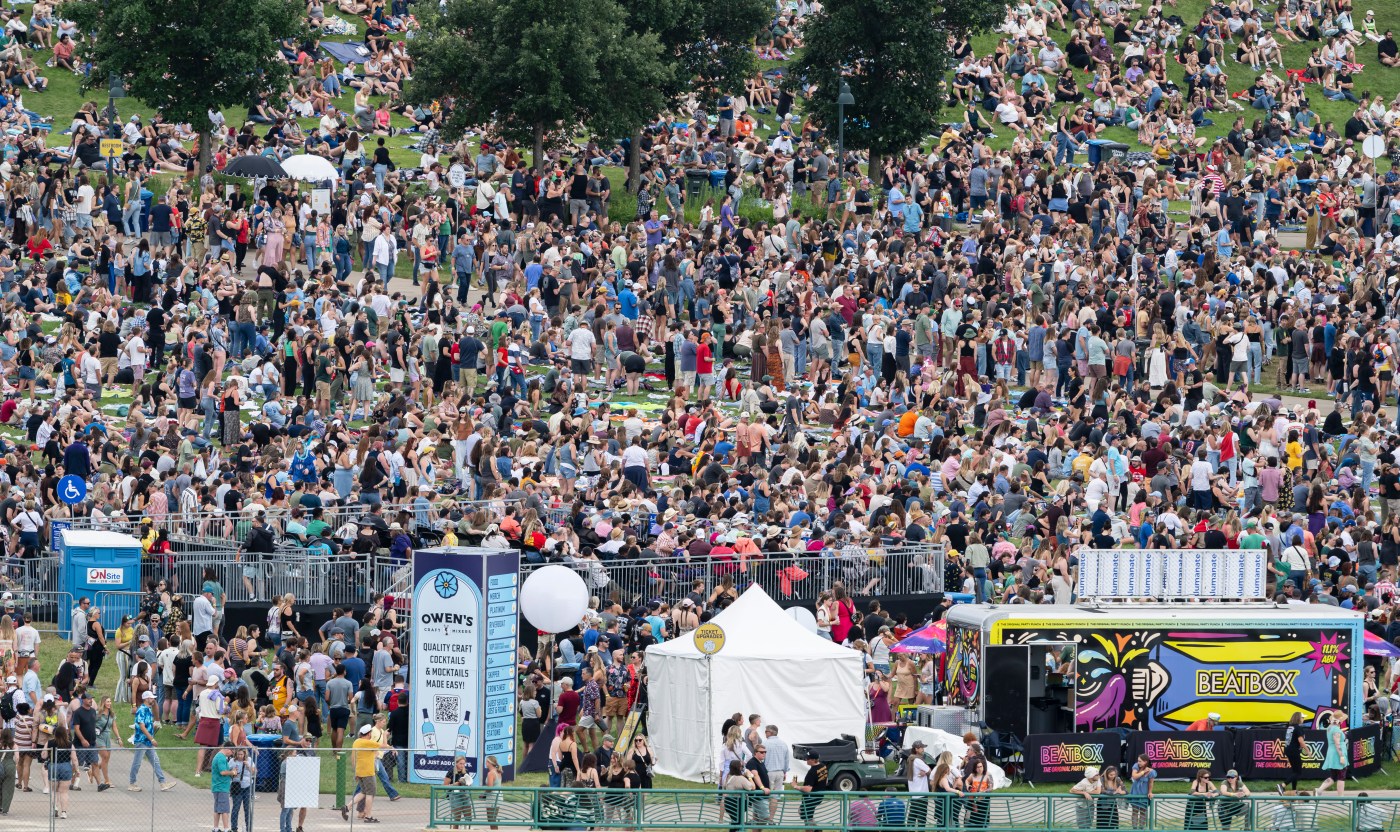
The extra security measures are needed now that downtown Stillwater has become a major tourism destination, Mueller said.
“It’s an entertainment district,” Mueller said. “The tourism, the people who are in the bars and restaurants, people who are coming to events, that’s what’s happening downtown – and that’s a different policing model than like a mall in Woodbury or some other gathering place.”
People who go to other entertainment districts around the country – such as Nashville or New Orleans – fully expect to be on camera, Mueller said, and people visiting Stillwater should have the same expectation. “Hopefully, that is a deterrent moving forward,” he said.
Civil liberties concerns
But groups such as the American Civil Liberties Union and the Electronic Frontier Foundation have raised concerns about automated license-plate readers, saying Flock and other mass-surveillance systems have severe privacy implications.
“The system is growing not just in numbers, but also in power and intrusiveness,” said Jay Stanley, a senior policy analyst with the ACLU’s Speech, Privacy and Technology Project in Washington, D.C. “Every customer of Flock that shares their data with other departments is contributing to a nationwide surveillance network of Orwellian proportions.”
Stanley also raised concerns about officers from U.S. Immigration and Customs Enforcement accessing and using data collected by Flock Safety’s automated license-plate readers.
“It’s been an issue around the country where some of the more liberal communities that have decided as a policy matter not to cooperate with ICE are finding to their surprise that their police department is collecting a lot of information on the comings and goings of their residents, and that ICE is able to search that,” he said. “Once you create records of where people are going and at what time, it’s not always easy to control who’s accessing that and for what purposes.”
But Mueller said he expects the cameras to help solve crimes in Stillwater and elsewhere.
If an event occurs like the one that happened in Waukesha, Wis., in December 2021, when the driver of an SUV plowed into a crowd of people at the city’s annual Christmas parade, killing five and injuring 48 others, “we can pull up those cameras live time and start utilizing them in a command post,” Mueller said.
Cameras also would have been instrumental in helping police figure out what happened to George Musser in 2022, Mueller said. Musser, 20, of Stillwater, was seen leaving Brian’s Bar around 2:10 a.m. Christmas Eve. His body was found around 7 p.m. on Christmas Day about two miles from the bar in Baytown Township.
“I don’t know that with this camera system, we would have been able to save his life, but I do feel confident that with a more robust camera system, we would have been on his trail a little bit sooner,” Mueller said.
How it works
The Stillwater City Council last year approved spending $222,500 for the cameras and license-plate readers, installation and the first-year annual recurring cost for upkeep and maintenance. The annual upkeep cost will increase once the license-plate readers and cameras are installed in the parking ramp.
The city has received two grants – one for $27,000, the other for $21,000 – to help cover the cost. The grants are from Washington County Emergency Management, which utilizes the Urban Area Security Initiative, a federal grant program, to enhance its emergency-preparedness capabilities, Mueller said.
Here’s how the motion-activated Flock cameras work: They identify and take a snapshot of the critical details of a vehicle that passes by it. The cameras capture the make, vehicle type, color, license plate (full, partial or missing), and various vehicle features, including damage and after-market alterations.
The program alerts officers to stolen or wanted vehicles, stolen license plates and missing persons. It also can be used as an investigative tool to search for vehicles involved in criminal activity, Mueller said.
Police officers last week arrested someone who was driving through town who had a warrant out for his arrest, Mueller said. “That’s the end goal: We catch bad guys, utilizing this.”
According to data in Flock’s “transparency portal,” which is linked to the city’s website, the existing license-plate readers in Stillwater have detected 167,614 vehicles over the past 30 days. Using information from the cameras, officers conducted 26 vehicle searches in that period.
Law enforcement agencies that use Flock can connect with other Flock-equipped agencies around the country to locate suspects, said Stillwater police Capt. Hunter Julien, who is overseeing the implementation of the program.
“Basically, the huge benefit of having Flock is the access you get with other agencies nationwide,” Julien said. “For example, if someone commits whatever crime in Stillwater and flees the state or area in a vehicle, we can track that vehicle as it moves through the state or country if it passes other agencies’ Flock cameras. I can think of many times we could have used this in the past if we had this system for serious crimes.”
Once all the Flock cameras and license-plate readers are installed, a map of their exact locations will be published on the city’s website.
“We want this to be public. We want this to be transparent,” Mueller said. “We want the public to know where all of these cameras are. They’re not going to be hidden. We want to publicize that there are cameras downtown, so none of this is quiet or Big Brother or secret stuff happening. We want everyone to know that our intention is to make downtown a safe area to come visit and hang out in.”
The Flock transparency portal linked to in the city’s website spells out what is detected (license plates, vehicles) and what isn’t (facial recognition, people, gender, race).
“Data is used for law enforcement purposes only,” the portal states. “Data is owned by the Stillwater Police Department and is never sold to third parties.”
Related Articles
St. Paul Fire Chief Butch Inks appointed to second term
Roseville police: New information in unsolved 1987 killing of Susan Capistrant
Man ‘randomly struck,’ wounded by gunshot fired outside his St. Paul home
900-pound meth case investigated by St. Paul officers draws federal charges
Through tears, Sen. Nicole Mitchell testifies in her burglary trial
Prohibited uses include immigration enforcement, traffic enforcement, harassment or intimidation, usage based solely on a protected class (i.e. race, sex, religion) and personal use, the portal states.
All data will be deleted from the system after 30 days unless it is being used in an active investigation, Julien said.
The cameras and license-plate readers are being installed on stoplights, city-owned light poles and special “Flock poles” erected to house a camera or license-plate reader. Police had hoped to have some of the cameras installed downtown before this weekend’s Lumberjack Days, the city’s popular summer music festival, but Flock officials were not able to schedule the installation on the city’s new LED streetlights in time, Julien said.
The cameras should be installed within the next few months, he said.
Other cities using cameras
Other communities in the area have installed or will be installing Flock Safety cameras, including Hudson, Wis., Forest Lake and Woodbury.
Woodbury has had license-plate readers installed in different commercial and shopping areas of the city for the past two years, said Cmdr. Tom Ehrenberg of the Woodbury Public Safety Department.
“We have 17 now, and we’ve had a ton of success with them,” he said. “They’re not in residential areas. They’re only checking the back side of the vehicle, not the front, so there is no concern for profiling individuals. It’s just the vehicle. It really is just to alert us to higher-level crimes like stolen vehicles and assaults.”
Eighteen Flock Safety license-plate readers have been installed in Hudson, mostly at entry points into the city and along main thoroughfares, including Vine Street and Crest View Drive, said Police Chief Geoff Willems. “They have been instrumental in solving crimes for us,” Willems said. “There are too many success stories to even remember. Those, coupled with our 16 traffic video cameras, have solved countless crimes.”
Forest Lake officials are in the process of having 13 license-plate readers installed throughout the city and three cameras installed in city parks, said Capt. Luke Hanegraaf of the Forest Lake Police Department. Final permits are being processed, and the readers and cameras should be up and running in August, he said.
Twelve Flock automatic license-plate readers will be installed in Cottage Grove by the end of the year. The exact locations are still being determined, said Phil Jents, a spokesman for the city.
Officials in St. Mary’s Point voted in 2022 to install four Flock license-plate readers, but then decided to cancel the order after receiving pushback from residents, said City Clerk/Administrator Cindie Reiter.
The ACLU’s Stanley said he is optimistic that communities will eventually reject the use of mass-surveillance technology like license-plate readers.
“I’m optimistic long term about privacy,” he said. “I think that people do, after a while, start to push back. It takes a long time for people to really become aware of new privacy intrusions. It takes a while for people to become aware of how it can affect them. The arc of history is long, but it bends towards privacy. I think what we’ve seen historically is that over time, people do eventually start to push back and to reclaim the freedom that they once had to not feel like they’re being watched every minute.”
New mobile barriers
Another Stillwater safety measure: Pitagone F18 Mobile Vehicle Barriers to be used at events like the World Snow Sculpting Championship, the Fourth of July and Lumberjack Days.
“We have a lot of events held in Lowell Park, and our whole goal is to separate vehicles from people. You know those don’t mix,” Mueller said. “We’re trying to build that barricade around where the people are versus where the vehicles are.”
Related Articles
Through tears, Sen. Nicole Mitchell testifies in her burglary trial
Cottage Grove: 43-year-old Hastings woman killed on U.S. 61
Feds say they’re investigating ‘massive scheme to defraud’ MN’s Housing Stabilization Services Program
Stillwater: Silver Sobriety marks 10 years with new location, new executive director
Weeklong burglary trial for Minnesota Sen. Nicole Mitchell begins
The 75 barriers, which are designed to stop or significantly slow down vehicles, will help protect people from any possible “directed, intentional terrorist attack or from someone who’s trying to do harm,” he said, but also from anyone who has a medical event behind the wheel or loses control of their vehicle.
“Tragic things happen,” he said. “It’s not just someone trying to kill people.”
The police department spent $200,000 on the new mobile vehicle barriers, Mueller said.
The bright red and yellow barriers won’t stop vehicles “dead in their tracks,” he said. “It’s going to roll under, hit the engine, basically the drive train, and make the vehicle inoperable. So it’s not immediate, but it’s going to stop you in short order versus just continuing on through people.”