Private managers of federally subsidized housing projects in New York City are systematically failing to properly screen tenants in the program, resulting in rent miscalculations and eviction filings, a City Limits investigation found. Tenants have little recourse to resolve issues.
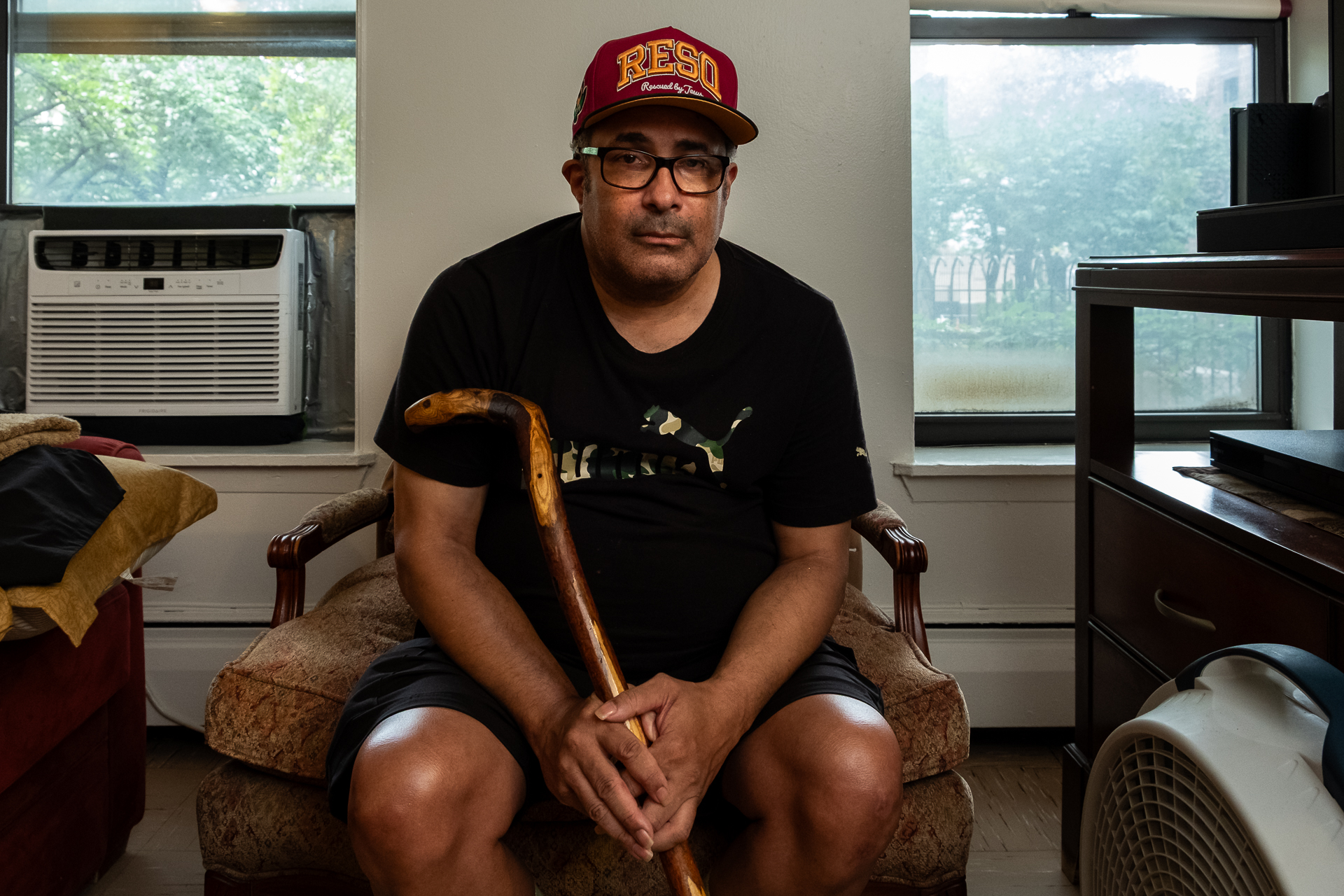
PBRA tenant Jose Tolentino in his Upper West Side apartment last month. (Adi Talwar/City Limits)
This is part one of an investigative series on the Project-Based Rental Assistance program in New York City, produced with support from the Fund for Investigative Journalism. Stay tuned for more.
Jose Tolentino, 56, was having a hell of a time reaching his property manager. He needed to get in touch with them to submit his annual income recertification packet for 2022.
Under the federally-subsidized Project-Based Rental Assistance (PBRA) program, he paid 30 percent of his income in rent for his Morningside Heights apartment—but he needed to cooperate with his property manager, Wavecrest, in order to submit proof of income.
For two years, Tolentino tried to get the paperwork done. He called and called, had his super fax the documents, and he’d asked for what he thought were reasonable accommodations given his disability. Because of his bad hips, he walks with a cane, and he wanted someone from the management company to come to the building to help him get the paperwork together. Now it was late.
Under the program, management is required to provide three notices of recertification deadlines to tenants, with clear instructions about how to reach management staff. Wavecrest provided no evidence that they served those notices properly, Tolentino’s lawyer would later allege, and simply told him to “go to the rental office.”
When his recertification wasn’t processed in time, Wavecrest terminated Tolentino’s PBRA subsidy, unbeknownst to him—and back rent was piling up at a rate of $2,860 per month.
Tolentino is one of 100,000 New York City residents who rely on the federal PBRA program, which helps low-income tenants afford their rent in subsidized buildings across the city. Every year, they work with their property management to recertify their subsidy so they can stay in their homes, a process requiring extensive documentation of their income and expenses.
But a City Limits investigation, which reviewed audits for over 400 PBRA buildings around the five boroughs, found that paperwork errors on the part of property managers are shockingly common—and can result in residents losing their subsidies, and even getting evicted. Tenants in PBRA buildings report that some property managers are hard to contact, difficult to work with, and sometimes retaliate against tenants who have ongoing issues.
Tolentino’s PBRA building in Morningside Heights. (Adi Talwar/City Limits)
Tolentino hoped to settle his recertification problem for good by talking to a human. He called ahead and showed up at Wavecrest’s office in Richmond Hill, Queens, over 90 minutes away—not easy given his ambulatory disability.
When he got there, Tolentino said the front desk told him he didn’t have an appointment and that his property manager wasn’t there that day. He left his paperwork with the desk there, he said. But when he called back, they said they never got it.
Management is also required to provide reasonable accommodations and investigate extenuating circumstances, like Tolentino’s disability and status as a veteran, that could contribute to untimely completion of a recertification.
But his property manager, Wavecrest, provided no such accommodations even though they knew, from Tolentino’s disability income and the U.S. Department of Housing and Urban Development’s public benefits database, that he was disabled.
“I think they change the rules as they see fit, whenever it benefits them,” said Tolentino.
Wavecrest filed for eviction against him in 2024. Anxious, Tolentino found himself quickly running out of options, looking for someone he could appeal to for help.
A maze of contractors
What happens when the authority overseeing your property manager is another private company?
That’s the case in the Project-Based Rental Assistance program, a lesser-known sibling of the federal housing voucher and public housing programs. Under PBRA, tenants receive rental assistance tied to a specific unit in a building full of subsidized apartments.
PBRA serves 2 million people nationally and about 100,000 in New York City. Over half of New York’s PBRA tenants are seniors and 90 percent are minorities, according to HUD data. Around 40 percent of households are led by someone with a disability.
But unlike Section 8 vouchers, Section 9 public housing, or even project-based vouchers used in the city’s PACT conversions for NYCHA properties, the PBRA program is overseen by a private contractor, not a public housing authority.
Three layers of contracts separate a tenant like Tolentino from the federal government that pays a portion of his rent. In New York, HUD subcontracts the program to the state’s Housing Trust Fund Corporation, a public benefit corporation managed by the Department of Homes and Community Renewal (HCR).
But the state housing agency has only a cursory involvement in the program: day-to-day management is contracted out to a $20 billion consulting firm called CGI.
CGI oversees the program through their CGI Federal office, fields complaints from tenants, coordinates payments to property owners, and alerts owners to ongoing health and safety issues reported by residents. The firm also audits property management companies’ compliance and policies annually, in what’s called a Management and Occupancy Review (MOR).
In New York City, HUD pays private owners to operate 441 PBRA buildings, covering more than 60,000 units citywide. Those private owners use separate management companies, like Wavecrest, to provide leases to low income tenants like Tolentino.
For tenants, all those acronyms and contracts mean it’s hard to tell who exactly is enforcing the rules. Responsibility often falls to property management companies that are stretched thin, hard to reach, and, as City Limits found, don’t always follow HUD procedures when it comes to recertification.
Widespread recertification failures
Every year, tenants in federally subsidized housing have to do what Tolentino tried to do: recertify their subsidy. They send in information about their income and various deductions, like those for medical expenses, disability, and childcare.
Recertification complications are common—people change jobs, lose jobs, get married, have a family member move in, or have their income from public benefits adjusted. A medical issue, the birth of a child, or other family changes could mean new deductions to factor in.
The recertification process must be initiated by the property manager. All property managers are trained to follow HUD’s handbook, which lays out specific rules for recertification, like providing tenants with the proper notices, safeguarding those who are victims of domestic violence or have a disability, and calculating rent and deductions.
Owners calculate rent by taking 30 percent of a tenant’s income, minus any deductions.
The problem is, “property managers do that wrong all the time,” according to Molly Rockett, a staff attorney and Project-Based Section 8 housing specialist at Legal Services NYC.
Conditions at PBRA buildings vary, but property management’s handling of tenant files is a problem at nearly all of them.
City Limits reviewed over 1,400 Management and Occupancy Review audits of 418 PBRA buildings in the five boroughs conducted by CGI, the firm acting on behalf of public agencies for the program in New York. Between 2019 and 2024, the large majority of buildings passed their review with a “satisfactory” or better score. But those passing grades obscure deeper compliance issues.
In the audit’s subcategory: “review of tenant files,” where CGI examines a sample of tenant recertification packets, 95 percent of property managers failed.
According to an analysis of the data through 2021 by Legal Services NYC, 973 audits—almost two out of every three—showed management companies made errors in calculating rent.
Tolentino’s PBRA recertification paperwork. (Adi Talwar/City Limits)
Another 25 percent included errors like failing to provide legally mandated notices of rent increases, reminders of recertification deadlines, reasonable accommodations for people with disabilities, or lease riders informing domestic violence survivors of their rights. In 375 audits, Legal Services NYC found both rent miscalculations and recertification errors.
A spokesperson for HCR said it reports all findings of noncompliance to HUD for follow up action. But the agency only flags management companies with below average or unsatisfactory MORs—which would overlook the hundreds of properties that pass the overall audit but consistently fail tenant screenings.
HUD did not respond to detailed questions from City Limits about MORs and how they are or are not used in program enforcement.
“At Wavecrest, we recognize that ‘human error’ is part of any process,” a spokesperson for Wavecrest told City Limits in an email.
They pointed to errors from both tenants and management as inevitable in a complicated and paperwork-intensive recertification process. They said they do not charge tenants for back rent when management is at fault for paperwork errors, though that would require catching the mistake.
Recertification errors were also common for tenants in public housing through NYCHA, who must follow the same recertification process each year. But NYCHA is under close watch due to a 2019 federal monitoring agreement that included upgrades and compliance standards for recertifications.
“NYCHA is under consent decrees for doing exactly the kind of misconduct that we see in PBRA buildings,” said Rockett.
The difference is, with PBRA, no one’s enforcing the rules—even when data shows widespread compliance issues. Instead of having a local housing authority to deal with, PBRA tenants have several layers of bureaucracy.
“No one in the government seems to be grappling at all with the fact that [these laws] just don’t functionally exist for the tenants who live in this program,” said Rockett.
Evictions result
In theory, evictions should be rare in subsidized housing like PBRA, where rent is based on income, with households typically paying no more than a third of their earnings.
But when recertification disputes don’t get remedied, they often result in an eviction notice. Since 2016, according to data from the Housing Data Coalition and the Right to Counsel Coalition, PBRA managers in New York City have filed 34,000 evictions—one filing for every other unit.
When tenants couldn’t recertify on time, they were surprised with larger-than-expected rent bills.
Other times tenants disagree with property managers about income and deduction calculations, and have few pathways to appeal.
“The stakes are very high in calculating that one-third. You are on the razor edge of livability and one millimeter over that is just pure financial ruin for the tenant,” said Rockett.
Property managers working in the PBRA program told City Limits that sometimes an eviction filing is an enforcement mechanism to get tenants to recertify.
Nearly 32,000 of those 34,000 eviction filings were for non-payment of rent, and just 2,165 were filed for other reasons, like a lease violation. Of those evictions filed, 1,412 PBRA households have been removed from their homes since 2016.
A spokesperson for HCR reiterated that property managers sometimes file for eviction to get a tenant to recertify. They emphasized that evictions should be a last resort, and that property managers may be reluctant to pursue eviction because of the costs of turning over a unit to new subsidized tenants.
People entering Brooklyn Housing Court located at 141 Livingston Street on the morning of March 20, 2023. (Adi Talwar/City Limits)
“The eviction process is a last resort in all cases and commenced only when a stalemate or non-responsiveness of a household occurs,” a spokesperson for Wavecrest Management said in a statement.
Staff for PBRA property managers told City Limits their hands are often tied when it comes to terminating subsidies—if they don’t get the right paperwork from a tenant, they have to turn off the subsidy faucet.
The program’s incentives, Rockett said, are set up to root out fraud. If property managers are caught letting tenants slide, they can be fined.
“The only thing that they’re really worried about is getting themselves or their bosses in trouble with HUD,” said Rockett.
And if a tenant falls behind, property managers act like a collections agency: they can recoup their costs or get a 20 percent cut of rental debt if they catch a tenant underreporting income.
“If the program is working, people shouldn’t be in housing court facing eviction, especially not for non-payment of rent,” said Ashley Viruet, a supervising attorney at Legal Services NYC.
Thin operations
Property managers in New York’s PBRA program are often stretched thin, managing dozens of buildings and thousands of units at once.
One recertification specialist, who spoke to City Limits on the condition of anonymity because they were not authorized to speak to the press, said they oversee 13 properties and thousands of apartments all across the city.
Residents report that just getting in touch with a property manager can be hard. Some are hesitant to raise an issue with management for fear of retaliation.
Tolentino says that after he criticized their recertification procedures, management would ghost him, ignore requests for repairs, and yell and harass him when they needed something from him.
“I didn’t want to be the headache, but this is the position that I found myself in, so I needed to do whatever I needed to do in order to try to resolve this issue and hopefully get back on the same page and move on without having to feel neglected, harassed, spoken down to, cursed at, being avoided,” he said.
When property management is hard to get in touch with, or not following correct procedures, it “looks like the tenant isn’t complying but it’s really the owner,” said Bridget Simmons, a staff attorney at the National Housing Law Project.
Housing advocates say that the thin staffing and compliance at property management companies is a consequence of private ownership.
“That means providing the service of managing subsidized housing at the lowest cost humanly possible to pocket the highest percentage of that money from HUD,” said Rockett.
Property managers and building staff who work on recertification and spoke with City Limits said they don’t want anyone to lose their housing, but some expressed frustration towards tenants.
“Ultimately, it is the resident’s responsibility to go and handle their business,” said one staff member. “I don’t want to see anyone lose their apartment… but I’m not going to babysit you.”
A sign in the leasing office of a PBRA building
in Harlem. (Patrick Spauster/City Limits)
A spokesperson for HUD did not respond to detailed questions about how it monitors staffing and compliance of property managers, but emphasized to City Limits in a statement that HUD-assisted tenants are themselves responsible for recertifying every year.
One building staff member said 40 percent of tenants are prepared with their paperwork each year, and another 60 percent, “act as if they don’t know anything about recertification.”
Tenants are also permitted to request a review and explanation of their recertification from management, a spokesperson for HUD told City Limits. But legal assistance groups called those reviews useless, since they’re conducted by the same building managers that just calculated the new rent in question.
CGI runs a tenant help line that tenants can call if they run into problems with their property managers. Many PBRA tenants City Limits spoke to didn’t know the help line existed, though the contact information was posted in management offices that City Limits visited.
City Limits called the help line multiple times and sent several emails. Representatives who picked up the phone said a supervisor would be in touch, but City Limits did not receive any communication from the call center before publication, despite following up over the course of several weeks. City Limits also left voicemails and emails with several CGI staff working on the program who did not respond.
In the last several years, HCR said it worked closely with local advocates regarding owner and tenant disputes and thoroughly reviewed tenant issues brought to them, escalating any noncompliance or nonresponse issues with HUD when necessary, according to a spokesperson for the agency.
CGI staffers themselves had trouble reaching the property managers they oversee on several occasions. In reports submitted to HCR and obtained by City Limits through a freedom of information request, CGI said it took nine unanswered inquiries and two full years to get management of one East Harlem property, Lexington Gardens, to respond to an inquiry about missing audit responses.
Another CGI report read: “The call center has extreme concerns with this managing agent, Manhattan North. This agent often doesn’t have updated contact information in [the data system] and doesn’t reply to inquiries for several weeks.”
Despite that complaint, Manhattan North received scores of satisfactory or better nearly 90 percent of the time across its 1,300 units and 11 properties.
Manhattan North did not respond to City Limits’ requests for comment, and CGI did not respond to questions about how management companies could continuously fail tenant screening audits but still pass on their overall score.
A super at a PBRA building, who asked that their name not be shared because they did not want to jeopardize their job, said turnover in property managers at their building is high—and each new manager has their own staff and procedures.
“You don’t know what you’re gonna get. So it’s like starting over,” the super said.
Spiti Housing for the Elderly in Astoria went two years without responding to CGI’s inquiries, according to the call center’s reports, which cited transitions in management companies and staffing for the lack of communication.
Because of those communication difficulties, tenants and LSNYC both said they feel the problems are more widespread than CGI’s reporting covers.
“I know I’m not the only one having issues because I see other residents from the building in court,” Vivian Colado, another PBRA tenant, told City Limits in Spanish. “I can guarantee you, it’s an experience that many more folks are having.”
Tenants told City Limits they are scared to speak up or push back, for fear of losing their subsidy.
A spokesperson for Wavecrest told City Limits that they take tenant complaints seriously and emphasized that employees are trained annually on reasonable accommodations policies and adhere to all city, state, and federal laws.
Tolentino ended up in housing court and, through the city’s Right to Counsel program, found a lawyer, Carly Gartenberg of Legal Services NYC.
“It’s just this kind of world of unanswered emails, unmet meetings, closed office doors, and then you pay the price,” Gartenberg said of navigating the system.
Nearly five years later, Tolentino was able to resolve his case in housing court and avoid eviction after showing his repeated attempts to recertify and unresolved repair issues. He feels betrayed by the ordeal, which worsened his depression and anxiety.
For now, he’s stuck with Wavecrest, and they are stuck with him.
“They don’t care at all. As long as they get their check,” said Tolentino.
To reach the reporter behind this story, contact Patrick@citylimits.org. To reach the editor, contact Jeanmarie@citylimits.org
Want to republish this story? Find City Limits’ reprint policy here.
The post The Compliance Crisis in New York City’s Project-Based Rental Assistance Program appeared first on City Limits.