Seantrell T. Murdock took a roundabout path to St. Paul the day police say he shot a Lowertown woman as she kneeled painting a mural.
The 29-year-old finished work in Plymouth and drove about 30 miles south to Lakeville, closer to his home in Scott County. He looped around to Burnsville and Eagan, before getting on Interstate 35E north and making his way to Shepard Road along the Mississippi River in St. Paul and then to Lowertown.
Carrie Shobe Kwok (Courtesy of Julie Shobe)
Surveillance video of the Sept. 25, 2024, killing of Carrie Shobe Kwok, 66, showed no confrontation or attempted robbery, police say. Other people were in the area, and it was still light out.
Police closed the case in December. They said they’d followed the evidence and it all pointed to Murdock, with no one else being involved.
Why Murdock did it and why he went to St. Paul will likely never be known. Just over 13 hours after the killing, as police tried to arrest Murdock, officers reported he raised a gun and they fatally shot him.
In a search for answers, the Pioneer Press reviewed hundreds of pages of law enforcement reports and interviewed investigators and people who knew Kwok and Murdock. They revealed more details of Murdock’s comings and goings before and after the homicide and how police quickly identified him.
Court filings in 2023 civil commitment proceedings say Murdock had been diagnosed with bipolar disorder. When he was admitted to the hospital then, he reported experiencing paranoia and hallucinations, a court document said.
His mental health condition is the only reason that police can find for a potential explanation.
“We found zero link to the victim, why she was chosen, why he ended up in downtown St. Paul,” said St. Paul Police Senior Cmdr. Wes Denning, who’s in charge of the homicide unit.
“None of it made sense,” said Sgt. Natalie Davis, lead investigator on the case with Sgt. Jeff Thissen.
“The randomness of it was super sad,” Thissen added. It was also unusual because most homicides are carried out by someone the victim knows.
Murdock’s mother, April Murdock, doesn’t believe he did it.
“My son wasn’t a killer,” she said recently. “My son wasn’t like that. He had mental problems, but he would never kill anyone.”
Studies have found that people with serious mental illness are more likely to be victims of crime than perpetrators of it.
Mother, grandmother, artist, woman of faith
Kwok moved into the Lowertown Lofts Artist Cooperative earlier in 2024. She worked with vintage clothing, textile art and handmade jewelry and enjoyed sewing, home design and remodeling.
“I think about her every day and miss her every day,” her sister, Julie Shobe, said recently.
She was a mother of two and a grandmother, and the glue who brought everyone together for family gatherings and holidays, Shobe said.
In one of son Bill Kwok’s last conversations with his mom, he complained he was thanklessly working toward the goals and happiness of everyone else and not his own.
“With a smile and a twinkling eye, she responded, ‘That’s what life is all about,’” Carrie Kwok’s grandson read from his father’s eulogy at her celebration of life last October.
“She was a patient and loving ear and a best friend to many, always ready to put her own projects aside and roll up her sleeves to get yours done,” according to Bill Kwok. “A lifelong artist, her life itself was an expression of this belief.”
Friend Pam Tucker remembered Carrie Kwok’s faith as “core and unconditional.”
Rosemary Williams and Kwok both went to Roosevelt High School in Minneapolis and later connected through a moms’ group and Bible study at their church.
“She was shabby chic before shabby chic was a thing,” Williams said.
She loved to restyle every home she lived in. She’d make cabinets and whittle holes for the knobs. She had an eye for fabrics and became a collector of rare and beautiful textiles.
Kwok had been working on vintage tablecloth shirts and wooden bead earrings, getting ready for the St. Paul Art Crawl.
Shooting at 5:16 p.m.
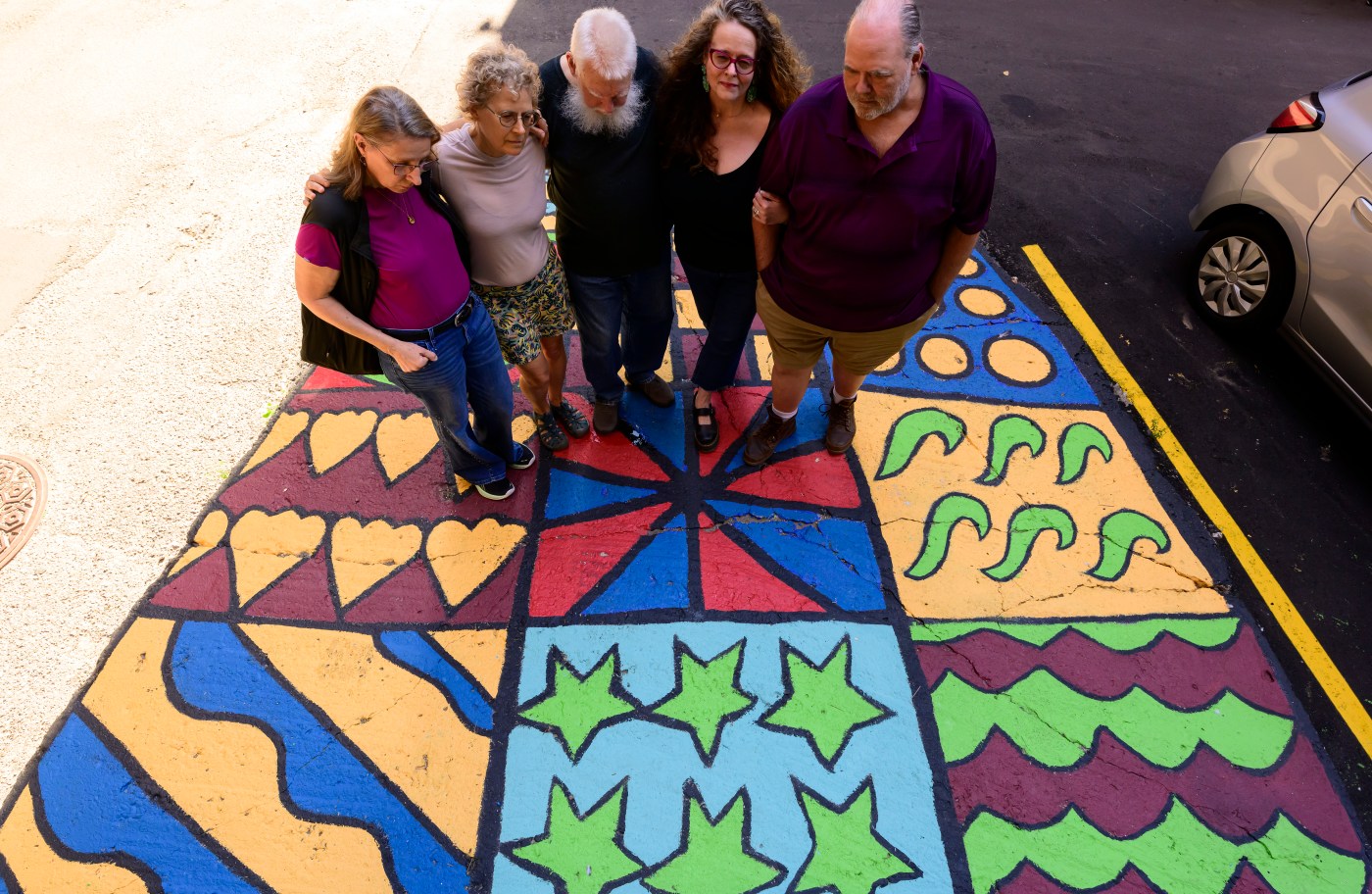
A small plaque adorns a mural that Carrie Kwok was painting in the alley behind the Lowertown Lofts Artist Cooperative in St. Paul. (John Autey / Pioneer Press)
Also in preparation for Art Crawl, the Lowertown Lofts Artist Cooperative was creating a public art piece in the building’s surface parking lot. Co-op members were painting it.
The co-op’s front door opens to an alley behind Kellogg Boulevard between Wacouta and Wall streets.
Surveillance footage showed the suspect parked on Sept. 25, 2024, at 5:15 p.m. He walked past Kwok. She looked in that direction, then back to her mural and continued painting.
He walked toward Kwok, reached into his front sweatshirt pocket, turned to Kwok and fired one shot and then multiple shots. It was 5:16 p.m., 24 seconds from when he’d first walked past her, according to timestamps from a video.
“It doesn’t appear there was any exchange between them whatsoever,” Denning said.
The man ran back to his vehicle and drove away, 24 seconds after the shooting.
People who lived in Kwok’s building were parking in the lot at the same time. They reported hearing shots and at least one ducked down for safety. They and other people rushed to try to help Kwok.
A man who lived nearby took off his shirt and held it on a gunshot wound on the back of Kwok’s head. Bystanders began chest compressions on Kwok. Officers and St. Paul Fire Department paramedics took over CPR, but Kwok could not be revived.
16 minutes after shooting, heading to church
Police and K-9s took up the search. Quickly, officers began pulling surveillance video from the area and saw the suspect had left in a silver Chevrolet Malibu. They identified the license plate, police reports say, and determined the car was registered to Seantrell Murdock, who lived about 45 minutes southwest in Belle Plaine.
Seantrell Tyreese Murdock is seen in a 2019 mugshot. (Courtesy of the Washington County Sheriff’s Office)
Police viewed more videos and saw the Chevrolet was heading toward Minneapolis. The car had been westbound on Ford Parkway in St. Paul, going toward the Ford Bridge, at 5:32 p.m., a law enforcement database with information about the locations of license plates showed.
A Minneapolis officer informed a St. Paul sergeant that another automated license plate reader spotted the Chevrolet on 36th Street near Chicago Avenue 10 minutes before they talked. The officer checked, but the car was gone.
The area is where Murdock went to church. Richard Lee, a minister at Worldwide Outreach for Christ, said Murdock stopped in and they talked “for a little bit.”
Murdock was pacing and Lee asked him, “Is everything OK?”
“He just seemed like he wasn’t himself,” said Lee, who’d met him at the church about a year earlier.
Lee asked Murdock how his family was and Murdock then “looked like he snapped back into reality,” the minister said.
After Murdock left, Lee called him to check if he was alright. Murdock told Lee he probably needed to get on medication, and Lee said he was there to talk whenever he needed.
The next day, when Lee found out that Murdock had been shot by police and was suspected in the St. Paul homicide, he was shocked.
“He was really trying to give his life over to Christ,” Lee said. “He was fighting on the inside, demons or whatever he was fighting, but he just wanted help.”
1 hour and 20 minutes after shooting, in hometown
Meanwhile, St. Paul police were told that a license plate reader in Belle Plaine had picked up the car there.
At 6:36 p.m., Murdock went into the Coborn’s Liquor in Belle Plaine and walked out with a $16 bottle of vodka, an employee later told police. He said he was familiar with Murdock from previous purchases, figured he forgot to pay and planned to bring it up when he saw him next.
Officers researching Murdock found records of his civil commitment proceedings, filed in Scott County District Court in 2023. When he was admitted to the hospital in January 2023, he reported “experiencing paranoia and auditory and visual hallucinations,” a court document said.
Related Articles
Former Customs officer from Minnetonka pleads guilty to possessing child pornography
Maplewood man arrested in fatal hit-and-run
Inver Grove Heights man gets 20 years for ‘coercing and manipulating’ girls to send nude photos
Judge finds Current DJ’s stalker violated restraining order but not guilty due to mental illness
New Richmond, Wis., man dies in crash in Oak Park Heights
A St. Paul officer wrote in a report: “Based upon this information and the apparent random nature of the crime, we believe Murdock may have been in a mental health crisis and experiencing a psychotic episode. … We were attempting efforts to quickly locate him.”
Police identified Murdock’s cellphone number and obtained information that showed where his phone pinged off cellphone towers. That’s how they tracked his phone’s path from Belle Plaine that morning to his work in Plymouth until 3:20 p.m. and then into Dakota County before pinging in downtown St. Paul at the time of the homicide.
Also, a search at the scene turned up yellow markings, possibly footprints, in the alley. Surveillance footage showed Kwok had been using yellow paint and it seemed the suspect stepped onto the colored walkway. Law enforcement later saw Murdock’s shoes appeared to have paint on the bottom.
Officers head to Belle Plaine
That evening, St. Paul police began heading to Belle Plaine. They set up surveillance around Murdock’s residence and developed plans for various scenarios.
“It was decided to not make contact with Murdock at the listed address due to his recent violent acts and possibility of being armed,” a Belle Plaine officer wrote in a report.
A regional SWAT team would not serve a warrant that evening due to children being in the home, but would in the morning when the kids left for school, a Belle Plaine sergeant wrote.
Seantrell Murdock seemed his normal self that night, April Murdock said. He and his family were cooking and listening to music.
April Murdock left for work about 6:15 a.m. on Sept. 26, 2024, and saw two vehicles in the area.
She called Seantrell Murdock, who was due to head to work soon, and told him a vehicle they’d seen outside the home the previous night was still there and she didn’t know why.
13 hours after shooting, a confrontation
Police on Oct. 1, 2024, released body worn camera footage showing the fatal shooting by St. Paul officers of homicide suspect Seantrell Tyreese Murdock in Belle Plaine on Sept. 26, 2024. (Courtesy of the St. Paul Police Department)
When Seantrell Murdock walked out of the home, two arrest teams pulled up in unmarked vehicles and activated their emergency lights at 6:42 a.m., body camera footage shows. The officers were wearing shirts that identified them as police.
Murdock pulled a handgun and began lifting it up as he walked toward St. Paul officer Aaron Bohlen, and the officer feared Murdock was going to shoot him and his partners, Bohlen wrote in a statement to the Minnesota Bureau of Criminal Apprehension.
Murdock said loudly, “Do it!” Bohlen added.
Bohlen said he fired three to four times and officer Lance Christianson reported he shot once. Murdock fell to the ground and Bohlen said he saw the handgun fall from his hand. It was still within reach of Murdock, and Christianson kicked the gun away.
A Belle Plaine sergeant radioed for an ambulance and an air ambulance helicopter.
Officers cleared in shooting
An autopsy found Murdock had a gunshot wound to the right chest, the back and the right arm. A BCA agent wrote that toxicology showed Murdock had alcohol and THC, which is in cannabis or marijuana, in his system. The amounts are not publicly known because the toxicology report was redacted.
Murdock’s DNA was found on the gun that police say he had in Belle Plaine. Testing ruled it out as the gun used in the homicide in St. Paul, Denning said. Officials have not found the gun used in the shooting.
The gun did not have a serial number, according to a report in the BCA file. Murdock was banned from possessing guns because of a 2013 felony burglary conviction.
Scott County Attorney Ron Hocevar announced in February that he determined the officers’ use of force was “necessary to protect these officers from death or great bodily harm” and they acted within the law.
April Murdock said she doesn’t believe the police statements that Seantrell Murdock was holding a gun. Body camera footage shows a handgun on the ground immediately after Murdock was shot; the view of what happened between him and the officers is not visible on video.
As for Seantrell Murdock’s innocence or guilt, “he can’t even speak for himself now,” his mother said.
Needed medication, mom says
Seantrell Murdock graduated from Shakopee High School. He had four children and was always “a provider for his kids,” his mother said in an interview with the Pioneer Press. He’d moved to Belle Plaine about nine years earlier because he wanted a safe place to raise his children.
They were living in a rental home, with April Murdock and her husband on one floor, and Seantrell Murdock on the other.
At the end of 2022 to the beginning of 2023, Seantrell Murdock tried LSD, April Murdock told the BCA. “People say that it opens you up for demons, I guess?” she said. “… That medicine just made him go overboard.”
Seantrell Murdock asked his mom to take him to the hospital in January 2023, telling her he was hearing voices.
“He went in freely at first,” her BCA statement said, but then he started fighting people. “I told them to keep him.”
Murdock put his hands around a nurse’s neck, threatened to kill hospital staff, and punched a security guard in the head and neck area, a court document said.
He “indicated he was scared of himself and he’d say he didn’t want to harm anyone and then shortly thereafter would state he wanted to kill others,” the document continued. It also said his mother told hospital staff he “had access to a firearm and she was fearful for her son’s safety.”
After Murdock began taking medications during his hospitalization, he was calm and cooperative with staff and willing to participate in out-patient chemical dependency treatment, medication and therapy, the document continued.
A petition for civil commitment was filed, but commitment was stayed for six months, concluding in August 2023, on various conditions — including that Murdock take prescribed medication and cooperate with Scott County Adult Mental Health case management.
Out of the hospital, Murdock did well, his mother said. He completed training to become an electrician. He was working as a crane operator in Plymouth.
But a couple of months before September 2024, “he was kinda feeling off,” April Murdock said. He asked for one of his mother’s prescription pills for anxiety. She told him, “Look, you need to go to your doctor and get medicine,” according to her BCA statement.
“They would not give him medicine,” April Murdock said. That was because Seantrell Murdock was told he needed to stop smoking marijuana. He said he would stop when he was prescribed medication.
“He basically tried to self-medicate himself” by smoking marijuana, April Murdock said.
‘I miss her joy’
At Kwok’s celebration of life last year, Pam Tucker said she worried for her friend: “Did she know? Was she afraid? Where did she go?”
Tucker said she believed, if Kwok could speak to them, she would say, “I am now with my Creator. … I am at peace. … Everywhere you’ve known me, I am there. Every corner you look for me, I am there.”
Kwok and Tucker were walking partners and Tucker said she imagined asking her friend on their next walk: “‘Carrie, so what is the meaning of it all?’ She would pause, pivot, catch my eye, a twinkle in hers, burst into laughter. I miss her joy.”
In Bill Kwok’s eulogy, he said the term “senseless” had been used over and over again about his mother’s death.
“How could something so horrific happen to such a kind and loving servant of God?” he asked.
Related Articles
Former Customs officer from Minnetonka pleads guilty to possessing child pornography
Train stabbing spurs outcry over Black-on-white violence, but data shows such occurrences are rare
Tennessee governor says more federal agents to join fight against crime in Memphis next week
Maplewood man arrested in fatal hit-and-run
Inver Grove Heights man gets 20 years for ‘coercing and manipulating’ girls to send nude photos