In Dallas, Organizers Mourn the Immigrant Victims of Recent ICE Shooting

posted in: All news | 0

On September 24, a gunman shot at the Immigration and Customs Enforcement (ICE) field office in Dallas, killing two immigrants, Norlan Guzman-Fuentes and Miguel Ángel García-Hernández, and seriously injuring another, Jose Andres Bordones-Molina, who were being detained at the site. 

The federal government was quick to blame the attack on the “far left” and the “dehumanization” of ICE agents “who are simply enforcing the law.” Around four hours after the shooting, FBI Director Kash Patel posted a photo of bullets with the message “anti-ICE” written on them allegedly found at the scene, citing this as evidence of the suspected shooter’s “idealogical [sic] motive.” 

But for the immigrant community in Dallas, the shooting is yet another instance of the violence and fear they have endured under President Donald Trump’s nearly $30 billion “deportation-industrial complex” and a continuation of the lack of transparency and accountability from the local and federal governments alike. 

The immediate aftermath of the shooting was marked by panic and fear in the immigrant community. At a vigil two days after the shooting, at Parkland Hospital where victims were being treated, Noemi Rios, an organizer with the Chicana-led community initiative Vecinos Unidos DFW, said that local organizations were being flooded with requests seeking more information about the identity of the victims. Rios told reporters that family members who “knew their loved ones had been detained” at the Dallas ICE field office “couldn’t get confirmation of life or death.” 

Flaka Martinez, another organizer with Vecinos Unidos, said that this panic was the result of ICE’s detainee locator system, which has been criticized by families of detainees and their lawyers for not providing up-to-date information regarding the whereabouts of detainees. Martinez urged that anyone detained by ICE must have their unique identification numbers (known as an “A-Number”) put into the system within 12 hours of detention. She also pointed to the fact that the facility where the shooting happened was not a detention center but rather an administrative office where people frequently visit for check-ins with ICE. “It’s not sustainable, nor safe to detain people at that facility,” Martinez said. 

Dallas community organizers held a vigil outside city hall on October 3 for the victims of the Dallas ICE office shooting. (Haley Hill)

Well before the shooting, family members with loved ones detained at that Dallas field office reported inhumane conditions in the facility, including overcrowding, medical neglect, and individuals being detained for more than a week without access to running water and air conditioning. Over 600 people were held at the field office in June and July for longer than ICE’s own 12-hour limit on detention in so-called “hold rooms,” according to data obtained by the Deportation Data Project and analyzed by El Movimiento DFW, a local group advocating for immigrant rights. Protests and public pressure led in part by Vecinos Unidos and El Movimiento led Democratic Congressmembers Julie Johnson, Marc Veasey, and Jasmine Crockett—who all represent parts of Dallas—to send a letter to Department of Homeland Security (DHS) Secretary Kristi Noem and Todd Lyons, acting director of ICE, on July 28 demanding “immediate answers” to reports about the field office. As of October 6, the U.S. representatives have not received a response.

For the immigrant community in Dallas, this lack of transparency around what advocates claim are unlawful and unjust detentions has become an expected response not just from federal law enforcement but local police as well. While the Dallas Police Department (DPD) maintains no official 287(g) agreement with ICE,  it has stated that the department “regularly” interacts with federal agencies and will “assist these agencies upon request.”

Tony Rodriguez, the regional commander of the Brown Berets of North Texas, a community defense group that runs an “ICE Watch” in the area, said that the DPD’s public comments are “political double speak.” Rodriguez pointed to a recent multi-agency operation led by Homeland Security Investigations, an arm of ICE, on the Chicas Bonitas Strip Club in Dallas for suspected “human trafficking and unlawful employment.” Rodriguez said that as soon as the Brown Berets’ ICE Watch was alerted of a possible raid, members of the organization were on the scene, collecting testimonials and documenting the arrests.

Corbin Rubinson, spokesperson for DPD, wrote in an email to the Observer that the department was “requested to provide perimeter security during the outside agency’s operation.” According to an ICE press release, federal agents arrested 41 undocumented immigrants; just five had criminal records in the United States.

With suspicion from community organizations already high, Senate Bill 8 could dramatically change how immigration enforcement is conducted in the state. SB 8 will force county sheriffs to enter into 287(g) agreements with ICE by next December, which could give deputies the authority to arrest and detain people off the street on the basis of immigration status depending on the 287(g) model a sheriff selects. As the Texas Observer has previously reported, around 30 local county sheriffs and police departments have already voluntarily inked “task force model” agreements, which effectively deputize local officers as ICE agents. 

(Haley Hill)

The ever-expanding relationship between local law enforcement and federal immigration authorities is a key detail in how one of the victims of the September 24 shooting, Guzman-Fuentes, a 37-year-old from El Salvador, ended up at the Dallas ICE Field Office that day. According to a press release from ICE, DPD arrested Guzman-Fuentes on August 25 on an aggravated assault charge—which ICE said was later dropped—and an outstanding warrant for a DUI. Shortly after Guzman-Fuentes was booked at the Dallas County Jail, ICE “encountered him” and filed an immigration detainer. The press release states that he was being transferred into the office that morning when the shooter opened fire, killing him and García-Hernández, a 32-year-old immigrant from Mexico who passed away due to his injuries five days later. 

As previously reported by the San Antonio Express-News, ICE is increasingly using county jails to detain undocumented immigrants before they are taken into federal custody and ultimately deported. While all Texas county jails have been sharing biometric data with ICE since 2010, since January of this year, the number of immigration detainers filed on immigrants booked at the Dallas County Jail has increased by 71 percent. When SB 8 goes into effect, those rates could further increase.

At a vigil held at Dallas City Hall on October 3, organizers gathered to “center the victims of the shooting” and to condemn the “dehumanization” of migrants by the Trump administration. 

Kate Lincoln-Goldfinch, an Austin immigration attorney who has been in contact with the families of the victims, told the Observer that for families, the loss of their loved ones has been compounded by the “way that the government has responded, by not giving them information quickly.” CBS reported that Guzman-Fuentes’ wife only found out that her husband had been killed after contacting the Salvadoran consulate. Organizers also read a statement from his sister, who said she wants people to remember her brother as “the greatest brother, tío, and friend.” The statement also noted that officials told her that she wouldn’t be able to see her brother’s body and would only be offered two hours for a funeral.

Eric Cedillo, an attorney representing García-Hernández’s wife, told the crowd that he must be remembered for his “heroism.” Cedillo said that when “bullets crashed through the window and hit Miguel,” he turned to the 18 year-old boy sitting next to him in the van and said, “I don’t think I’m going to make it, get underneath me. Let me shield you.”

Looking ahead, Martinez, the community organizer, said that in spite of the Trump administration using the shooting as a pretext to vilify resistance to ICE, her community is determined to continue to fight against Trump’s deportation machine and “serve justice for [the victims’] families.”

The post In Dallas, Organizers Mourn the Immigrant Victims of Recent ICE Shooting appeared first on The Texas Observer.

Average long-term US mortgage rate eases to 6.3%, back to its lowest level in about a year

posted in: All news | 0

By ALEX VEIGA, AP Business Writer

The average rate on a 30-year U.S. mortgage edged lower this week, returning to its lowest level in about a year.

Related Articles


Forecast: Home equity rates, the Fed and what’s next for home equity borrowing


Should you pay off your mortgage early?


Average long-term US mortgage rate ticks up for second straight week, to 6.34%


FTC sues Zillow and Redfin over deal it accuses of supressing competition in rental ads


Profit margin on flipping a home is at a 17-year low due to high prices

The average long-term mortgage rate slipped to 6.3% from 6.34% last week, mortgage buyer Freddie Mac said Thursday. A year ago, the rate averaged 6.32%.

The modest drop brings the average rate back to where it was two weeks ago, after a string of declines brought down home loan borrowing costs to their lowest since early October 2024.

Borrowing costs on 15-year fixed-rate mortgages, popular with homeowners refinancing their home loans, also eased this week. The average rate dropped to 5.53% from 5.55% last week. A year ago, it was 5.41%, Freddie Mac said.

Mortgage rates are influenced by several factors, from the Federal Reserve’s interest rate policy decisions to bond market investors’ expectations for the economy and inflation. They generally follow the trajectory of the 10-year Treasury yield, which lenders use as a guide to pricing home loans.

The 10-year yield was at 4.13% at midday Thursday, up from around 4.09% the same time last week. The yield has been trending higher since it slid to around 4.02% on Sept. 11.

In late July, mortgage rates started declining in the lead-up to the Federal Reserve’s widely anticipated decision last month to cut its main interest rate for the first time in a year amid growing concern over the U.S. job market.

However, Fed Chair Jerome Powell has since signaled a cautious approach to future interest rate cuts. That’s in sharp contrast with other members of the Fed’s rate-setting committee, particularly those who were appointed by President Donald Trump, who are pushing for faster cuts.

Even if the Fed opts to cut its short-term rate further that doesn’t necessarily mean mortgage rates will keep declining. Last fall, after the Fed cut its rate for the first time in more than four years, mortgage rates ticked higher, eventually reaching just above 7% in January this year.

Gophers football vs. Purdue: Keys to game, how to watch, who has edge

posted in: All news | 0

PURDUE vs. MINNESOTA

When: 6:30 p.m. Saturday
Where: Huntington Bank Stadium
TV: Big Ten Network
Radio: KFAN, 100.3 FM
Weather: 64 degrees, mostly clear skies, 9 mph east wind
Betting spread: Gophers, minus-7.5

Records: Gophers (3-2, 1-1 Big Ten) are coming off a 42-3 beatdown from No. 1 Ohio State in Columbus on Saturday. Purdue (2-3, 0-2) lost to now-No. 17 Illinois 43-27 in West Lafayette, Ind., last weekend.

History: Minnesota has lost two straight to the Boilermakers, including a 49-30 road defeat in 2023. That loss really stung more because Purdue was 2-7 at the time and amassed 604 total yards. The U leads the overall series 41-35-3.

Context: After a 1-11 season in 2024, Purdue fired head coach Ryan Waters, hired Barry Odom and he has already doubled that win total. He went 19-8 in the previous two years at UNLV after a 25-25 run at Missouri.

Big question: Can the Gophers bounce back? They were completely owned by the Buckeyes last weekend, so are they able to turn the page or will they still be licking their wounds? A homecoming crowd should help put the humbling in the past.

Key matchup: Gophers tacklers vs. Purdue running back Devin Mockobee. Minnesota has missed an average of 15 tackles per game against Power Four competition this season, while the 5-foot-10, 195-pounder has 255 of his 305 rushing yards this season coming after contact, per Pro Football Focus. Mockobee has averaged 9.4 yards per carry in his two previous games (2022, ’23) against Minnesota.

Stats: The Gophers have, for the most part, enjoyed scheduling Purdue for homecoming. The Boilermakers are the third most-frequent opponent (11 games), behind Northwestern (19) and Iowa (14). In this set-up, Minnesota is 7-4 against Purdue, but suffered a 20-10 loss in 2022.

Who has the edge?

Gophers offense vs. Purdue defense: The Boilermakers have given up at least 460 yards of total offense to its three opponents from the Power Four conferences, all of which have all been ranked this season — USC, Notre Dame and the Illini. Purdue’s pass defense has been especially bad, ranking 134th out of 136 programs in yards per attempt (10.4). … With the Gophers struggling to run the ball this year, QB Drake Lindsey should be airing it out like he did in the second half against Rutgers. … RB Darius Taylor returned from a two-game absence to have eight carries against the Buckeyes. After coming off a hamstring injury, his role is expected to increase and could really come in handy in the short passing game. … Purdue is 100th in the nation with 12 plays allowed over 30 yards, but Minnesota has only produced five in the same category (124th). The opportunities will be there, but can Gophers’ pass catchers take advantage of the mostly zone coverages? … The U reshuffled it offensive line to start the Ohio State loss and switched at guard midway through the game. They need to figure it out because they are 104th in yards per rushing attempt (3.79). EDGE: Gophers  

Gophers defense vs. Purdue offense: The Boilers are among the worst in the nation in turnover margin (minus-7, tied for 131st) and giveaways have really cost them. They have only three points off turnovers, while allowing 34. The Gophers are plus-2, but have only one takeaway against P4 competition. S Kerry Brown’s pick against Rutgers led to a U touchdown that put that comeback in full gear. Minnesota needs to catch the would-be interceptions that have been thrown to their defensive backs. … The Gophers defense ranks 84th in stop rate (58.5%), meaning just over half of opponent drives end in punts, turnovers or turnover on downs, per ESPN. This metric doesn’t include FCS programs, so no cupcake win over Northwestern (La.) State to bloat the numbers. For reference, a top 30 team gets off the field without points allowed on 67% of total series. … Purdue is second in the Big Ten with 181 passing attempts, but Ryan Browne has completed 62.2%, which is 15th in the conference. … WR Michael Jackson II is the clear-cut No. 1 receiving option with 32 receptions, more than double Mockobee’s 14. … Most of the Gophers’ D-line has struggled to create consistent pressure. DE Anthony Smith has 16 pressures, but nobody else has more than six. EDGE: Purdue  

Special teams: Gophers K Brady Denaburg has missed one field goal in each of the last three games and is 66.7% on the season. Purdue K Spencer Porath is a perfect 7 for 7 on the year. … KR Koi Perich should have an opportunity for a big return; Purdue is allowing 31 yards per return (128th in nation). EDGE: Gophers 

Prediction: On paper, this Big Ten matchup looks like a potential shootout, but the over/under point total seems low at 52.5. Here’s a friendly wager it goes over, with Minnesota driving it. Gophers, 31-24.

Related Articles


Gophers football: Big Midwest schools want Shakopee’s Blake Betton


Gophers’ offensive line issues tied to Ohio State in more ways than one


Gophers must regroup after getting ‘butt kicked’ at Ohio State


From finances to final score, Buckeyes are blowing out Gophers


Gophers football: Darius Taylor returns to play Ohio State

Everything we know about the next steps in the deal to pause the war in Gaza

posted in: All news | 0

By LEE KEATH and SAMY MAGDY

CAIRO (AP) — A breakthrough deal pausing the war in Gaza has been reached. But will it lead, as U.S. President Donald Trump proclaimed, to “a Strong, Durable, and Everlasting Peace”?

Related Articles


Israel and Hamas will exchange hostages and prisoners after agreeing to a pause in the war in Gaza


World leaders express hope after Israel and Hamas agreed to first phase of plan to end Gaza war


South African activists on Gaza flotilla claim harsh treatment by Israel over genocide case


Turkish foreign minister says sides are close to a Gaza ceasefire agreement


Israel and Hamas agree to part of Trump’s Gaza peace plan, will free hostages and prisoners

It took pressure on both Israel and Hamas from the United States, Arab countries and Turkey, each saying it was time to end a 2-year-old war that has devastated the Gaza Strip, killed tens of thousands of Palestinians, sparked other conflicts around the region and increasingly isolated Israel.

That push sealed an agreement on a first phase that would free the remaining living Israeli hostages within days in exchange for the release of hundreds of Palestinians imprisoned by Israel.

But it left unanswered a long list of questions over what happens next.

Israel wants to ensure that Hamas disarms. Hamas wants to ensure Israel pulls its troops completely out of Gaza and is not allowed to restart the war. At the same time, a postwar government for Gaza must be worked out to replace Hamas’ rule. Without that in place, reconstruction is unlikely to take place, leaving Gaza’s more than 2 million people in continued misery.

With no trust between the sides, much relies on continued pressure from the deal’s guarantors — the U.S., Egypt, Qatar and Turkey. Any hitch in working out those intertwined issues can unravel everything and potentially lead to Israel resuming its campaign to destroy Hamas.

Here is what we know about the deal.

Immediate steps

Once the Cabinet of Israeli Prime Minister Benjamin Netanyahu and the country’s parliament ratify the deal — expected on Thursday evening — a partial pullback of Israeli forces in Gaza will start, according to Arab officials and a Hamas official, speaking on condition of anonymity because the text of the accord has not been released.

The extent of the withdrawal has not yet been made public, but Hamas officials have said troops will move out of populated areas.

Hamas has agreed to release the 20 living hostages within a few days, likely Monday, and Israel will free hundreds of Palestinian prisoners. Hamas also will hand over the remains of around 28 hostages believed to have died, though for logistical reasons that may take longer.

At the same time, hundreds of aid trucks will start moving into Gaza, with the numbers growing over time.

Negotiations for the next phases would then begin.

Troop withdrawal

Hamas had long insisted it would not release its last hostages unless Israeli troops leave Gaza completely. Now, after agreeing to free them first, Hamas says it is relying on solid guarantees from Trump that the full withdrawal will happen.

But how long it will take – weeks, months, years — is unknown.

Israel has spoken of keeping troops in a buffer zone within Gaza and in the Philadelphi Corrido r, a strip of land on Gaza’s border with Egypt.

Israel is unlikely to relinquish those areas unless Hamas disarms and the void left in running Gaza is filled by a body that Israel deems palatable.

An initial 20-point plan issued by Trump last week called for an Arab-led international security force to move into Gaza, along with Palestinian police trained by Egypt and Jordan. It said Israeli forces would leave areas as those forces deploy.

It is not known whether that system will be followed or an alternative will be negotiated.

Disarmament

Hamas long refused to give up its weapons, saying it had a right to armed resistance until Israel’s occupation of Palestinian territories ends.

For Israel, it’s a key demand. Netanyahu has repeatedly said its campaign will not end until Hamas’ military capabilities are dismantled, including the network of tunnels built around the territory.

There are signs, however, that Hamas could agree to a “decommissioning” of its offensive weapons, handing them over to a joint Palestinian-Egyptian committee, according to the Arab officials with direct knowledge of the negotiations who spoke on condition of anonymity.

Future government

Israel has said it wants a Gaza purged of Hamas influence. But it has also rejected giving any role to the West Bank-based Palestinian Authority or any arrangement that could lead to the creation of a Palestinian state.

Hamas, which has ruled Gaza since 2007, has agreed to step down from governing the territory and hand over governance to a body of Palestinian technocrats.

What takes its place is still uncertain.

Under Trump’s plan, agreed to by Netanyahu, an international body – the Council of Peace or Board of Peace, as both names have been floated — will govern.

It would hold most power while overseeing the administration of Palestinian technocrats running day-to-day affairs. It would also hold the commanding role of directing reconstruction in Gaza. Trump’s initial 20-point plan called for former British Prime Minister Tony Blair to lead the body.

Hamas has so far not agreed, saying Gaza’s government should be worked out among Palestinians in light of their rights to sovereignty.

The stakes

Israelis celebrated the agreement announced overnight after three days of talks in the Egyptian resort city of Sharm el-Sheikh. For much of the Israeli public, freeing the last of the hostages held for two years has been their top priority.

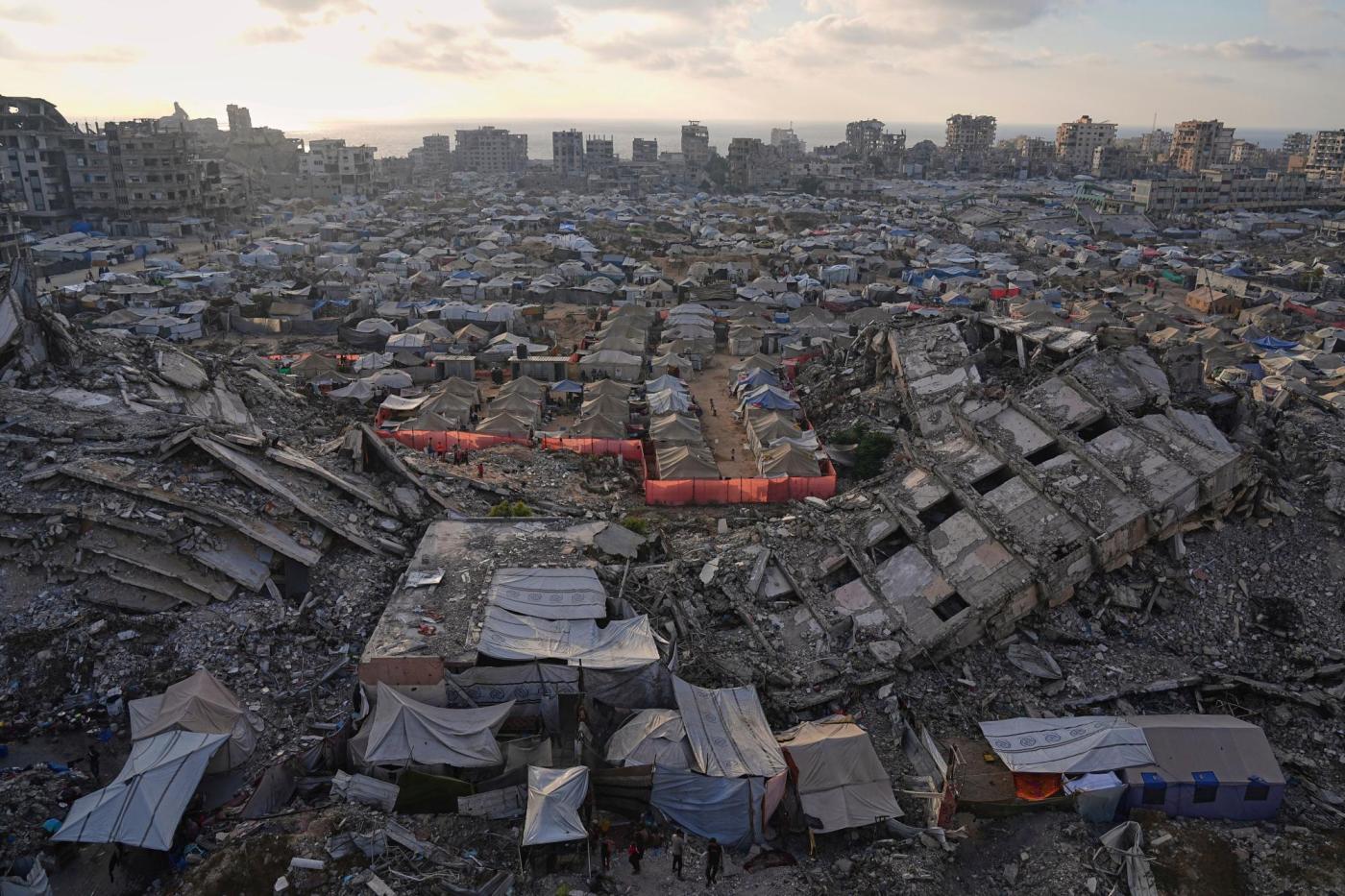
But Palestinians in Gaza were more uncertain. There was relief that the relentless bombardment and ground offensives may stop for a time and aid may flow in. But there was also skepticism and worry over how long any pause in fighting would last, whether hundreds of thousands will be able to return to their homes, and whether Gaza — its cities largely in ruins — will ever be rebuilt.

Many Palestinians fear Israel will take any breakdown in the talks as a chance to resume its assault. For months, Netanyahu and his hard-line allies have insisted they will keep long-term direct security control over Gaza and have spoken of pushing out its Palestinian population, ostensibly on a “voluntary” basis. In Gaza, many believe that remains Israel’s objective.

Pressure from the U.S. and its allies — if it continues after hostages are out — could prevent Israel from relaunching a full-fledged war.

But there is another, murkier scenario.

If Hamas and Israel cannot reach a final deal or negotiations drag on inconclusively, Gaza could slide into an unstable limbo, with Israeli troops still holding parts of it and Hamas still active. In that case, Israel would be unlikely to allow significant reconstruction, leaving Gaza’s population languishing in tent camps or shelters.