Federal judge reverses rule that would have removed medical debt from credit reports

posted in: All news | 0

By ADRIANA MORGA and CORA LEWIS

NEW YORK (AP) — A federal judge in Texas removed a Biden-era finalized ruled by the Consumer Financial Protection Bureau that would have removed medical debt from credit reports.

Related Articles


Republicans are considering changes to Trump’s request for $9.4 billion in spending cuts


World’s premier cancer institute faces crippling cuts and chaos


Immigration agents demand tenant information from landlords, stirring questions and confusion


Capital One, Walmart: A look at some of the consumer cases dropped by the CFPB under Trump


Mike Waltz pledges to make UN ‘great again’ at Senate confirmation hearing

U.S. District Court Judge Sean Jordan of Texas’s Eastern District, who was appointed by Trump, found on Friday that the rule exceeded the CFPB ‘s authority. Jordan said that the CFPB is not permitted to remove medical debt from credit reports according to the Fair Credit Reporting Act, which protects information collected by consumer reporting agencies.

Removing medical debts from consumer credit reports was expected to increase the credit scores of millions of families by an average of 20 points, the bureau said. The CFPB states that its research has shown outstanding healthcare claims to be a poor predictor of an individual’s ability to repay a loan, yet they are often used to deny mortgage applications.

The three national credit reporting agencies — Experian, Equifax, and TransUnion — announced last year that they would remove medical collections under $500 from U.S. consumer credit reports. The CFPB’s rule was projected to ban all outstanding medical bills from appearing on credit reports and prohibit lenders from using the information.

The CFPB estimated the rule would have removed $49 million in medical debt from the credit reports of 15 million Americans. According to the agency, one in five Americans has at least one medical debt collection account on their credit reports, and over half of the collection entries on credit reports are for medical debts. The problem disproportionately affects people of color, the CFPB has found: 28% of Black people and 22% of Latino people in the U.S. carry medical debt versus 17% of white people.

The CFPB was established by Congress after the 2008 financial crisis to monitor credit card companies, mortgage providers, debt collectors and other segments of the consumer finance industry. Earlier this year, the Trump administration requested that the agency halt nearly all its operations, effectively shutting it down.

“The Associated Press receives support from Charles Schwab Foundation for educational and explanatory reporting to improve financial literacy. The independent foundation is separate from Charles Schwab and Co. Inc. The AP is solely responsible for its journalism.”

Opinion: EDC’s Plan for Red Hook is a Boon for Developers

posted in: All news | 0

“The problem with EDC’s plan is that most Red Hook residents were never given an opportunity to have in-depth discussions, backed by independent technical research and assistance, about the future of the community.”

City and state officials announcing plans to redevelop Red Hook’s Brooklyn Marine Terminal last year. (Caroline Rubinstein-Willis/Mayoral Photography Office)

The City’s Economic Development Corporation—an agency under Mayor Eric Adams’ office—recently released a plan to redevelop Brooklyn’s Red Hook waterfront with majority market-rate housing while purportedly stabilizing the limited port facilities that are left there. That plan has met with a good deal of skepticism and outright opposition from Red Hook residents and some key elected officials. 

The problem with EDC’s plan is that most Red Hook residents were never given an opportunity to have in-depth discussions, backed by independent technical research and assistance, about the future of the community. As a result, the mayor’s plan, if implemented, may very well inflate economic and racial inequalities, stimulate more upscale development and displace more people than it is able to provide housing for.

I know this because in 1992, over two decades ago, I was a senior planner with the Brooklyn Office of the City Planning Department and main advisor to Community Board 6 as it completed the neighborhood’s first community plan, “Red Hook: A Plan for Community Regeneration,” one of the first community plans that went on to be approved by the City Planning Commission. I worked closely for almost two years with Community Board 6 and its appointed subcommittee that included residents, nonprofits and business representatives.

Among the many neighborhood conditions that residents then saw as problematic were lack of public access to the waterfront, and the racial and class divisions partially corresponding to the divides between public housing and other renters and homeowners. It is clear that these divides still exist. 

It is also clear to me that EDC’s plan would only exacerbate these historic divisions. First of all, it would create a new segregated enclave of mostly upscale private housing on the waterfront. Secondly, it would spur additional speculative land value increases that will spark demand for even more private housing, displace tenants, and further isolate other commercial waterfront uses and public housing.

Third, it proposes to encourage limited waterfront commercial development without solid solutions to the growing problems of last-mile deliveries, traffic congestion, waste management, and access to public transit.

I strongly urge residents, business owners, Community Board 6, and all elected officials, including those who will soon take office, to stop EDC’s rush towards approval of the plan.

The next city administration should make a fresh start in the spirit of the ground-breaking 1994 community plan. That plan took time—two years—and it was worth it! I am convinced that genuine community engagement is capable of yielding creative new ideas and plans across generations that lead to transformative changes.

Tom Angotti, Ph.D., us an urban planning and policy development professor emeritus at CUNY’s Hunter College and The Graduate Center, and an adjunct professor at Parsons/The New School.

The post Opinion: EDC’s Plan for Red Hook is a Boon for Developers appeared first on City Limits.

Nextdoor social site, looking for a revival, pins hopes on partnership with local news providers

posted in: All news | 0

By DAVID BAUDER

NEW YORK (AP) — Nextdoor, the social media site that aims to create connections among neighbors, is trying to shake off an uneven past and a nagging sense it is being underutilized. How? It is turning to professional journalists for help.

Related Articles


St. Paul and Minnesota Foundation announces new president, CEO with strong local ties


From ‘No Nukes’ to Nuclear Now: The progressive energy flip


Capital One, Walmart: A look at some of the consumer cases dropped by the CFPB under Trump


Most US stocks fall, but Nvidia keeps Wall Street near records


JPMorgan posts strong second quarter numbers, though Dimon warns of tariff, geopolitical risk

The company announced a partnership Tuesday with more than 3,500 local news providers who will regularly contribute material to the app. As part of a redesign, it is also expanding its ability to alert users about bad weather, power outages and other dangers, along with using AI to improve recommendations for restaurants, services and local points of interest.

“There should be enough value that we are creating for neighbors that they feel like they need to open up Nextdoor every single day,” said Nirav Tolia, the company’s co-founder and CEO. “And that isn’t the case today.”

The potential for Nextdoor to help itself and journalists at the same time is most intriguing.

Nextdoor is carrying portions of local news stories from providers in the area where the user lives. If people want to learn more, a link to the news site is included. At launch, Nextdoor says it has more than 50,000 news stories available, representing just over three-quarters of the app’s “neighborhoods.”

A future for news that never arrived

When Nextdoor began in 2011, the local news industry was in the early stages of a freefall that continues today. The number of journalists in the U.S. dropped from 40 per 100,000 residents in 2002 to slightly more than eight today, according to a study issued this month by Muck Rack and Rebuild Local News. Nearly a third of the nation’s counties have no full-time journalist.

Into this tumult came an app with a promising premise and infrastructure, perhaps a template for local news of the future. Its users — Nextdoor likes to call them “neighbors” — were organized into more than 200,000 distinct neighborhoods, with the ability to start conversations once shared over back fences: Do you know a reliable babysitter? What’s that building going up down the street? Who serves the best burger?

Yet Nextdoor’s developers knew technology, not the news business. They didn’t see a role for professional journalists at the outset.

FILE – Nextdoor CEO Nirav Tolia poses for photos at his office in San Francisco on May 11, 2016. (AP Photo/Jeff Chiu, File)

“We thought in our early days that neighbors would take over, almost as citizen journalists or local reporters,” Tolia said. “I think we’ve come to the conclusion that neighbors can only do so much.”

Even worse, the site became a magnet for racists and cranks, the kind of neighbors you try to avoid. Nextdoor became so filled with suspicion — why is a person of a different color or nationality walking down the street? — that its moderators had to spend considerable time rooting out racist posts and changing rules to prevent them.

For some users, the negatives outweighed the positives.

“Nextdoor has been a valuable resource for my family,” Ralinda Harvey Smith, a woman from Santa Monica, Calif., wrote in the Los Angeles Times in 2020. “I found a nanny share for my kids on Nextdoor. When I posted looking for a mechanic to replace my car headlight, a neighbor offered to change it free of charge. When the pandemic struck and disinfectant wipes were impossible to come by, a woman on Nextdoor DM’d me offering to leave some on her porch.”

“Yet I’ve long seen remnants of racism across the site that have left me with a bad feeling not only about the app, but the city I love,” Smith wrote. That made her log on less frequently.

Trying to make Nextdoor essential for users

Whatever the reasons, enough users consider Nextdoor inessential that its leaders were compelled to make the changes being announced now. The site has 100 million registered users, but only about 25 million are on the site at least once a week, Tolia said. Nextdoor, which went public in 2021 to attract a new round of financing, wants to see them more often.

Nextdoor hired a former executive at The New York Times, Georg Petschnigg, as its chief design officer to oversee the changes.

The company said its surveys found users wanted to know more about what was going on in their communities beyond the utilitarian information. Other social networks are similarly bringing in more outside material, Tolia said. “When you rely on user-generated content, it’s kind of unpredictable in terms of quality, timeliness and relevance,” he said.

“If I were in their shoes, I’d be doing this. I don’t know why they didn’t do it sooner, but that’s for them to answer and not me,” said Chuck Todd, the former “Meet the Press” moderator who has taken an interest in local news since leaving NBC. Semafor this spring speculated Todd might be interested in buying Nextdoor. Todd wouldn’t discuss that.

He is waiting to see if Nextdoor has a real commitment to news or just to reaching more eyeballs.

“It’s an opportunity to do the one thing that Facebook could have done but chose not to,” Todd said. “You don’t want this to go down the road of just trying to get traffic for traffic’s sake, because that’s what happened to Facebook after it went public.”

The irony of engaging with professional journalists isn’t lost.

“It’s like what is old is new again,” said Sam Cholke, manager of distribution and audience growth for the Institute for Nonprofit News. Its hundreds of members include the Texas Tribune, the Plateau Daily News in Highlands, N.C., and the Daily Yonder in Whitesburg, Kentucky.

Several of its participating news organizations are joining with Nextdoor, and “my hope is that our members see significant benefits from it,” Cholke said.

Hoping for mutually beneficial relationship

The local news industry continues to suffer from the same problems that have led to its downfall the past two decades: a dwindling number of readers and advertisers. An offhand comment by Tolia — about how people used to pick up “a piece of dead tree” from their driveways to get their news — speaks to fading prospects.

FILE – Cars and pedestrians move along crooked Lombard Street in San Francisco on Thursday, July 3, 2025. (AP Photo/Jeff Chiu, File)

Facebook’s deemphasis of news on its platform and Google’s increasing use of AI at the expense of referrals to news articles are adding to the death spiral, said Tim Franklin, head of the Medill Local News Initiative at Northwestern.

“If Nextdoor is another vessel to get readers to news sites, and local news sites in particular, it would come at a real moment of vulnerability for local news organizations and would be a real opportunity,” said Franklin, whose worry is that relying on third parties is unpredictable.

Josh Schneps, who runs a series of local news operations in New York City and Long Island, like the Flushing Times and Park Slope Courier, has already had material appear on Nextdoor in a soft launch and is seeing an increase in traffic to the sites.

“I feel like media is in a state of evolution and there’s no playbook,” Schneps said. “My goal is to get our content in front of as many people as possible. I’m more than happy to be the guinea pig” for Nextdoor, he said.

An industry — and a company — both need help. Maybe they can help each other.

David Bauder writes about the intersection of media and entertainment for the AP. Follow him at http://x.com/dbauder and https://bsky.app/profile/dbauder.bsky.social.

Lynx’s Kayla McBride earns all-star nod, after all

posted in: All news | 0

After Minnesota was originally tabbed two all-star selections — Napheesa Collier and Courtney Williams — Lynx coach Cheryl Reeve couldn’t help but wonder why that figure wasn’t higher.

“I don’t know why only Phee and Courtney are all-stars when you have the best team in the league by a few games,” Reeve told reporters after the rosters were announced. “There are teams that are below us in the standings by a lot that have three all-stars. Historically, teams at the top get minimum of three, oftentimes four. So, really disappointing. … We are disappointed in the coaches’ voting with regards to their selections for all-stars.”

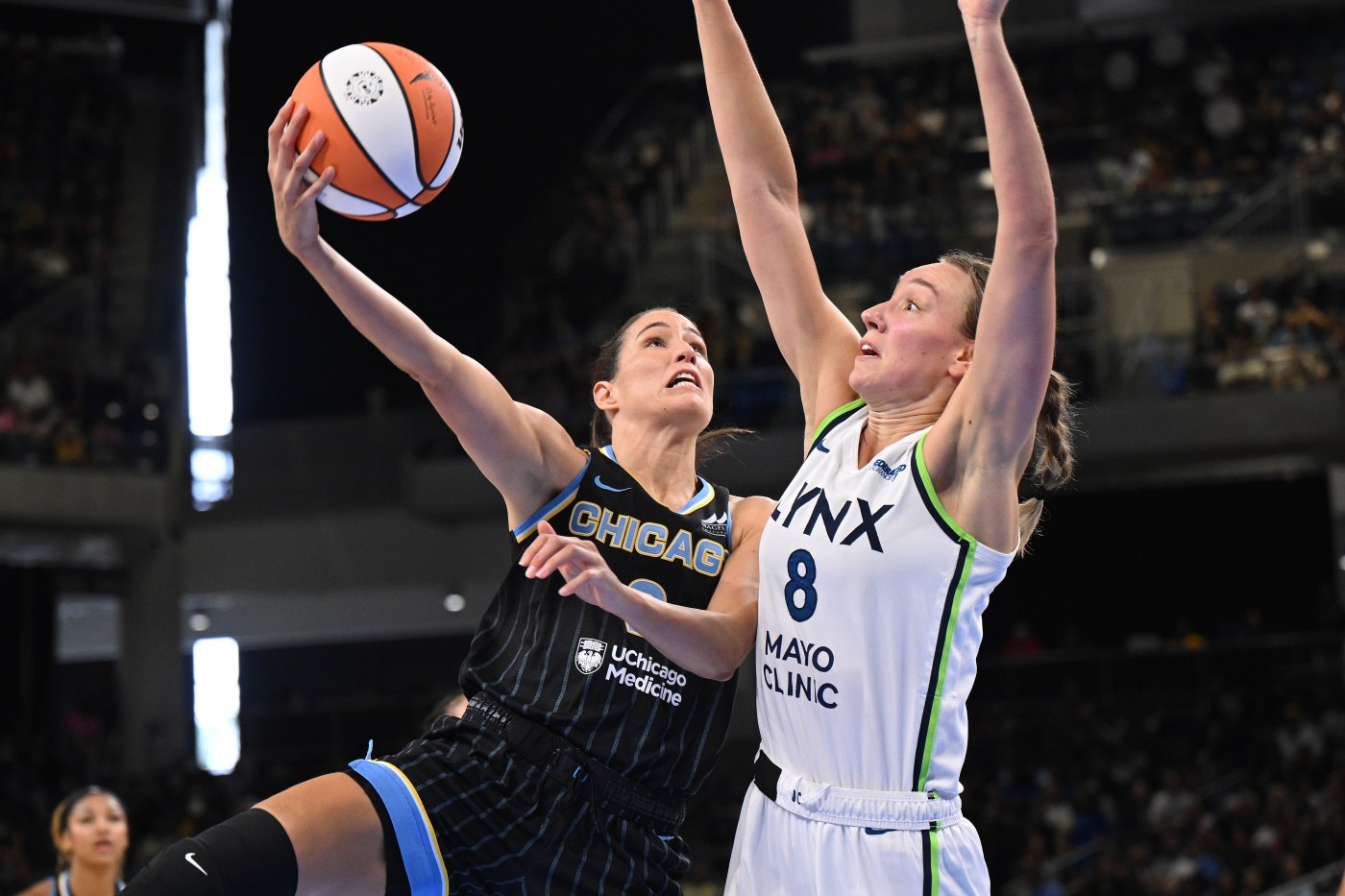
At least one of Minnesota’s grievances has been addressed, as guard Kayla McBride was named an all-star replacement by WNBA Commissioner Cathy Engelbert on Tuesday. McBride takes the place of Atlanta Dream wing Rhyne Howard, who is expected to miss the rest of July with a knee injury.

McBride is averaging 14.1 points a game this season while shooting 38% from the 3-point line and a gaudy 94% from the free-throw line. She is second in the Association, behind only Howard, in 3-pointers made per game (2.6).

McBride leads all Lynx’s starters in defensive rating this season — Minnesota allows opponents to score only 93.5 points per 100 possessions when the guard is on the floor — and is second among starters behind only Collier in net rating (12.9).

McBride will, fittingly, play for Team Collier alongside Collier and Williams. That squad will be coached by … Cheryl Reeve. They’ll take on Team Clark, captained by Fever guard Caitlin Clark.

McBride’s inclusion leaves Alanna Smith as Minnesota’s lone remaining “snub.” The Lynx’s three all-star selections put them on par with Indiana for the most in the WNBA. This marks McBride’s fifth all-star selection.

The All-Star Game is set for 7:30 p.m. Saturday in Indiana.

Related Articles


New all-star Courtney Williams leads Lynx to 11th straight home victory


‘Sickening’ day casts pall on dominant Lynx victory