It’s been more than 15 years since the Parks & Trails Council of Minnesota began purchasing easements from property owners to extend the popular Gateway Trail into Scandia.
Now, that work is finally coming to fruition.
City officials next month expect to approve the plans and specifications for a trailhead on city-owned land near Meister’s Bar & Grill along with a tunnel under Oakhill Road (Washington County Road 52) and a one-mile trail connecting the two, said City Administrator Kyle Morell. The estimated cost of the project is $4.6 million. Construction could start in May and should be complete by the end of 2026, he said.
A Sept. 19, 2025, map shows the Gateway Trail plans between Scandia and William O’Brien State Park, which include a tunnel under Oakhill Road. (Kathryn Kovalenko / Pioneer Press)
But the tunnel, which has an estimated price tag of $1.5 million, has been controversial. Officials from the Minnesota Department of Natural Resources, the agency that will own, operate and maintain the state trail, say it is a necessary safety measure.
The Gateway Trail is one of the state’s most heavily used trails, attracting an estimated 314,000 users in 2024. It currently runs 19 miles from St. Paul to Pine Point Park in Stillwater Township. Plans call for a four-mile extension of the Gateway Trail from the east entrance of William O’Brien State Park to downtown Scandia, and the number of users is expected to only increase, said Kent Skaar, the senior project manager for acquisition and development for the DNR’s parks and trails division.
“The tunnel is absolutely a safety consideration,” Skaar said. “Do we have crossings of highways like Oakhill Road? Absolutely. Are we intentionally trying to find them and build them? No. We’re building tunnels where we can and where it makes sense, and here it really does.”
But Linda and Loren Nickelson, the couple who owns land on Oakhill where the tunnel will cross the highway, say it is unnecessary and poorly planned.
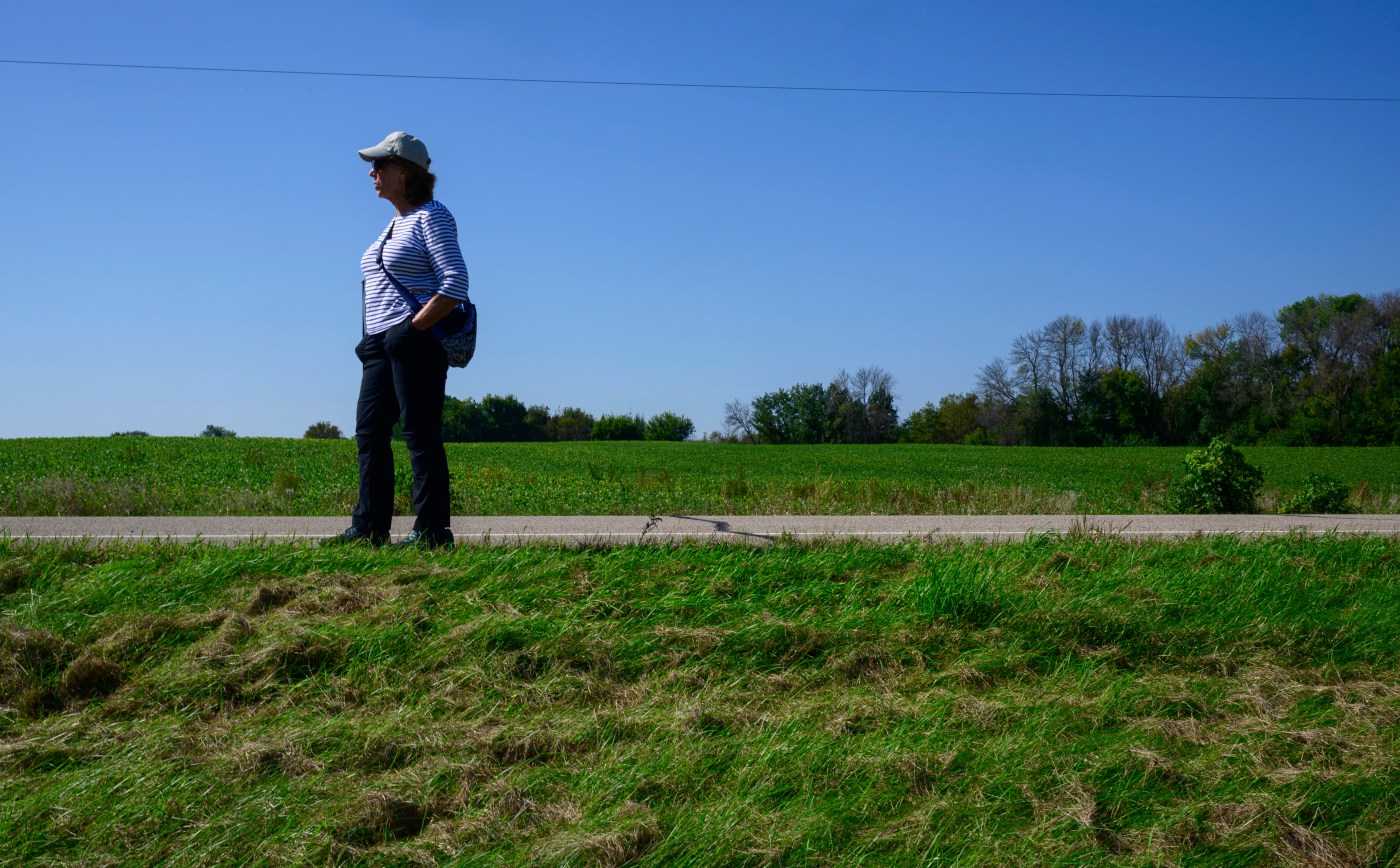
Linda Nickelson grew up in the area and owns 54 acres of undeveloped land on the north side of Oakhill. The land in question has been in her family for generations. “My great-grandparents came from Sweden and settled in the area in the mid-1800s,” she said during a recent tour of the property. “It’s where I grew up.”
Nickelson, who lives in Crosslake, Minn., said she only recently learned of the plans for the tunnel, which she claims will “destroy more than half of our road frontage and create a wetland on the remaining portion.”
She is asking city officials to halt the plans before it is too late.
“I’m not against the trail,” she said. “But just because some people put the cart before the horse and went forward with partial payment for preliminary work on this tunnel does not mean this tunnel should come to fruition and sit there dormant for many years into the future. The Gateway Trail hasn’t even been constructed to connect to the tunnel.”
Plans call for trail sections on both sides of a realigned Oakhill Road to accommodate bicycles, pedestrians and horseback riders. The tunnel crossing is designed for pedestrians and bicyclists; they will be directed to use the trail section on the north side of the road and cross under Oakhill via the tunnel. Horseback riders will be directed to a trail section on the south side of the road, so horses do not have to go through the tunnel; they will cross at an at-grade crossing further northwest on Oakhill Road, where the trail meets the road at the property just north of Nickelsons’ land.
“The fact that a very short distance down the road, there will be a crossover for horses, bikers and pedestrians who do not want to use the tunnel, makes this whole endeavor seem foolish,” Nickelson said.
The trail also will require the “clear cutting” of 100-year-old oak and maple trees north of their property, Linda Nickelson said. “That’s a pity considering how very few people will end up using that trail.”
The state in 2017 purchased a trail easement for $91,000 from the property owner on the south side of Oakhill, and no construction easement is required on an adjacent property as the new alignment will be contained within the easement, Skaar said.
Linda Nickelson said it makes more sense to have the entire trail built on the south side of Oakhill Road and come out on city-owned property near where the city’s new Water Tower Barn Arts and Heritage Center will be built.
“That brings the trailhead out in close proximity to pickleball and tennis courts, a playground, picnic tables, the Gammelgården Museum and a much larger parking lot for horse trailers,” she said. “Isn’t that a much safer alternative? There would be no need for a tunnel, no crossover, no need to construct a parking lot in an extremely busy section of Scandia. No removal of 100-year-old oak and maple trees, no unlawful destruction of wetlands, no very expensive road reconfiguration.”
If the tunnel is deemed unnecessary, that money “could go towards the actual trail construction,” she said. “A tunnel to nowhere serves no purpose.”
The majority of the easements for the existing state trail corridor were acquired between 2007 and 2010 following consideration of potential options, community support and landowner interest, Skaar said. Several options were considered during the corridor selection and property acquisition, including the south side of Oakhill, he said. “This included the consideration of potential trailhead locations, including a ‘shared-use’ facility as suggested, which as I remember was considered too impactful to the city’s current activities and uses,” he said.
Skaar said all state trail corridor acquisition is from “willing sellers only.”
He also said the trail segment from Scandia to the tunnel will have “limited wetland impacts.” The plans have been completed in compliance with the Minnesota Wetland Conservation Act, and the impacts will be mitigated, he said.
Project deadline
The tunnel and trail will be located on county-owned right-of-way that abuts the Nickelsons’ property. Officials have asked the Nickelsons for a temporary construction easement to access her property to grade the slopes from the property to the trail, but she said she will not grant it. “That would be like putting a stamp of approval on foolish spending,” she said.
Crews can work around it, but it will mean constructing a two- to five-foot retaining wall and a fence in the right of way “to construct the trail at the appropriate grades and not infringe on their property,” said Mayor Steve Kronmiller.
If the Nickelsons, who would like to build senior housing on the property, agree to the construction easement, the city would create an access to the property that meets city standards, he said.
Scandia Mayor Steve Kronmiller. (John Autey / Pioneer Press)
“Right now, they’re driving through a wetland on a farm road to get to their property,” he said. “If we’re not allowed to have the easement, our costs are going to go up in order to build the retaining wall and all of that. If they want to develop their property in the future, they’re going to have to build that access themselves.
“We’ve been trying to work with them. They just don’t like the tunnel, and I think they’re trying to find a way to stop it, and I understand that.”
The city got a $2.68 million grant from the Legislative-Citizen Commission on Minnesota Resources to extend the trail from the trailhead behind Meister’s Bar & Grill to Oakhill Road. The money also will cover a realignment of 2,000 feet of Oakhill Road and the raising of the road by 6 feet to accommodate a new tunnel under the road.
Funding for the trail extension, per the terms and conditions of the LCCMR grant appropriation, must be expended by June 30, 2027, Skaar said.
“If it is not complete, the funding disappears,” Skaar said. “At this point, the plan is basically complete. Right now, the intent is to proceed to a construction contract and award this fall with construction next year. It can be done in a year.”
Mahtomedi football game canceled Friday night due to nearby law enforcement activity
St. Paul: West 7th Street reopened after sinkhole closed area for 4 months
St. Paul: Early voting opens as mayor’s race, school levy overshadowed by high taxes, ‘stagnation’
Public internet access restored to St. Paul libraries, rec centers after cyberattack
Charlie Kirk event at U to go ahead with conservative Michael Knowles
Washington County is contributing $800,000 for work related to the tunnel and the realignment of Oakhill and another $200,000 for the project is coming from the Federal Recreational Trail Grant Program that the DNR applied for and received, Skaar said.
Scandia officials are taking the lead in the design and construction of the trail. If the winning bid comes in higher than anticipated, the DNR will work to help secure that additional funding, Skaar said.
Washington County agreed to help pay for the project because a tunnel is needed for the “long-term safety and comfort of trail users,” said County Engineer Wayne Sandberg. “It’s consistent with how we have been managing other regional and state trails at uncontrolled crossings of county highways.”
The speed limit on that section of Oakhill is 55 mph.
Said Kronmiller: “Even if we reduce the speed limit to 30 mph, the sight lines in that area aren’t the greatest. If you’re not really familiar with the area, especially if you’re coming in from Highway 95, you’re going to come up and all of a sudden there’s this crossing in the middle of nowhere that you just wouldn’t expect to be there. … It would be unsafe to have a pedestrian crossing at grade.”
“We’ve learned that at-grade crossings don’t work well with that much bicycle traffic,” Sandberg said. “That’s why we were really strong on going into this one, that if we’re going to extend the Gateway up to Scandia, we need to make sure this is a tunnel from the very beginning, so we don’t have a tragedy right out of the chute.”
Washington County officials will not allow the trail to cross Oakhill, a county highway, at grade, Sandberg said. To support a grade separation, county officials agreed to contribute financially toward a tunnel option, he said.
Built in segments
Doug Ferron, of Forest Lake, rides along Oakhill Road on his way through Scandia on Tuesday, Sept. 16, 2025. Today the Gateway Trail ends 10 miles south of Scandia at Pine Point Regional Park, but plans call for it eventually to reach Scandia via William O’Brien State Park. (John Autey / Pioneer Press)
Eventually, the trail will go south from the tunnel to a new trail entrance to William O’Brien State Park on the north side of the park. The trail will go through the park and then eventually connect to Pine Point Park, the current terminus of the trail.
The trail is being built in segments as money and land become available, Skaar said.
Why build the northernmost part of the trail before the rest of the trail is constructed? Skaar said all long trails are built in phases, and that it makes sense to do the Scandia segment first.
“It is really a circumstance, admittedly, of funding,” he said. “When it comes to state trails, we are building incrementally when funding and the corridor is available.”
Building a trail from Scandia all the way to Pine Point Park would be a substantial project to design and construct “in a typical period,” he said. “Building them in 1-, 2- or 3-mile segments is really the most efficient. … That has been the history of the program and remains so.”
The DNR is obtaining design work for the portion of the trail from the tunnel at Oakhill to William O’Brien and is estimating construction to be “three to five years out,” he said.
In 2024, William O’Brien State Park had 205,747 day uses and more than 22,000 overnight uses. Many of those visitors will be traveling up to Scandia once the trail is constructed, Kronmiller said. “When you look at all of these factors, now all of a sudden (a tunnel) makes sense.”
Scandia resident Susan Rodsjo said she predicts the Gateway Trail extension is going to be a huge boon to the area.
“It’s been frustrating that it has taken so long to actually get it here,” she said. “I’m just hoping it’s here by the time I have grandkids at this point, so I can enjoy it with them. When we bought the land, that was actually one of the huge benefits to us, that the Gateway Trail was coming to town. We’ll be able to hop on our bikes, go to William O’Brien. Eventually, we’ll be able to bike all the way to St. Paul. That’s pretty darn cool.”
Mahtomedi football game canceled Friday night due to nearby law enforcement activity
Drivers asked to use extra caution for motorcycle Flood Run weekend
‘Field of Bands’ fundraiser at Washington County Fairgrounds to aid veterans and troops
Leapin’ Lena’s stick is now a part of Stillwater history
Duluth cannabis dispensary is state’s first licensed seller to open its doors … at 4:20 p.m. no less
Rodsjo said she expects the Gateway Trail to do for Scandia what the Root River Trail did for Lanesboro and the Cuyuna Country State Recreation Area did for Crosby.
“Have you been to Crosby?” she said. “We have gone through Crosby for years. They made something out of their mines for mountain biking, and they really did a phenomenal job. Next thing you know, ‘We’re, like, let’s go to Crosby for the day.’ There’s good restaurants, there’s fun shops. They have the most amazing grocery store. All of a sudden, it’s the hot spot. … There’s so much you can do for your economy with things like biking.”
Mayor Kronmiller said he is certain things will work out and the trail will be constructed as planned.
“It’s like a puzzle with a bunch of pieces that all have to be put together in the right way at the right time, and it’s all starting to come together now,” he said.