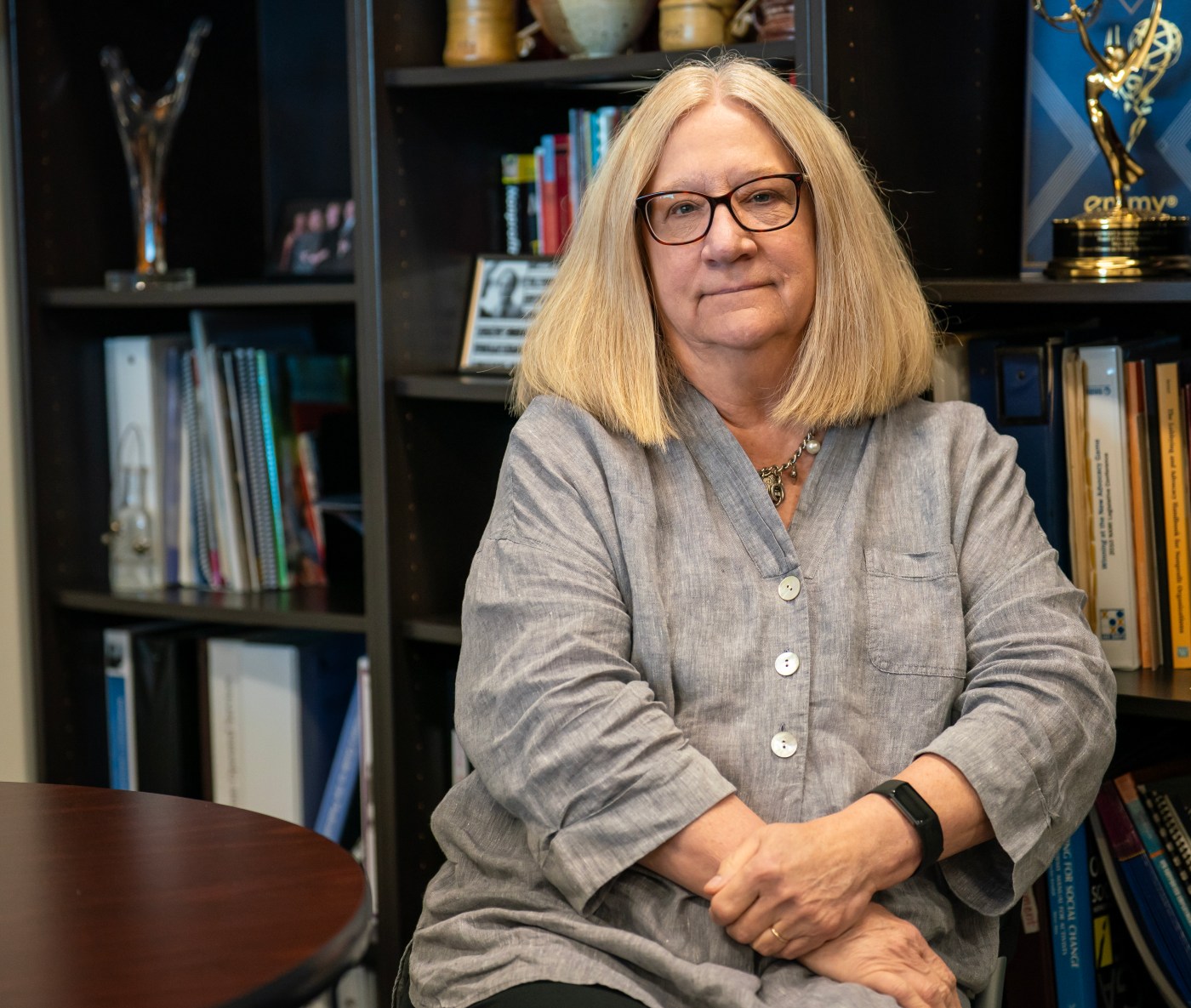
As head of the National Alliance on Mental Illness Minnesota, Sue Abderholden “brought the muscle of love to bear on our mental health systems,” said Kirsten Anderson, the executive director of AspireMN.
Sue Abderholden in the NAMI Minnesota offices in St. Paul on Sept. 24, 2025. Abderholden will retire on Oct. 15. (Claudia Staut / Pioneer Press)
“Sue is fearless, and she is incredibly capable,” Anderson said. “She is deeply committed, based on her love of people and her resolve that we can build what’s needed and we can always do better. … The ferocity that is associated with her and her legacy comes from an incredible amount of love.”
Abderholden, 71, of Minneapolis, retires on Wednesday after 24 years as executive director of NAMI Minnesota.
During her tenure, she has been a driving force behind major legislative reforms that transformed the state’s mental health system, successfully advocating for the passage of more than 20 laws that protect the rights of Minnesotans with mental illness.
Among her impacts:
laws that require mental health training for teachers;
mental health screenings for people entering jails;
expanded crisis and community-based services;
strengthened mental health parity protections;
limiting solitary confinement in prison for individuals with mental illnesses.
“When Sue shows up, she shows up — as a professional and as someone who is a deep believer in the future we can build together,” Anderson said. “She believes in people. She believes in family members. She believes in her friends. She believes in our elected officials. And she also believes in democracy as being able to be the vessel of what makes life better for everybody.”
When Abderholden was hired at NAMI Minnesota in October 2001, the organization had a $160,000 budget and 2½ staff members — “and the only other full-time person quit my first day on the job,” she said.
The St. Paul-based organization now has a $3 million budget and a staff of 35 and is recognized as one of the most effective and respected mental health advocacy organizations in the nation.
Abderholden was instrumental in making NAMI an organization focused on adults and children — not just adults, Anderson said.
“The majority of NAMIs across the country do not pick up children’s issues and pursue them,” she said. “That was never a question, of course, with NAMI Minnesota. Sue decided that it would be inclusive of all people who have experienced mental illness and all the people who love them in those equations.”
One of Abderholden’s final achievements, according to Anderson, was “going through, truly, hundreds of pages of state statute to remove some really icky words” that were used to describe children with mental illness.
“Sue just said, ‘Our statutes don’t have to have these yucky words. We can do better,’” Anderson said. “So she just went through them line by line. She didn’t ask anybody else to do it. She just did it. Those words are gone. We’re talking about children who are mentally ill, and words matter. To me, it’s representative of just one more gift that she is sharing with children and families and our wider community, demonstrating once again that we can do things better. It’s just a matter of our political will.”
Studied pre-medicine at Macalester
Abderholden grew up in Antioch, Ill., and attended a Catholic boarding school in Lake Forest, Ill. She moved to St. Paul in 1972 to attend Macalester College, graduating in 1976. She double-majored in political science and pre-medicine, but she didn’t get into medical school.
“You have to remember that this was 1976,” she said. “The first question from the first medical school was, ‘Do you plan on getting married?’ I said, ‘Well, I hope to someday.’ And they said, ‘Well, you’re not serious.’ When the second medical school asked the same question, I’m, like, well, I know the answer. So I said, ‘No,’ and they said, ‘What’s wrong with you?’”
A doctor at the former Ramsey Hospital in St. Paul, where Abderholden was doing research on stress ulcers in burn patients, suggested that she work at Dakota’s Children, a West St. Paul residential center for children with intellectual and developmental disabilities.
“I never turned back,” she said. “I still have a picture of all of them in my office as a reminder to me. I mean, it literally changed my life. I loved working with those kids, but I also saw how hard it was for parents to leave their children there. It was a state-of-the-art group home. It was the only alternative to the institutions at the time. And it was really hard. We had no community services for them. These kids were barely allowed into schools yet.”
Nuclear missile workers are contracting cancer. They blame the bases
How ‘The Great Lock In’ can help achieve your financial and wellness goals
AstraZeneca agrees to lower drug prices for Medicaid under Trump administration deal
Medicine from a vending machine? Devices installed in Chicago
Doctors and nurses are punched, choked, even shot. States want to stop that
Abderholden got her master’s degree in public health from the University of Minnesota in 1980 and then took a job at the Minnesota Department of Health. When officials at The Arc Minnesota, a disability advocacy nonprofit, announced they were looking for a new public policy director, Abderholden applied. The families she’d grown close to at the group home all wrote letters to Arc board members on her behalf, she said, and she got the job.
“They all said, ‘Hire this young woman,’” Abderholden said. “I would have never gotten the job at Arc if I hadn’t had that one. You never know what job is going to lead you to your best job.”
Abderholden went on to become Arc’s executive director and stayed at the organization for 10 years. She held leadership positions in the Minnesota office of U.S. Sen. Paul Wellstone and PACER Center before taking the job at NAMI.
Abderholden’s husband, Lee Keller, died in 2021. She has two daughters, Ona and Eva.
Sue Abderholden Q&A
Abderholden recently spoke with the Pioneer Press about her career. The transcript has been edited for clarity and conciseness.
Q: I’ve heard you say that when someone gets a cancer diagnosis or has their gallbladder removed, friends and family send get-well cards and deliver hotdishes. That doesn’t happen when someone is hospitalized for mental illness.
A: We call it a “no-hotdish illness,” and I think that just says a lot. It’s getting better. When you have a loved one hospitalized for a mental illness, you should be getting hotdishes and get-well cards and visits and phone calls and all those things. It should be treated like any other illness. No one gets through a serious illness by themselves. We have to think about how do we provide those kinds of natural supports in the community to people with mental illnesses and their families?
Q: With one in four people having some form of mental illness, you can’t go far without finding someone who either lives with mental illness or has a family member who does. Did you have a special personal interest in mental health when you started at NAMI?
A: I have family members who struggle with their mental health. My mom struggled, especially during menopause, with depression. My husband also had serious depression. I’ve just met so many people along the way who’ve also become good friends, who’ve had kids with really serious mental illnesses, you know, so it’s all those people that I’m really going to miss because they’re just incredible. I mean, just in terms of their endurance, you know, hanging on to hope, just not giving up. There’s one family where their son would just disappear for months at a time, and they just never gave up. Right now, he’s doing really well.
Q: For so long, it was so taboo to even talk about mental health issues. You’ve always said the best way to break down barriers is to talk about them. Can you elaborate on that?
A: Every time someone talks, a brick comes off the wall of silence. I think it’s changed a lot. When I started, people weren’t talking about it. And we knew that in terms of the little research there was about changing public attitudes, it comes down to people’s stories, so we really wanted to give people permission to share their stories and in a safe way, especially if they’re talking about suicide. I really think it helps because then you have someone that’s like, “Oh, they look like me, right? Oh, that’s not so scary.” I think people’s stories made a huge difference. And then, honestly, COVID.
Q: Tell me more.
A: During COVID, everyone experienced at least a day or two of feeling depressed or anxious about the world, about what was happening. And so I think we just saw a lot more empathy. We saw that with employers reaching out, saying: We want to talk about mental health in the workplace. We saw youth talking a lot more about it, especially about what happened to them during COVID. It feels like we just kind of ripped the curtain away or broke down the wall or whatever, and we just don’t really see that same kind of reticence to share their stories. Still a little bit in rural Minnesota, still a little bit in some, you know, diverse communities, but so much different certainly than 24 years ago.
Q: That’s good.
A: It is good because that’s how you create change, right? Those people have to be comfortable enough to reach out to their legislator to say, “This is an issue that impacts me, and I want you to do this or that or whatever.”
Q: Let’s talk about your time at the Capitol, because it seems like that was such a major part of your work at NAMI. Have we done enough? What’s next?
Marcus Schmit named executive director of NAMI Minnesota
NAMI Minnesota announces four new board members at annual conference
A: We’ve done a lot, but not enough. I keep telling people I had this wonderful mentor back when I worked at Arc, and she said, “When you look ahead and see how much work you have to do, you need to look behind you and see how far you’ve come.” That’s absolutely true. So much has changed.
We used to fund things through grants. Well, now most of those services are funded through Medicaid and Minnesota Care. Not everything through private insurance yet, but we’re getting there. People used to have to wait in line at the county for those kinds of services. I think we’ve done a lot of shifting to view it as health care, not forgetting, you know, kind of the social determinants of health. We still need to talk about housing and food and all those kinds of things. We’ve created a wide array of services. So in some ways, we really do know what we need to do. We just haven’t fully funded it.
Q: What weren’t you able to accomplish?
A: The one thing I didn’t complete that I really wanted to do was to separate out children’s mental health from the child-protection system. We’re not quite there yet. We’re close. It’s really a funding issue. And I’m really hoping that they carry it forward next year and do that final push.
Q: Why is it so important to have it separate?
A: Because those families don’t belong in child protection. They haven’t done anything wrong. They’re just seeking services. And because we use Title IV-E (a federal program that provides reimbursement to states) to pay for room and board, we have to follow the child-protection laws. Families have to go through the child-protection system for children’s residential services — not for psychiatric residential treatment facilities, because they are fully funded by Medicaid. We had a bill that would actually use state dollars to pay for room and board, so families wouldn’t have to do that anymore. That’s one I wish we had gotten done.
Q: Anything else?
A: More recently, they finally funded one of my ideas that I am really kind of proud of. It’s called voluntary engagement. The hardest calls I would get were from families who are saying, “You know, I can see my loved one is decompensating. I don’t know if they stopped taking their meds or the meds aren’t working, but I can see it. I called the county, and the county says until they’re a danger to themselves or others, there’s nothing we can do.” That always seems so wrong to me.
So we created in the commitment law kind of a voluntary engagement or engagement in services. It finally got grant funding, and that funding finally went out the door just last month. The idea behind it is if a parent calls the county, they would send out someone like a peer specialist to try to engage that person into treatment. So it’s not one and done. You know, the crisis team goes out. They don’t want services. They leave. Well, the peer specialist would come back every day for 90 days.
Q: What are you seeing mostly in terms of mental illness now?
A: I mean, anxiety. That’s the top one and has been for years and I think kind of increased after COVID, followed by depression.
Q: What about schizophrenia?
A: With the legalization of cannabis, we should be thinking about schizophrenia and psychosis more because we’re going to see more of it, especially if younger people are using (cannabis) more consistently. We actually just finished a rack card of warnings about cannabis use — it’s not risk-free. If you have a history of schizophrenia in your family, don’t use it.
Q: Let’s talk about loneliness. I know that’s one of the issues you’ve been talking about lately.
A: I think COVID did a number on us in terms of loneliness. Our system isn’t set up to look at whether someone’s lonely or not. For example, in a psych unit, you have to give up your phone. I don’t even know my daughters’ phone numbers. I need my phone to be able to do that. There’s no phones in the rooms in a psych unit, so there’s one phone in the main area, and you hope a patient picks up the phone to connect you with your loved one. That’s not a great way to go, right? And then, you know, so many people are discharged, and there’s no one in the room … and then you’re surprised that they don’t make their next appointment. Even when they visit with their therapist or psychiatrist, does anyone bring up, “Who’s your support system?” … We know loneliness leads to other healthcare conditions like diabetes, a greater risk for suicide, all sorts of things. And it’s like no one is paying attention. The former surgeon general called it the new epidemic. I’ve been trying to encourage providers to really think about that.
Q: What are your plans for retirement? I’m sure it’s a bittersweet time.
A: It is. I really do love the work, but I’m 71 and, you know, none of us know how much time we have on this Earth, right? So there are some other things that I would like to do. It has been a job that’s exhausting. I’m typically working six days a week, seven during the legislative session. So just getting some time to, frankly, relax, catch up on my sleep, take walks, visit family and friends. I have a whole huge pile of books to read, and I’m going to clean the closet. There’s all those kinds of things that I just think it’s kind of time. I have one daughter who lives in San Francisco, and she always says, “Come in the spring when everything’s green.” I’ve never been able to because of the session, so I’m like, “Next year, I will be there.”
St. Paul: CLUES moves food service, child care into former church site
Member-owners of Mississippi Market and River Market co-ops approve merger
Downtown St. Paul: Nonprofit acquires vacant Alliance Bank Center
A wallflower blooms: After weeks in a shipping container, Chinese stowaway cat getting ready for adoption
U of M considers selling historic Eastcliff mansion to its foundation
Q: You’ll have to take up pickleball.
A: Oh, God. No.
Where to find help
Families can find mental health information and resources for crisis care on NAMI Minnesota’s website, namimn.org.