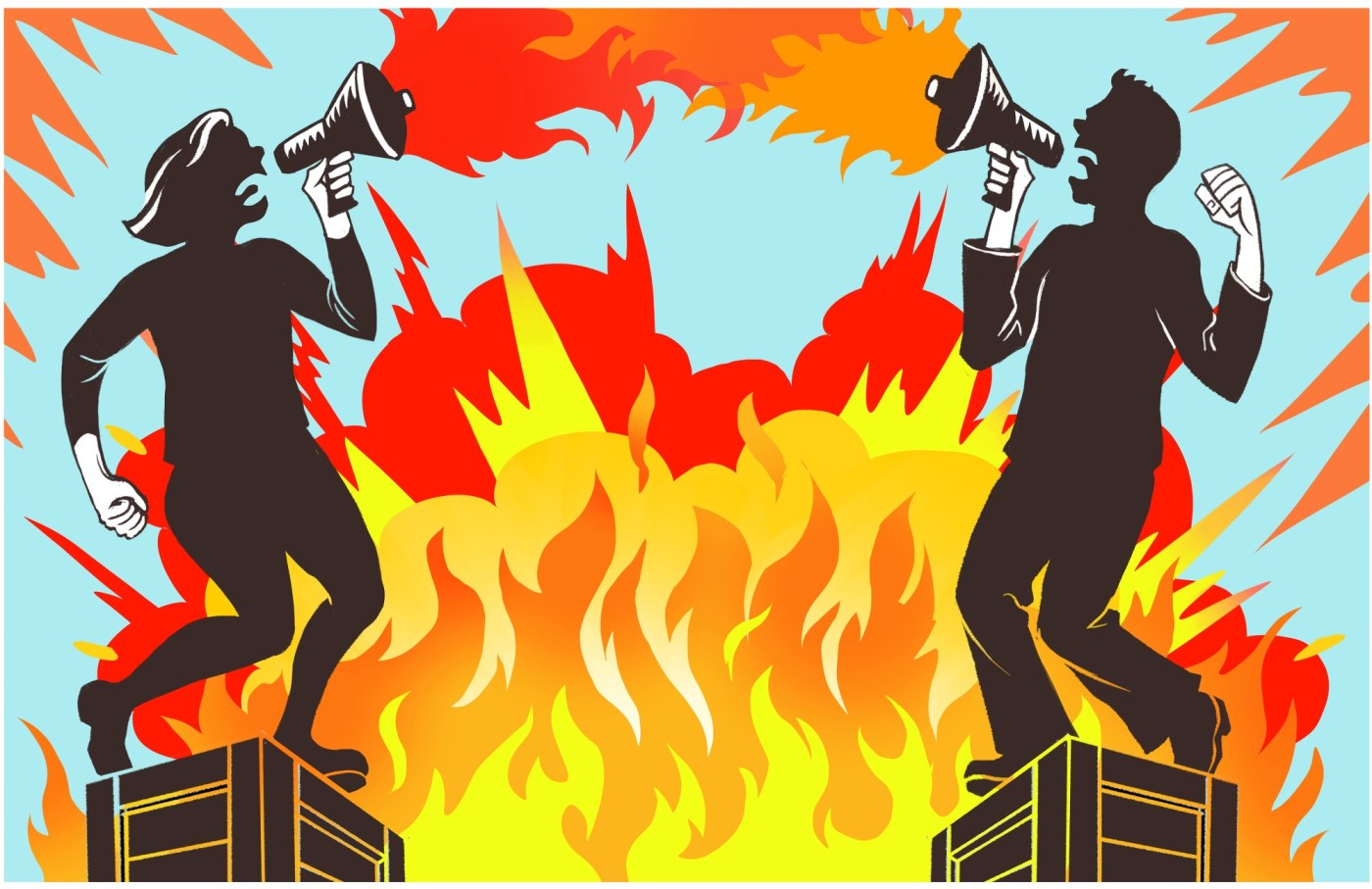
The political assassination of conservative activist Charlie Kirk produced a range of reactions from those on the fringes of a deeply polarized nation, with calls for violent retribution on one extreme matched by something of a macabre glee over Kirk’s murder on the other.
But between those political counterpoles there’s also been bipartisan pleas for unity and a rejection of politics as bloodsport in the interest of mending a social fabric frayed by discord and division.
With that in mind, here are several strategies people can personally employ to help bring down the political temperature:
Debate in good faith
Christine Mellon, Ed.D, a Wilkes University professor and the speech and debate coach there, shared a number of recommendations for how to facilitate a safe, respectful and constructive environment for the free exchange of ideas. Among other advice, she said people engaged in respectful debate should be clear in their viewpoints and avoid personal or ad hominem attacks.
And they should be willing to agree to disagree, too.
“Because sometimes, no matter how hard you try, your viewpoints are just different,” Mellon said. “And I think if you can say ‘we’re going to agree to disagree’ that also keeps the level and the integrity of the debate in a calm atmosphere.”
Healthy, constructive debate also demands a willingness to listen and an earnest, good-faith effort to understand other points of view.
“When you go into a debate space sometimes you understand exactly what it is that you want to say really well, and you just know, whatever the other person is going to say, ‘well I just disagree with that,’ ” Mellon said. “But the problem is that, have you really tried to understand? Like maybe their background factors into what they believe, or maybe their education factors into what they believe. So you have to be willing to understand their other point of view.”
Common ground is a good place to start, she said.
“I don’t really know too many people who don’t look at the situation of last week and aren’t absolutely saddened for his family,” Mellon said, referencing Kirk’s killing. “Start there. … It’s tragic what’s happened to his family. I mean I don’t have to necessarily agree with him politically in order to understand how tragic it is. So I think that’s it, you want to try to look for common ground.”
Another problem, Mellon continued, is that people often don’t realize that the point of debate is to find solutions to problems.
“I think people have lost sight of why it is that we should be debating with each other in these open forums, because it’s so important that we solve some of these things,” she said. “I mean I might not always agree with the way that someone else wants to arrive at a solution, but if you’re not offering that, if you don’t recognize that as the end goal, then of course it is going to devolve into something that’s going to be incredibly unpleasant.”
In closing, Mellon reiterated that an argument doesn’t have to amount to a fight.
“We don’t define argumentation the same way that it seems like society is,” she said. “In our classes, argumentation is much more about, again, trying to arrive at solutions, understanding compromises, understanding the other person’s point of view. This is what’s going to allow us to have positive discourse.”
Log off, take a break
One arena where debate often devolves into something else is the digital space. At its best, or at least in theory, social media can be a tool for transcending differences and communicating across political and other divides. But it can also become a veritable battlefield, with some of the most incendiary and divisive content often garnering the most engagement.
Licensed clinical social worker John Rosengrant, the executive director of the NEPA Youth Shelter, said sometimes it’s good to log off, especially when social media becomes a source of anxiety or otherwise adversely impacts one’s mental health.
“That’s the best advice I could give,” he said. “Just shut it off. And no matter how much you want to engage, no matter how much you want to get off your chest and debate with that other person, shut it down. Walk away. Shut it down and just let it go, because it can turn into a perpetual cycle that you’re not going to be able to get out of. Fundamentally it comes down to self-care, and we as social workers teach people all the time about how to practice self care. Especially now, in this climate that we’re in, people really really need to learn those strategies to be able to just walk away and don’t take the bait.”
Among other pitfalls, Rosengrant said it’s easier to misinterpret meaning and intent in online interactions.
“I think you’re missing the nonverbal communication cues,” he said. “When you’re face-to-face with someone you can see the facial expressions, you can hear the inflections in their voice, you can sense the empathy or the sympathy that they’re exhibiting toward you. When you’re online, or you’re engaged in any kind of written communication, that goes away. And we know that people will often misinterpret a text, or they’ll misinterpret the way that you write something to somebody because they’re framing it the way that they’re reading it.”
Rosengrant also agreed that social media can embolden people to say things online they likely wouldn’t say in face-to-face interactions, contributing to a more acrimonious online environment that can have an offline impact.
“I think that people feel as if they’re stronger, or maybe more invincible online as opposed to in-person,” he said. “I definitely see the different dynamic. People are more free to speak their mind or to say what they feel or to engage in an argument with someone, and then what you see is people don’t know when to shut it off. And then they’re becoming angered and they’re becoming more anxious toward the people around them because of the engagement that they just had on social media.”
Embrace shared values
Others asked about the hostility that too often defines American politics encouraged an embrace of shared values — a recognition of a common humanity that should supersede partisan differences.
“Respect for the individual is certainly at the core,” said Phil Yevics, cantor at St. John’s Byzantine Catholic Church in Scranton and a volunteer officer with the Scranton Area Ministerium. “Every religious tradition has some version of (the concept) that each person is a reflection of the divine, and that therefore is worthy of respect.”
The Scranton Area Ministerium is a voluntary association of leaders from different faith communities and social service agencies in the region. It seeks “to provide mutual support and enrichment, to advocate for the shared values of our religious traditions and to undertake cooperative action for the good of the larger community,” per its website.
Family is an example of a shared value, something Yevics said he recognized during a World Refugee Day celebration held earlier this summer at Nay Aug Park.
“It was just such a joy to see that, the great diversity of people, but they love their kids, they’re all nurturing to their families,” he said. “That’s something that is relatively easy to recognize.”
Broadly speaking, Yevics said it’s important to see others as human beings and as more than just holders of different views or ideologies.
“At the ministerium … our purpose is to form personal relationships, to get to know each other well enough that we can then work together for the common good,” he said. “We all want to live with respect. We all want to have a job where we can feel like we’re contributing to society. We all want to provide for our families and be able to nurture their growth.”
Engage on local issues
During times of deep polarization, people with disparate views on national politics or on different sides of various culture wars may find common ground on more local issues.
“Many local problems are less partisan,” said University of Scranton political science professor Jean Harris, Ph.D., who described local politics as generally more accessible and a good starting point for people looking to engage politically.
Democrats and Republicans who don’t see eye to eye on much in the state or national political spheres might, for example, agree on a local land-use issue or community effort. In working together locally, they might also develop personal connections not defined purely by politics and begin to bridge broader divides.
“At the local level that is more possible, more probable, because (with) local issues in many cases — when we’re looking at things like data centers and things like that — neighbors are on the same side no matter what their political ideologies are,” Harris said. “That is a good starting point to get comfortable working with people in a civil way. … That relationship building is really important, and it’s easier to do that definitely engaging in local-level issues and politics.”