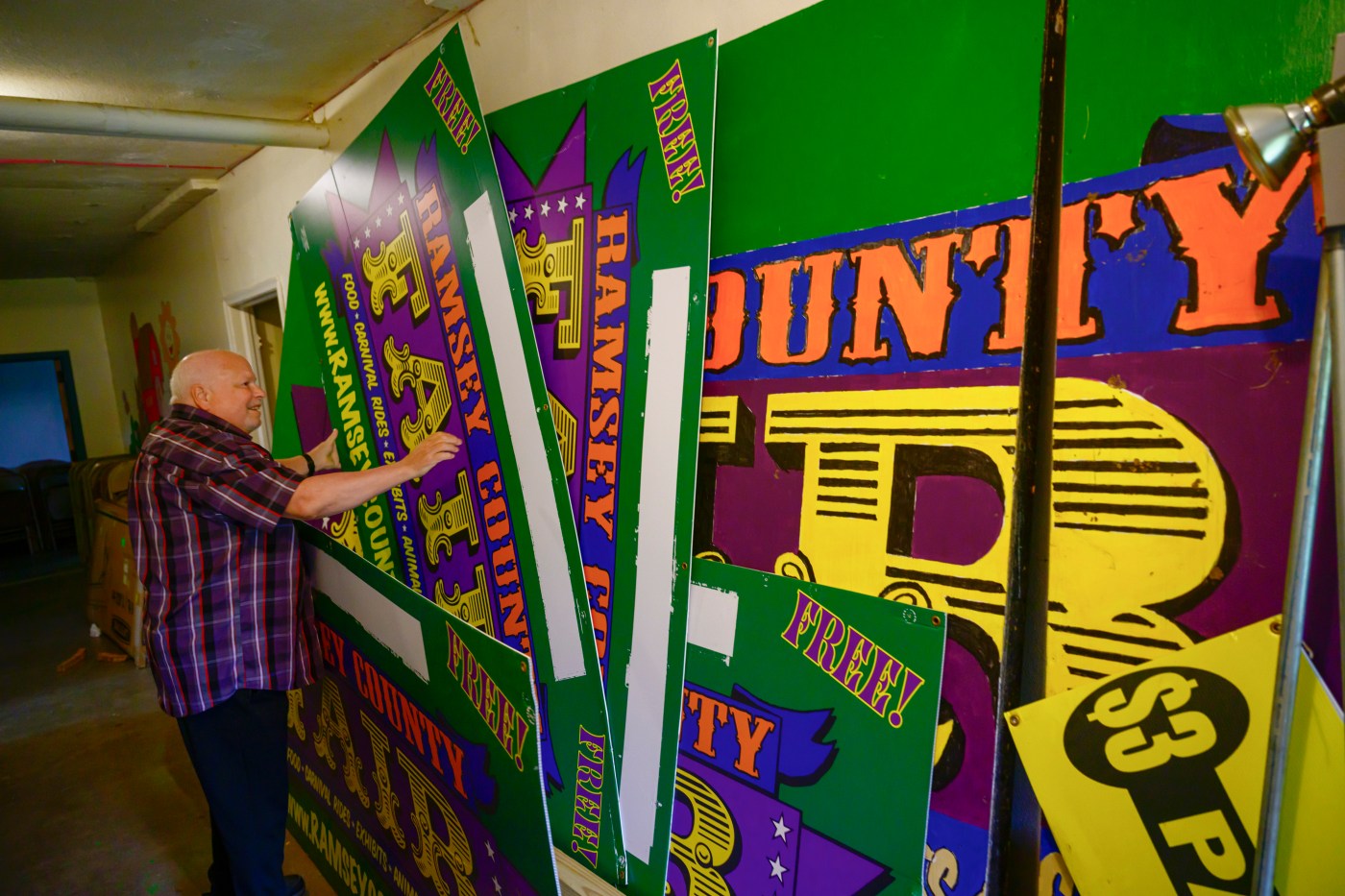
Over the past few months, 85 county fair gates have opened across Minnesota’s 87 counties.
The only exceptions?
Sparsely populated Cook County on the North Shore, whose fair faded away more than a decade ago, and Ramsey County.
This county — home to the biggest State Fair in the nation by daily attendance — has not held its own county fair since 2019, largely due to a long-running dispute with Ramsey County leaders over some $30,000 in land-use fees. Now, a sixth summer has come and gone without a Ramsey County Fair, which had previously been operating for more than a century.
“The term ‘resurrect’ has been bandied around, but I don’t know if resurrect is the right word because we’re still here, ready to go,” Ramsey County Fair board president Ron Suiter said. “We’re just asking the county for a chance to do it. But I don’t know if they even understand or care what we’re trying to do.”
So what actually happened to the Ramsey County Fair — and how might we get it back on track?
The first Ramsey County Fair was held in 1913 in White Bear Lake, on the grounds of what’s now Central Middle School but at the time was land owned by the Ramsey County Agricultural Society, the nonprofit that operates the fair. The Hippodrome Ice Arena, still in use, was constructed for the fair in 1926.
In response to school district expansion plans in the 1950s, fair officials accepted an offer from Ramsey County to move to the Ramsey County Poor Farm Barn in Maplewood and 20 acres of green space around it. Although the fair now only has access to less than 3 acres, that’s been the site of the Ramsey County Fair since 1954.
At the time, the understanding among decision-makers from both the county and the agricultural society was that this agreement was to be in perpetuity, according to Joe Fox, 93, who has served on Ramsey County Fair board since 1966. Indeed, several brief reports in both the St. Paul Dispatch and Pioneer Press from 1955 note that the money generated from the White Bear Lake land sale was given to Ramsey County in exchange for use of the Maplewood site as a “permanent” fairgrounds.
But here’s the problem: That agreement was apparently never written down anywhere. No contracts were ever drawn up; no leases signed. From land use to insurance coverage to trash pickup to security, since 1954, the fair has subsisted on a vast network of handshakes, verbal agreements, mutual favors and institutional memory. And for more than six decades, that was enough.
Until it wasn’t.
Ron Suiter, president of the Ramsey County Agricultural Society, talks about why the Ramsey County Fair was canceled for a sixth year, at the fair’s office at the Ramsey County Parks and Recreation complex in Maplewood on Wednesday, May 21, 2025. (John Autey / Pioneer Press)
‘There needs to be an agreement’
In 2019, while preparing for the ill-fated 2020 Fair, Suiter, who is also president of the Ramsey County Agricultural Society, received a series of notices from various county agencies that took him by surprise.
First and foremost, county officials had become uncomfortable with the reliance on handshake agreements and wanted to formalize the financial relationship between the fair and the county.
Related Articles
St. Paul caregiver wins scholarship after extra effort with 92-year-old patient
Maplewood man arrested in fatal hit-and-run
Judge finds Current DJ’s stalker violated restraining order but not guilty due to mental illness
Ramsey County Board sets tax levy hike at 9.75%, but may try to lower it
Ramsey County: Michael Soto named director of policy, administrative strategy
Going forward, said Ramsey County property manager Jean Krueger, the fair would need to begin paying the county to lease the land, to cover operating costs like utilities and to reimburse Ramsey County Parks and Recreation for the time its staff spent on the clock on fair tasks like set-up and trash collecting.
Based on previous years’ needs, the county estimated the fair would owe about $25,000 per year. Another $8,000 or so was later added as a rental fee for the fair to allow visitors to park in the Aldrich Arena lot. The county told Suiter the money would be due upfront, before the fair, he said.
Additionally, as part of this reevaluation, the county also informed the agricultural society that it was revoking its willingness to indemnify the fair and that the organization would need to purchase its own liability insurance. Previously, the county had shielded the agricultural society against any legal action for fair activities, but county officials came to determine they could no longer shoulder this taxpayer expense on behalf of an outside organization, Krueger said.
“It was a process that ended with us saying, the fair could be held on the grounds, but there needs to be an agreement that they need to, in essence, incur the same sort of fees as anyone else that rents the property,” Krueger said. “There are many organizations that would love to have free use of county property. We just can’t do that for one group and not others.”
Around the same time, the agricultural society also learned it would no longer be able to use any of the interior building space on the fairgrounds for public fair purposes.
Previously, Parks and Rec had cleared out parts of its administration building and an equipment storage barn, both of which are located on the fairgrounds site, for the fair to host exhibitions and vendors, but the department no longer plans to do so, Krueger said.
And the large two-level historic barn, which also houses year-round offices for the agricultural society and University of Minnesota Extension and is a centerpiece of the fairgrounds, is not suitable to be open to the public, Krueger said. Large events might overwhelm its antiquated plumbing system. And the second floor — which lacks sufficient fire protection and is not accessible for people with disabilities following the removal of a structurally unsound ramp in 2020 — is off-limits to anyone, including both the barn’s office tenants and outside events like Fright Farm Haunted House, which had used the space for free until closing when the building changes were made in 2020.
Any one of these updates alone would require fair leaders to completely rethink portions of the event, Suiter said. But for the changes to all come at once, he said, felt like a deluge the fair could not withstand.
(Although COVID-19 was ultimately the prevailing reason for the 2020 and 2021 fairs being called off, these obstacles predate the pandemic and likely would’ve forced the cancellation of those years’ fairs regardless, as has been the case in 2022, ’23, ’24 and ’25, Suiter said.)
“They just keep squeezing us,” fair board vice president Dennis Larson said. “They make us promises, and then the next generation forgets that they’d made the promise (and says), ‘Oh, we can’t do that, it’s too much work.’ … There’s no question we needed to be more formal than we had been, but then they went way too far.”
Joe Fox, Ramsey County Agricultural Society board member, explains the Ramsey County Fair layout at the Ramsey County Parks and Recreation complex in Maplewood on Wednesday, May 21, 2025. (John Autey / Pioneer Press)
‘This is the exception’
Let’s step back a second. To an outsider, it may seem unexpected that a stalwart organization like the Ramsey County Fair didn’t have formalized financial and land-use contracts with the county.
But to other county fair leaders around the state, including Don Merkens, president of the Minnesota Federation of County Fairs, it’s not surprising that a fair like Ramsey County’s would’ve subsisted for decades on informal handshakes and personal goodwill.
“That’s very common in the county fair business,” he said.
County fair budgets are notoriously tight, and many agricultural societies typically don’t have much money in the bank year-round, several fair leaders around the state all said.
Frequently, the money generated from a fair goes directly toward paying back the operational bills from that very fair. Even during some of the Ramsey County Fair’s heyday years, breaking even once the gates closed felt like a victory, said Joe Fox, the nearly 60-year fair board veteran. So some degree of generous trust is necessary, he said, as is perhaps a willingness to flex the norms of typical business relationships for the good of the fair.
What is not common, though, is for a county to charge its own county fair to operate, said Merkens, who also oversees the Norman County Fair in northwest Minnesota. Many counties see it as within their best interest to support an accessible civic festival that elevates agriculture and youth programming like 4-H, even in urban settings, he said, and he’s surprised by Ramsey County’s stance.
“I do not know of one other county (fair) in Minnesota that has to pay to use county or city grounds,” Merkens said. “This is the exception right here in Ramsey County.”
To be clear, not all county fairs operate on public land. Within the metro, fairgrounds for the Dakota, Washington and Scott county fairs are each owned by their respective county agricultural societies, representatives confirmed. The Hennepin County Fair takes place at Corcoran Lions Park, and the county agricultural society leases it (for free) directly from the Corcoran Lions club, fair board president Mike Rouillard said.
Merkens is right, though: The county fairs that do take place on public land, at least around the Twin Cities area, do so without having to pay rent. Take the Wright County Fair, which updated its agreement with the county to a new 20-year lease in 2018. In lieu of monetary rent, the county continues to offer the land in exchange for “the goodwill and services provided by the Ag Society.”
Similarly, the Anoka County Fair takes place on county-owned lands, said Anoka County Fair board president Michael Ahlers, though the county agricultural society does own the fairgrounds’ parking lot. The organization does have a written land-use agreement with the county, but it’s more or less a formality.
“One of our biggest assets is the relationship that we have with the county,” he said. “It’s not that we pay this much and get that much. We’re branding Anoka County, and they get to reap the benefits. If we have a great fair, that’s Anoka County.”
The heart of the issue here, Larson said, is that Ramsey County is misguided in seeking to avoid differential treatment for the fair versus other outside organizations, because a county fair fundamentally is different from other outside organizations, legally speaking.
In Minnesota, county agricultural societies are governed by Chapter 38 of the Minnesota State Statutes, which grants them unique powers, including certain taxation benefits, exemption from zoning ordinances and the power of eminent domain, by which they technically can forcibly requisition private lands to be used for fair purposes as long as they compensate the former owners. This makes county fairs almost like quasi-governmental organizations, said Ahlers of the Anoka County Fair, even though some of the privileges aren’t exactly practicable.
“There’s way more power that we are given in the state statute than we could ever enforce,” he said. “Even though we have eminent domain power, there’s no way we could have enough money to go through the legal battles to actually do it.”
Still, Ramsey County Fair officials say: The point stands.
“It’s not as if we’re just anybody from up or down the street,” Fox, the longtime Ramsey County Agricultural Society board member, said.
Joe Fox, Ramsey County Agricultural Society board member, looks at photos from when he won the milking contest at the Ramsey County Fair at the Ramsey County Parks and Recreation complex in Maplewood on Wednesday, May 21, 2025. (John Autey / Pioneer Press)
‘Re-grounding us in what our goals are’
So now, the $33,000 question: Will the Ramsey County Fair ever happen again?
For Suiter and the other board members of the Ramsey County Agricultural Society, paying the county an upfront fee for land use and other services is a non-starter. Suiter said he tried requesting that the county waive the fee temporarily, maybe for a year or two, to give fair organizers a chance to rebuild, modernize and develop long-term systems to bring in enough money to cover the annual fee in the future. This proposal has gone unanswered, he said.
In separate interviews, Suiter and Krueger each alleged that the other’s side had failed to respond to negotiations over the payment.
Suiter claimed the county was unable to specifically itemize the various charges that summed to $25,000 — apart from the additional $8,000 for parking — and that the figure had been determined arbitrarily, both allegations that Krueger disputed.
Besides the land-rental fee, the remainder of that amount is just an estimate of county services and billable staff time, Krueger said. If the fair were to choose to provide its own electricity and trash maintenance and security, then the county would have no need to charge for those services, she said.
“Historically,” she said, “the county has picked up all of those costs. But the operating costs are up to them based on how they would want to structure and provide for the fair.”
This was not the message Suiter and Larson felt they had received from the county.
“We were willing to pay for hard costs,” Larson said. “If you want to meter the electricity, we’ll pay for it. The trash. We’ll pay for security. No matter what hoop we jumped through, they came up with another one. And they couldn’t come up with any more, so they came up with the $25,000, and that was the dealbreaker.”
And then there’s the barn.
A dated and faded sign for the Ramsey County Fair at the Ramsey County Parks and Recreation complex in Maplewood on Wednesday, May 21, 2025. (John Autey / Pioneer Press)
Over the years, Larson said, the agricultural society has sunk its own funds into upgrading the barn to be suitable for county fair exhibitions. Although leaders recognize that those improvements to a county-owned building did indeed become county property, they view it as a snub for the county to have removed the second-floor access ramp without investing in replacing it or otherwise working to bring the building back into compliance with safety codes for public use.
The county has limited resources and other needs took priority, Krueger said.
“We saw no reason for county purposes to put in any sort of new ramp on the outside,” Krueger said. “(Office space) is the only use of that building that we have. For that use, there’s no need to upgrade the upper level or do any significant improvements on the first floor. We maintain that building, we’ve updated the systems to provide the office space on the first floor, but we have other buildings that are critical to the county’s provision of services to our residents.”
However, Suiter is hopeful that the Ramsey County Fair has found a new hero in County Commissioner Kelly Miller, who assumed office in January and whose district includes the Maplewood Fairgrounds.
Suiter and Miller met earlier this year about the challenges facing the Ramsey County Fair, and in separate interviews, each said the meeting was constructive. Miller has also actively sought meetings with other county officials to understand the county’s perspective, she said.
“I think a good place to start is just restarting this conversation and just re-grounding everybody, both at the county and at the agricultural society,” she said. “Because the county is in support of the fair. We are in support of having a county fair. So I think it’s just re-grounding us in what our goals are for the fair.”
Related Articles
St. Paul: Administrative citations question heads to voters
Stillwater-area churches collecting guns to forge into garden tools
Looking for a mentor: Iris
Stillwater prison nears half capacity as closure plans advance, official says
St. Paul: After Selby Ave. property demolished without permit, concerns over new student housing builds
Some county decisions regarding the fair — especially as relating to building usage — are unlikely to be negotiable at this time, she said, and she stands behind the county’s decision to approach the Fair with the same treatment any other external organization would receive. But she agrees with Krueger that the Ramsey County Agricultural Society’s potential $25,000 bill to the county could be lowered if the society were to assume some operating costs, and she was pleased to hear Suiter and the fair board were open to the idea.
“I’m not 100 percent sure why there was that communication breakdown in the past, but I can say, going forward, I’m hopeful to be a helpful piece in bringing that communication together and moving things along,” Miller said.
If we do ultimately see a return of the Ramsey County Fair in 2026, it’ll look different.
If the fair stays on the Maplewood Fairgrounds, it’ll probably be smaller than before, and fully outdoors. A gate admission charge to what has historically been a free fair is not ideal, but not out of the question. Later this month, Suiter has a meeting planned with the owners of Maplewood Mall to discuss whether the fair could even take place there instead.
And either way, organizers will need to rearticulate the importance of a county fair in both fulfilling its mission of agricultural education and representing the urban diversity of Ramsey County. A county fair is not a street festival, Suiter said; it’s something unique.
“In many ways, we are starting over,” Suiter said. “We’ve got to reinvent ourselves in a different way.”