By SOPHIKO MEGRELIDZE and DASHA LITVINOVA
TBILISI, Georgia (AP) — Almost every day for nearly a year, Gota Chanturia has joined rallies at Georgia’s parliament against the government and its increasingly repressive policies. He’s done this despite mass arrests and police violence against demonstrators.
Related Articles
Sarah Mullally named the first female Archbishop of Canterbury in history of Church of England
Japan’s governing party is choosing a new leader Saturday to succeed Ishiba
Hegseth announces latest strike on boat near Venezuela he says was trafficking drugs
Israel intercepts the last boat from the Gaza flotilla as Israeli minister mocks the activists
One of 2 victims in Manchester synagogue attack was accidentally shot by police
And the civics teacher keeps marching even though he’s racked up an astonishing $102,000 in fines from the protests. That’s about 10 times what the average Georgian earns in a year.
“We’ve said that we will be here until the end, and we’re still here,” Chanturia told The Associated Press as he participated in yet another demonstration this week in the capital of Tbilisi.
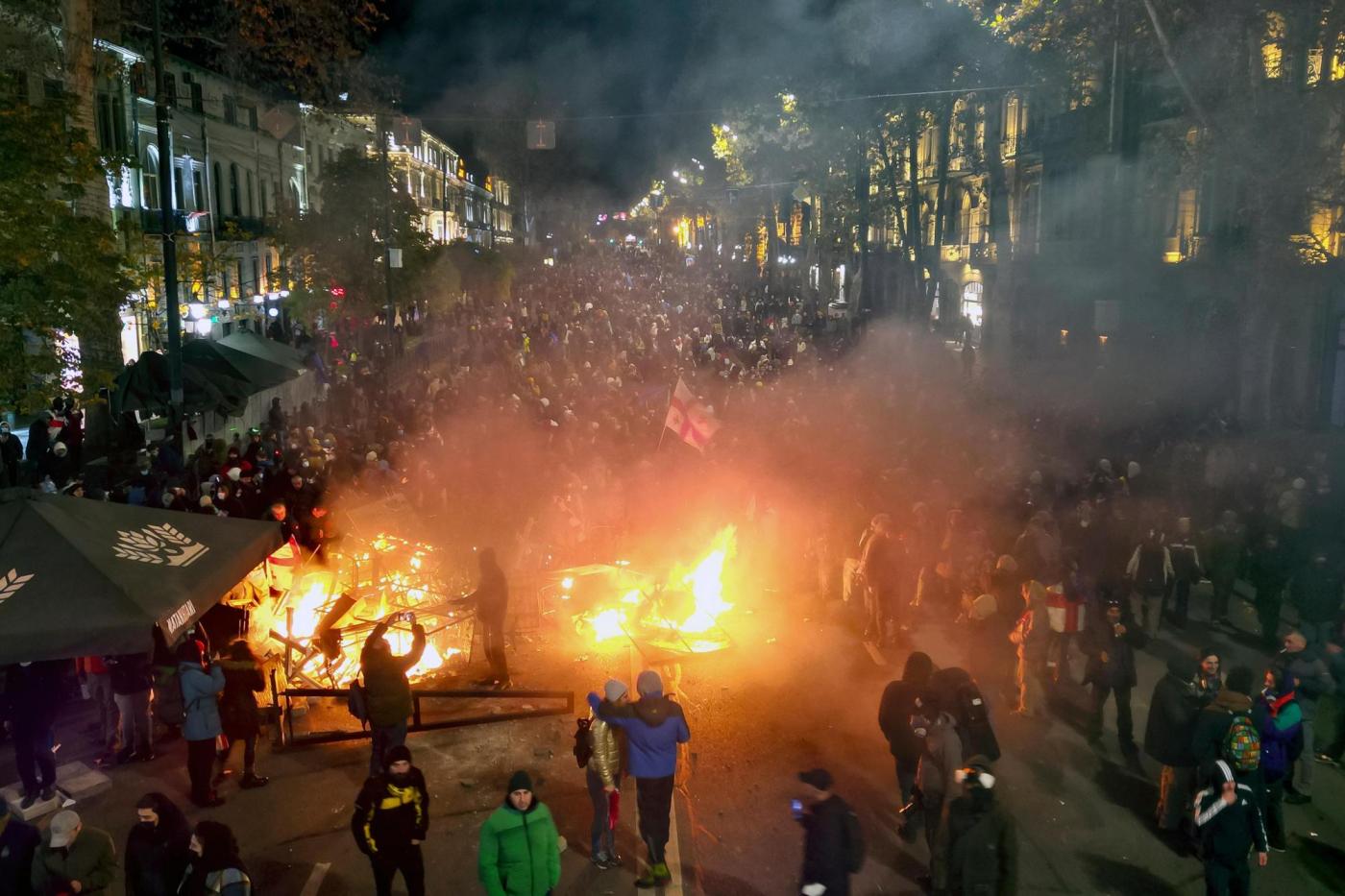
The protests began when the government halted talks about joining the European Union. That move came after the longtime ruling party Georgian Dream won an election that the opposition alleged was rigged.
The rallies, big and small, continue despite a multipronged crackdown by the government through laws that target demonstrators, rights groups, nongovernmental organizations and independent media.
More protests are planned for this weekend to coincide with local elections.
The repression in the South Caucasus nation of 3.7 million has drawn comparisons to Georgia’s powerful neighbor and former imperial ruler Russia, where President Vladimir Putin has stifled dissent. Georgian Dream has been accused of steering the country into Moscow’s orbit of influence.
Human Rights Watch says Georgia is suffering a “rights crisis.” The clampdown is unprecedented in the country’s independent history and is escalating steadily, said Giorgi Gogia, the group’s Europe and Central Asia associate director.
But Georgia’s vibrant civil society is pushing back, and it has become a question of “who would blink first,” Gogia said. If it’s the public and civil society, they could wake up in an authoritarian country, “which would be a huge transformation from what Georgia used to be up until now,” he added.
Fines, beatings and prison
Ketuna Kerashvili joined a rally in rainy Tbilisi on Wednesday despite the fact that her 30-year-old brother Irakli was arrested in December, convicted of disrupting public order, and sentenced to two years in prison. He had rejected the charges as unfounded.
Kerashvili told AP her brother’s trial was “tough to watch.”
Ketuna Kerashvili attends a protest in Tbilisi, Georgia, Wednesday, Oct. 1, 2025, to denounce the government’s anti-European Union stance and call for the release of those detained as part of a crackdown on political opponents ahead of municipal elections. (AP Photo/Zurab Tsertsvadze)
“All of those boys and girls who are in prison now were trying to protect our country from pro-Russian forces and a pro-Russian government,” she said.
The violent crackdown escalated after largely peaceful protests in late November 2024, with over 400 people detained within two weeks; at least 300 reported severe beatings and other ill-treatment, according to Amnesty International. The group alleged much of the brutality occurs out of sight in detention.
Between April 2024 and August 2025, at least 76 people have faced criminal prosecution in the protests, with more than 60 imprisoned, according to Transparency International Georgia, an anti-corruption organization. The number of prosecutions is likely higher now, and scores more people have been slapped with steep fines.
Chanturia said he was fined 56 times for allegedly blocking a road –- a common charge levied against protesters. He said he hasn’t paid them and doesn’t intend to. Under new regulations, failing to do so could land him in jail.
Gota Chanturia, a member of the Movement for Social Democracy, shouts as he attends an anti-government protest near the parliament building in Tbilisi, Georgia, on May 10, 2025. (AP Photo/Zurab Tsertsvadze)
HRW’s Gogia says it’s hard to estimate how many people have been fined, but he estimates it could be thousands. The penalties are issued via automation, like highway tolls and traffic fines, with authorities using surveillance cameras with facial recognition.
Sometimes those penalized weren’t protesting but just happened to be at the rally. Mariam Nikuradze, a prominent journalist and co-founder of the independent news site OC Media, has accrued 20,000 lari (about $7,300) in fines, after being cited four times for allegedly blocking a road. She said she was merely covering the demonstrations.
Javid Ahmedov, a journalism student from Azerbaijan, told AP he was filming at a July protest when the cameras spotted him. He learned he had been fined 10,000 lari (about $3,700) upon returning to Georgia last month to complete his studies at the Georgian Institute of Public Affairs.
He eventually was denied entry, risking the completion of his degree and his U.S. scholarship.
“I have to be in Georgia,” he told AP from Germany, where he is now an exchange student. “But it’s a big question.”
Opposition parties, media and NGOs targeted
Authorities also have targeted key opposition politicians and parties, along with rights activists and media.
In the summer, eight opposition leaders were jailed on charges of refusing to cooperate with a parliamentary inquiry, and two more were arrested later on different charges. The opposition said these arrests were politically motivated.
FILE – A demonstrator gestures trying to stop riot police during a protest near the parliament building in Tbilisi, Georgia, on Tuesday, April 30, 2024. (AP Photo/Zurab Tsertsvadze, File)
In August, authorities froze the bank accounts of seven rights groups. The Prosecutor’s Office alleged they were supplying demonstrators with gear like masks, pepper spray and protective glasses that were used in clashes with police. The organizations said the gear was for journalists covering the rallies.
The government is trying to create a narrative that there are attempts to overthrow the government, violate the constitution and engage in sabotage and violence, said Guram Imnadze of the Social Justice Center, a group whose funds were frozen.
Another goal is to “stop all the independent actors in the country, to limit or shrink democratic free spaces in the country, (and) make independent actors such as NGOs, media outlets or individual activists unable to support democracy,” he said.
Georgian Dream has filed lawsuits against several independent TV channels and revealed plans to petition the Constitutional Court to declare the main opposition party, United National Movement, and others to be unconstitutional.
Prime Minister Irakli Kobakhidze said last month the lawsuit will target everyone considered to be under the umbrella of the United National Movement, under the radical opposition and under foreign influence — “against all of them. Against everyone, everyone.”
He alleged the protests are orchestrated and funded from abroad.
“No foreign agent will be able to destabilize the situations in the country,” he added, referring to legislation that allows labeling NGOs, media and individuals as “foreign agents.”
FILE – Demonstrators stand under the spray from a water cannon outside the parliament building in Tbilisi, Georgia, on Dec. 2, 2024, to protest the government’s decision to suspend negotiations on joining the European Union. (AP Photo/Zurab Tsertsvadze, File)
The targeted groups remain defiant. The seven groups with frozen funds vowed to “fight against authoritarian rule and Russian-style laws, using every legal mechanism available, to ensure that the opponents of the democratic and European path enshrined in our constitution cannot achieve their goals.”
Seeking EU pressure on the government
Gogia says the crisis represents Georgia’s “stark departure” from “trying to be a modern, independent, pro-human rights country with a very, very vibrant civil society and human rights community.”
HRW and other international rights organizations last month urged the EU and its member states to “use all diplomatic and legal tools at their disposal to exert pressure on Georgian officials and members of the judiciary, prosecution and law enforcement, involved in human rights abuses, and prosecutions of human rights defenders and civil society activists.”
Despite suspending talks to join the EU, Georgian authorities still “care what the EU does or says,” Gogia said, adding the public overwhelmingly supports membership and the government knows that.
Kobakhidze said this week the goal of EU membership by 2030 is “realistic and achievable.”
But a European Commission official told AP that “the repressive actions taken by the Georgian authorities are far from anything expected from a candidate country.”
“The EU is ready to consider the return of Georgia to the EU accession path if the authorities take credible steps to reverse democratic backsliding,” said the official, who was not authorized to comment publicly and thus spoke on condition of anonymity.
Litvinova reported from Tallinn, Estonia. Associated Press journalist Sam McNeil in Brussels contributed to this report.